We’re Back In Our Happy Place! We are here in Estepona for the month of March. It is our fourth time here and it has become our favorite.
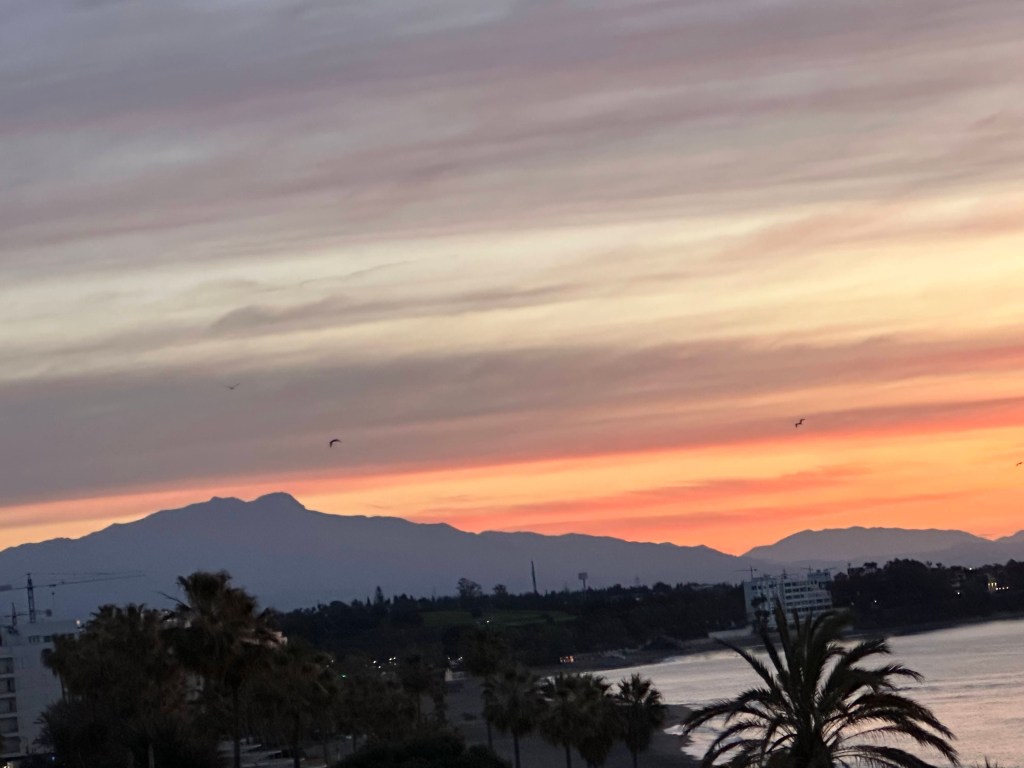
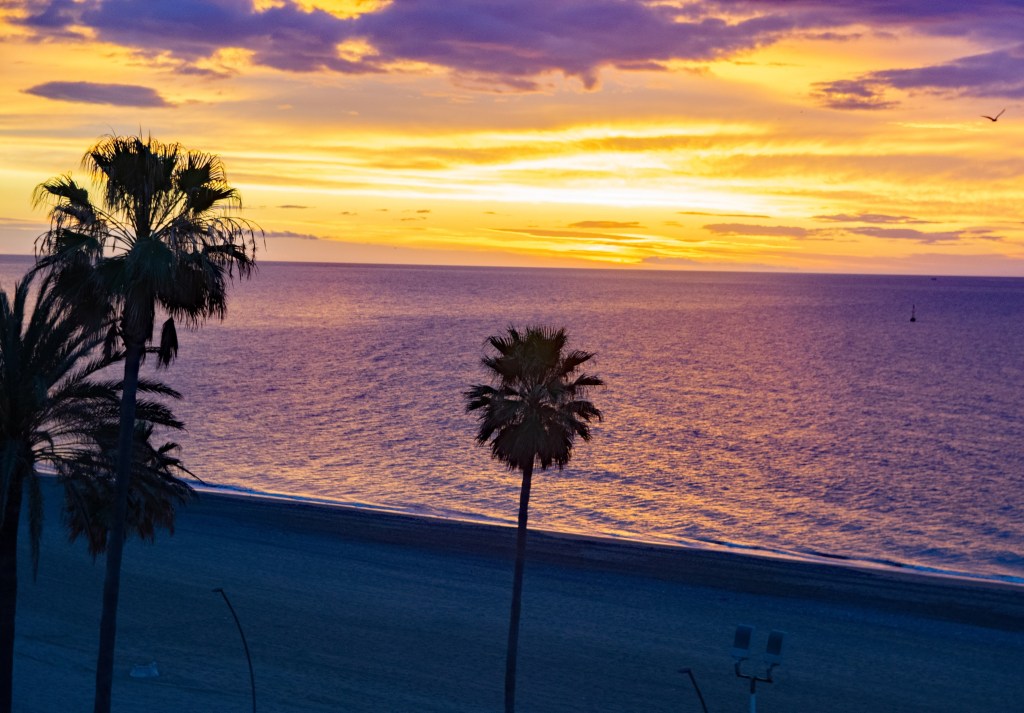
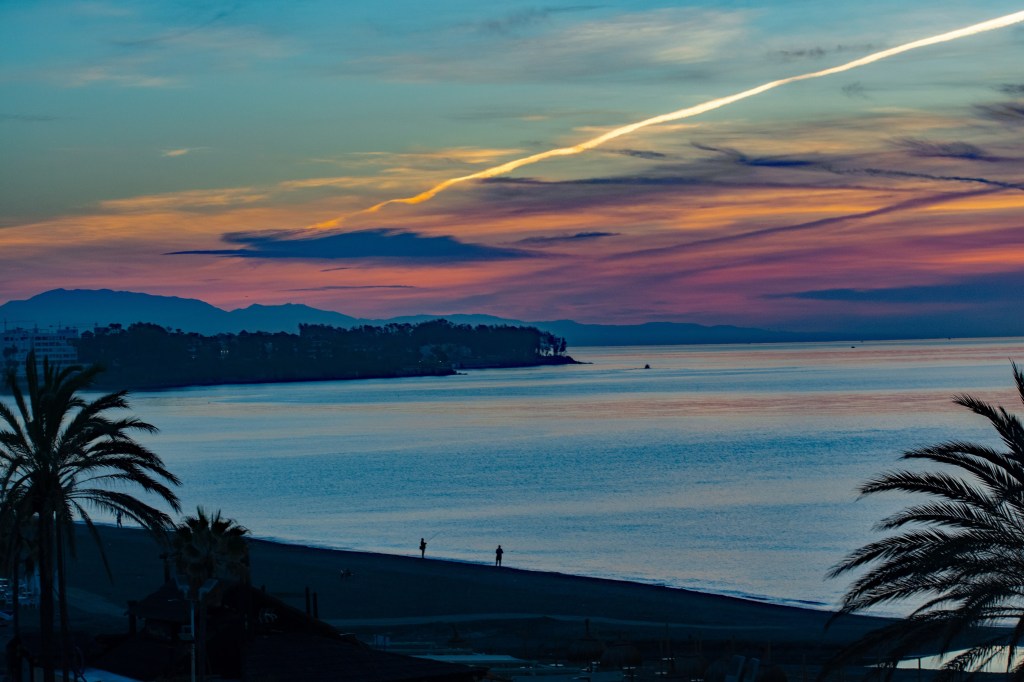
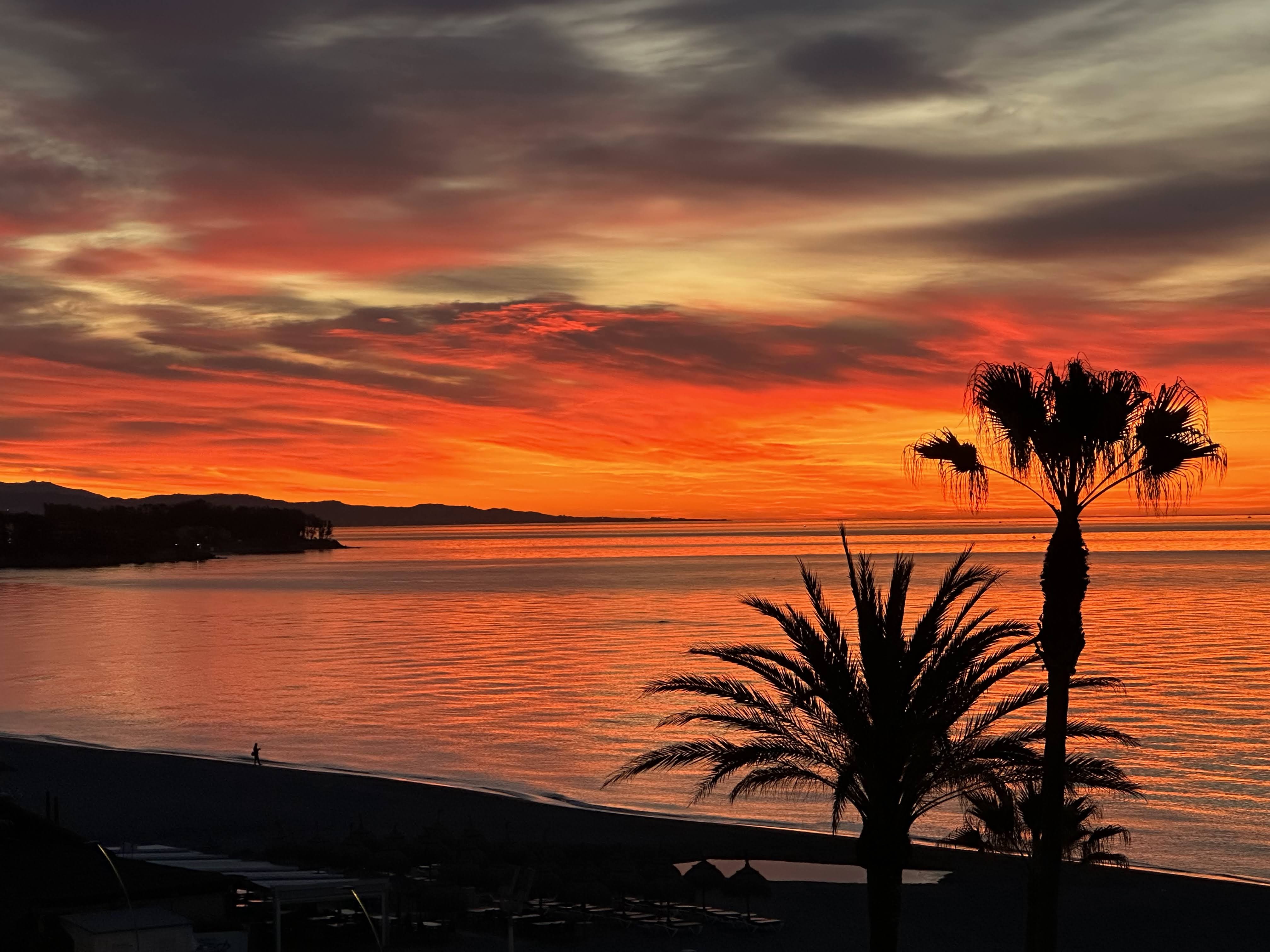
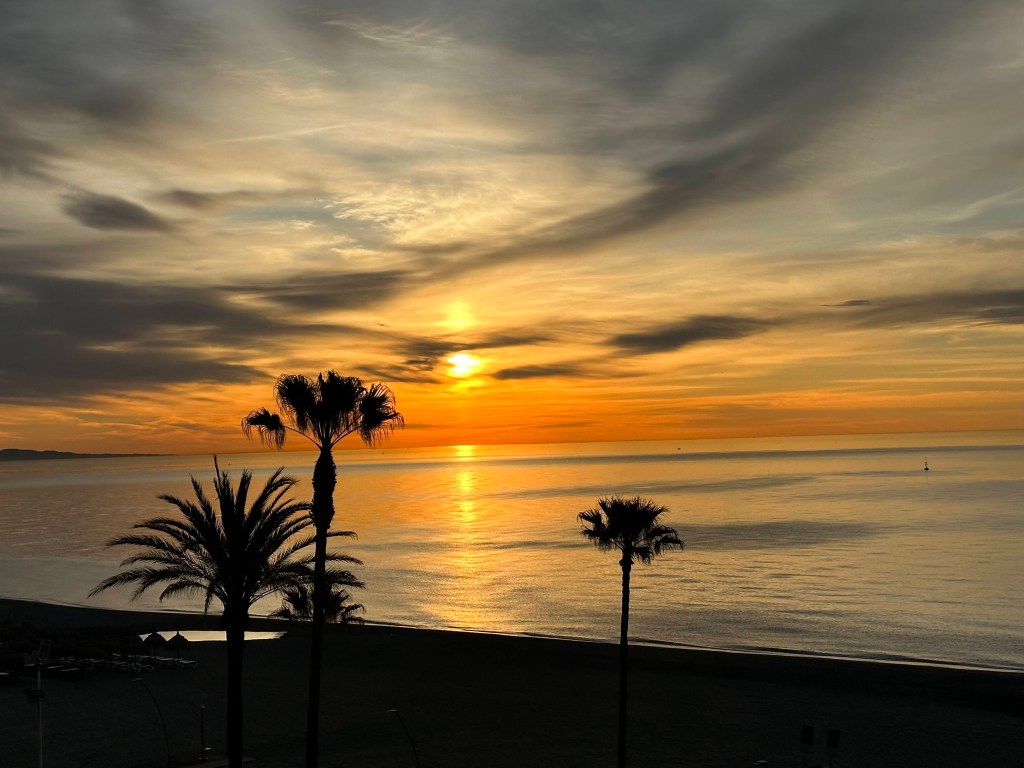
Sunrises From the Balcony
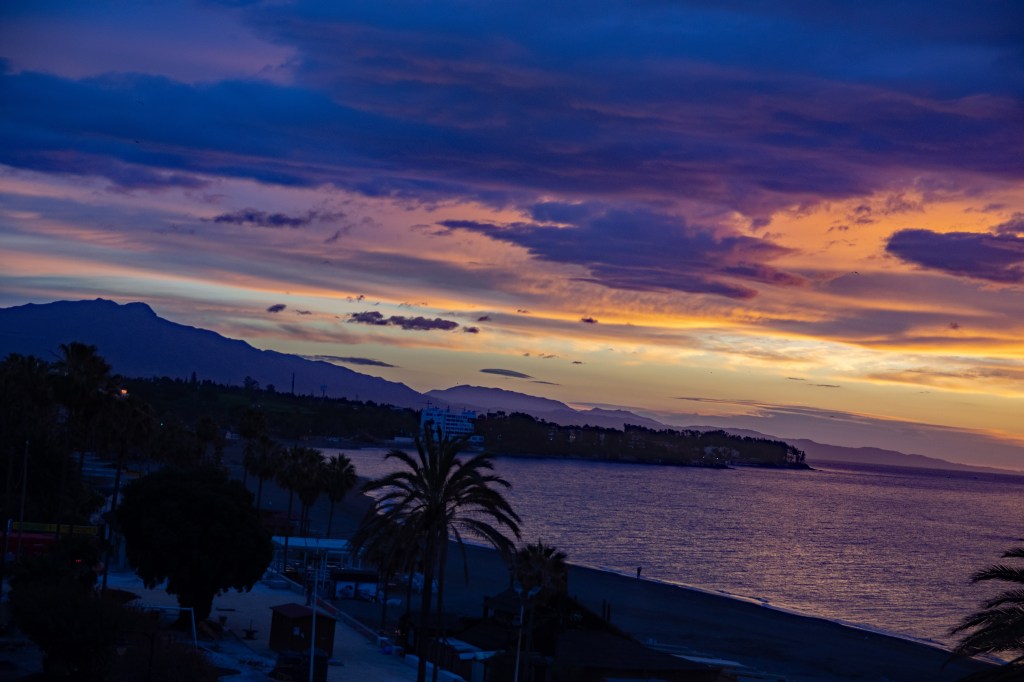
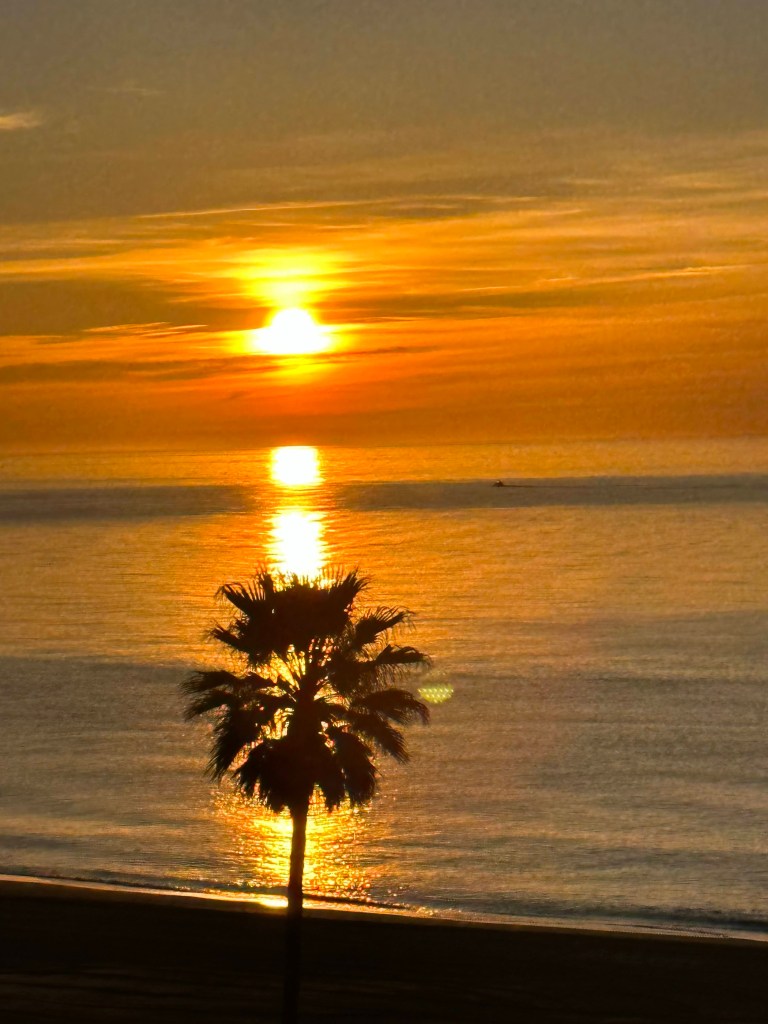
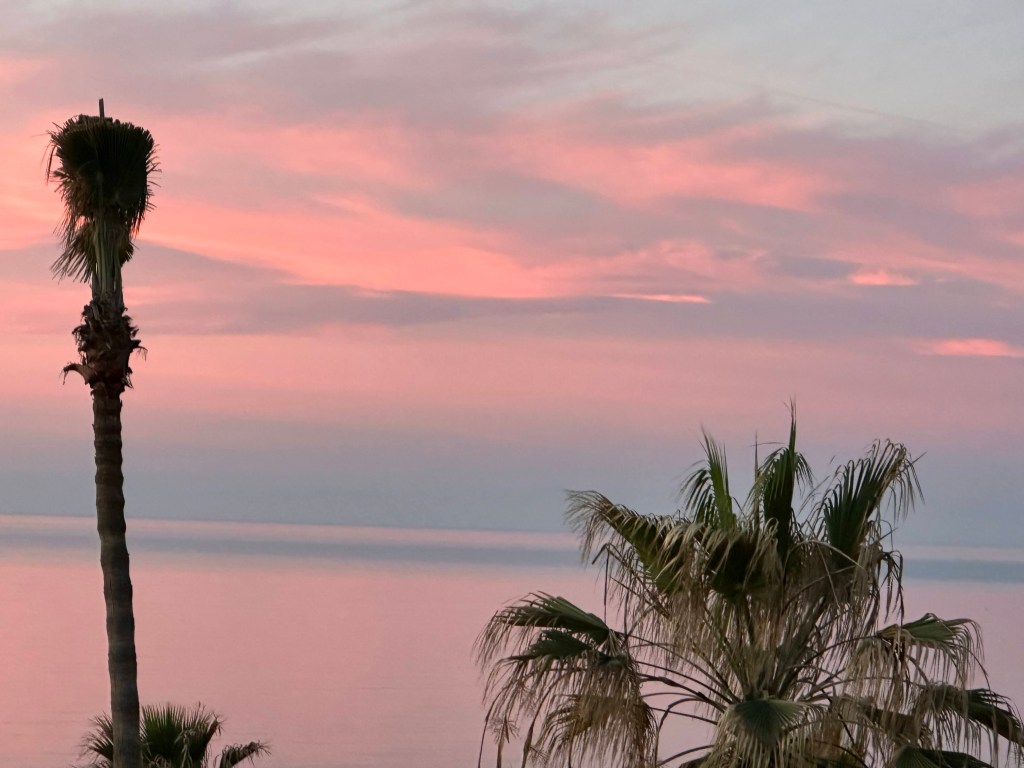
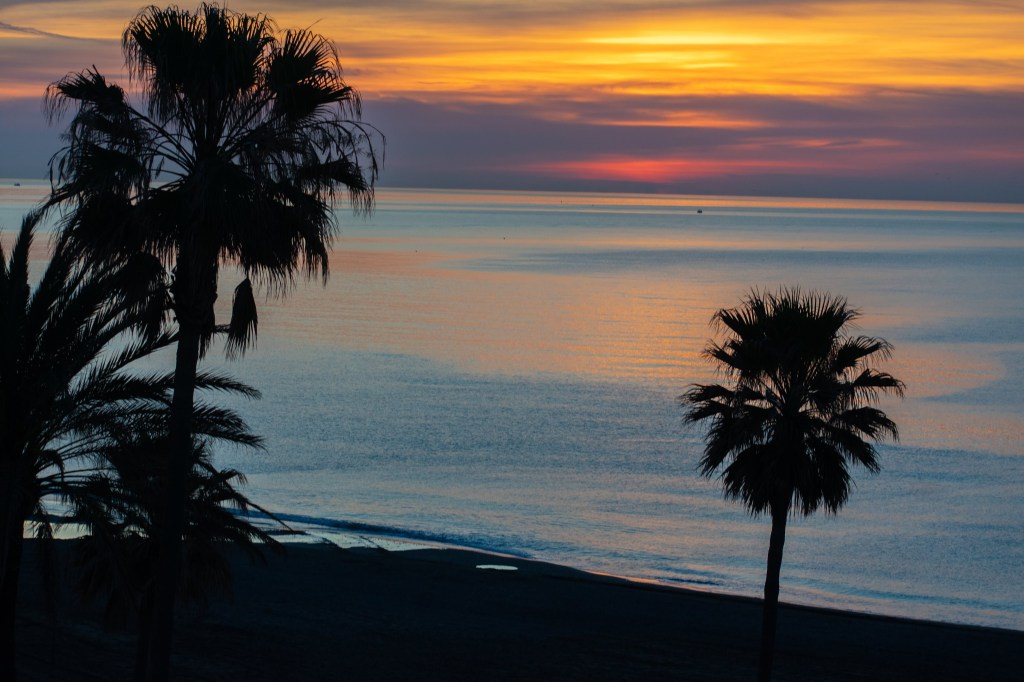
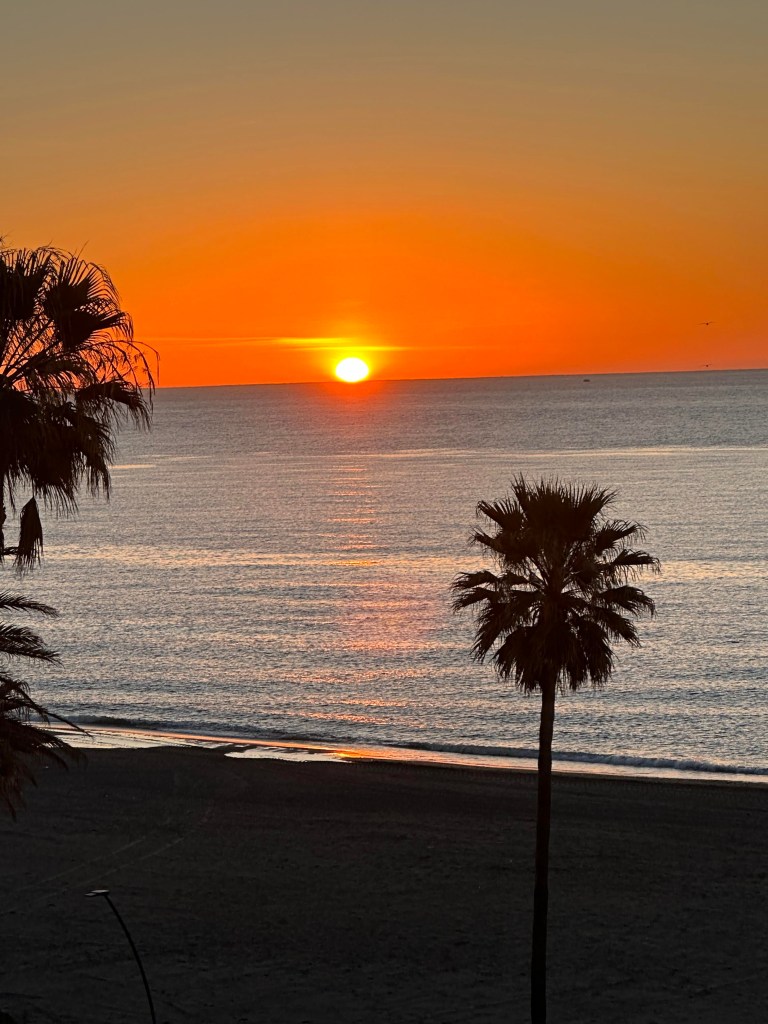
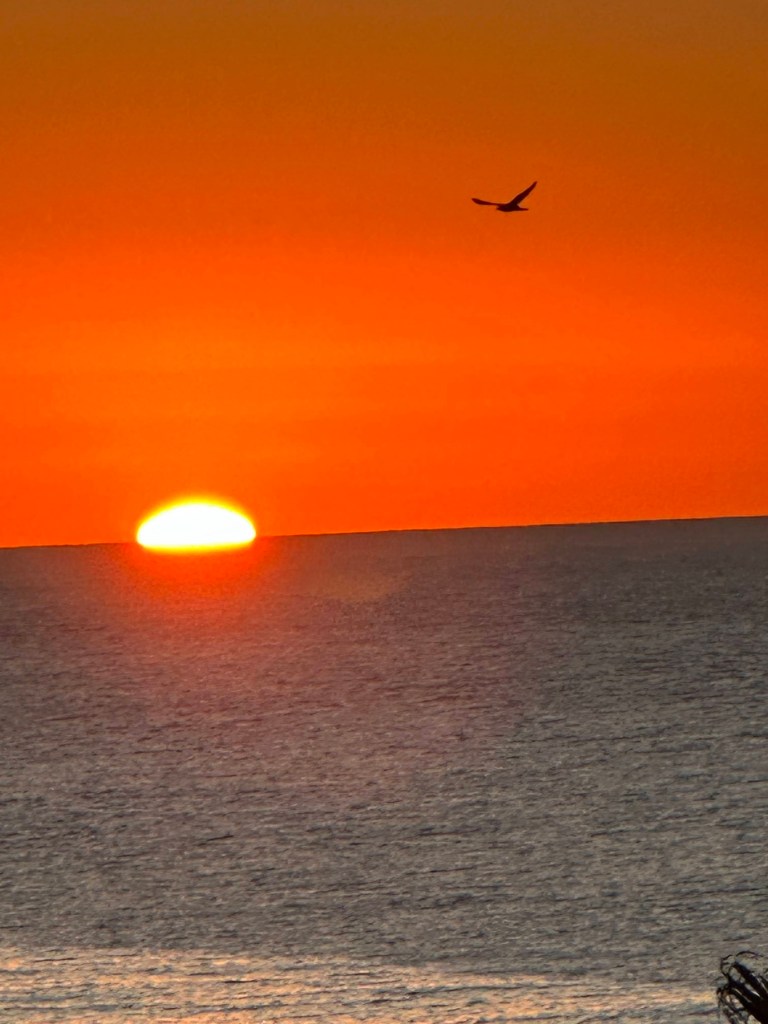
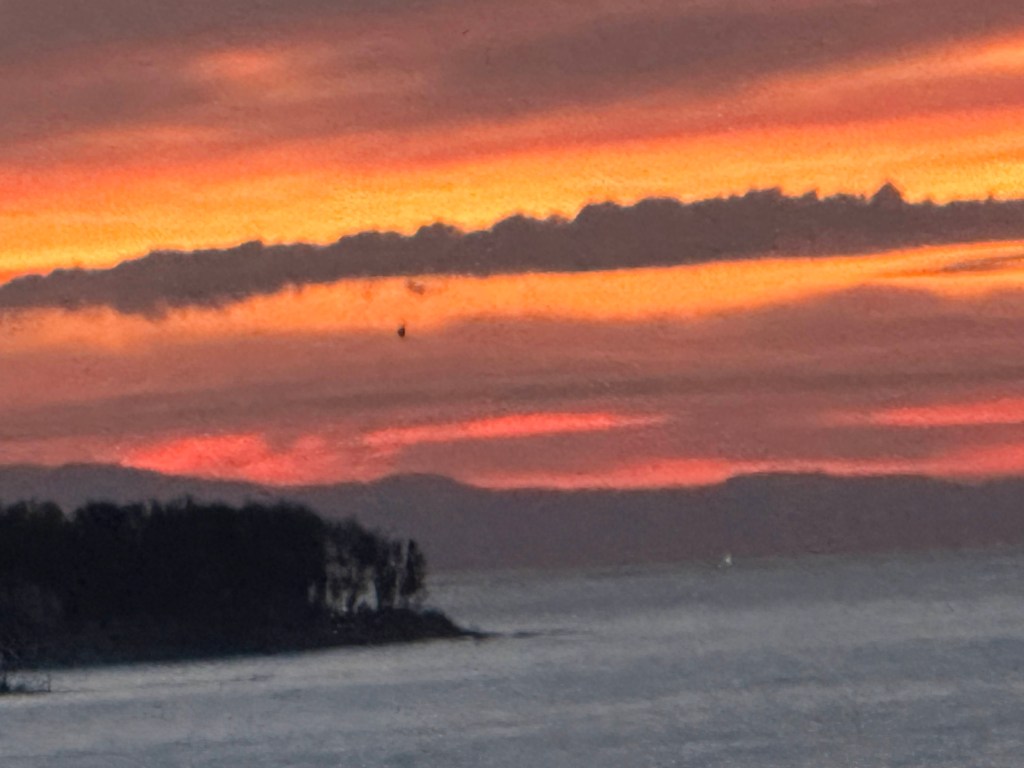
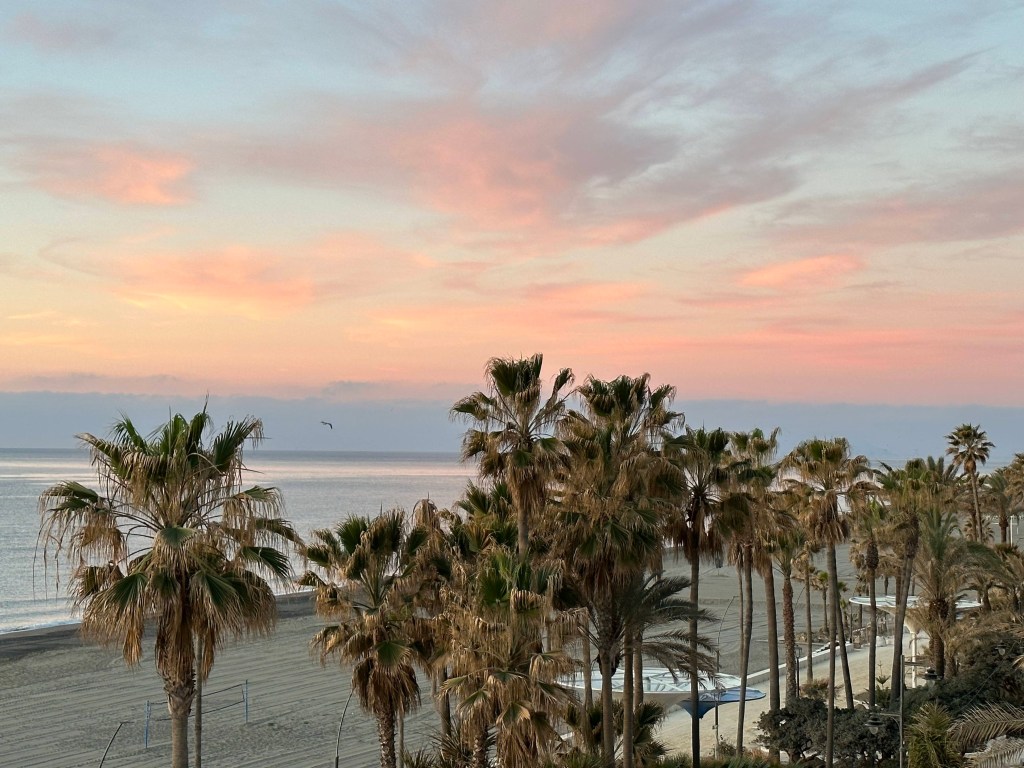
Our balcony looks out over The Mediterranean. I am usually up early enough to see the sunrise. No two mornings have been the same!
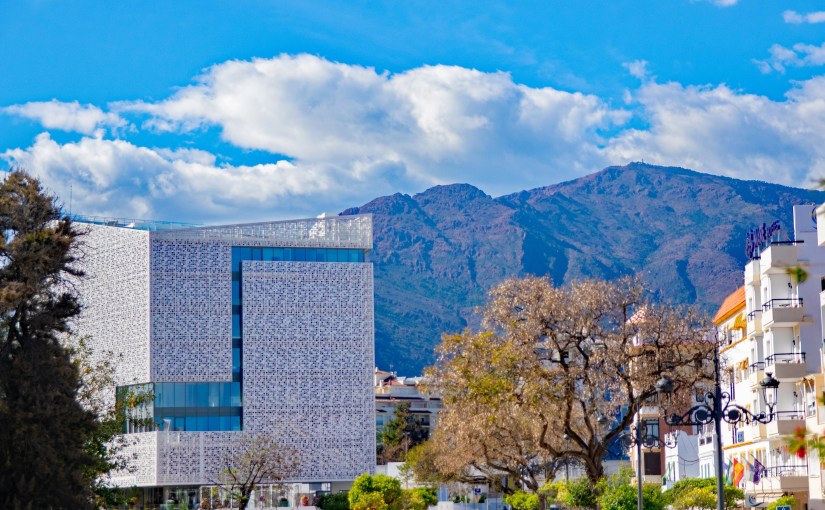
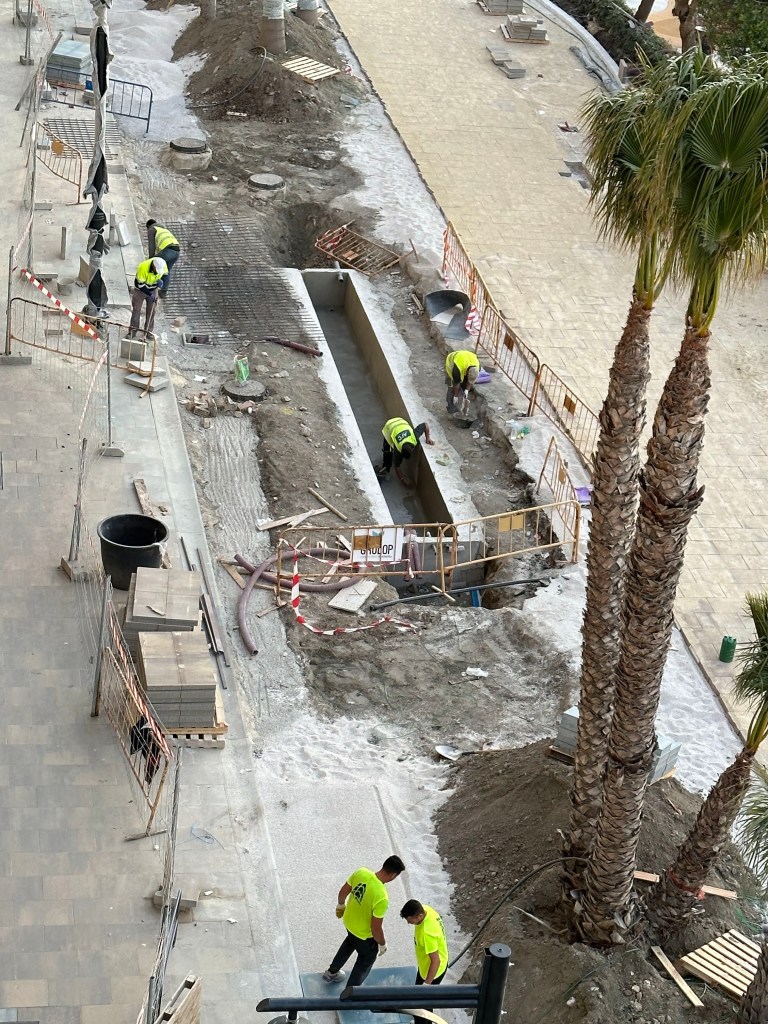
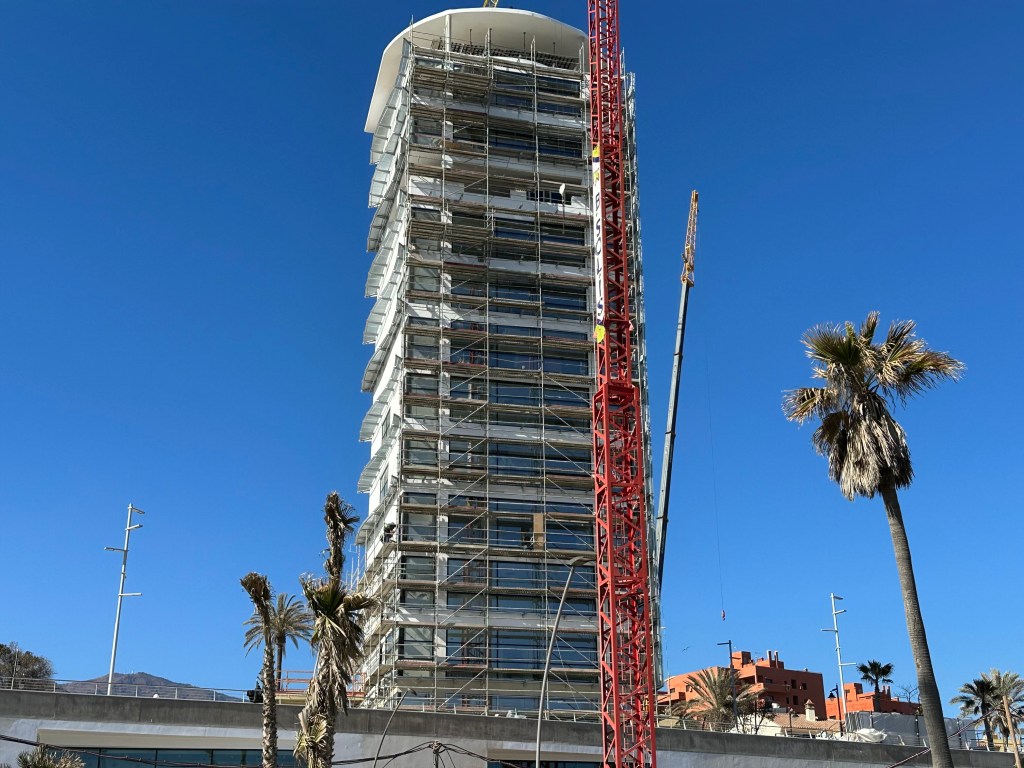
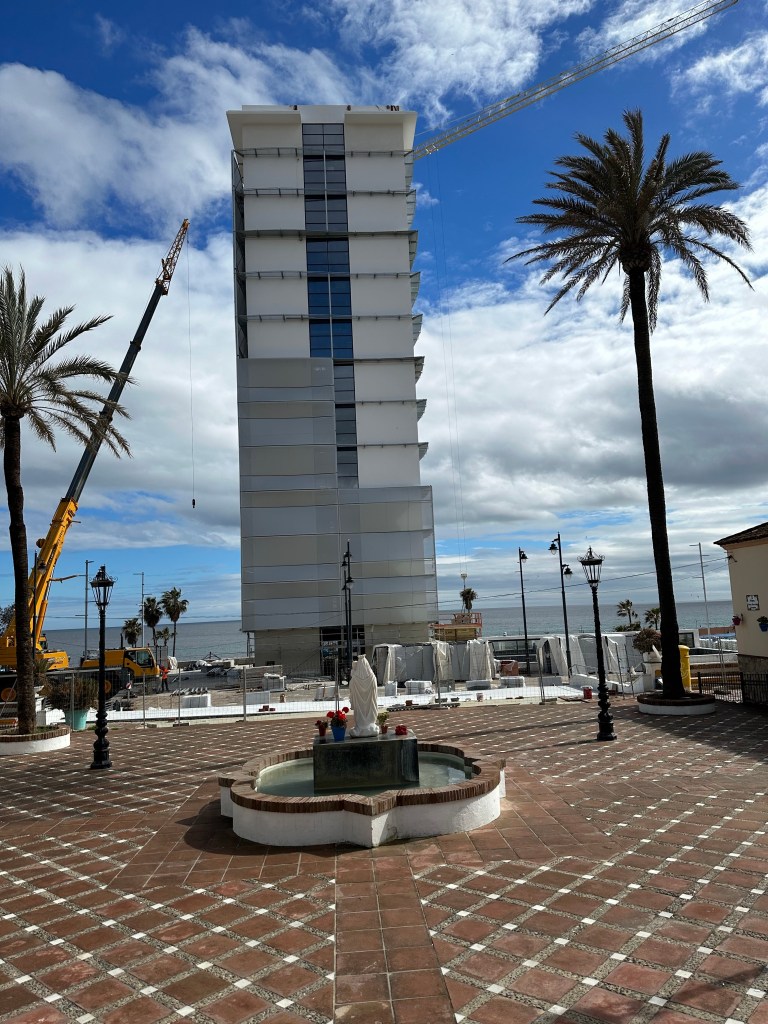
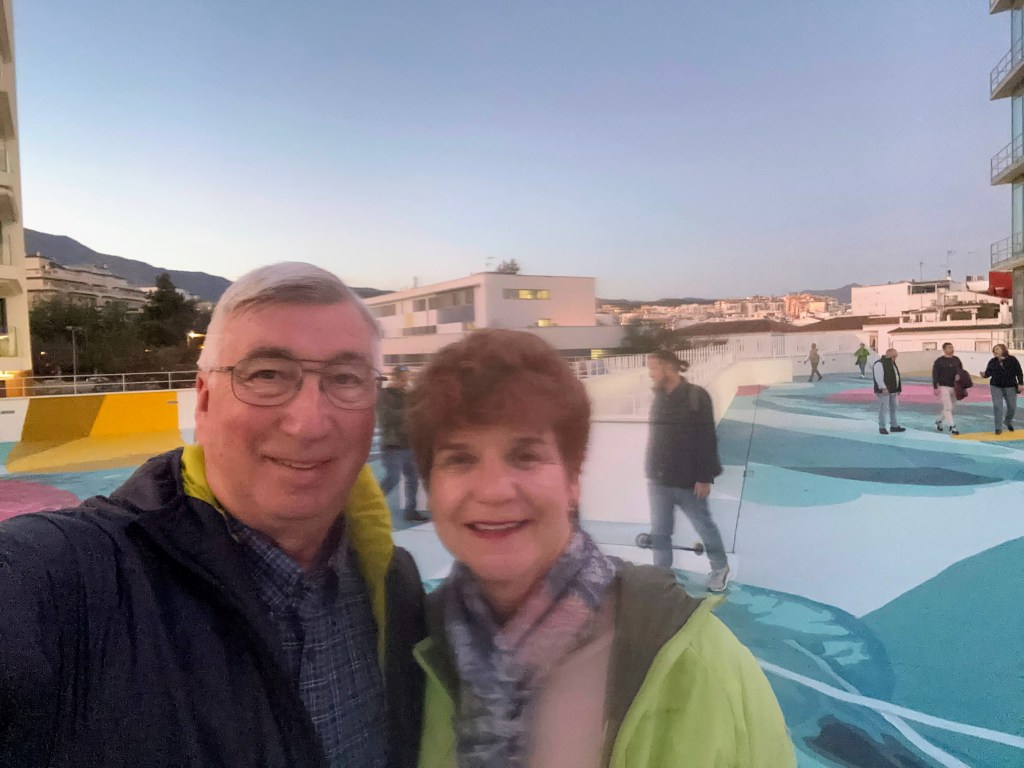
The construction workers arrive at first light. The widening of the paseo (pedestrian walkway) is almost complete. Almost the entire length of Estepona’s long beachfront (Playa de la Rada) is now free of traffic. By this weekend, most of the work should be finished just in time for the grand opening of the Mirador; a new building between here and the port. Previously, that site was unimproved and unattractive with weeds and graffiti. It will now be a public access area. The building will house an art gallery, a multi-story library, an auditorium, a restaurant, and a rooftop lookout.
The grand opening is March 31st, unfortunately, the day we travel home. Hopefully, next year we can enjoy the new additions.
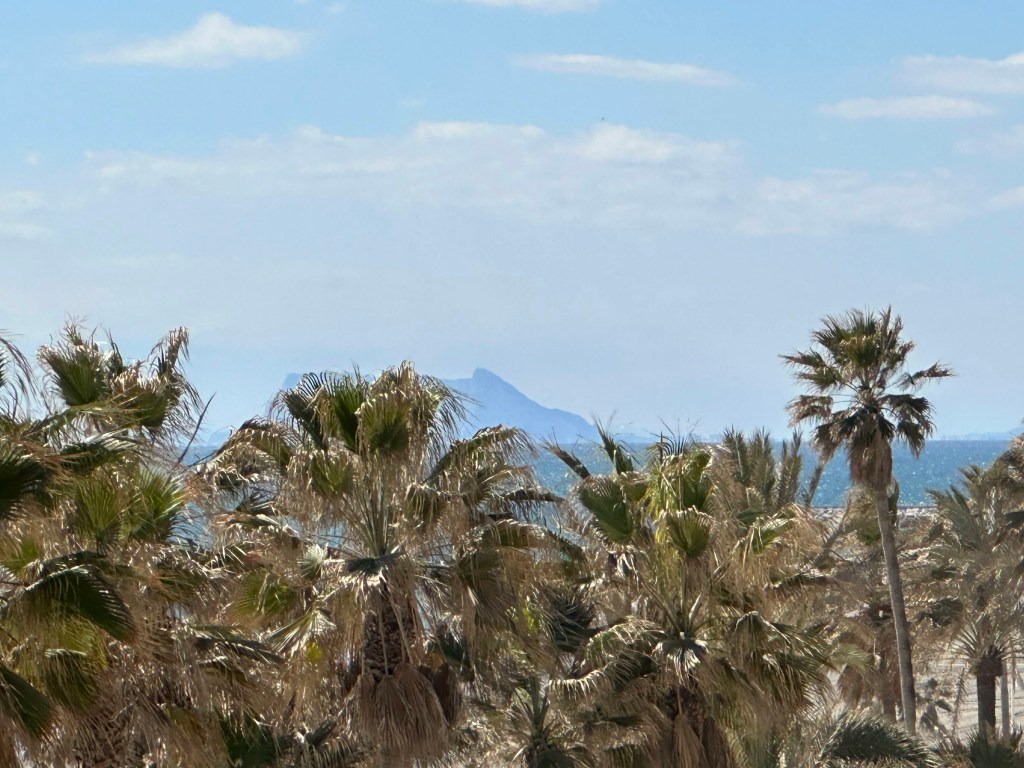
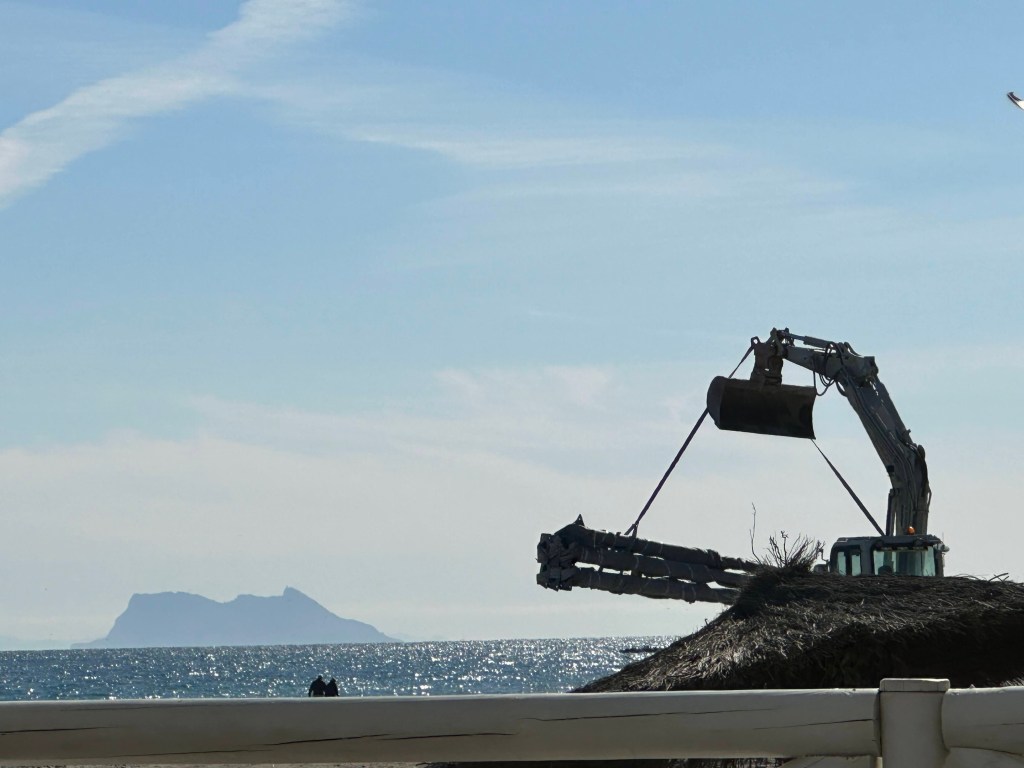
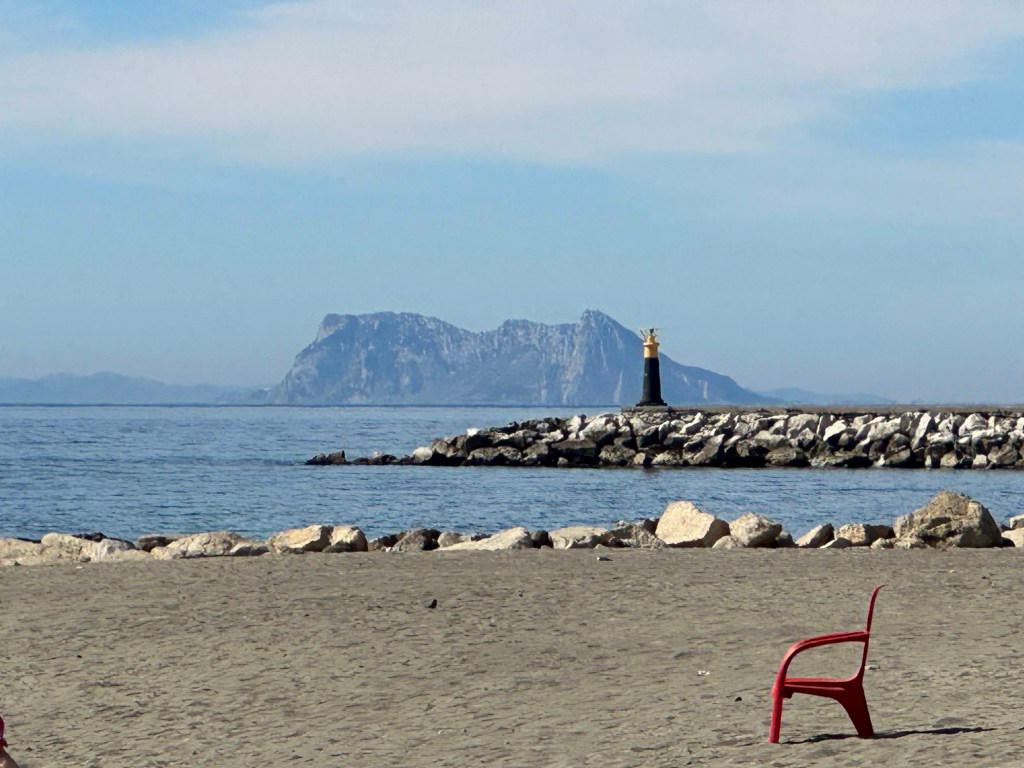
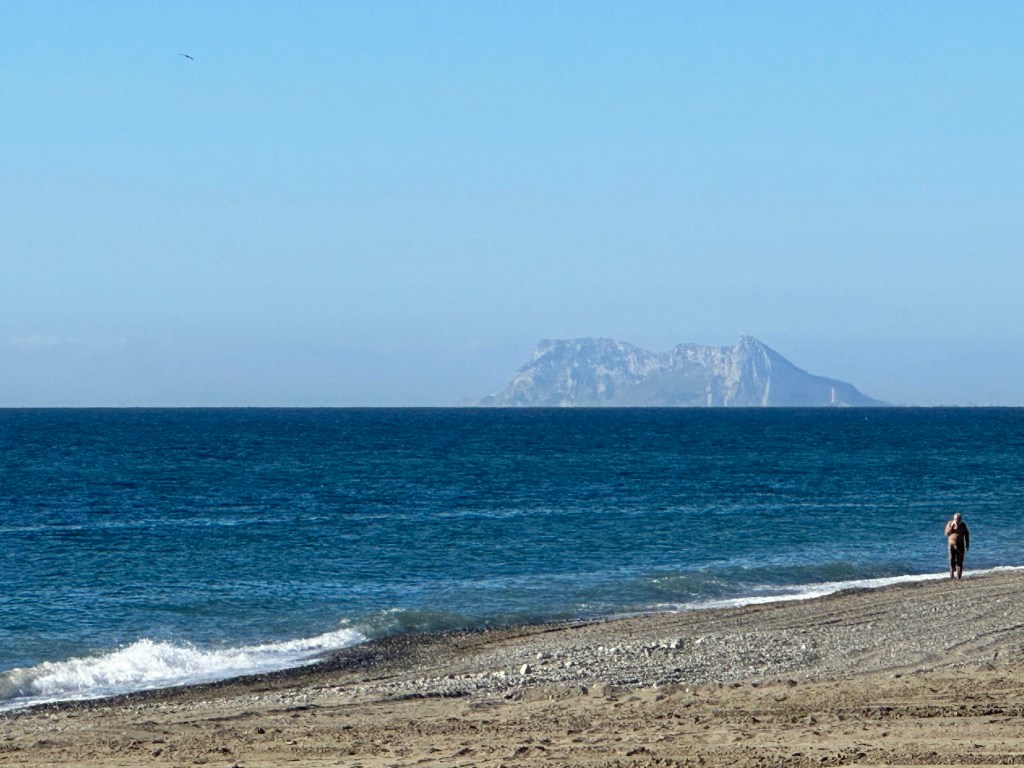
Workers BelowGibraltar Behind the Palms
All Around Town: The Old and The New
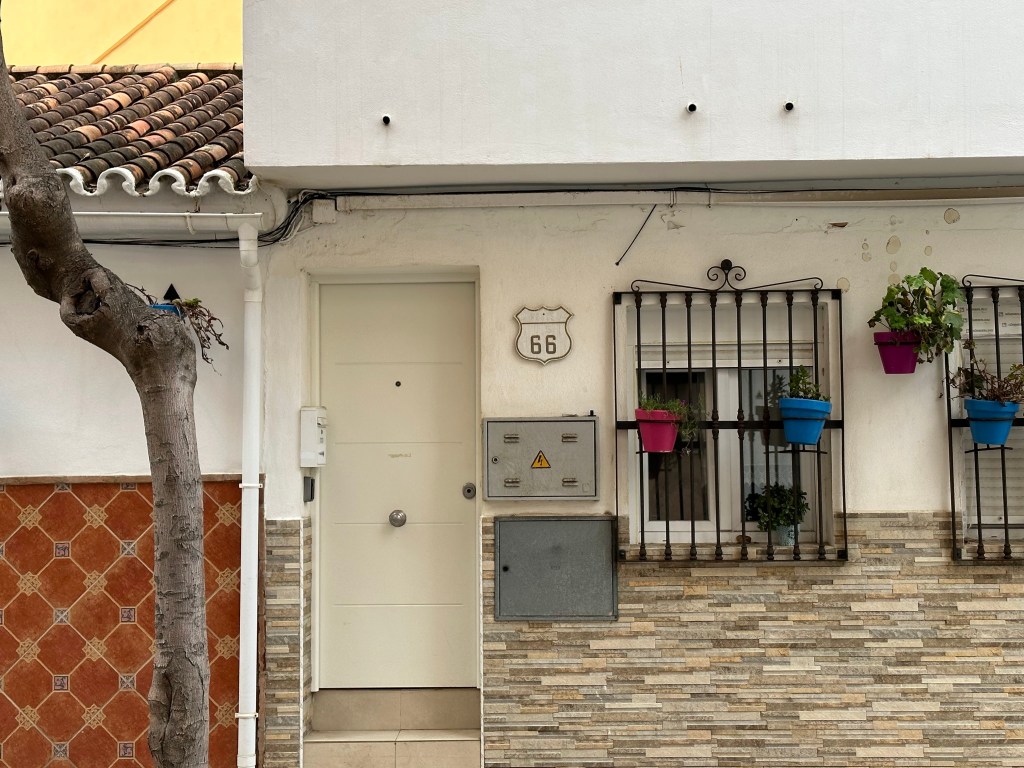
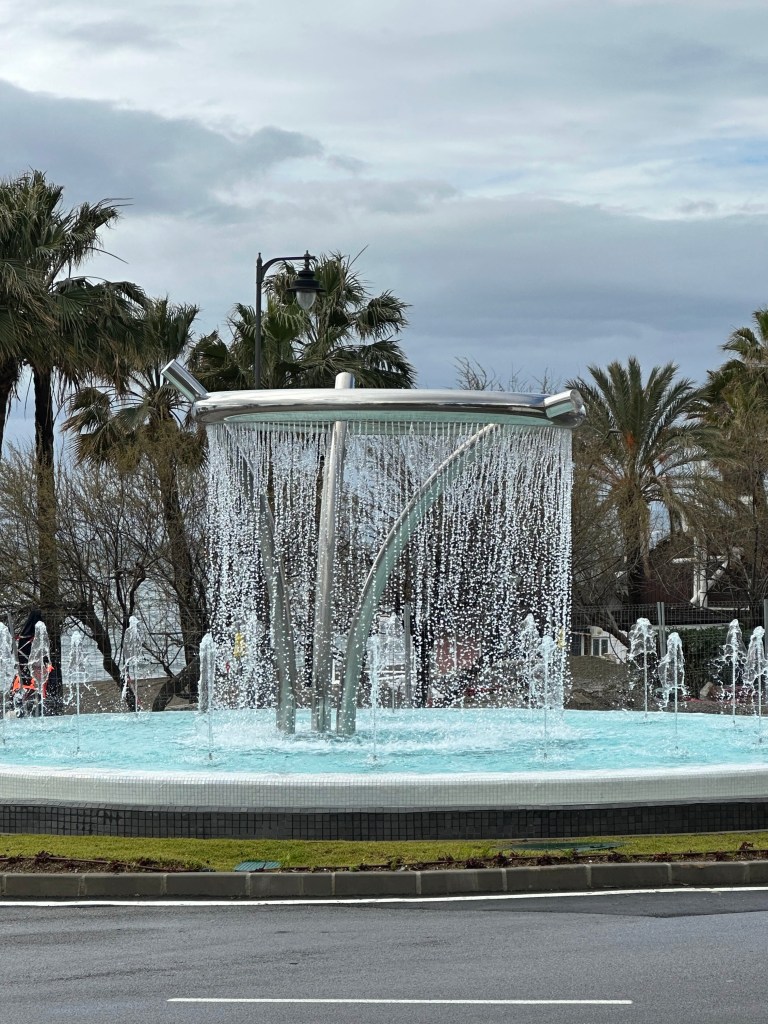
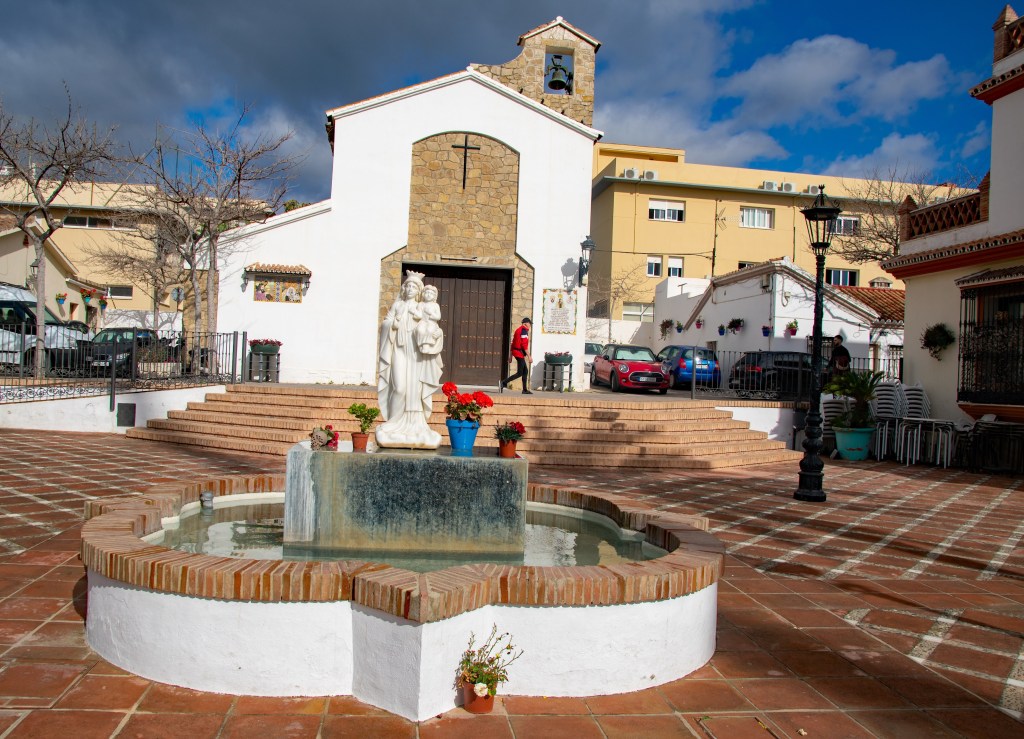
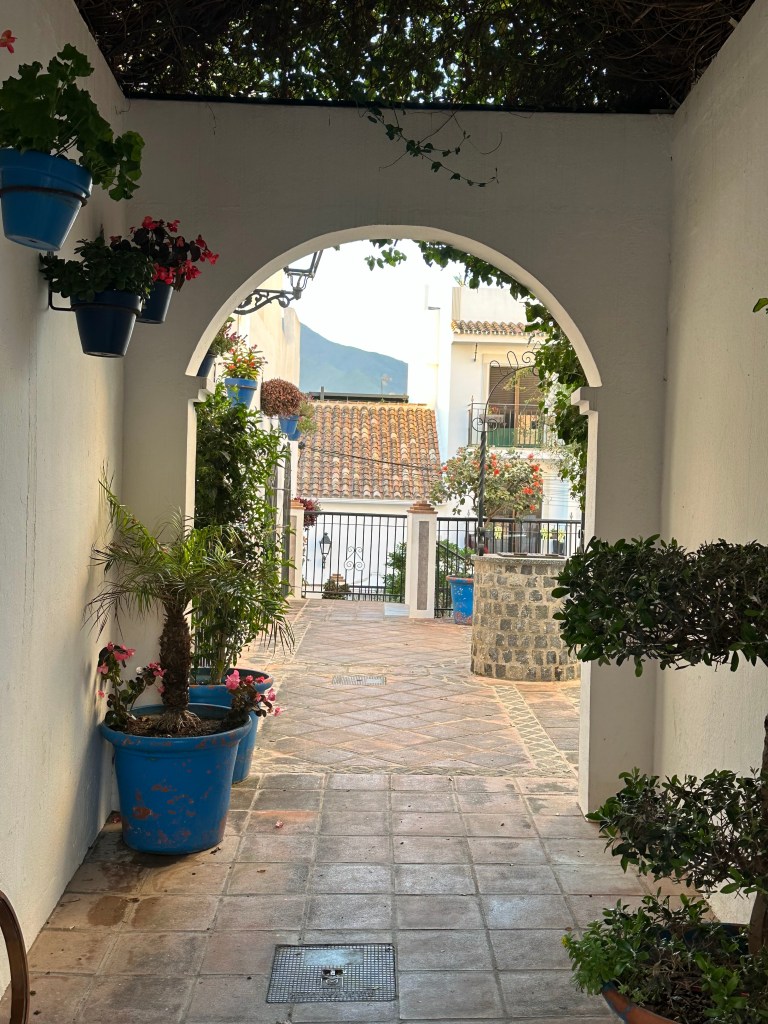
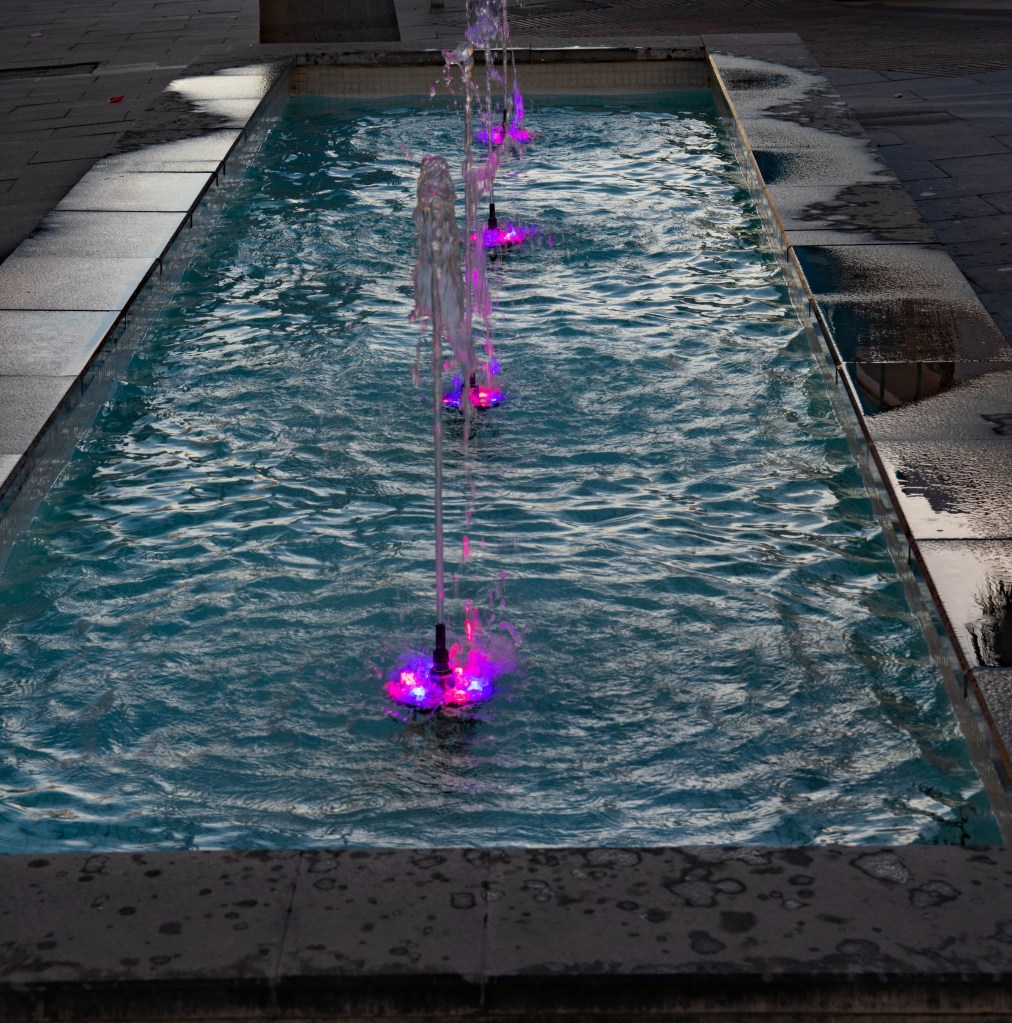
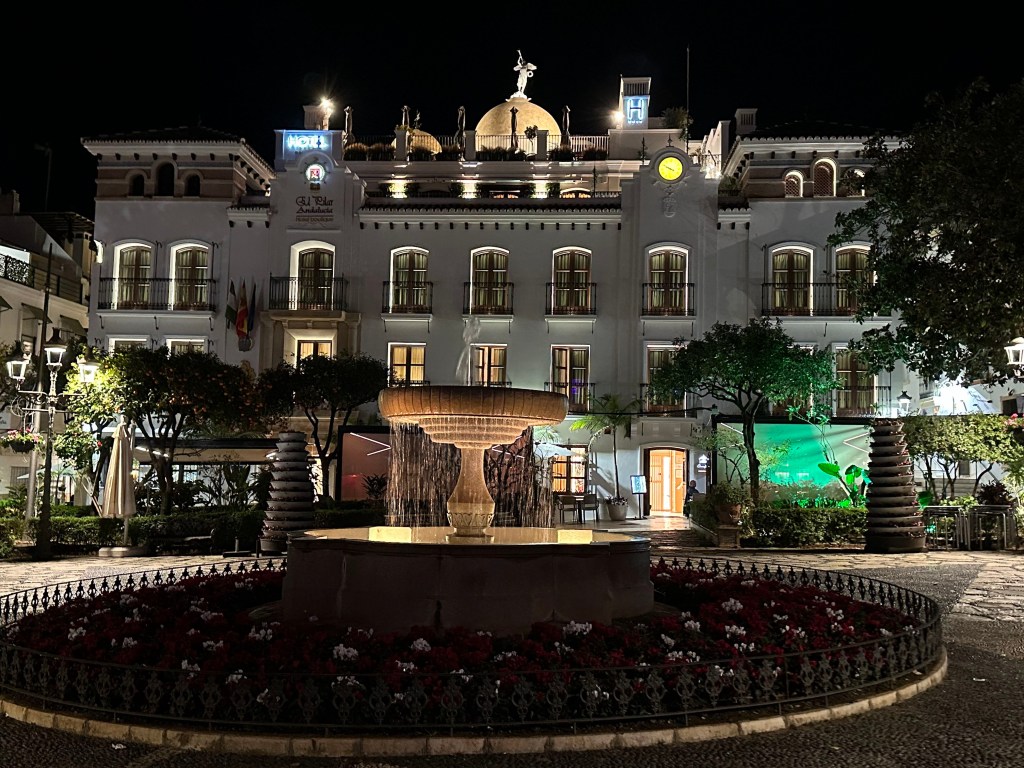
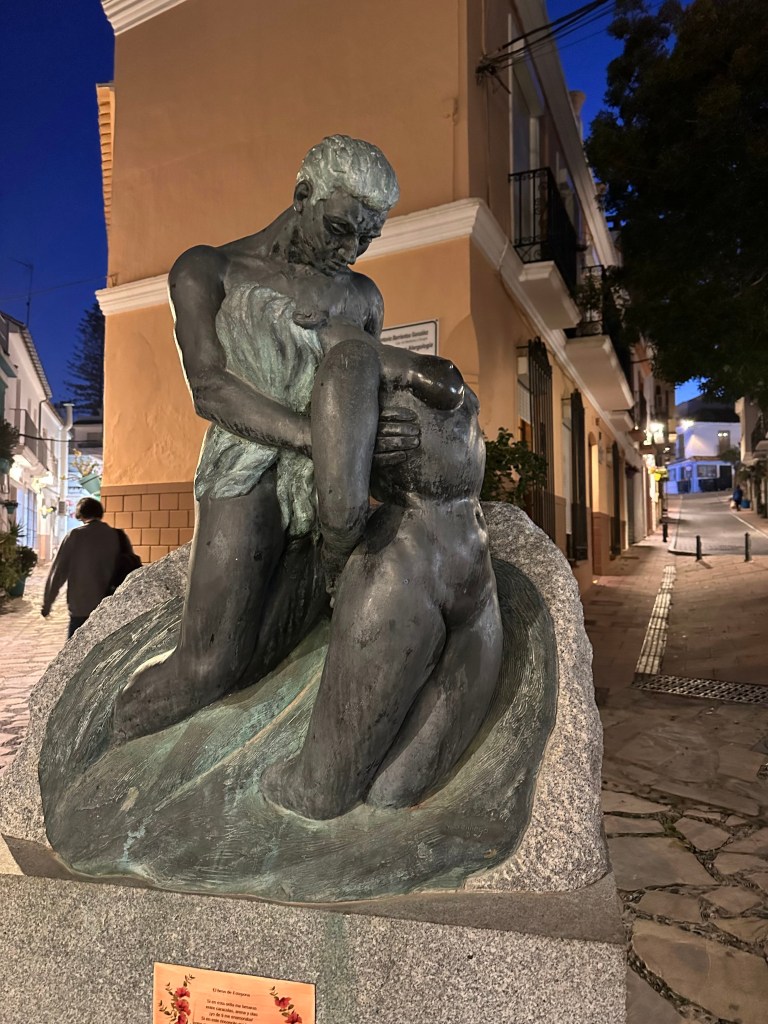
The MiradorGibraltar and a CraneFisherman’s CottageBeyond Cristo BeachNew FountainFrom Plaza Virgen del CarmenOde to Estepona (Village of Fishermen)Cottages
Virgen Del Carmen Church (Patroness of Fishermen)
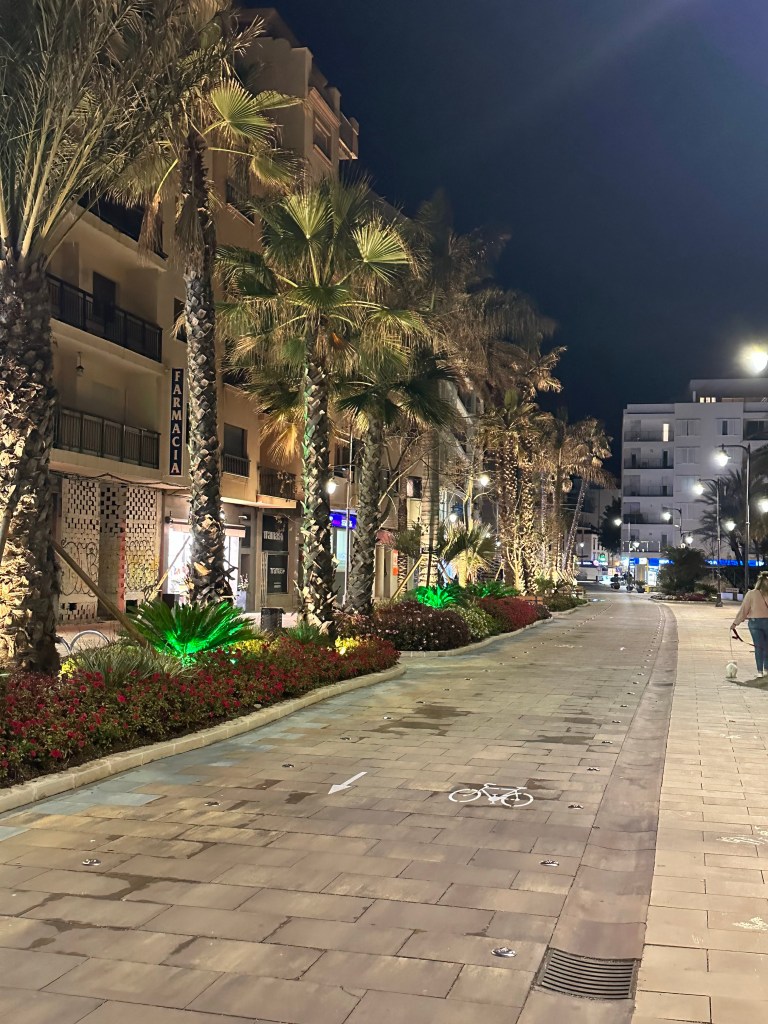
Nuestra Señora de RemediosOld TownPart of the New PaseoPlaza de FloresOrchidarium at Night
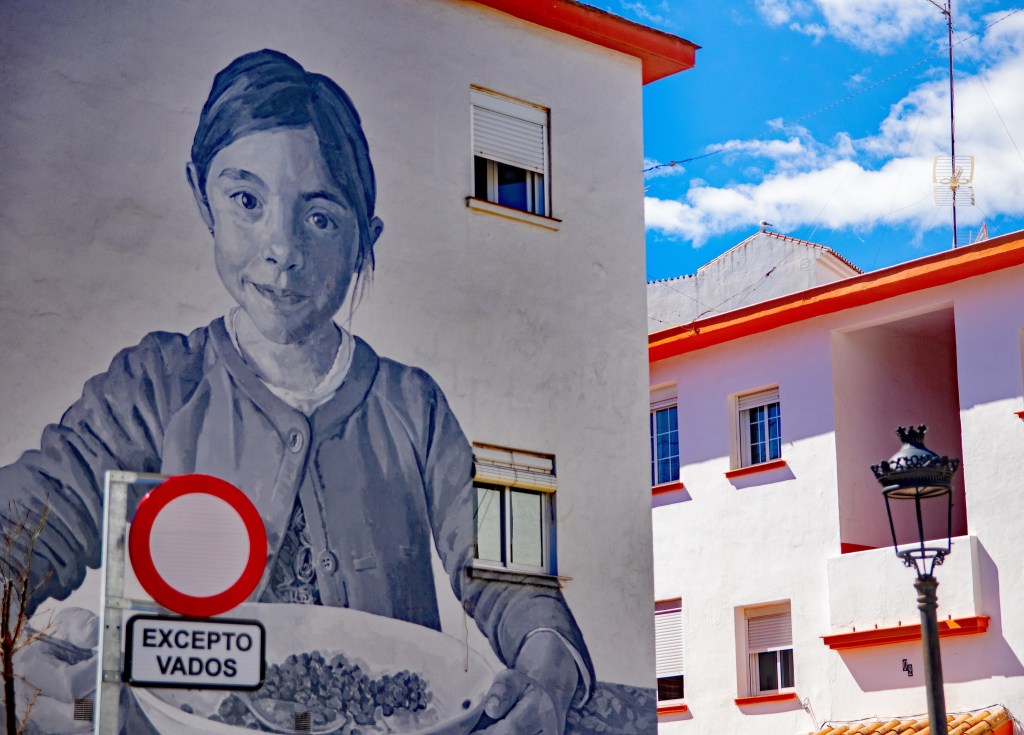
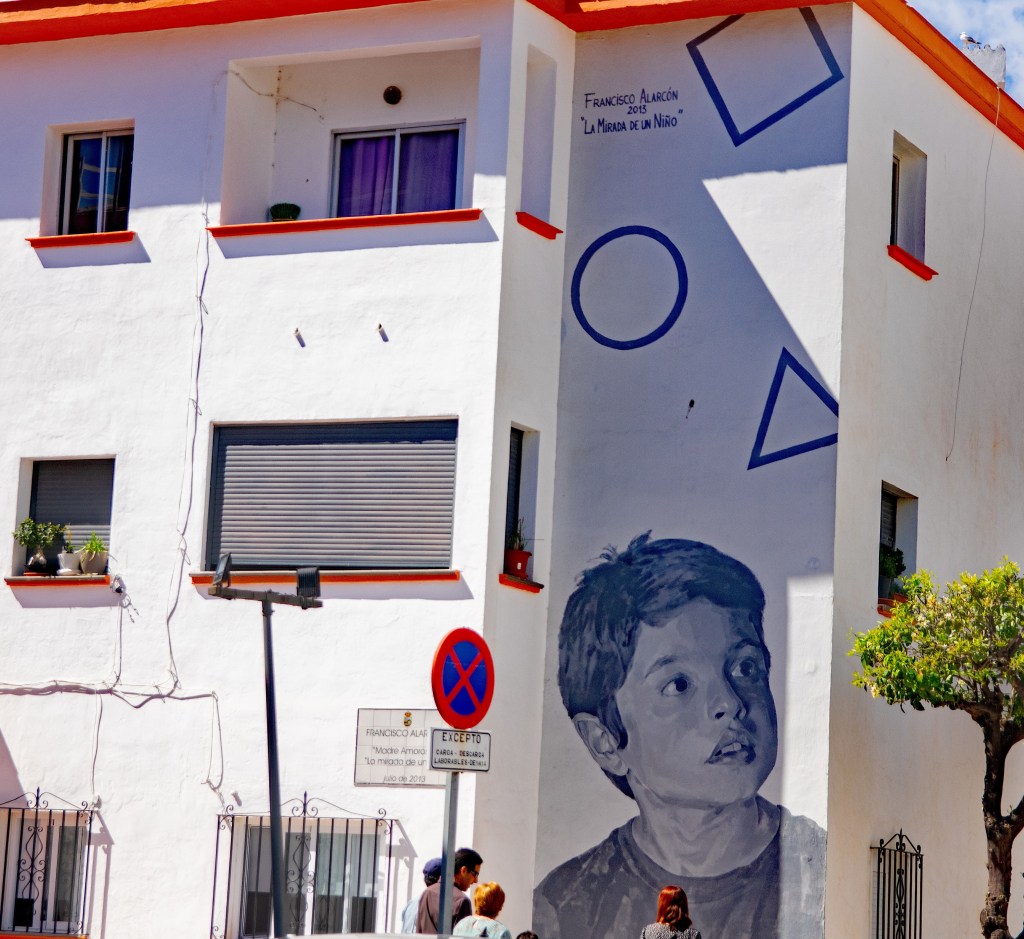
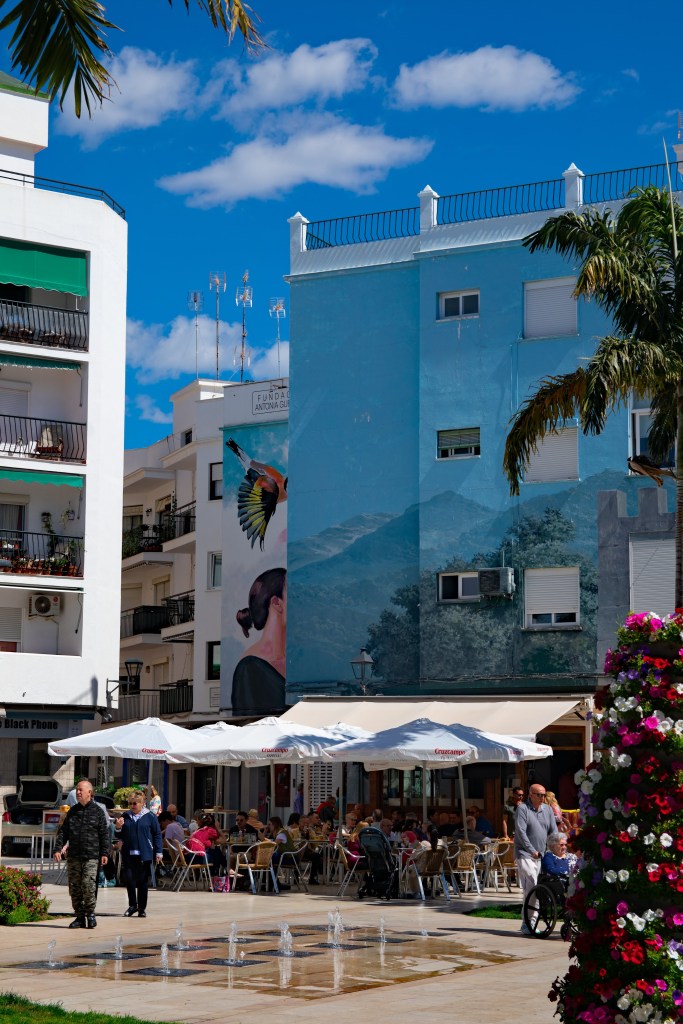
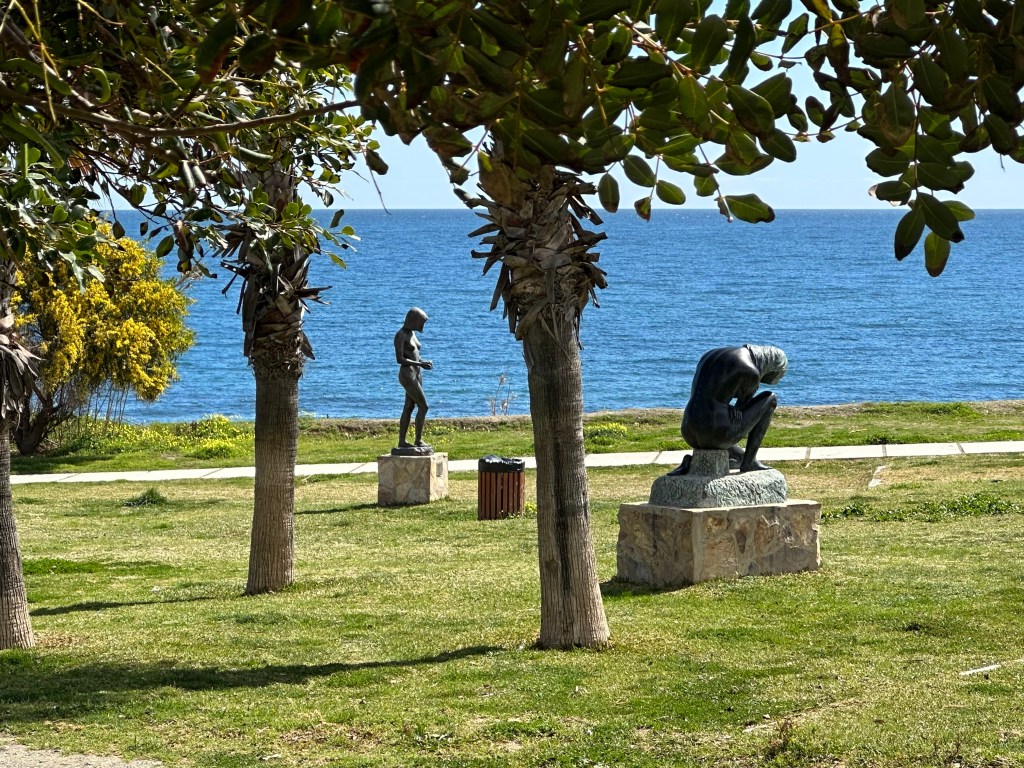
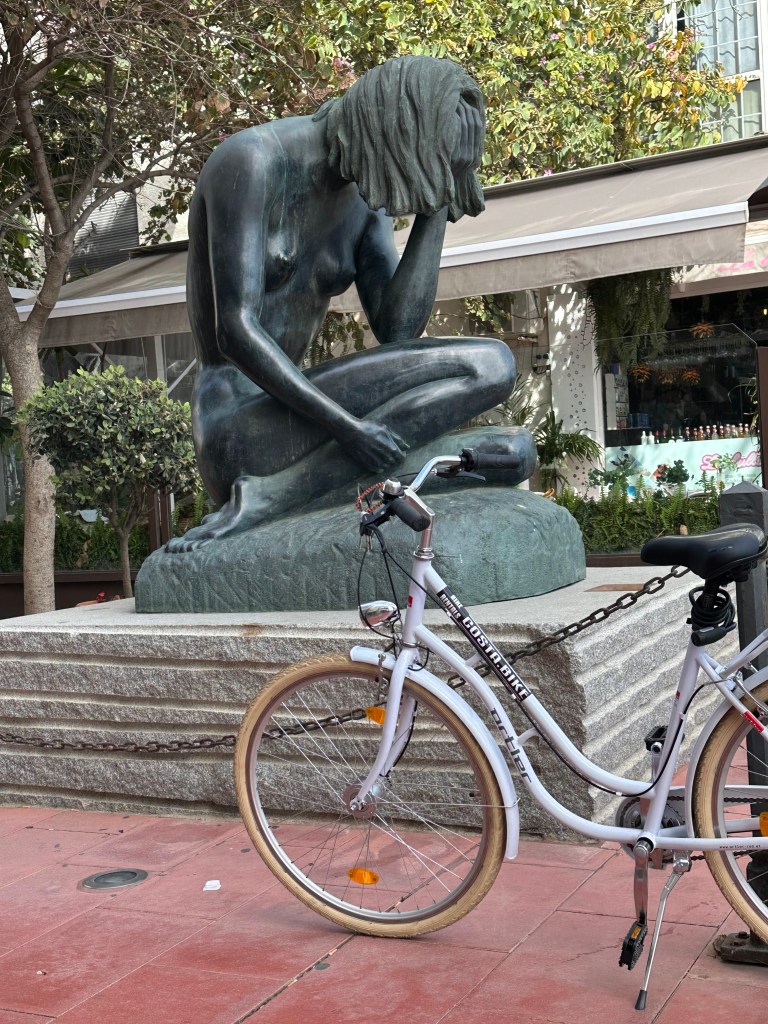
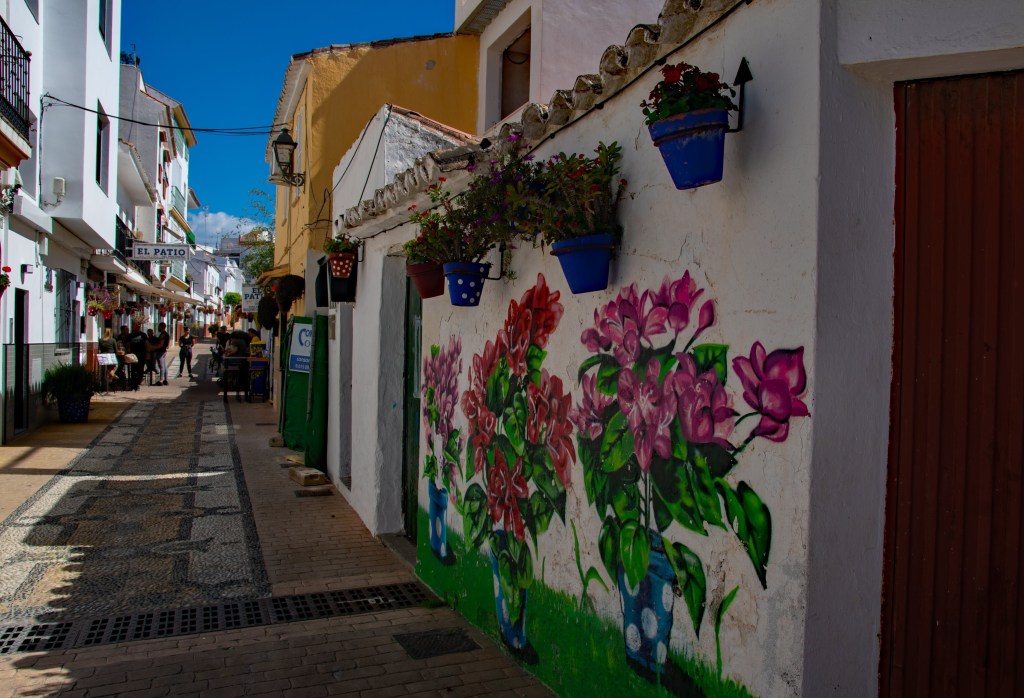
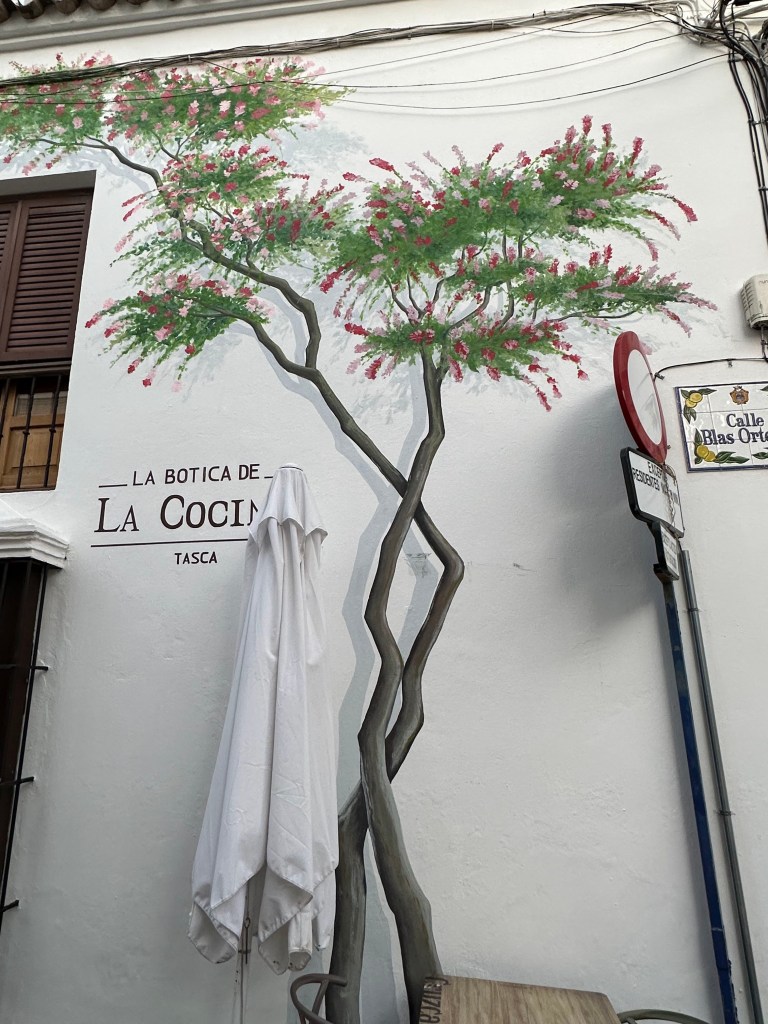
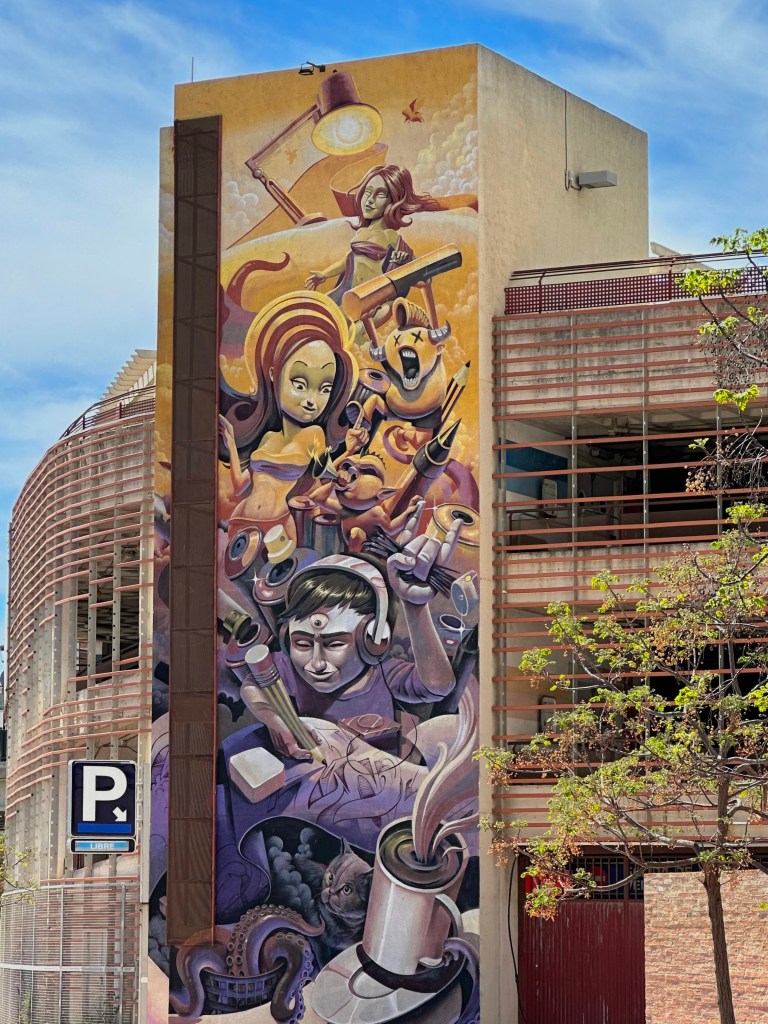
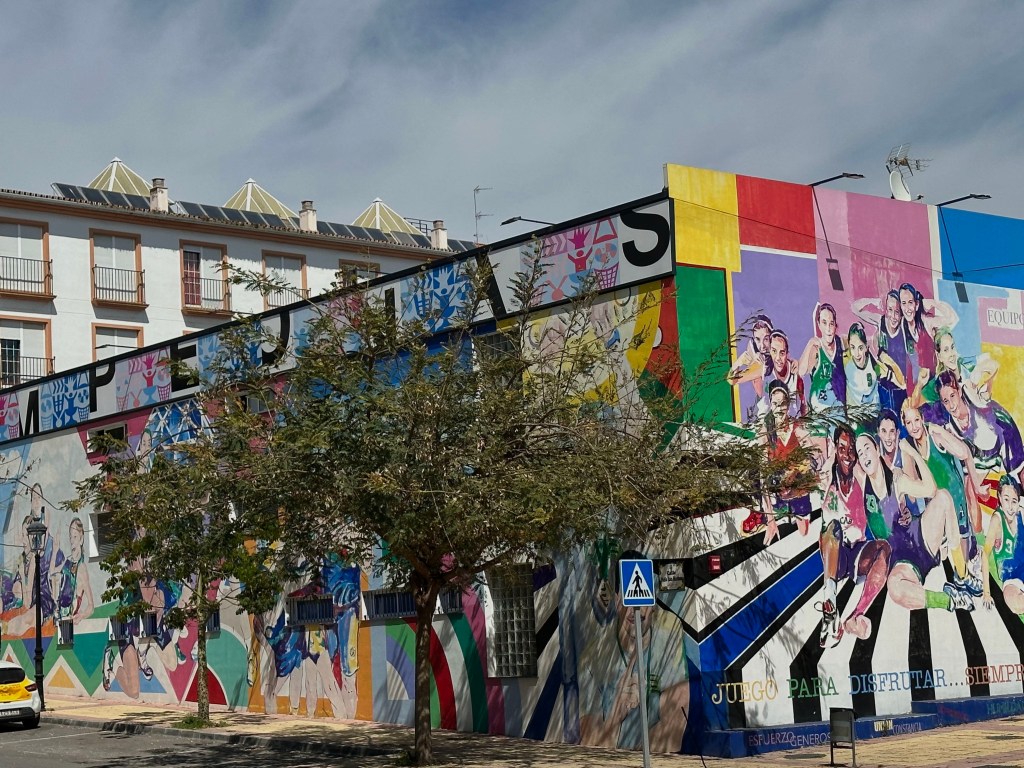
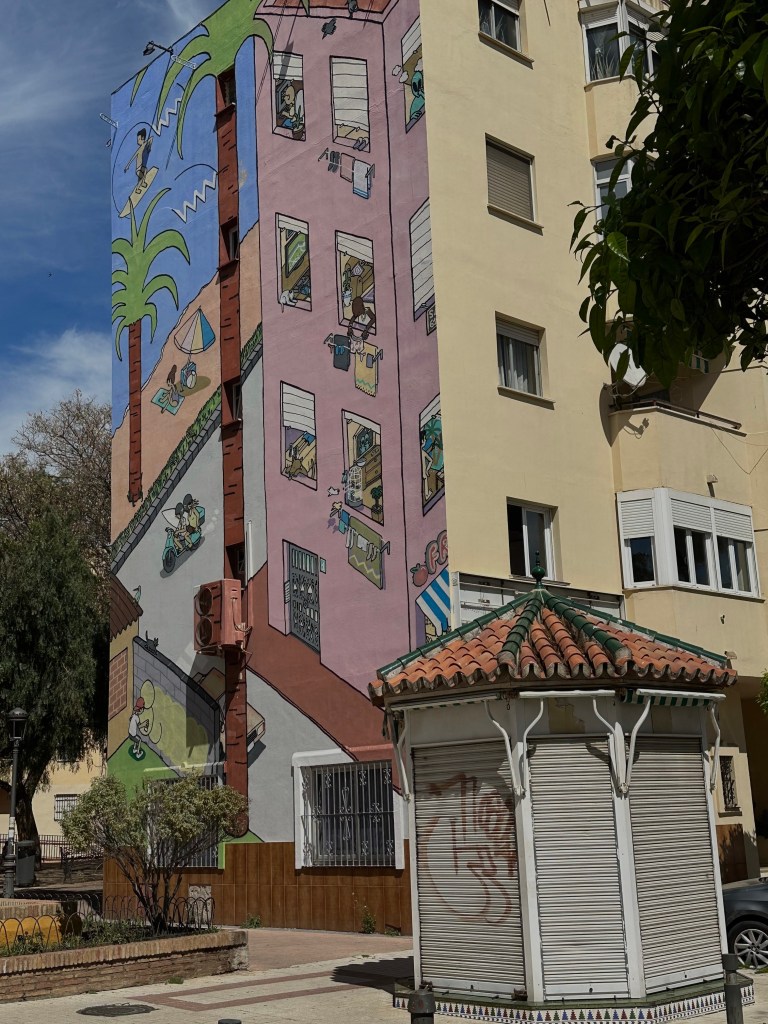
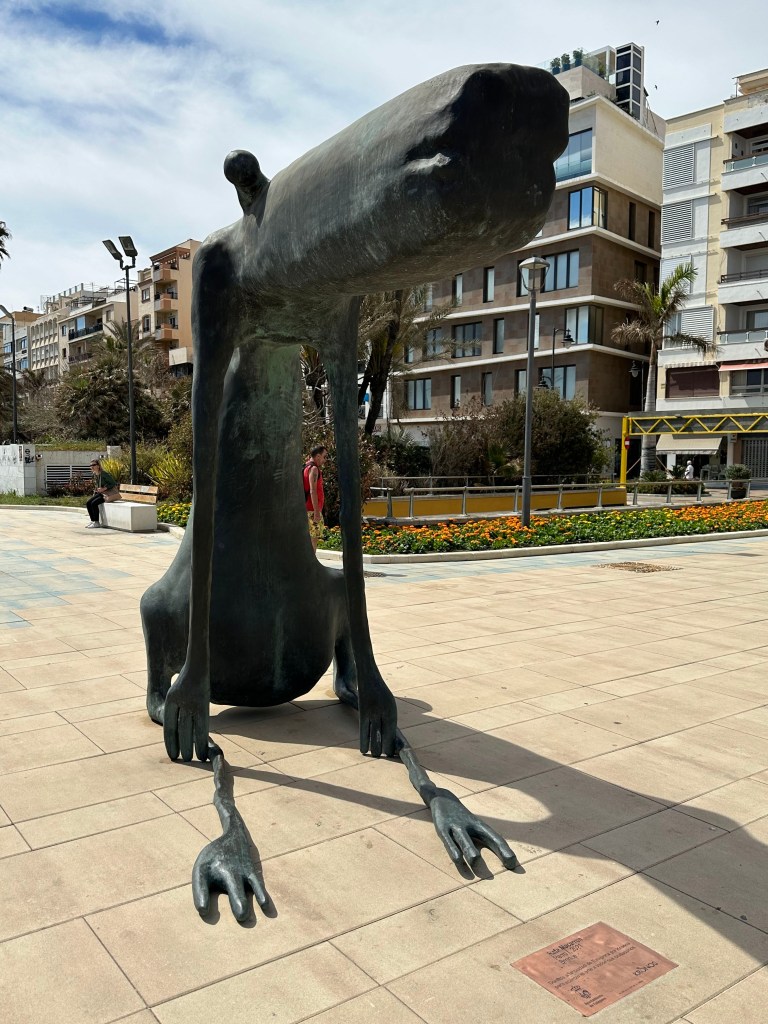
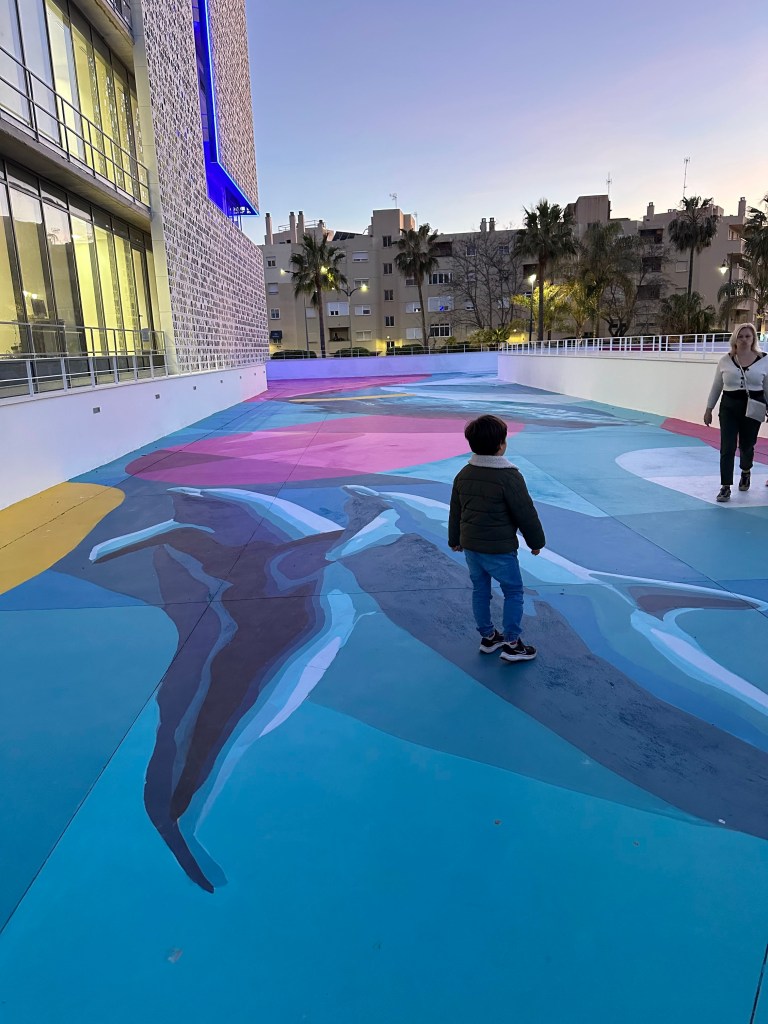
Just a Sampling of the Public Art in Estepona
They Say It’s A Dog
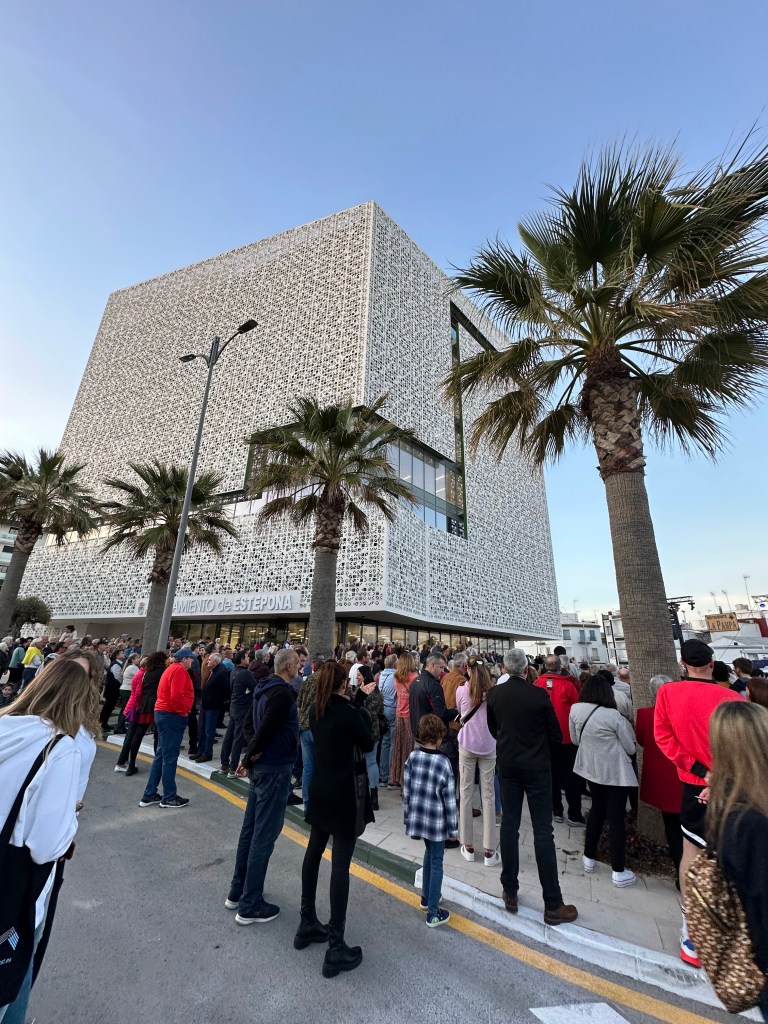
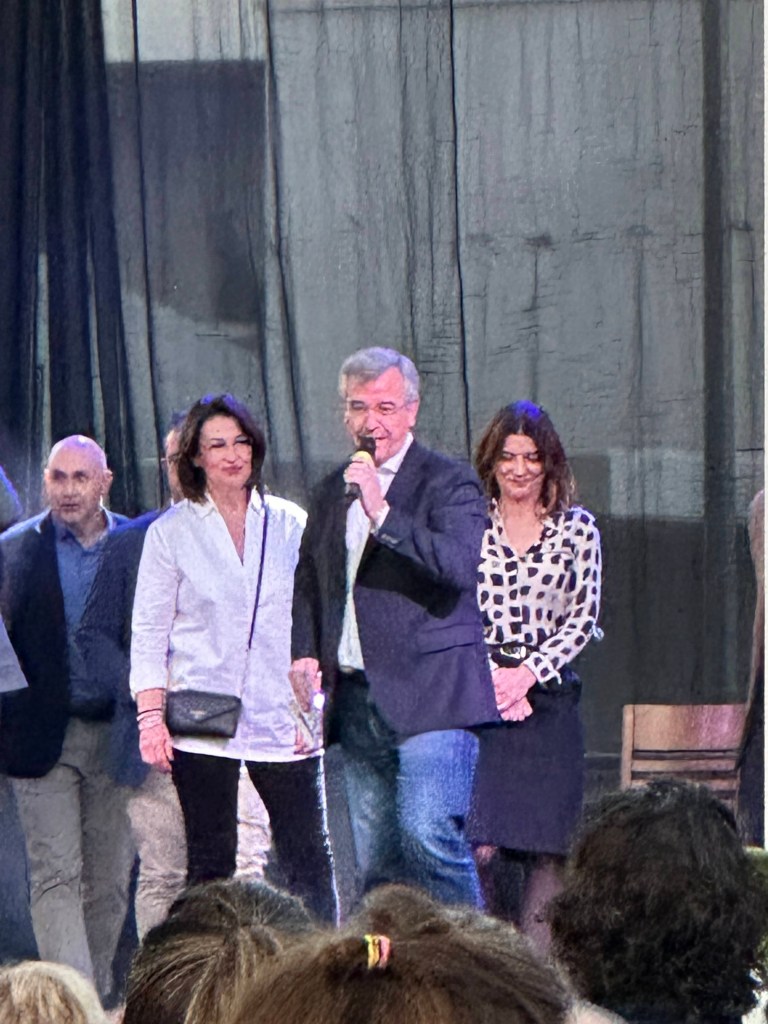
Grand Opening Party for City HallMayor Urbano
City Hall (El Ayuntamiento) Behind Us
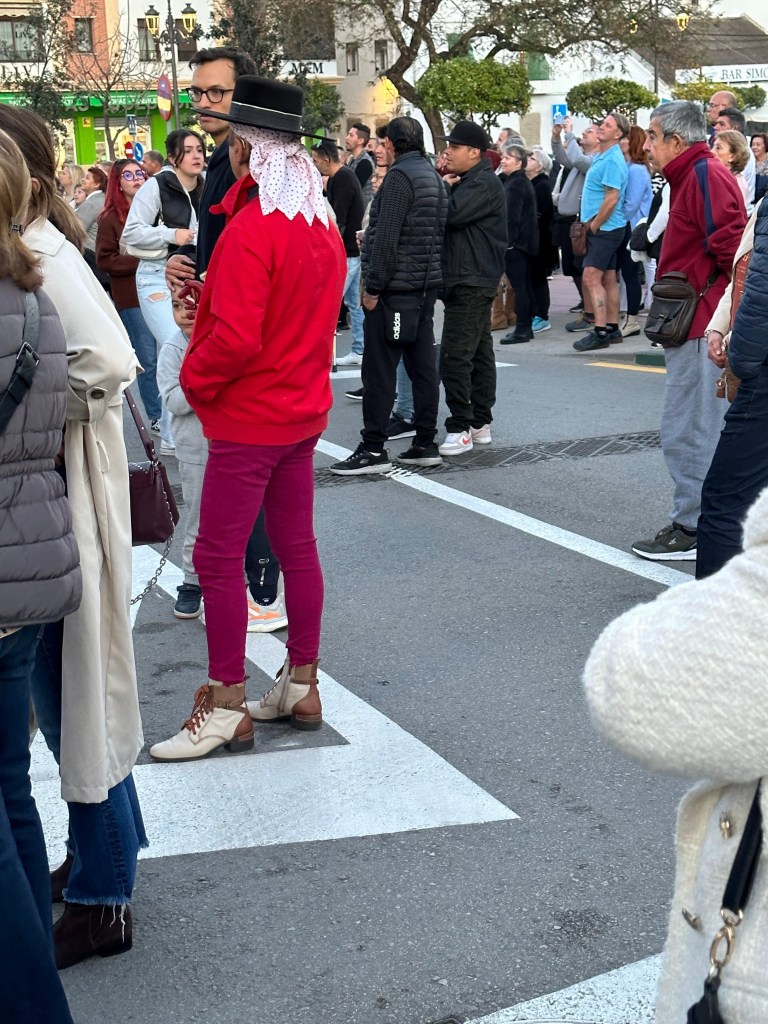
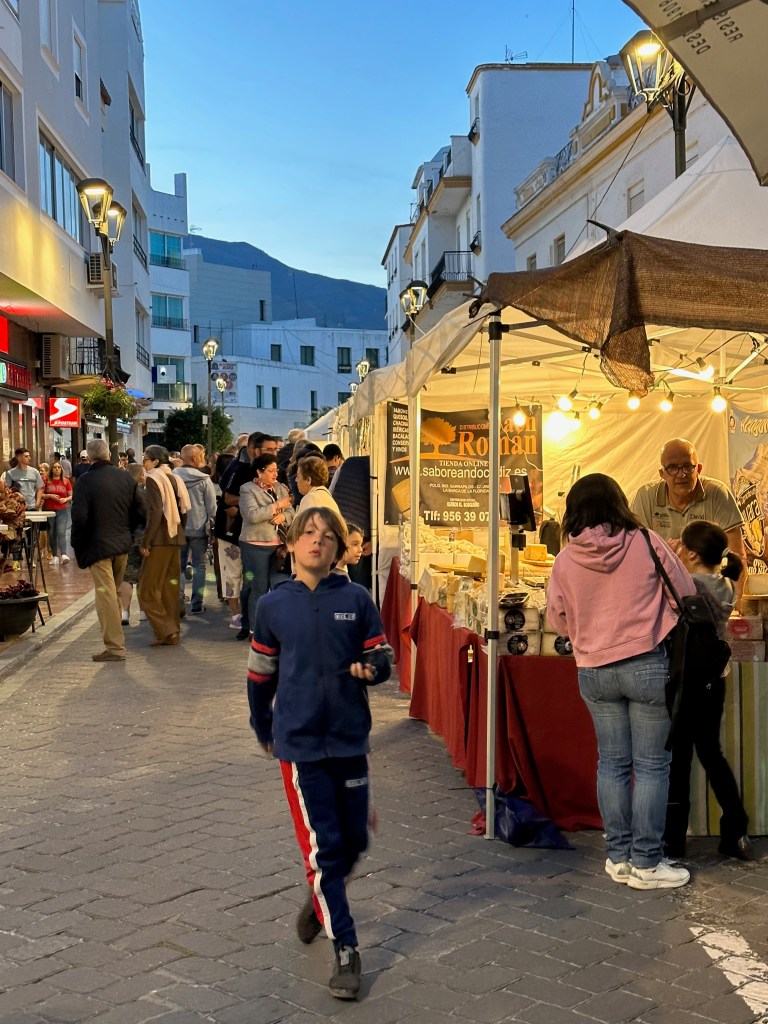
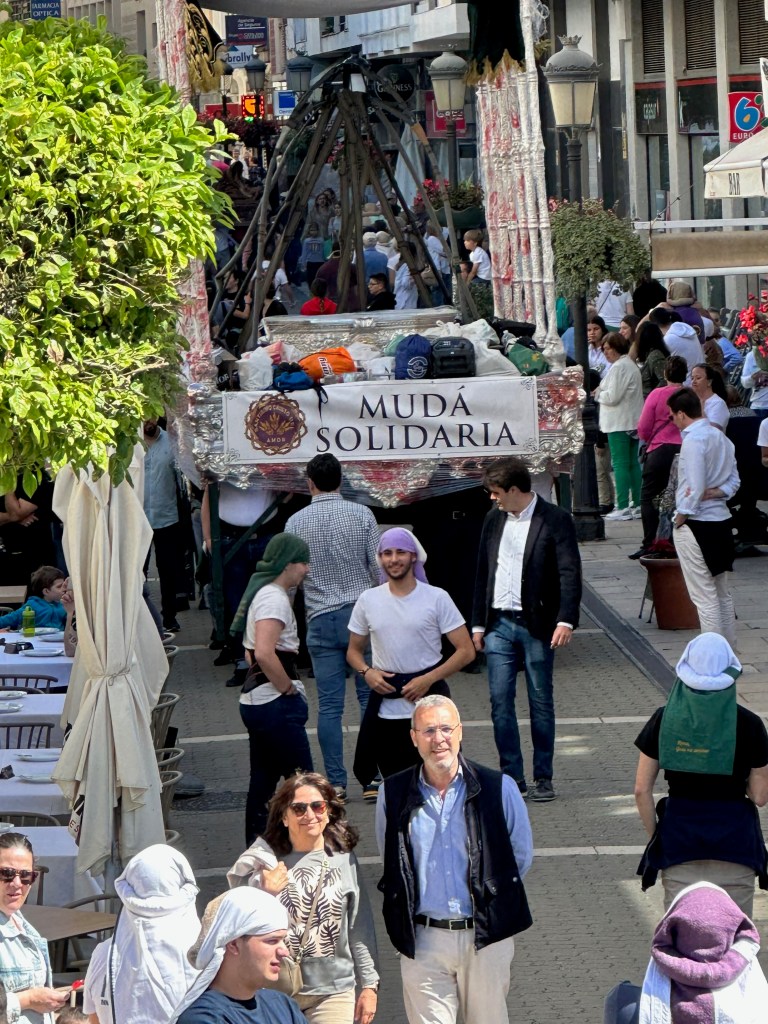
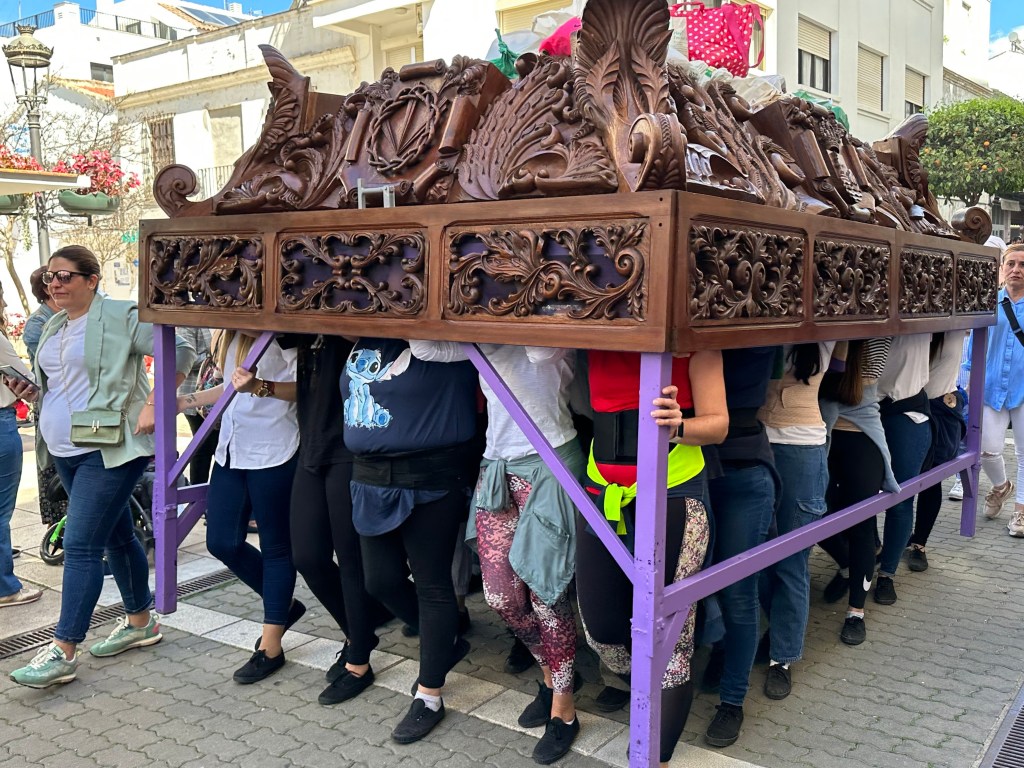
There is always something happening here. Last weekend there was a street fest to celebrate Estepona’s Old Town. It was complete with cheese vendors, tapas crawls, free concerts, and contests. There was also a rehearsal for the Semana Santa (Holy Week) processions. Since they were out there they collected food donations along the route.
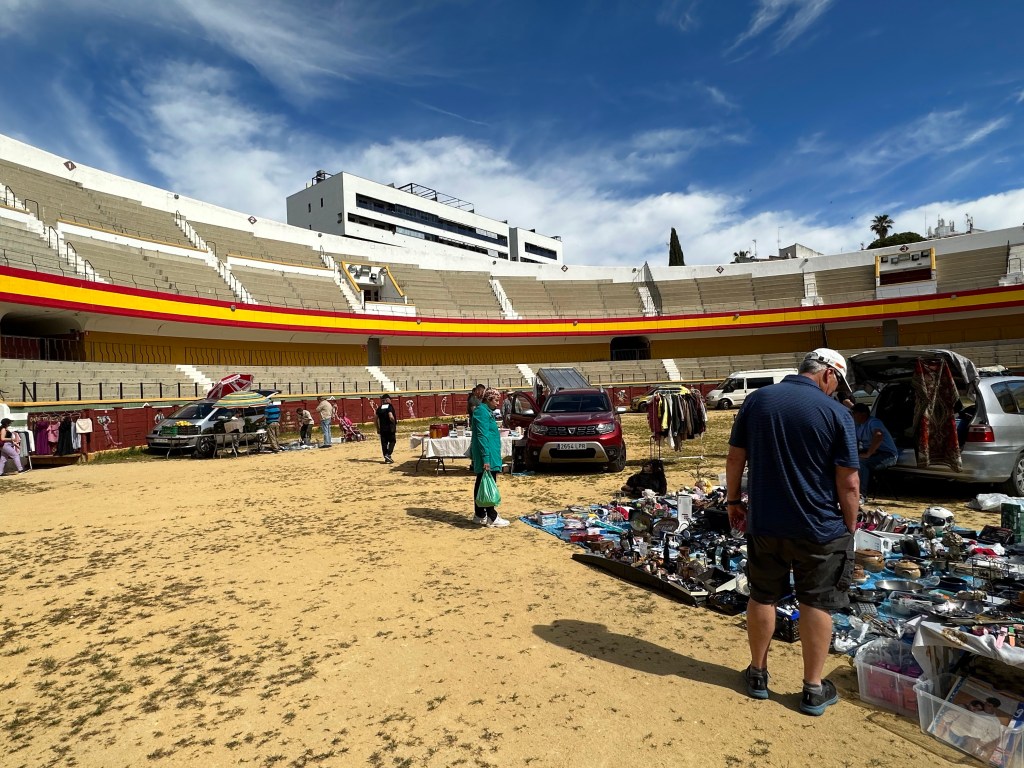
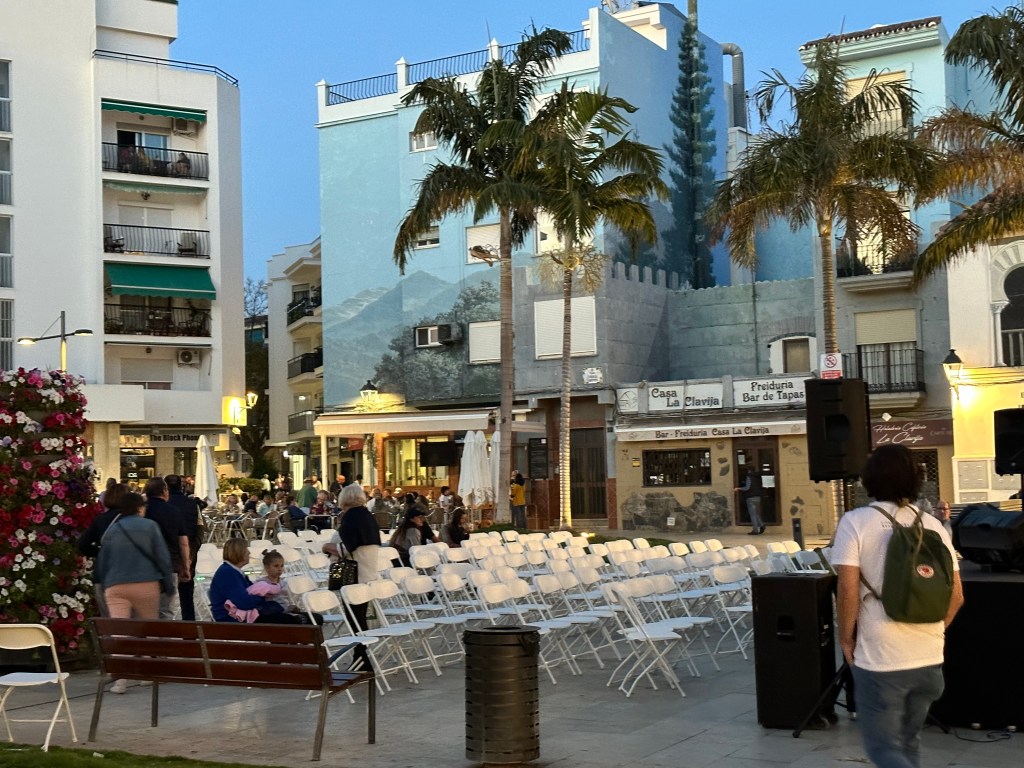
Cheese FestivalPractice ParadeGetting in Shape to Carry the FloatOutdoor Chess at Plaza de Ajedrez Sunday Morning Flea Market at Bull RingFree Concert
A Day on the Mountain
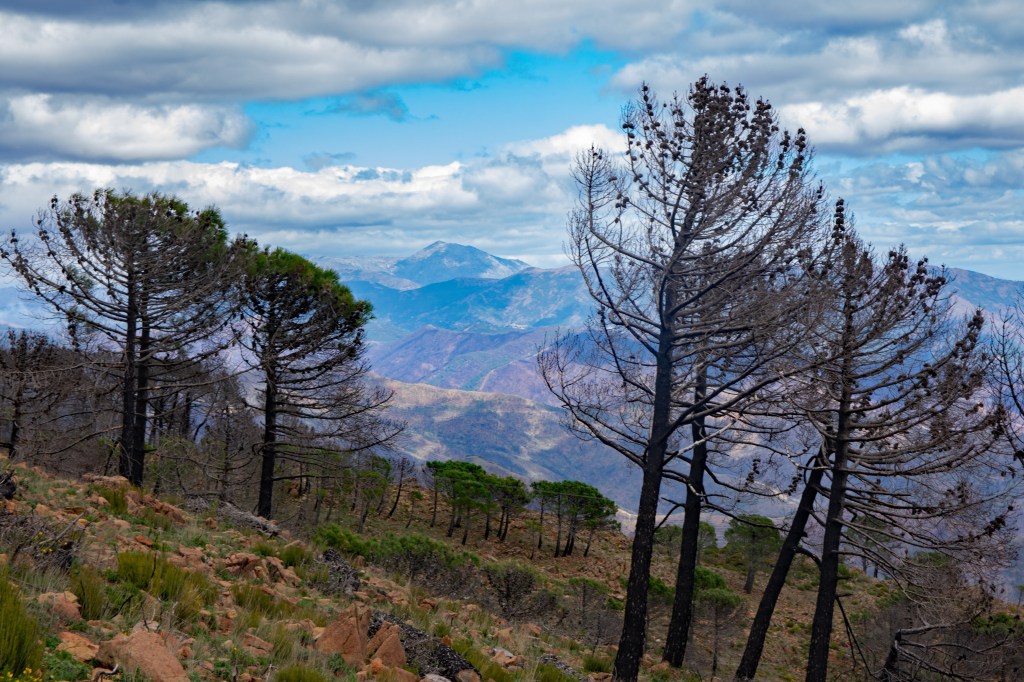
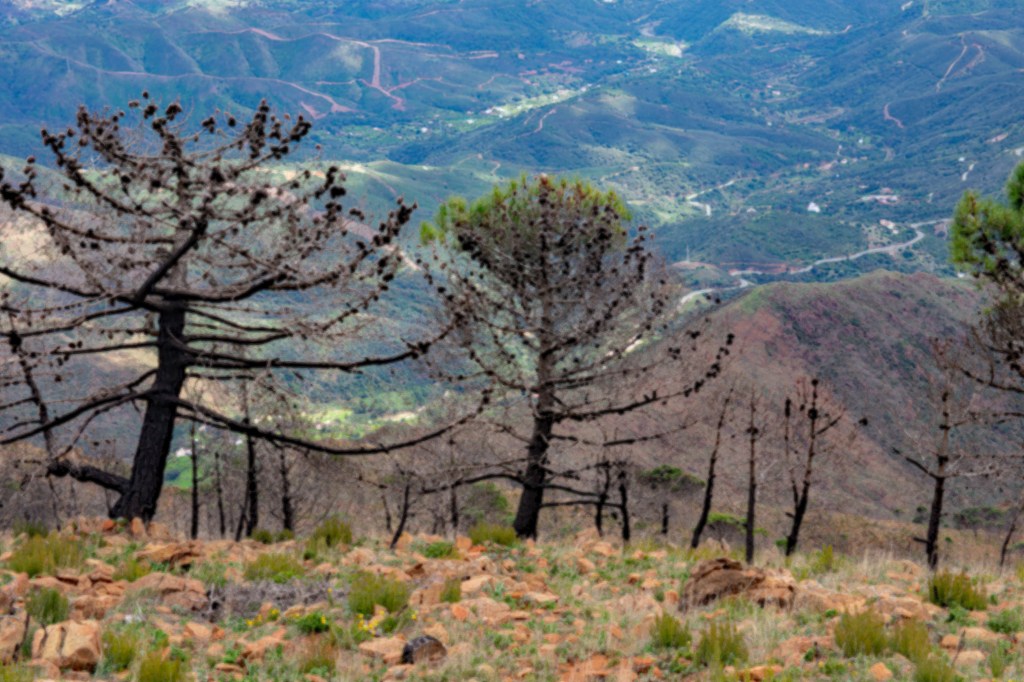
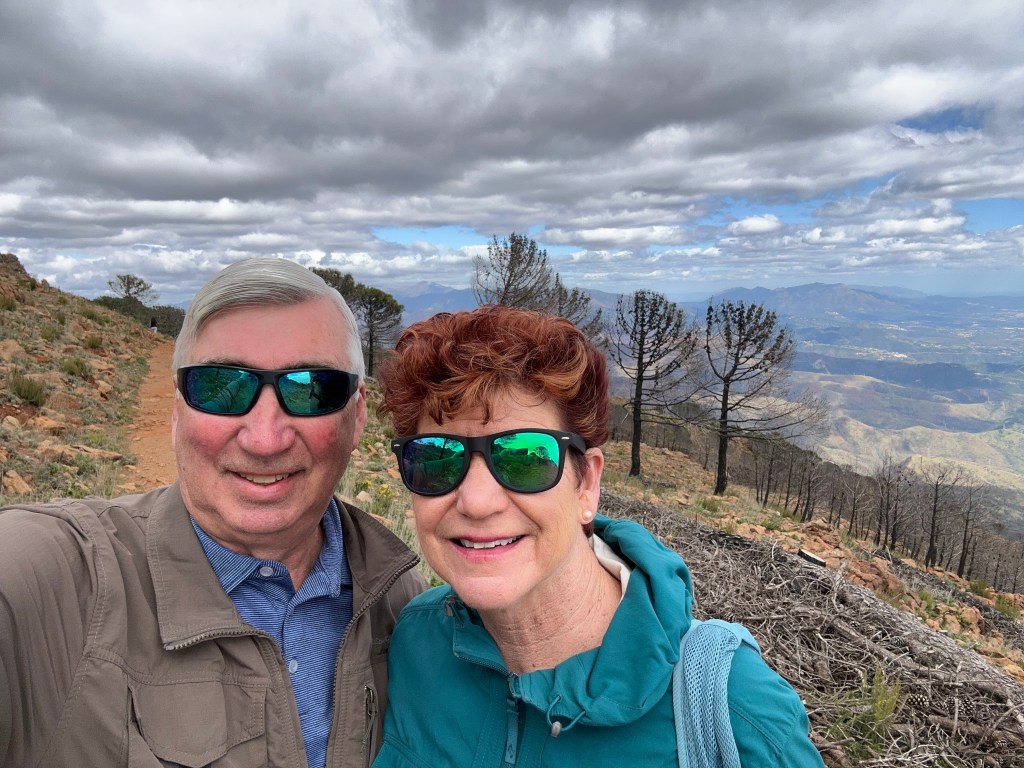
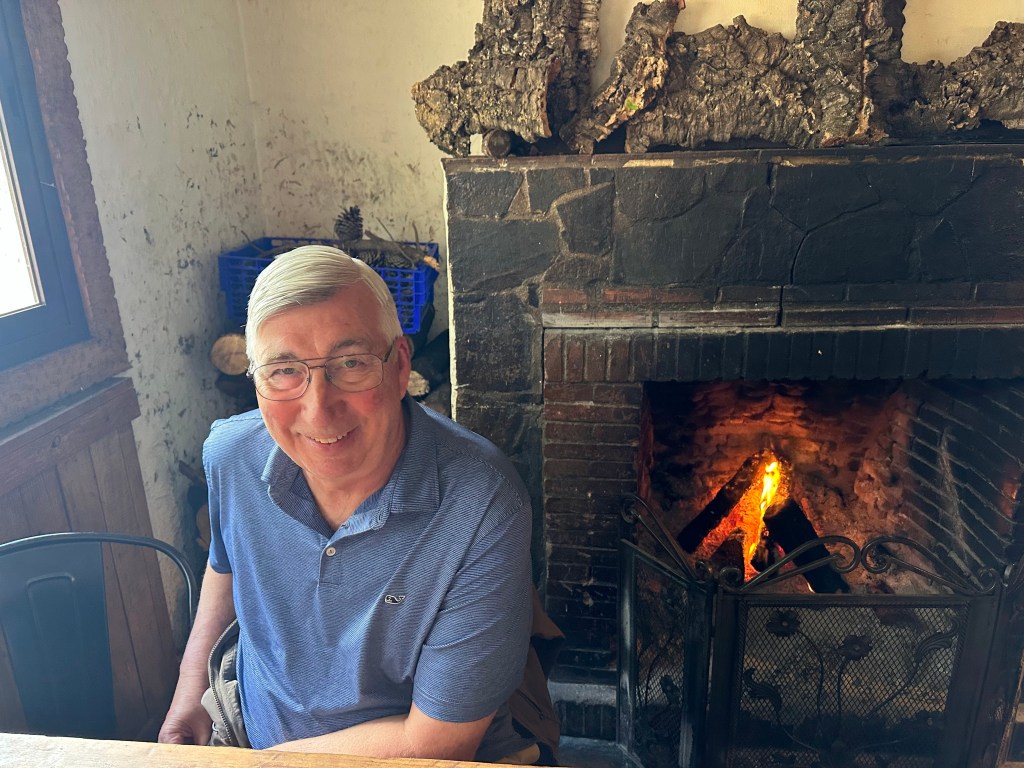
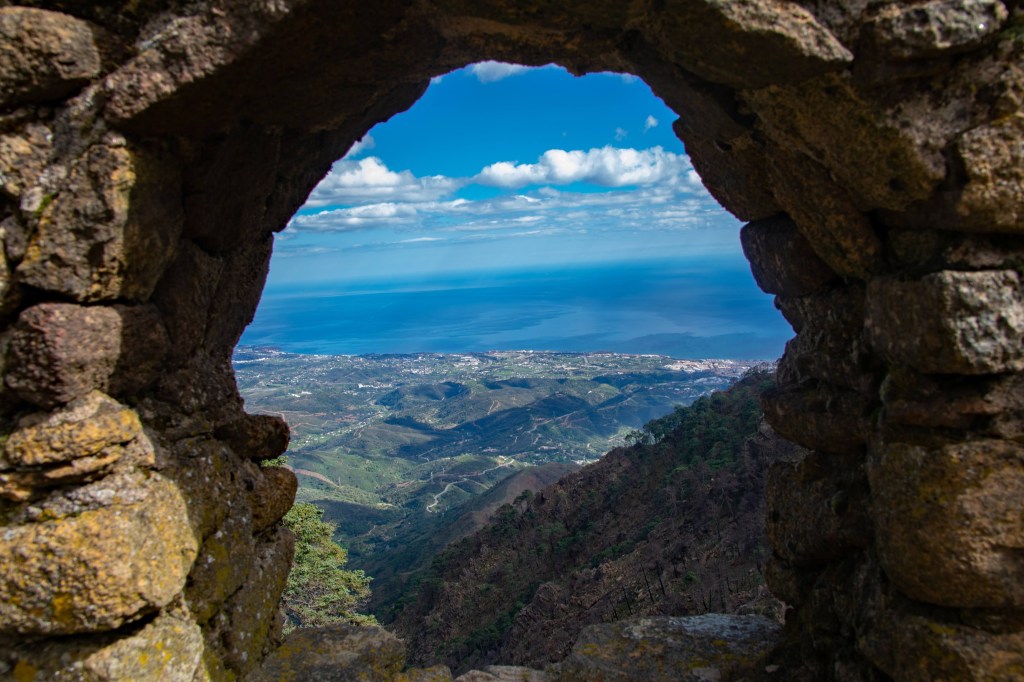
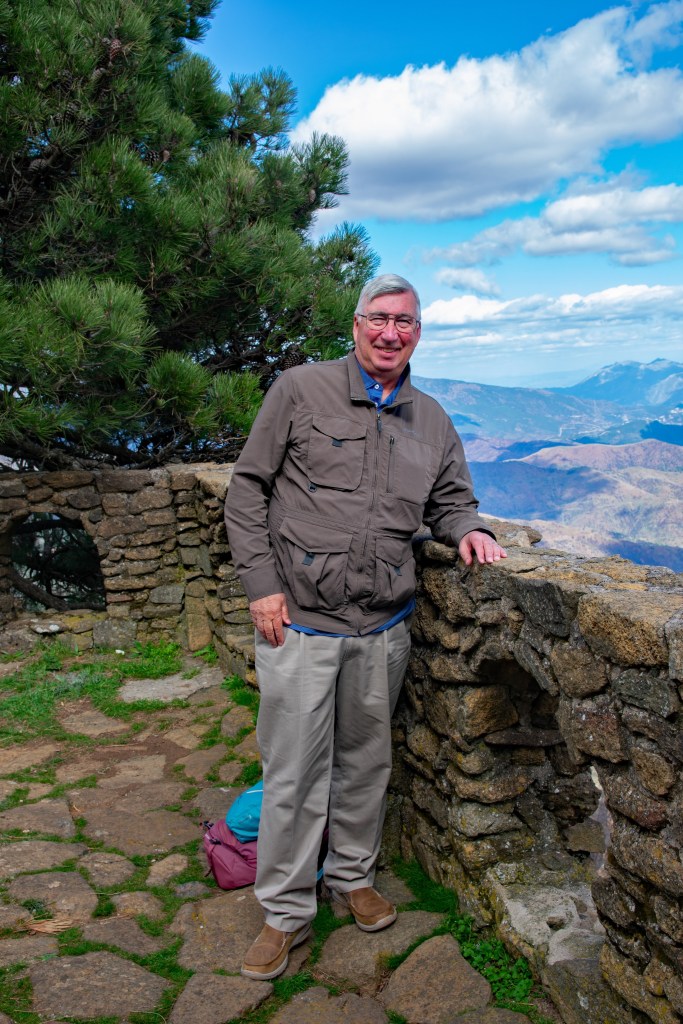
One Saturday, we took a taxi up into the Sierra Bermeja Natural Park. It was about a 40 minute ride straight up. Sure glad I wasn’t driving! Our driver decided to wait for us. We told him we had a lunch reservation, but he said that was no problem. He would turn off the meter and wait. We walked around a bit up at the overlook. The views were spectacular of mountains, woods, and the town and sea below. Lunch at Venta El Refugio in a charming old inn was delicious. We chatted with a nice couple from Denmark. As promised, our taxi driver was there when we were ready to descend.
We saw the devastation from the wildfire two years ago. It came really close to the place we had lunch.
Our Estepona activities included swimming at the indoor pool three days a week and yoga class outside twice a week.
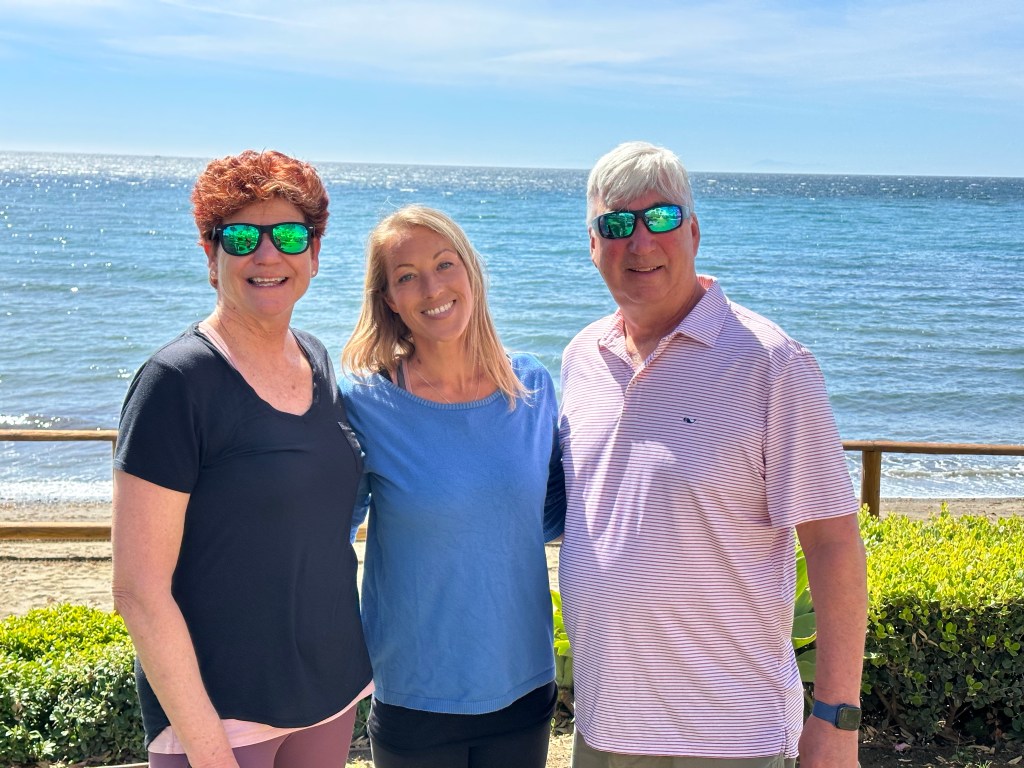
With Nettie, our yoga teacher
Favorite After Yoga Brunch Spot
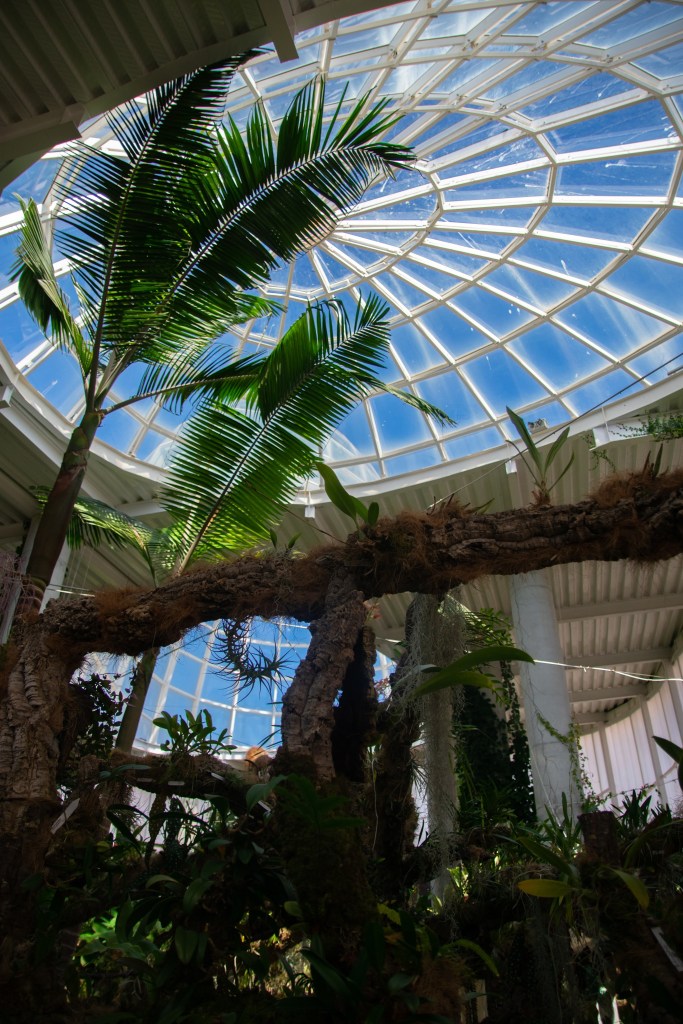
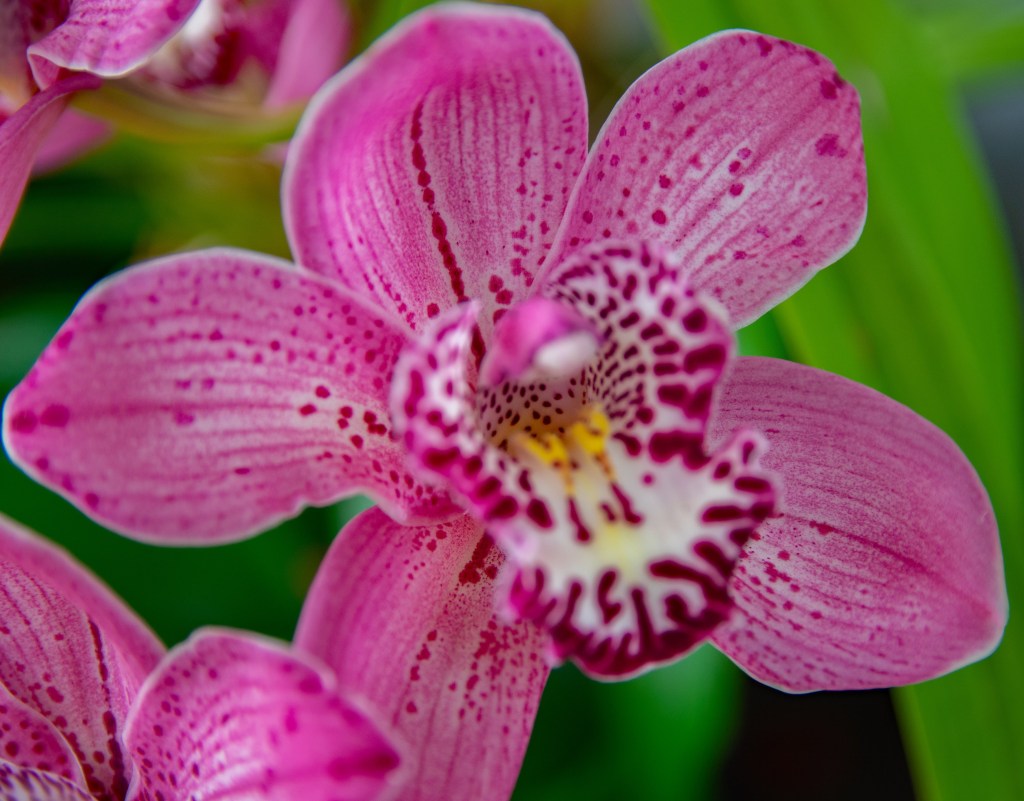
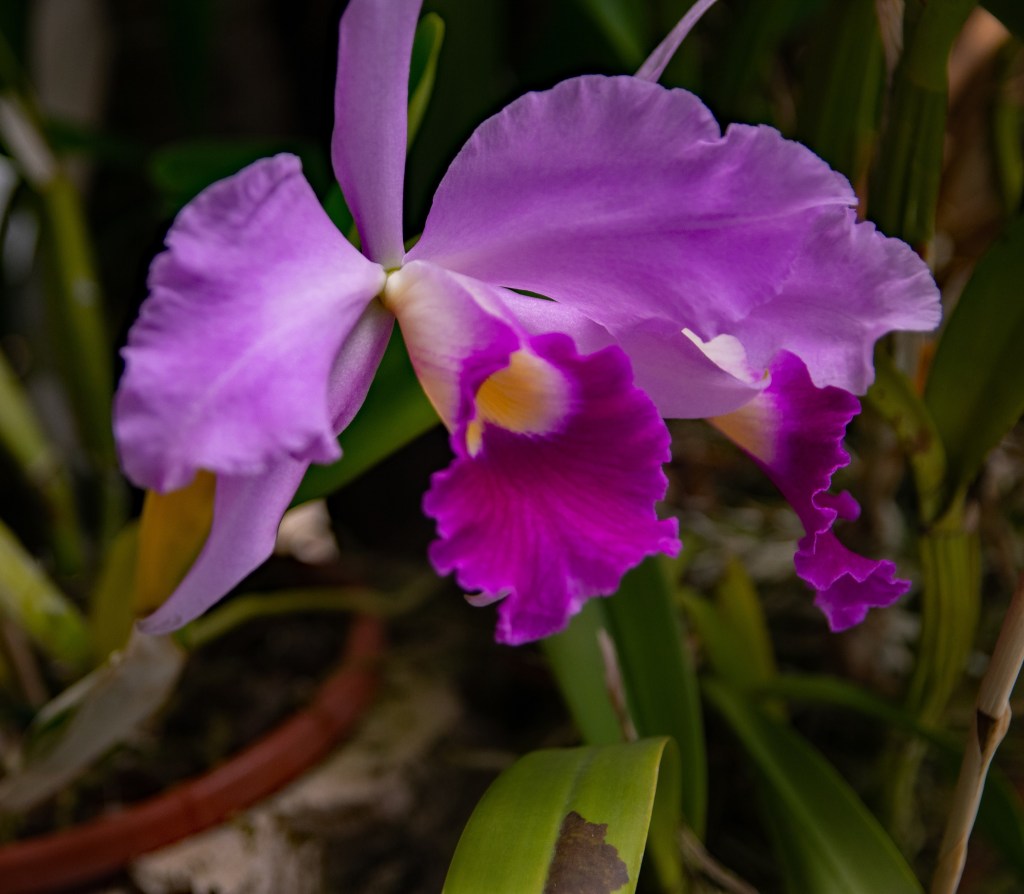
The Orchidarium
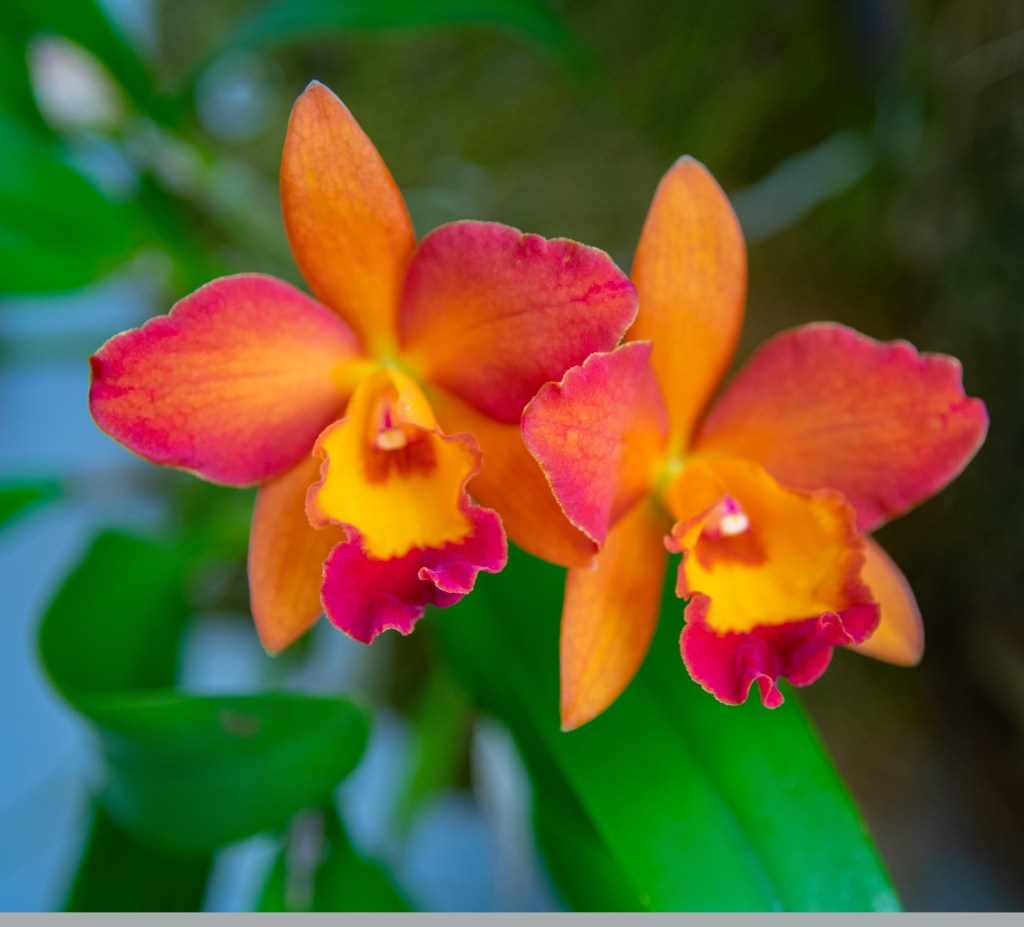
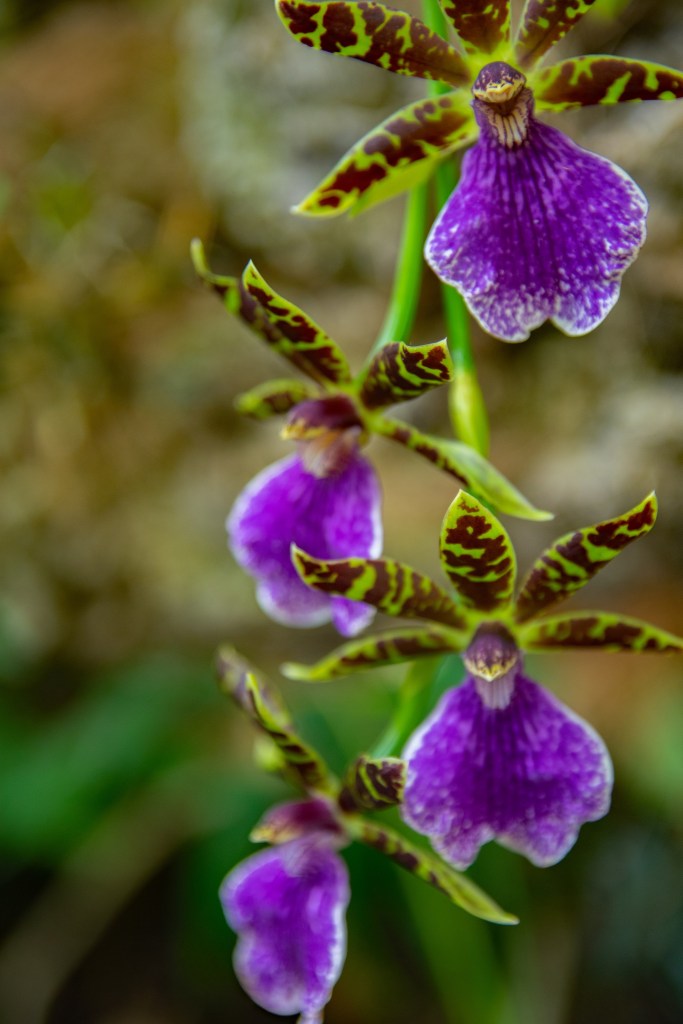
Estepona’s Orchidarium is in a beautiful setting. Inside the building, is the largest orchid collection in Europe.
The Beach
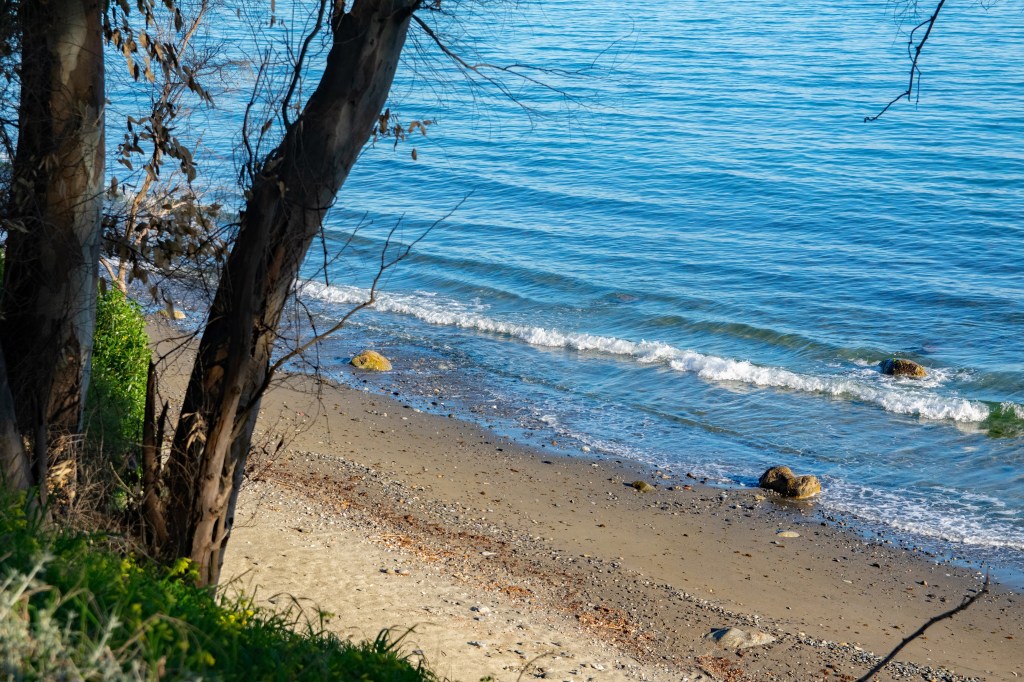
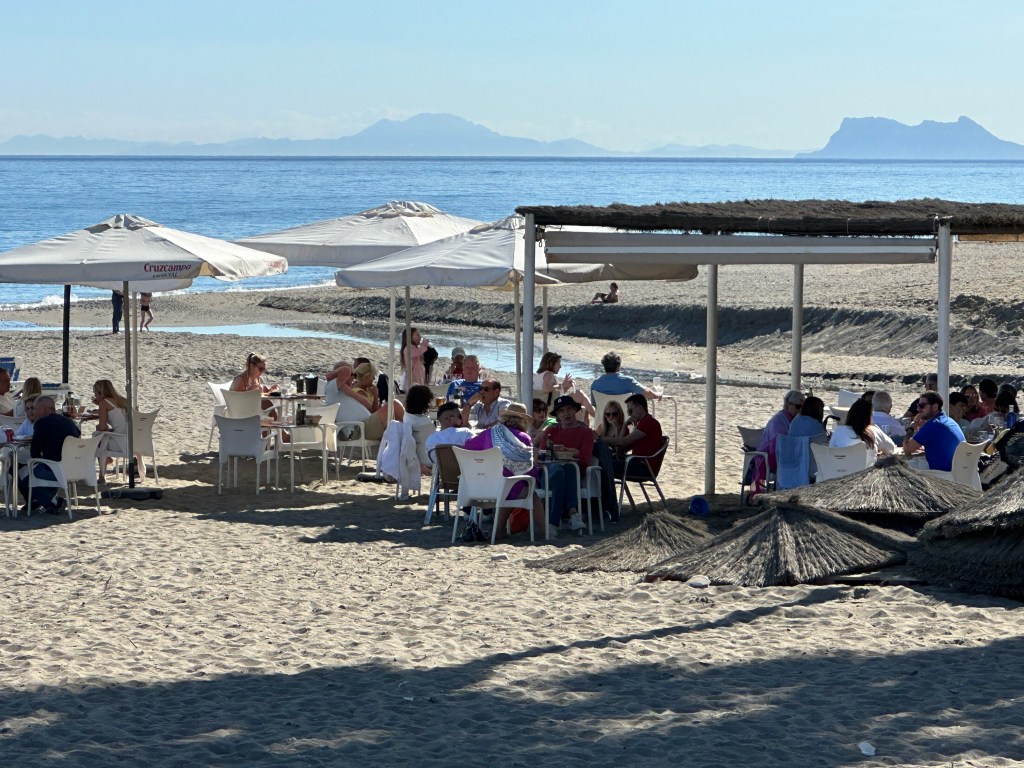
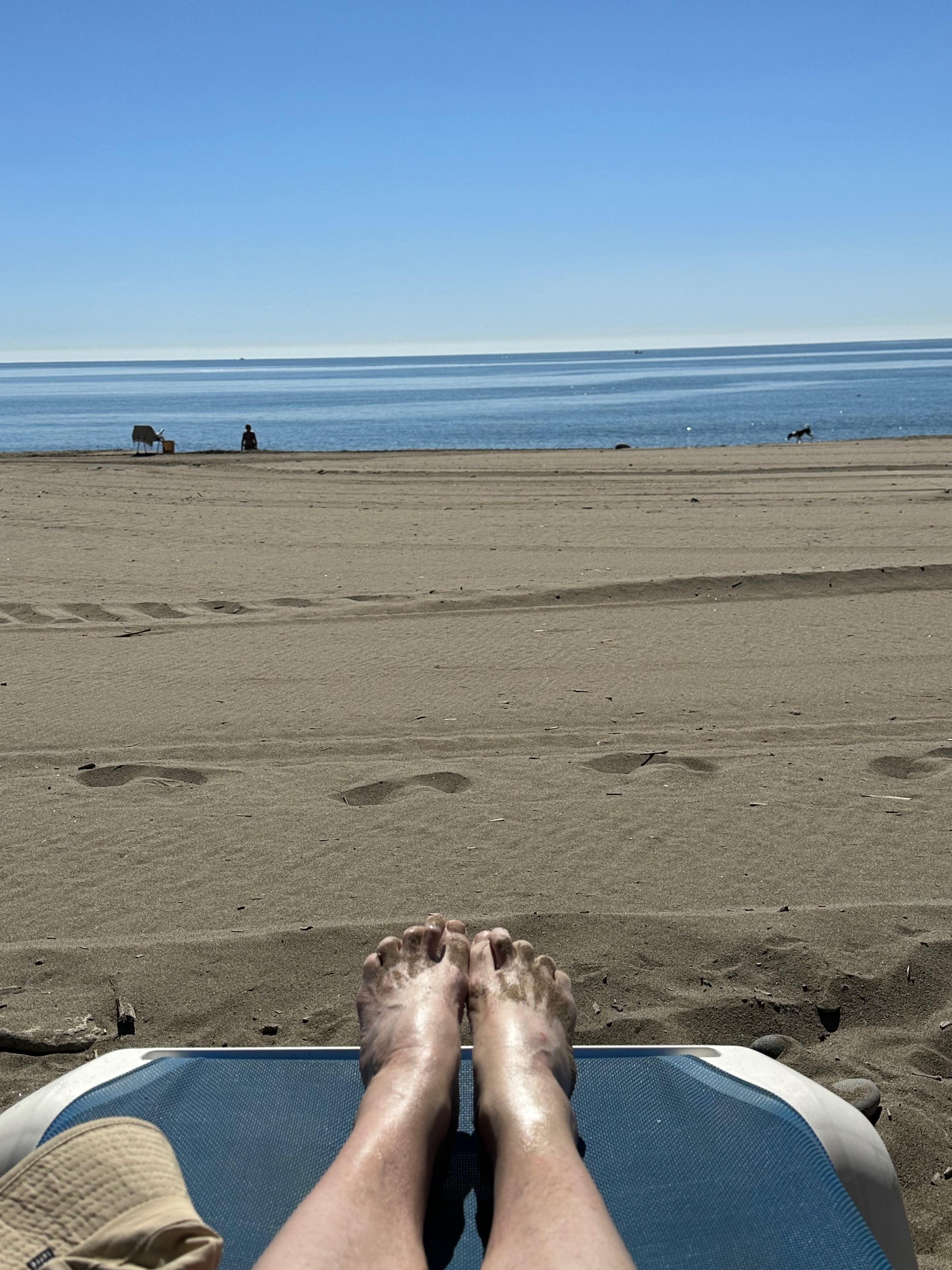
The Beaches and Beach Bar/Restaurants are open for the season. Playa La Rada is a super-long beach that is Estepona’s front porch. Whether you walk the paseo or the sand, the views are spectacular. Chiringuitos (Beach Bars) serve great food and drink. Playa La Rada ends at the fishermen’s port. A walk through the recreational port area of town will get you to Playa del Cristo, a lovely cove with a sandbar. This is a favored spot for young families and paddleboarders.
Cristo Beach
Rent a lounge chair and umbrella for 7 euros for the day. A member of the waitstaff will serve food and beverage to your spot or you can claim a beachside table for lunch.
The best part of choosing a spot and staying awhile is the opportunity to make friends. The “Estepona Gang” is a group of expats who adopted us for the month. We enjoyed hanging out with them very much and hope to be back next year!
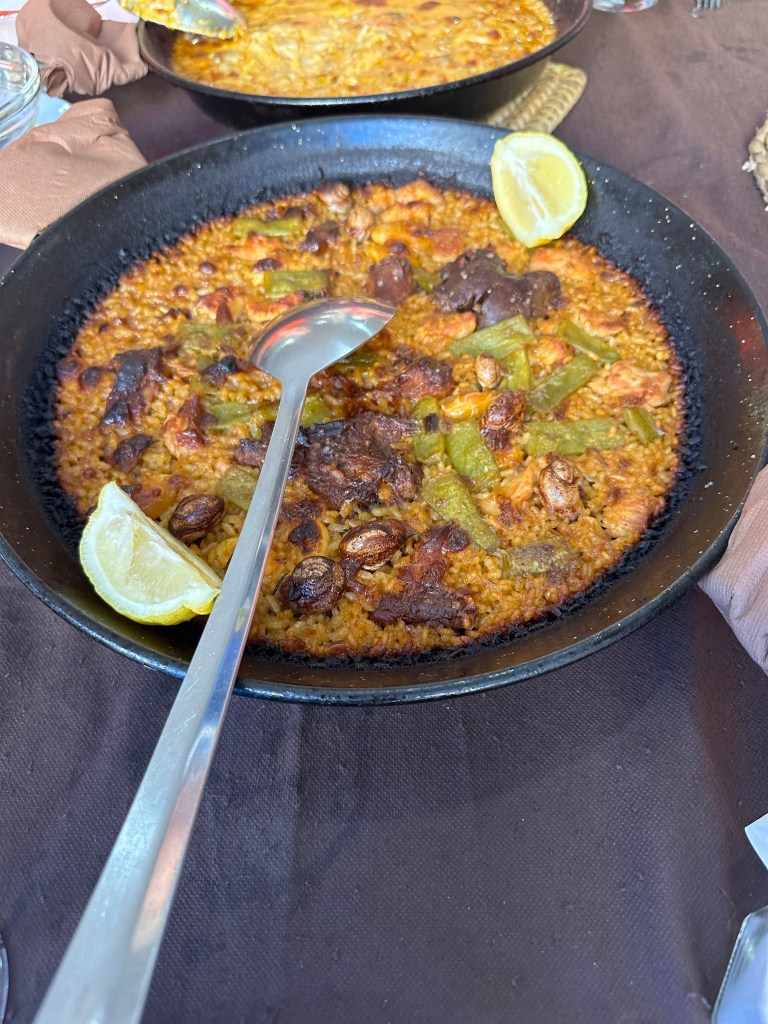
Paella ValencianaAt Arrocería HatilloFarewell Dinner at Chiringuito Paco.
We hired a private driver to take us from Fez to Chefchaouen. The price was reasonable enough to make it an attractive alternative to the bus. The road was a narrow (almost) two lane highway. The car would often have to skirt around donkeys and sheep, and when another vehicle would decide to pass us, things got a little scary. Our driver was friendly and pleasant. We stopped for lunch at a “roadside resort”.
(Double click on photos for larger view)
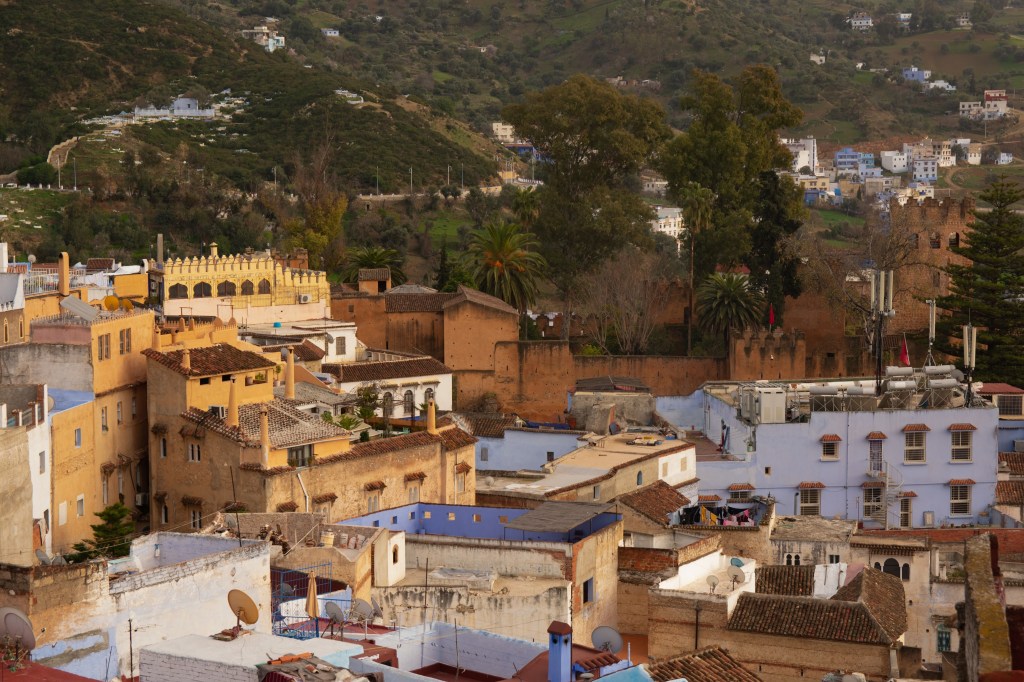
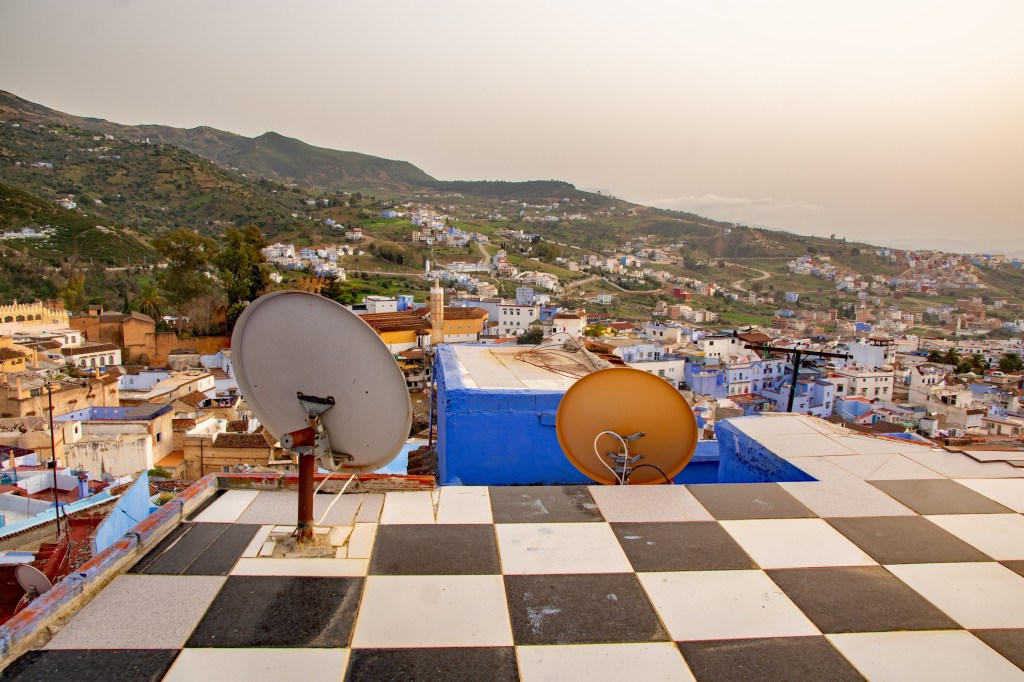
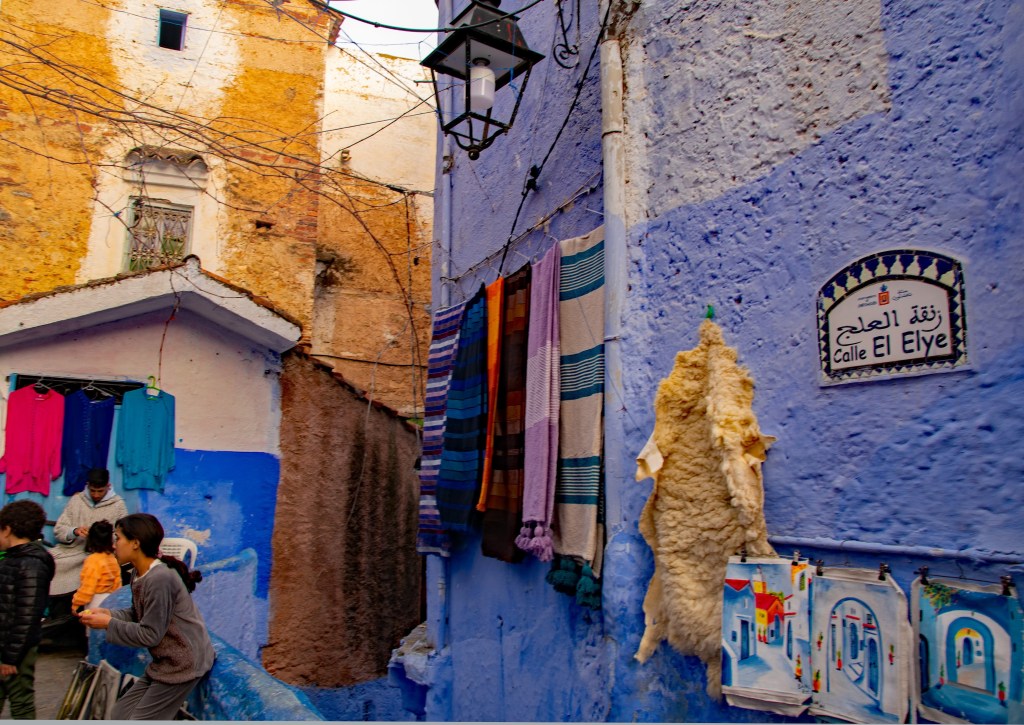
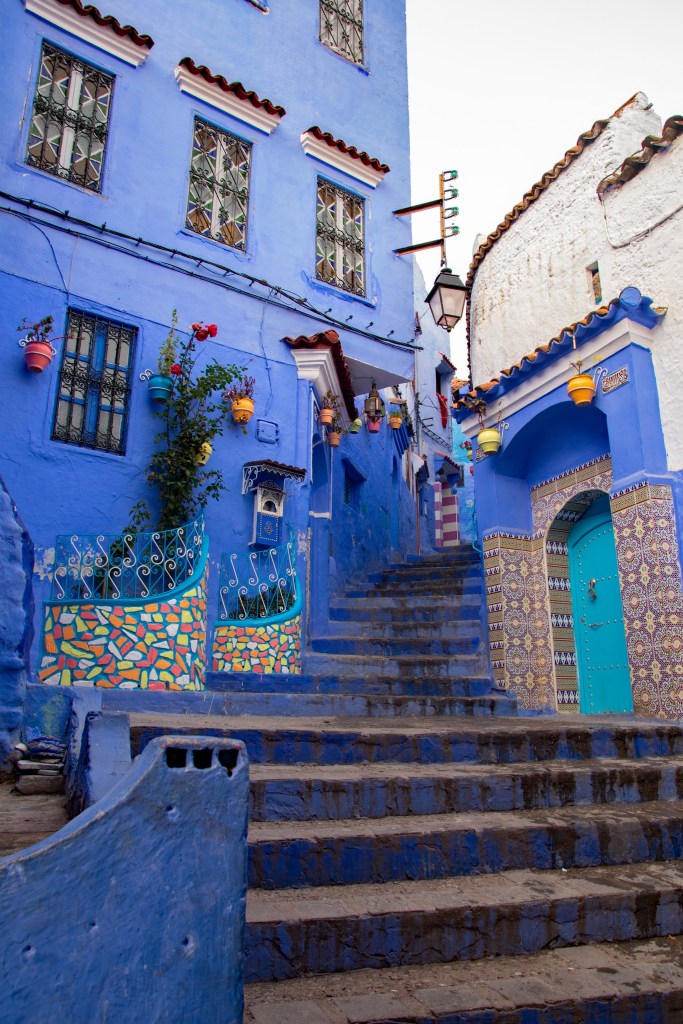
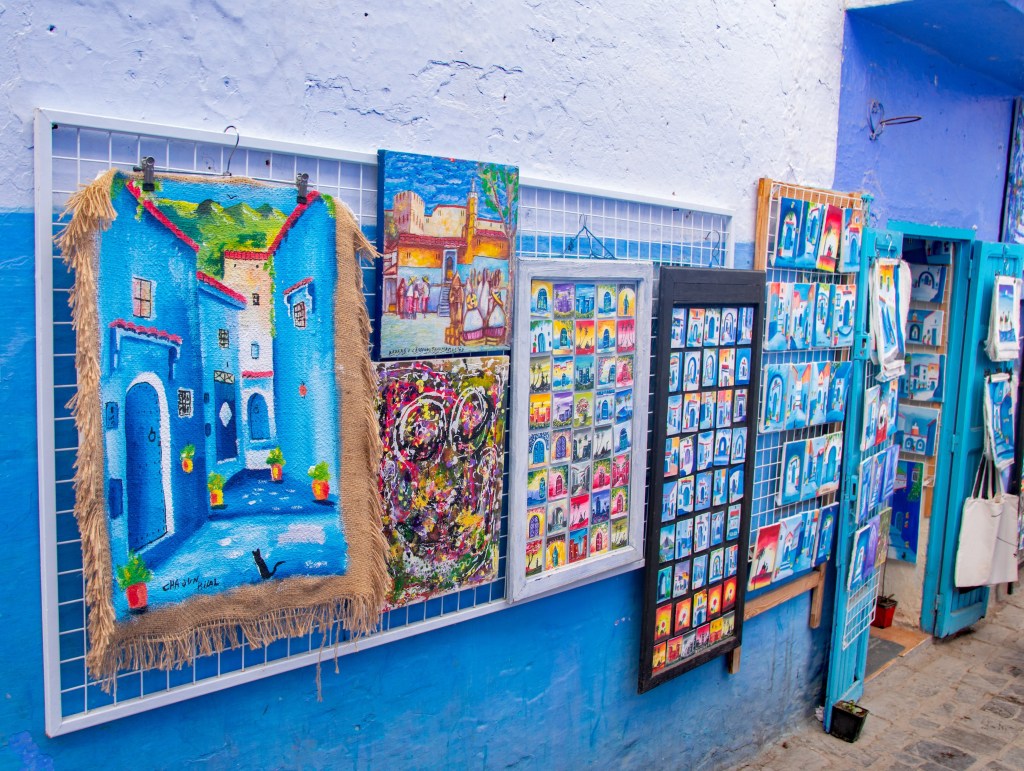
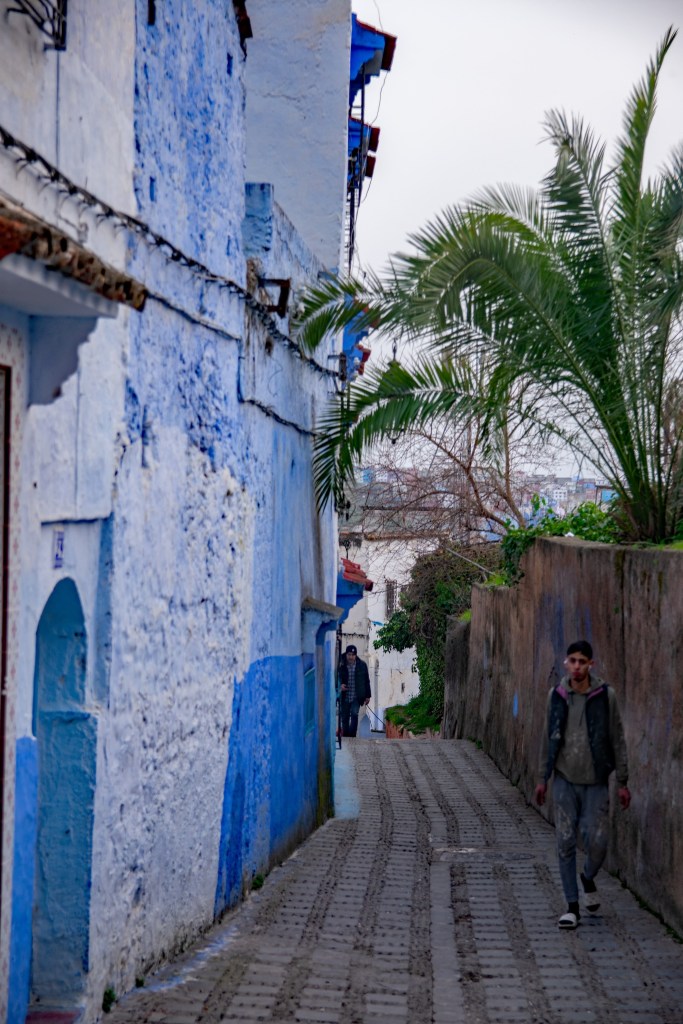
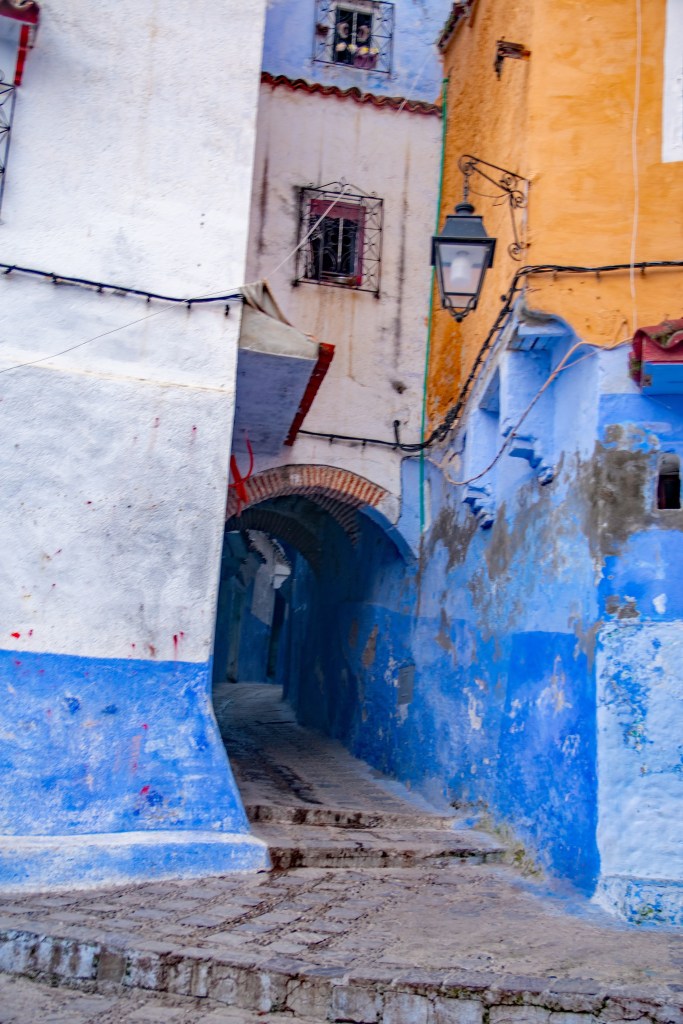
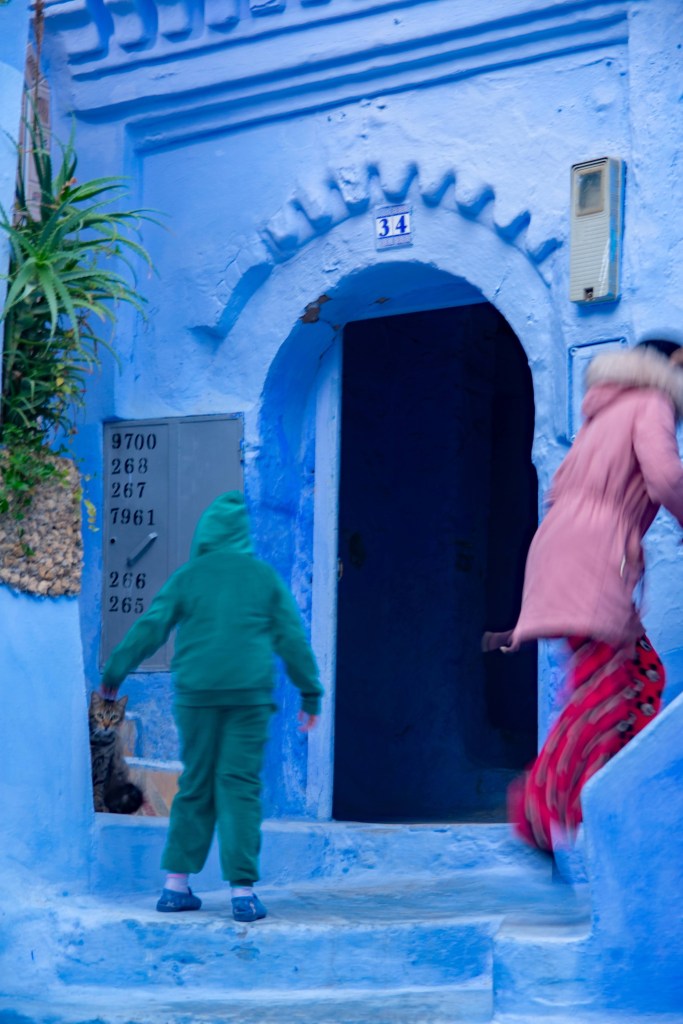
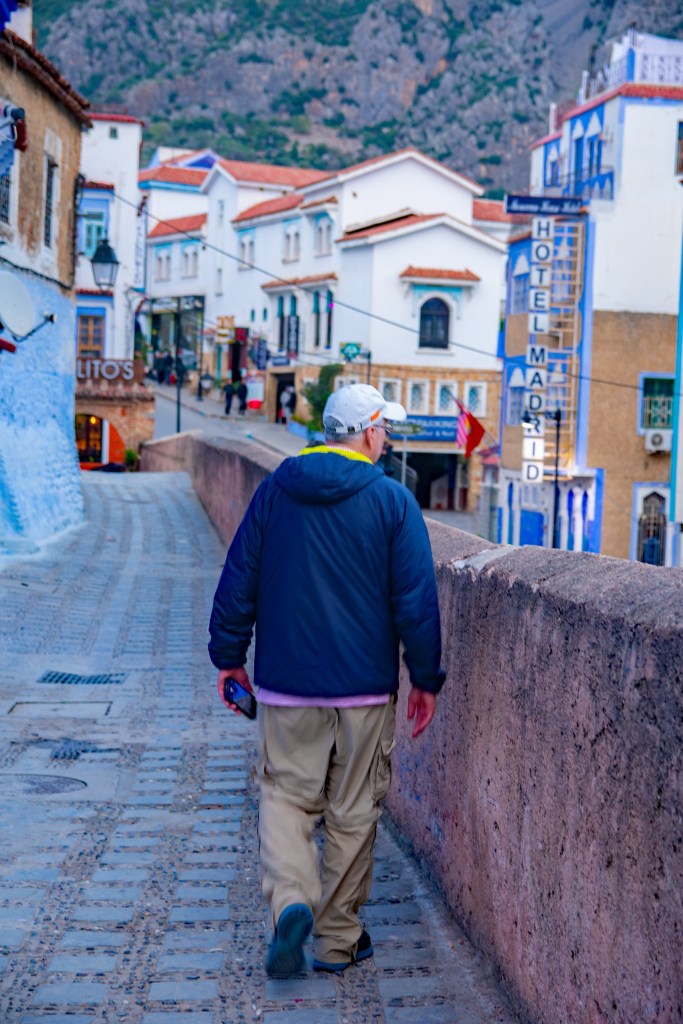
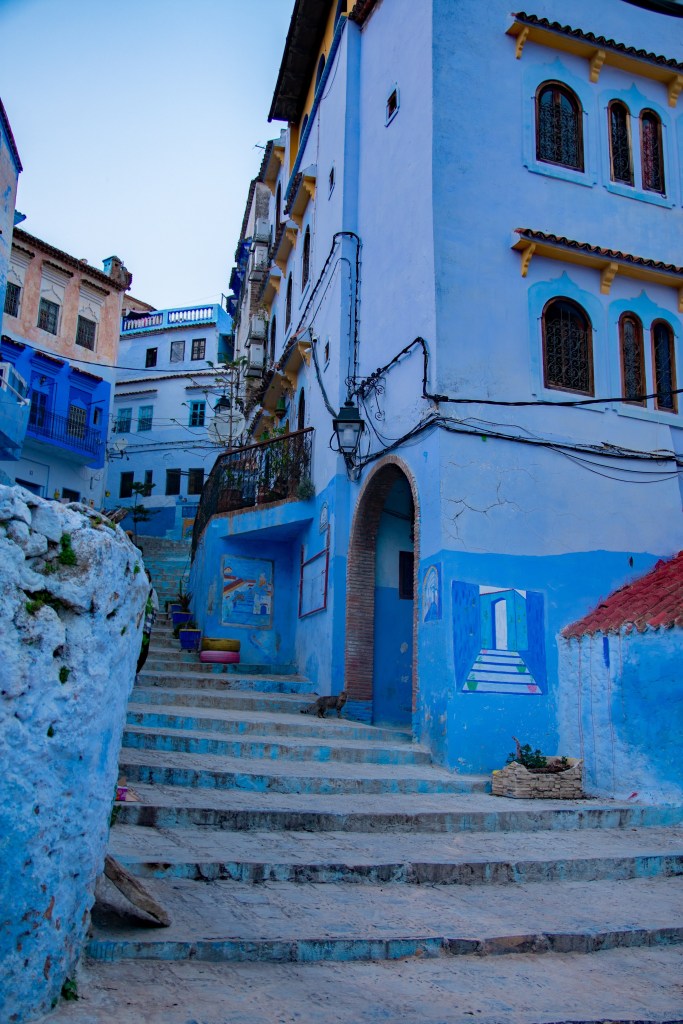
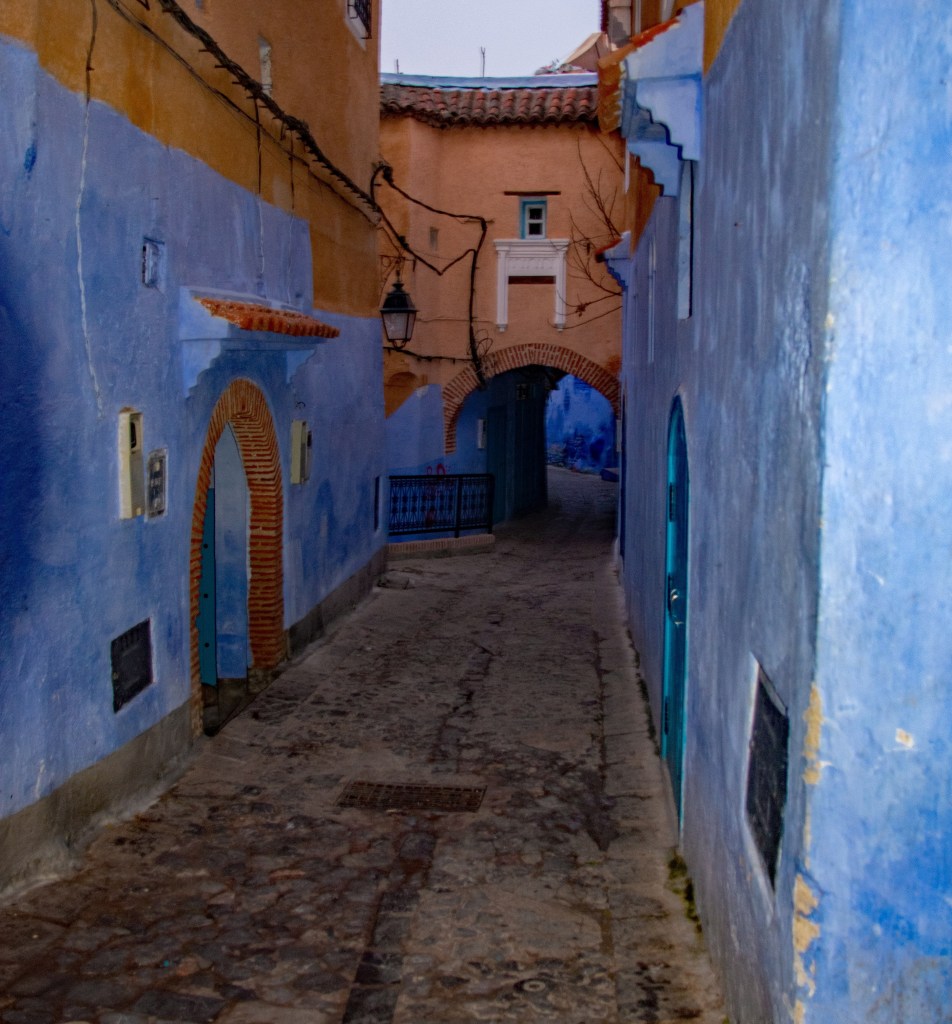
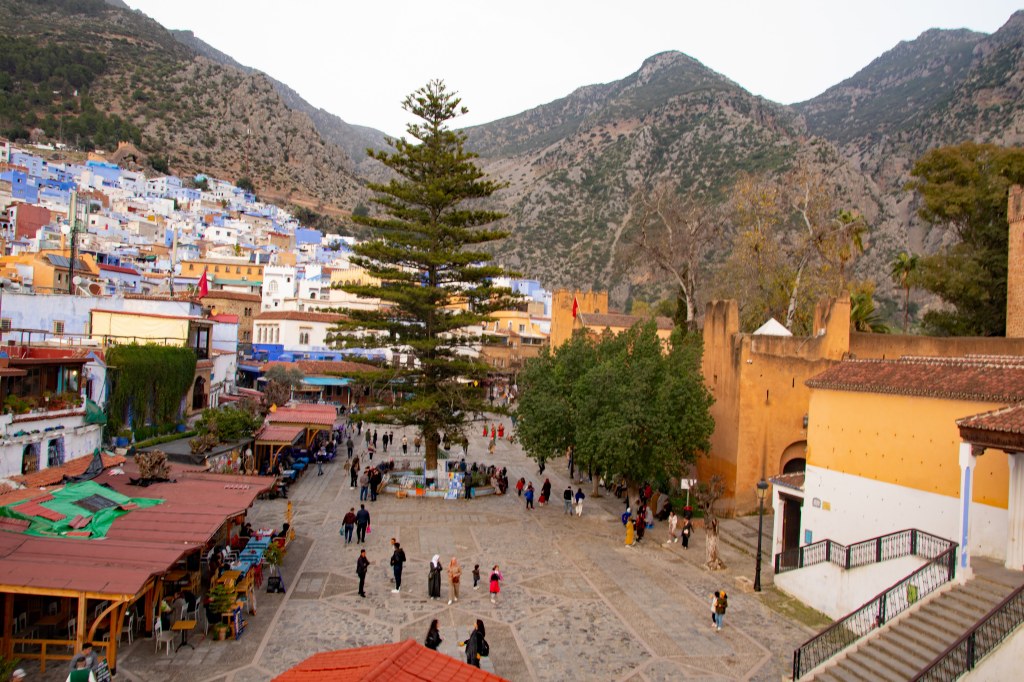
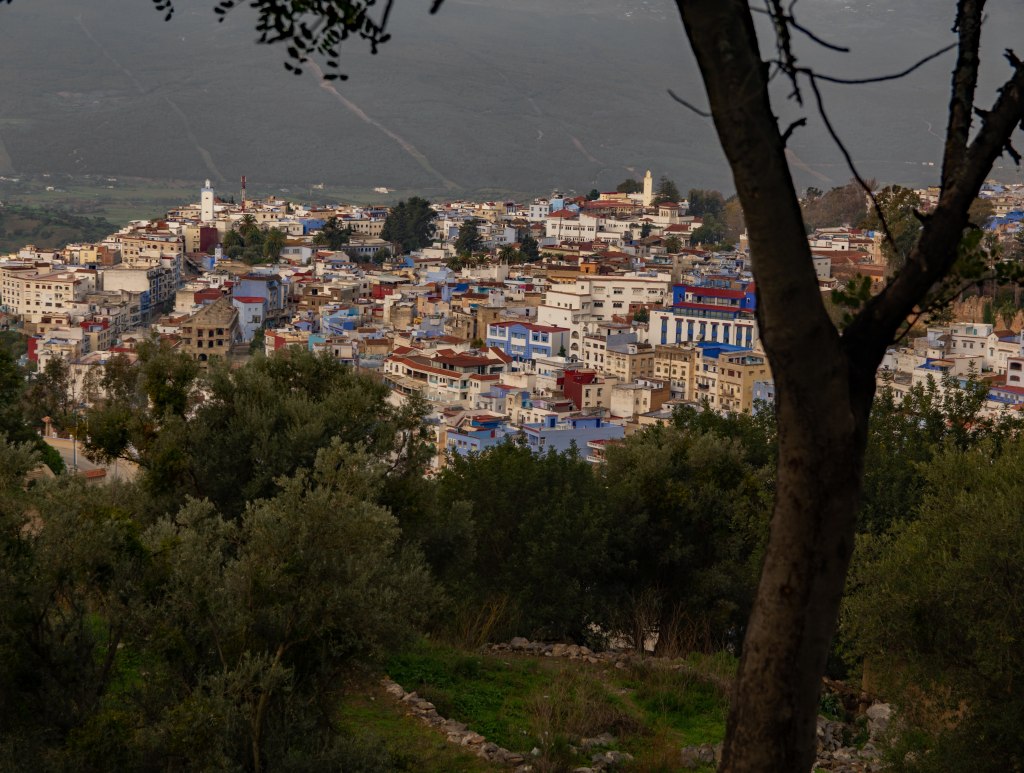
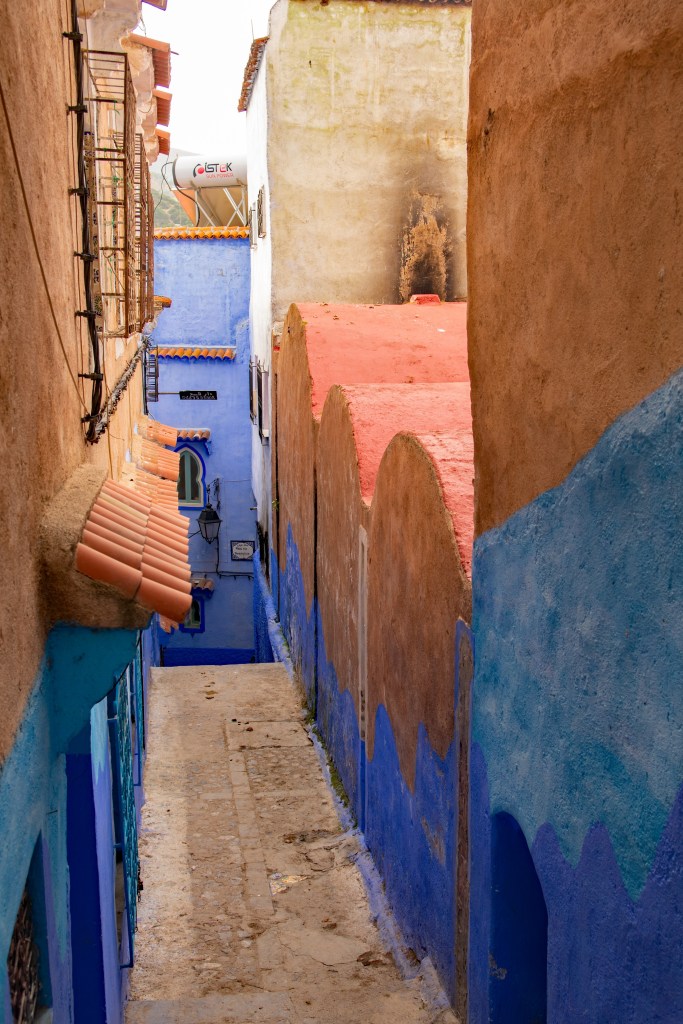
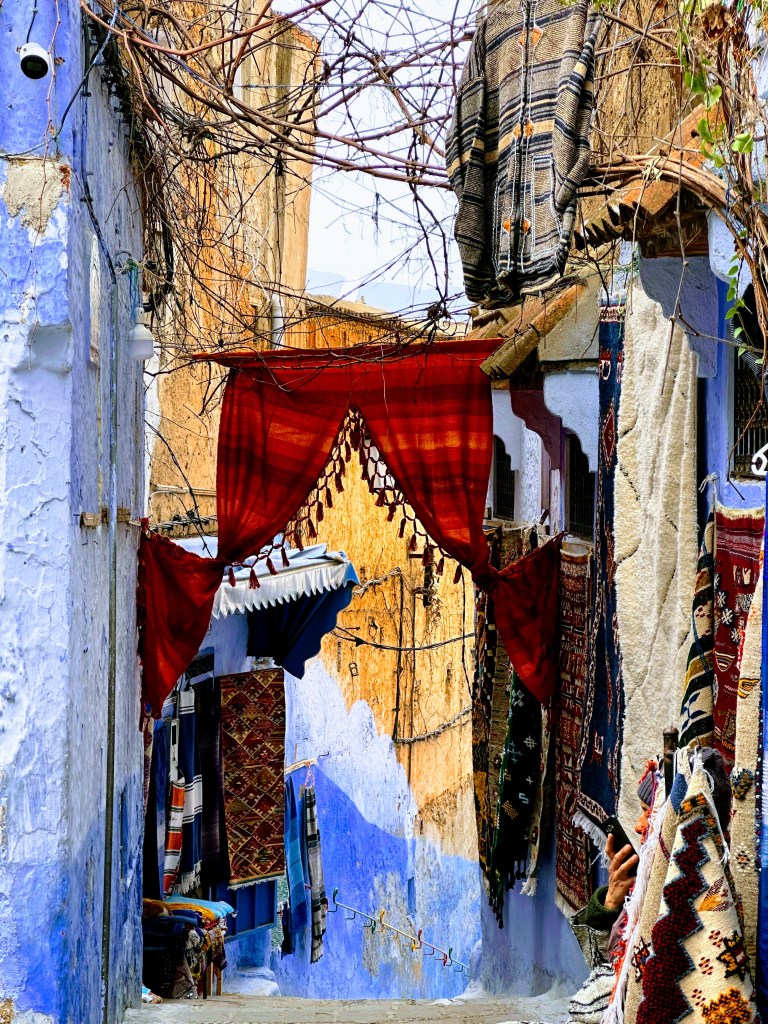
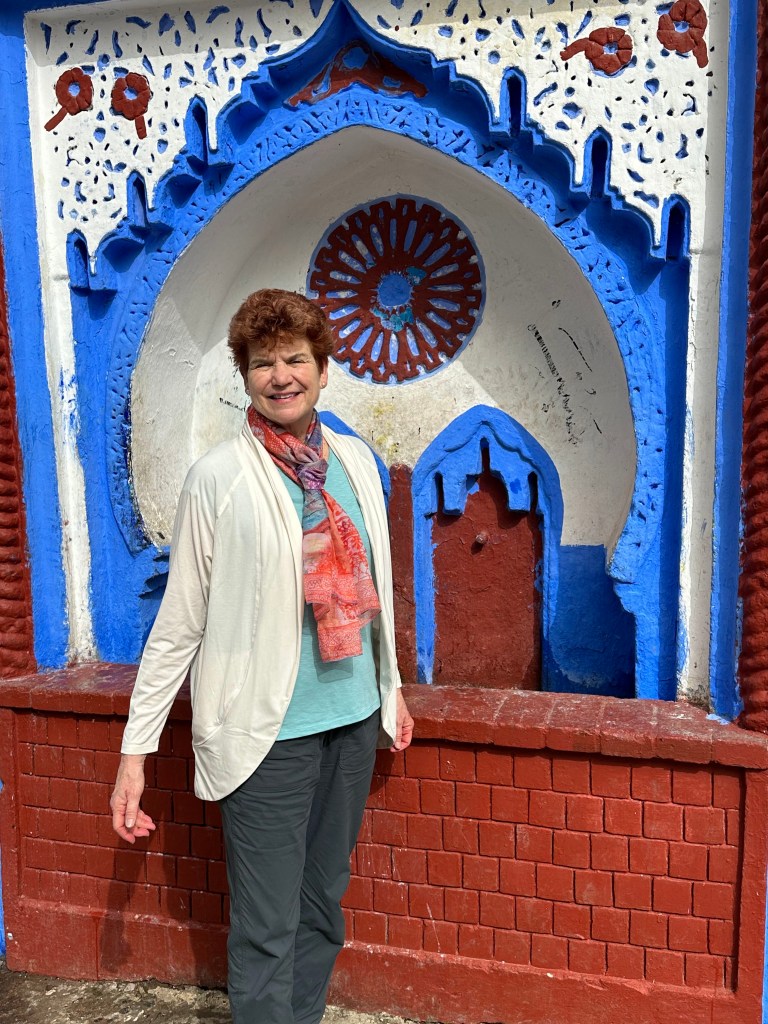
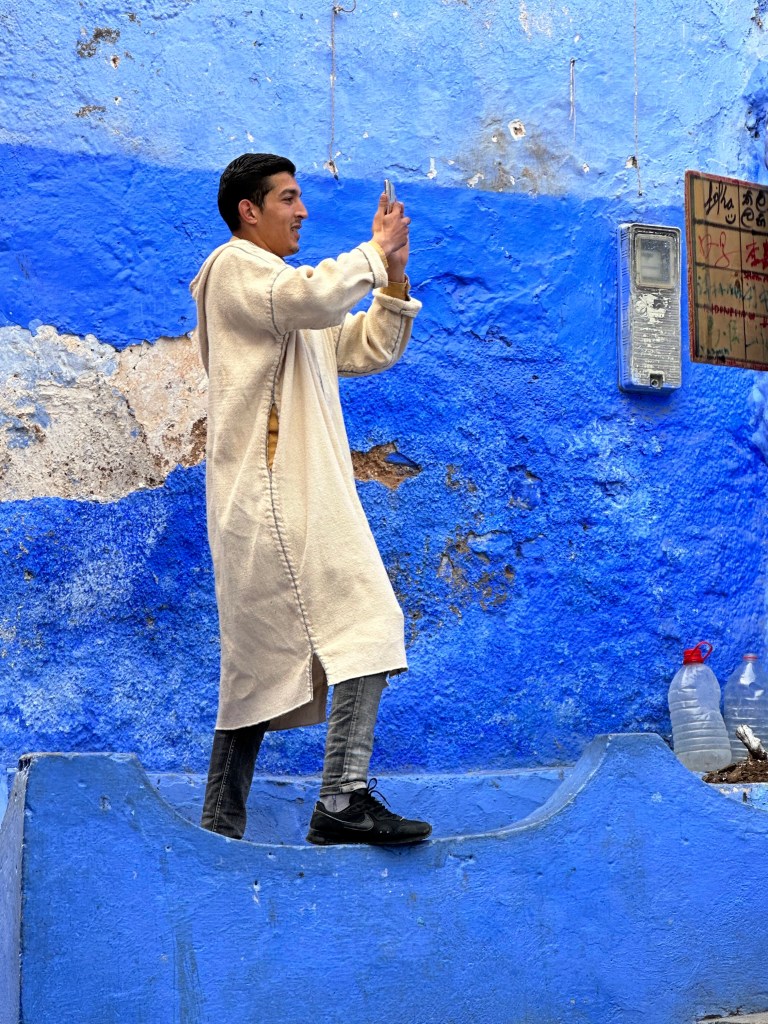
View of ChefchaouenView from our terraceRooftopsOur StreetRooftop View of the Square
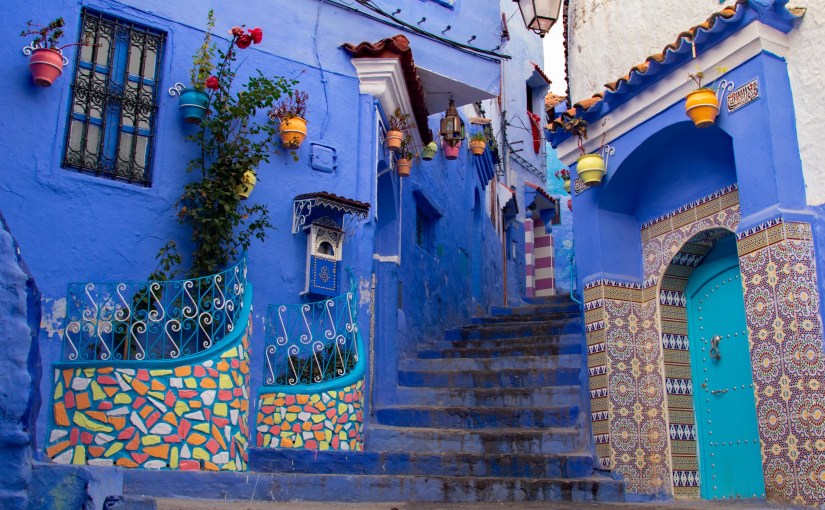
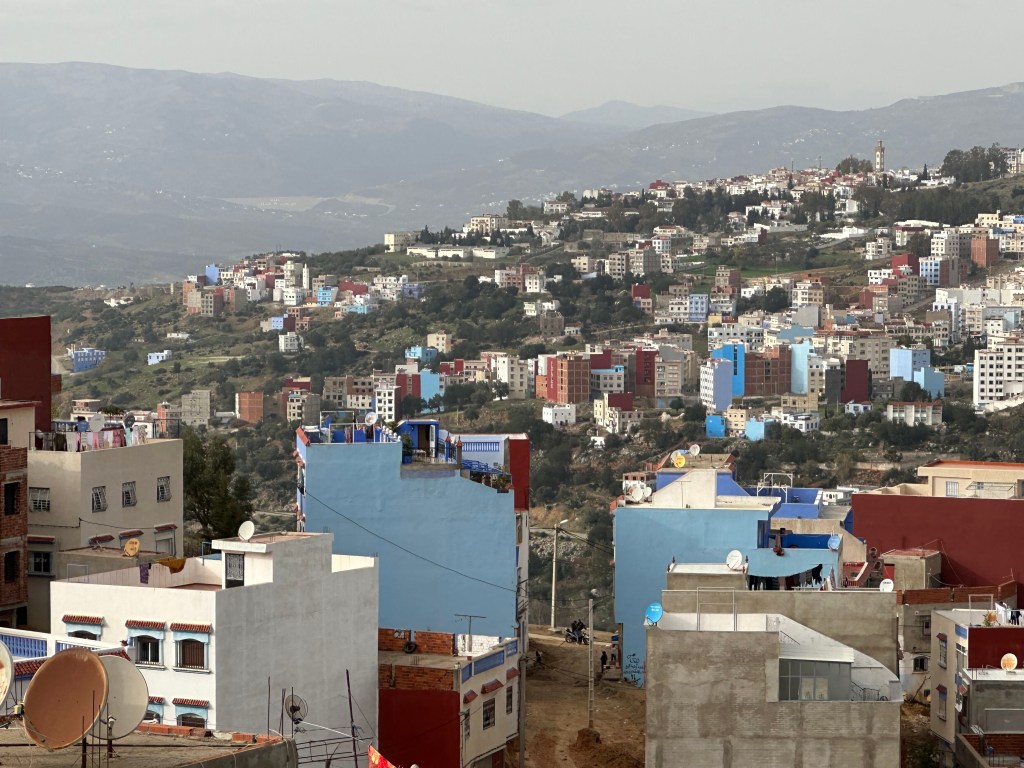
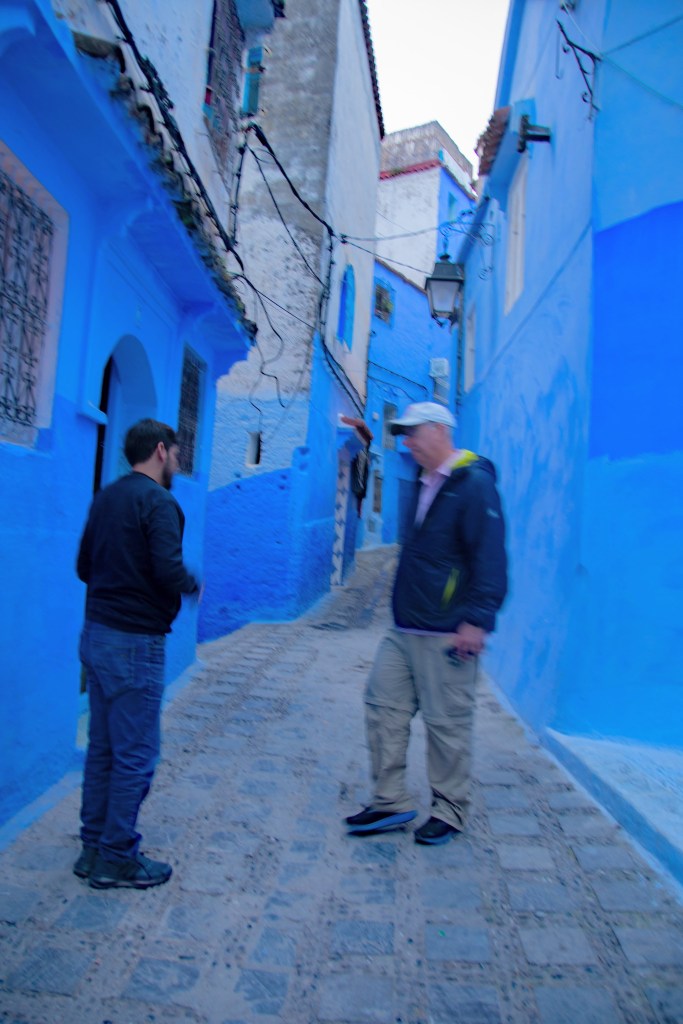
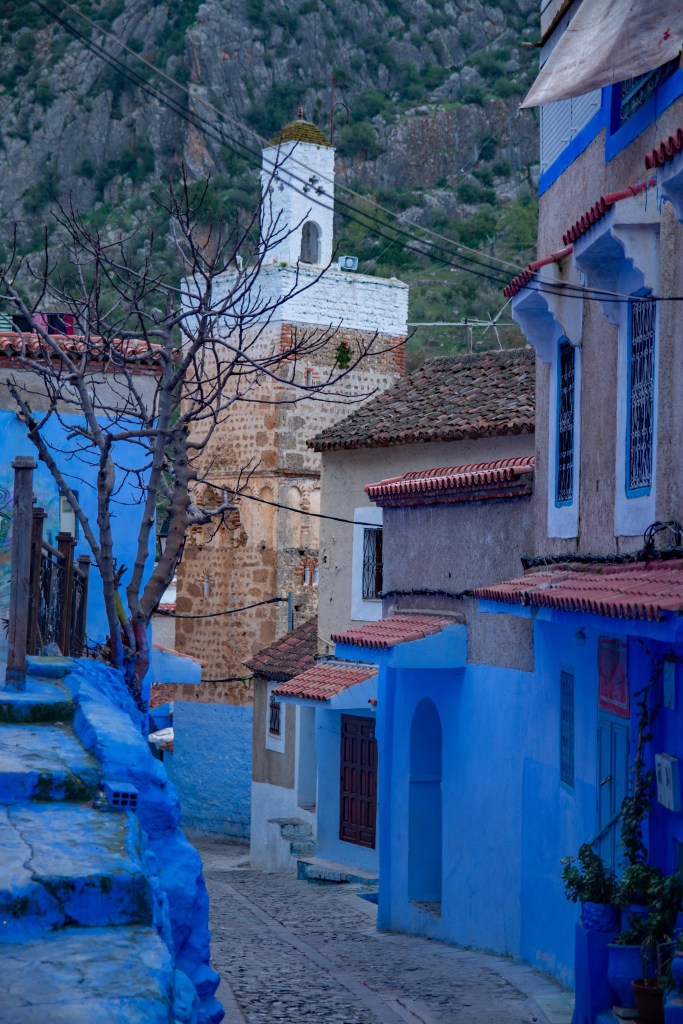
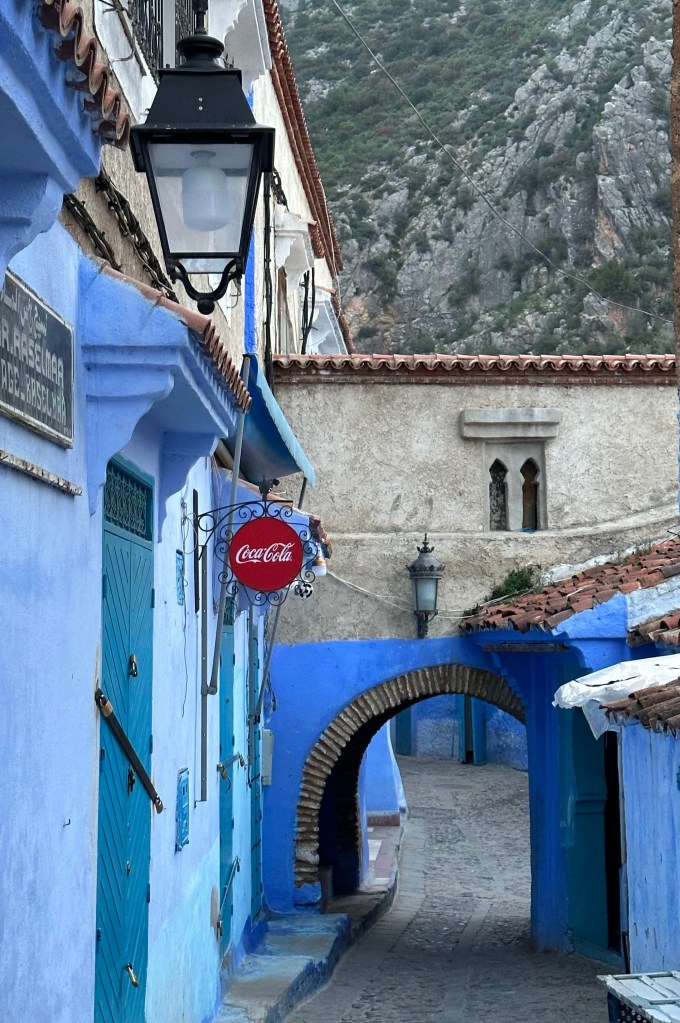
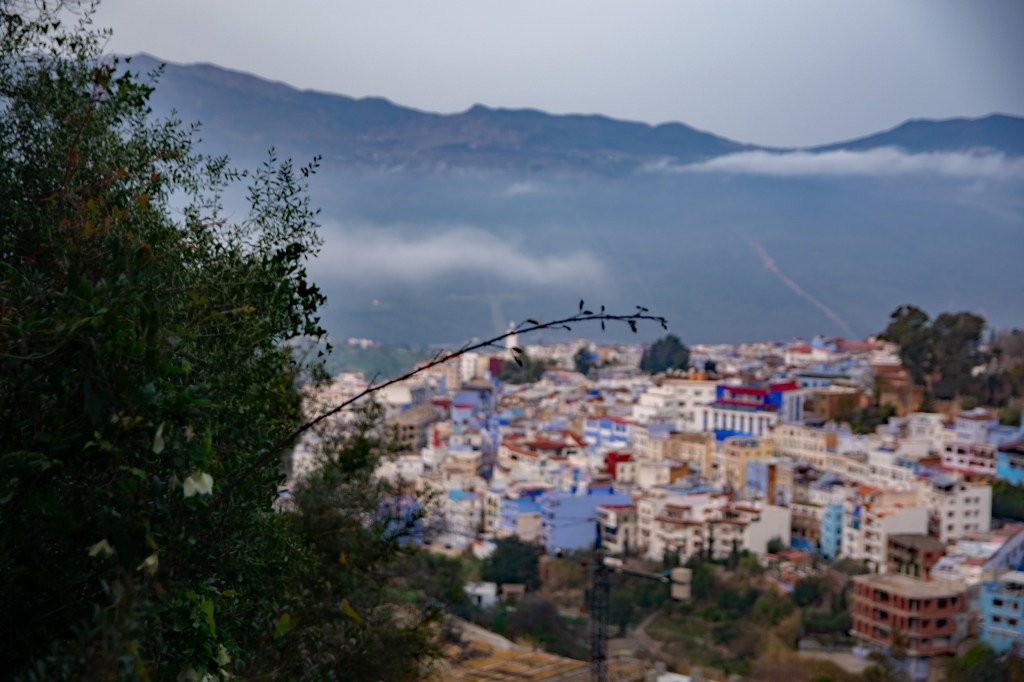
Chefchaouen is known as Morocco’s Blue City, and from the photos you can see why. The reason for the blue is less clear. The village was built in the 1400’s and turned blue in the 1900’s. Theories abound; the favorite being that Jewish immigrants who migrated there at the start of World War II painted their homes blue to represent the sky. Chefchaouen is a charming small city nestled in the Rif Mountains. It is an attraction for hikers, photographers, and artists. Rumor has it that some visitors come for the cannabis grown in the surrounding region. Bill was approached by a local resident about making a purchase, but he declined. Moroccan law has legalized cultivation, but not recreational use. Buyer beware.
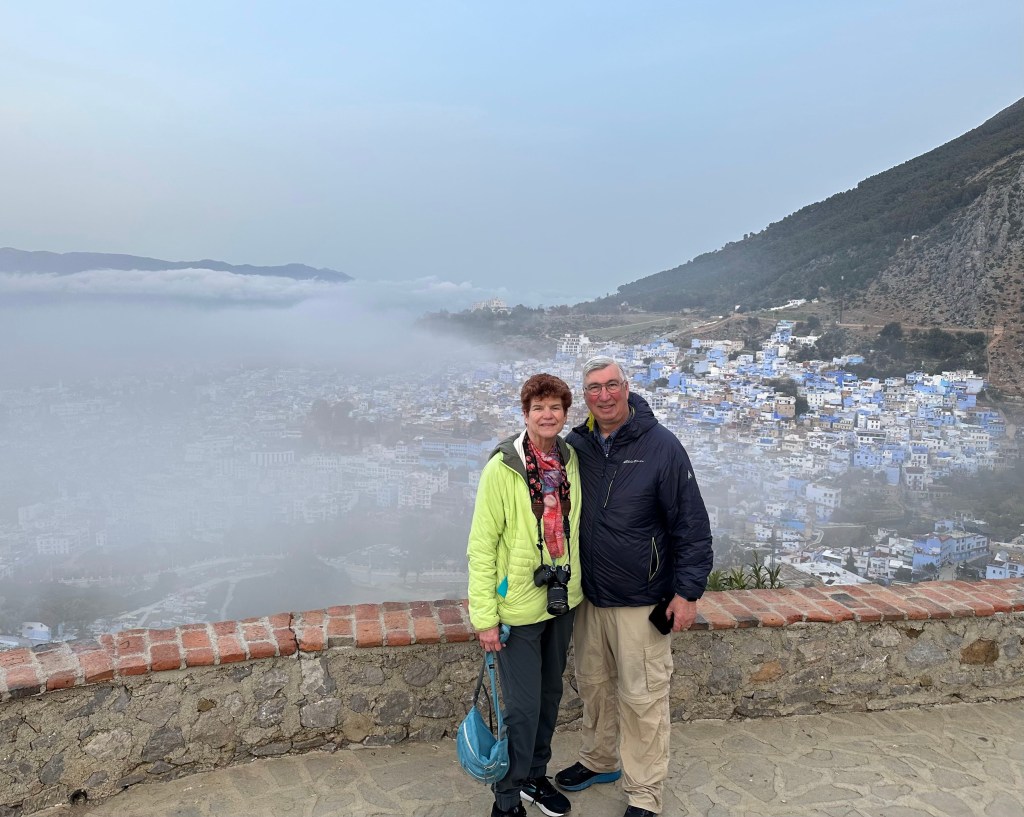
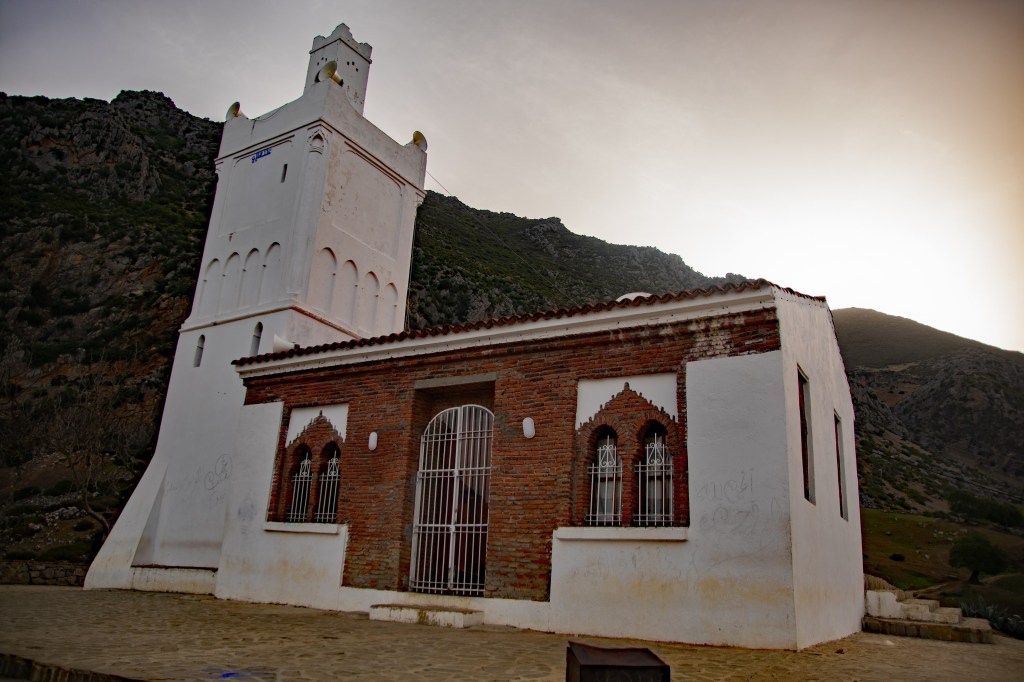
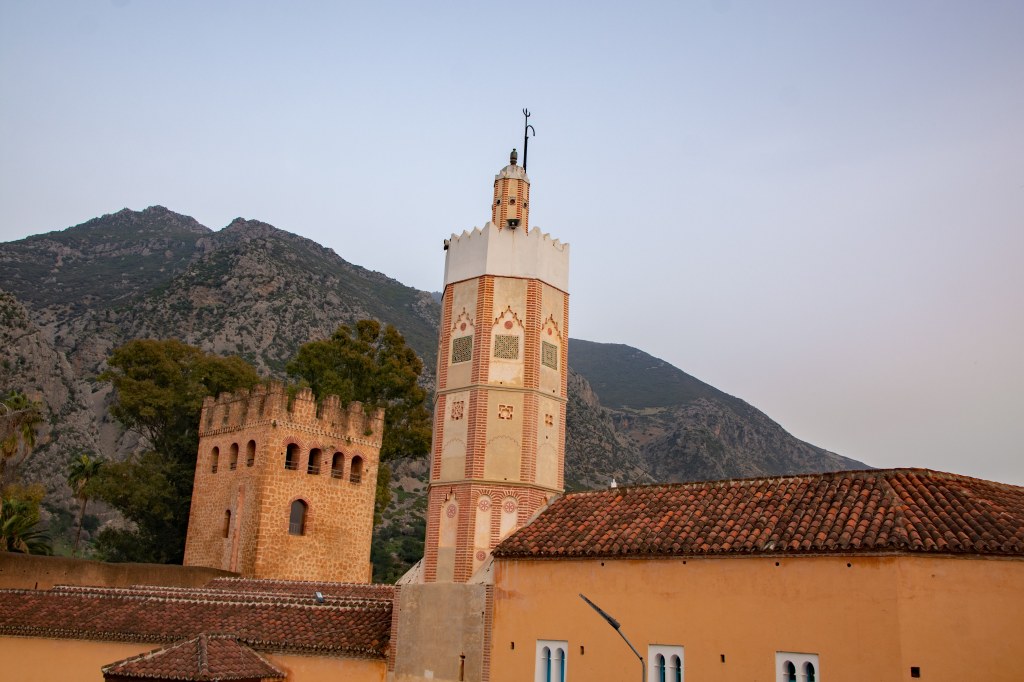
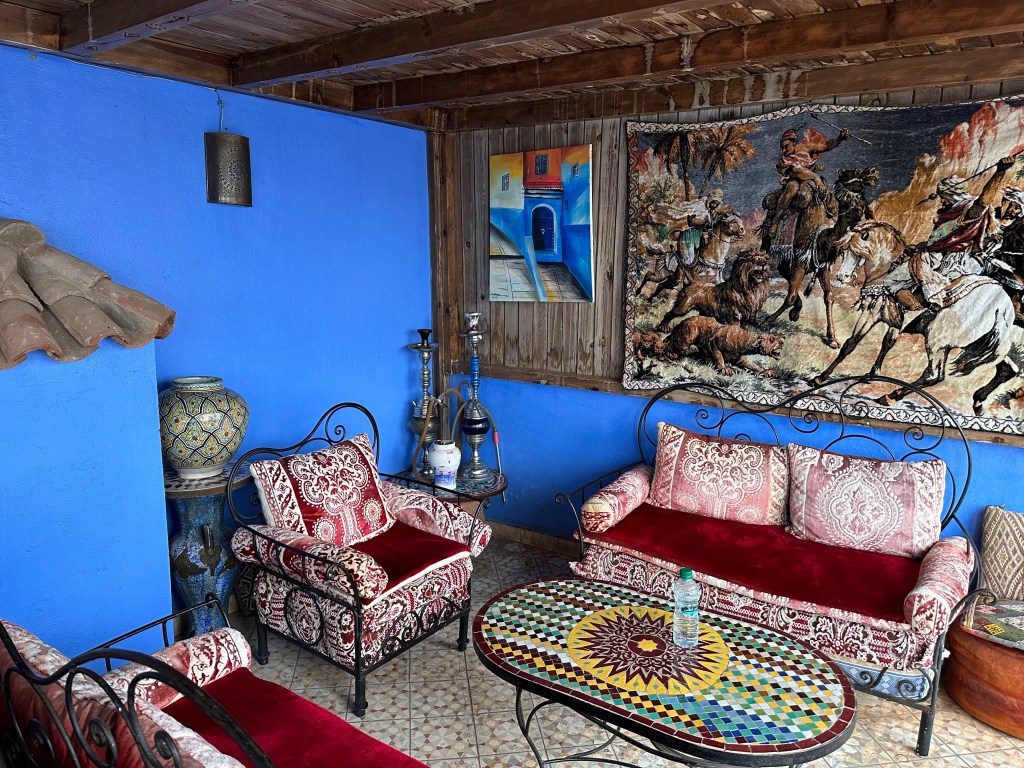
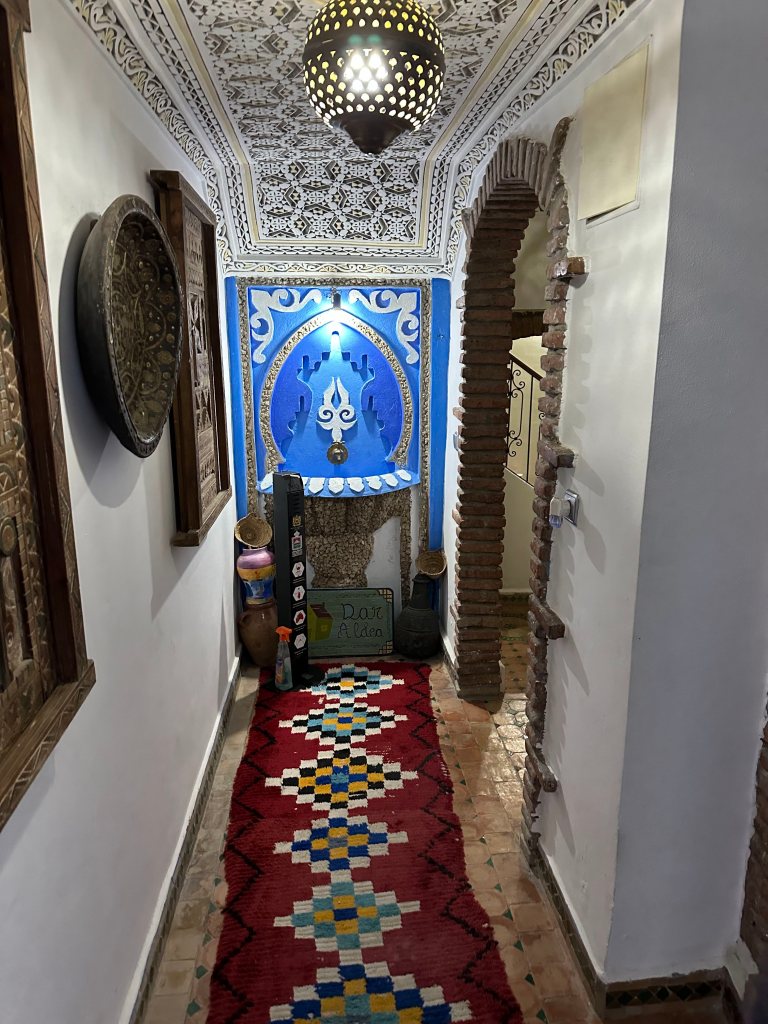
We stayed two nights at Dar Aldea, a bed and breakfast. Our daughter Christine had stayed there in 2019. The couple who run it, Ahmad and Assami, took good care of her, and she recommended it to us. On the day we arrived, Ahmad took us for a long walk around town and joined us for dinner at a local restaurant. When I told him I wanted to take photos in the morning light, he volunteered to take us up the hill to the Spanish Mosque the next morning for the sunrise. The fog was so thick in the morning that we couldn’t see much of anything. But as promised, the mist lifted. The sun really didn’t make much of an appearance, but the views were great anyway.
Ahmad and BillMorning FogThe Cemetery- Another UNESCO projectThe KasbahThe Spanish Mosque
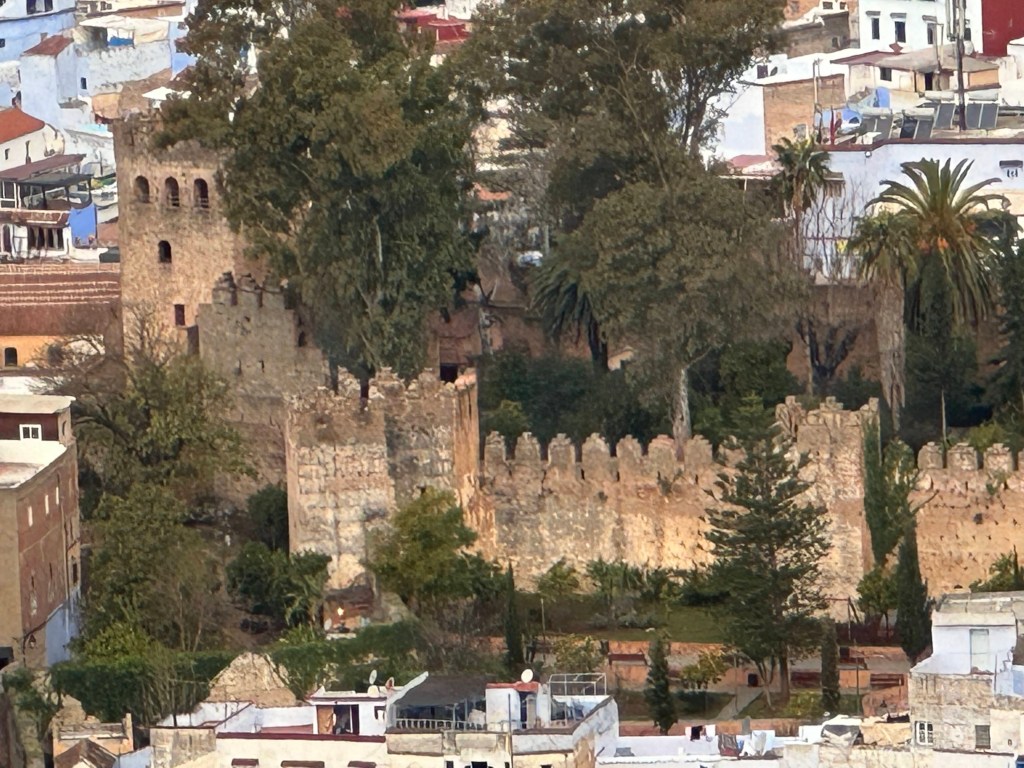
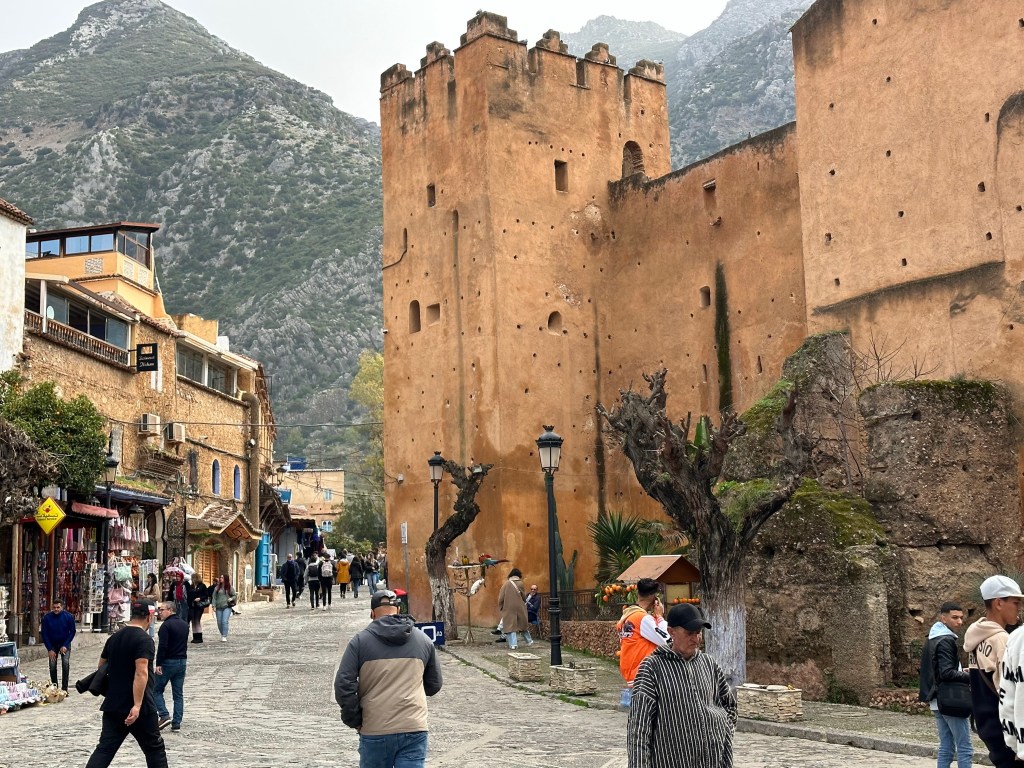
Chefchaouen’s big square Outa El Hammam is next to the Kasbah (fortress) and the city walls. We enjoyed a visit to the the 15th century structure and its museum and gardens. Once again, I was reminded of the shared Andalusian culture of Southern Spain and Northern Morocco. During the reign of the Catholic Kings and the Inquisition in Spain in the 1500’s, there was a large migration of Spanish Jews and Muslims to Morocco. The Sephardic Jews continued to speak 15th century “old” Spanish for several more centuries. From the 1920’s until 1956, the Spanish occupied Chefchaouen, and Spanish is widely spoken there today.
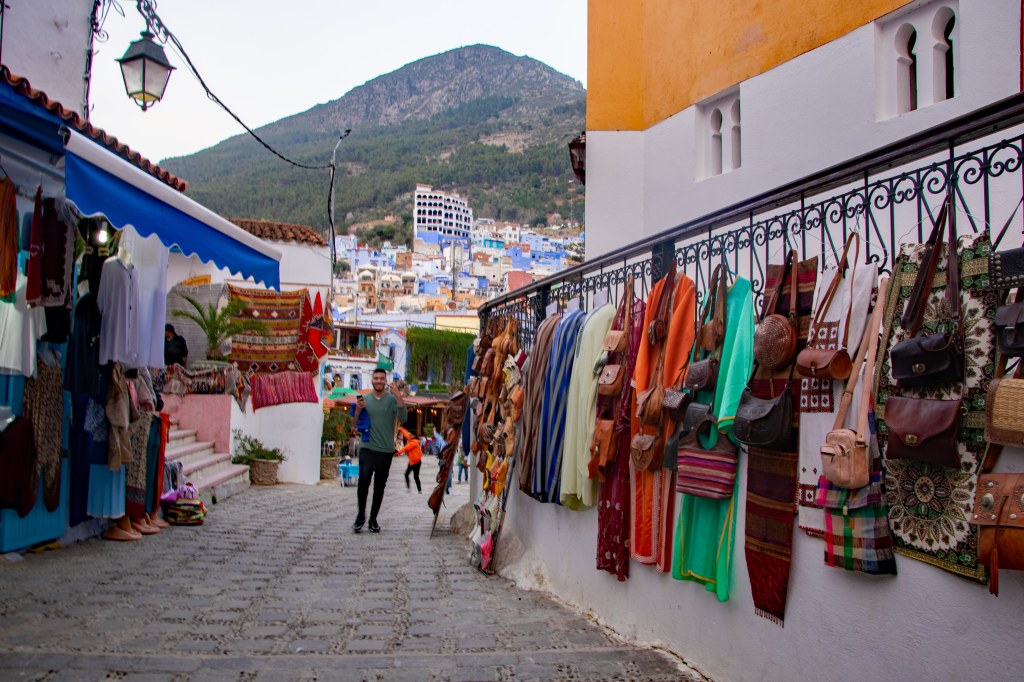
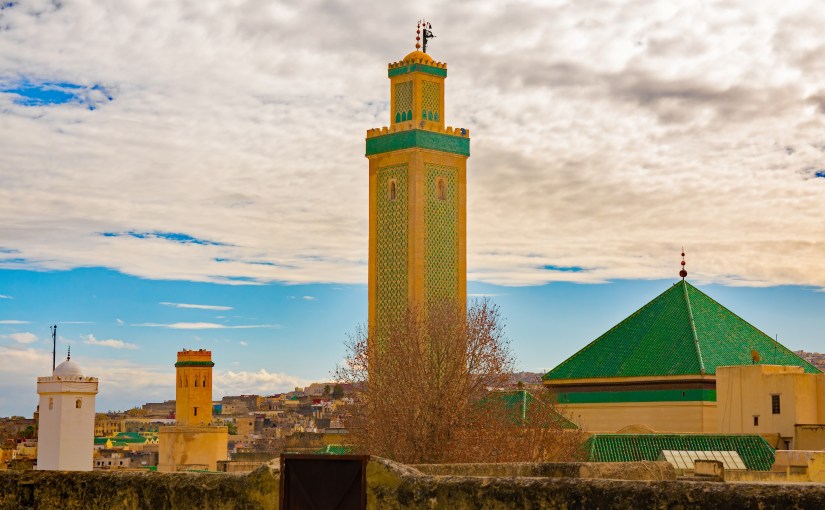
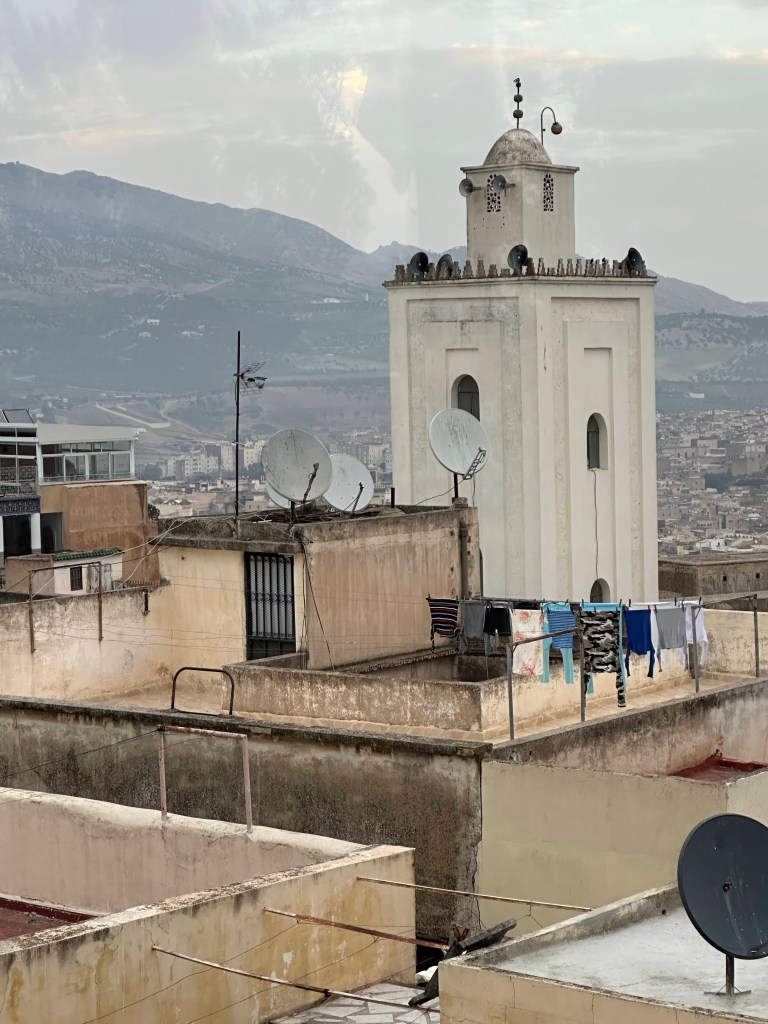
Outa El Hammam is also the location of Chefchaoun’s main mosque. Non-Muslims may not go inside. The main square is bordered by shops and small restaurants. This is also where for 10 dirhams, you can hold a parrot, or jam to some native music. The vibe here is much more laid back than in Marrakech or Fez.( Perhaps due to the cannabis) The vendors are low key and souvenir prices are considerably cheaper.
By staying in a private home, we were a witness to family life. We met Ahmad and Assami’s son and daughter and were able to converse with them about school and sports. Of course, they speak excellent English. Assami cooked us a wonderful breakfast each morning and we ate in the family’s living room. They arranged a ride to the ferry out of Tangier-Med on the day we left.
Tangier-Med is a very large and relatively new port and terminal. We were able to purchase our tickets to Algeciras and exchange our leftover Moroccan currency at the same counter. We boarded the ferry for the one and a half hour crossing. Unfortunately, departure was delayed by three hours. Fortunately, food was available and I had a good book. We were able to get a bus back to Málaga from Algeciras; arriving home to Málaga much later than expected, but happy to be there.
Main SquareMain Mosque and KasbahChefchaouen at DawnBehind the Hammam
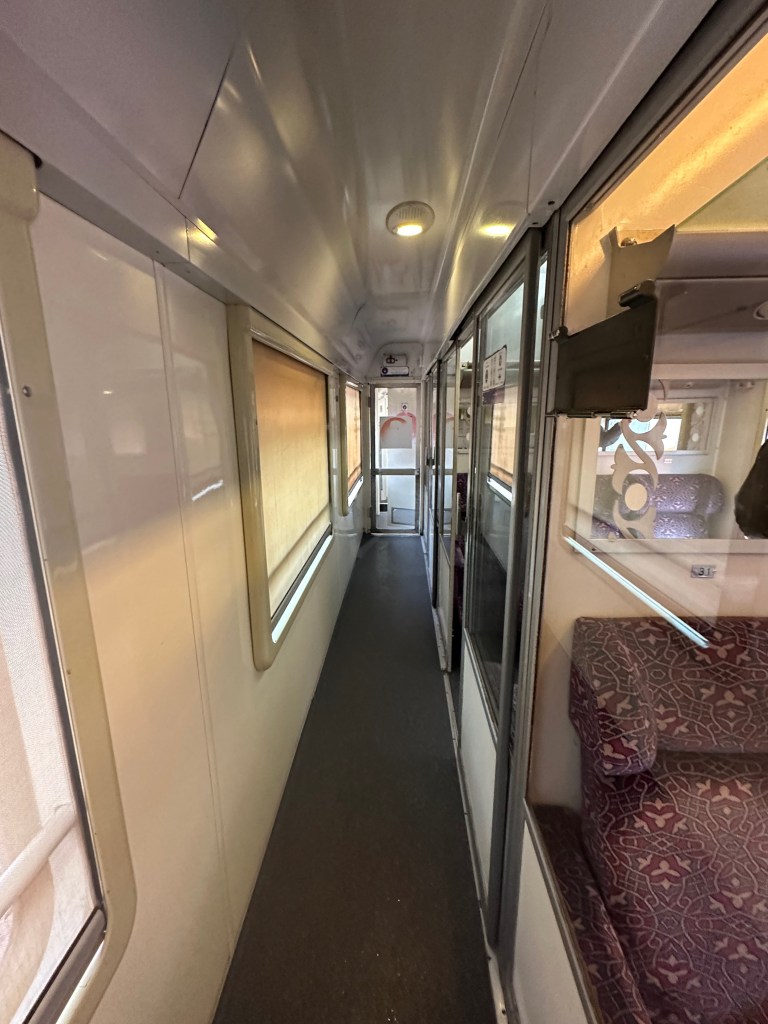
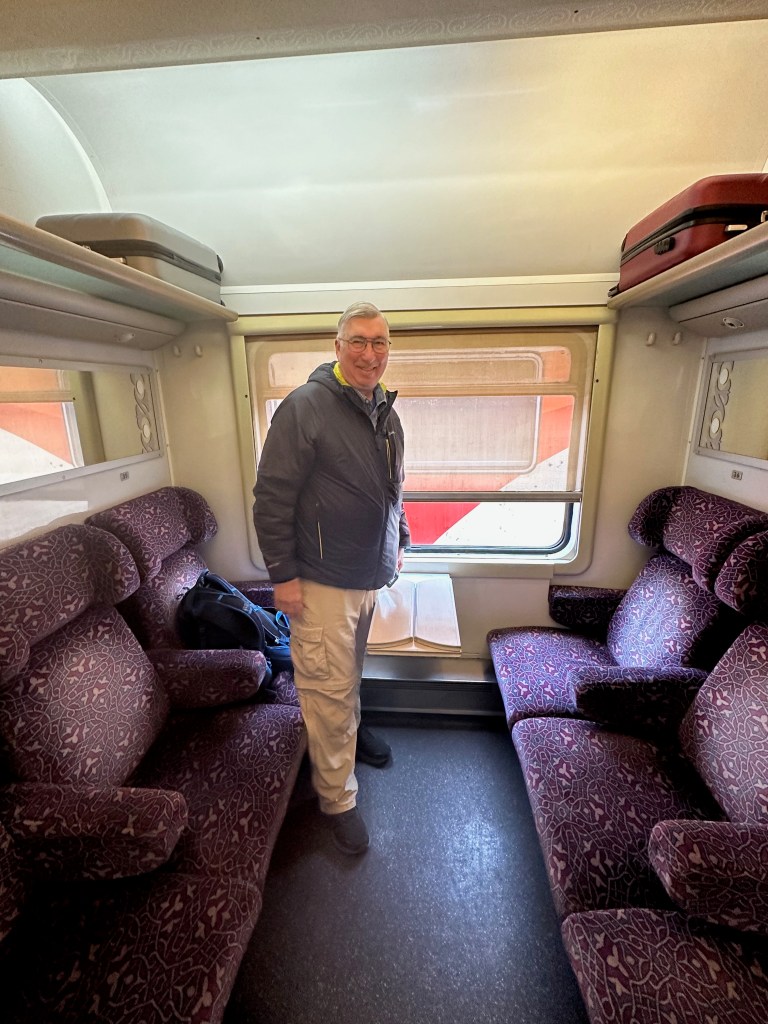
The Marrakech Express made famous in the song by Crosby, Stills, and Nash is an overnight train from Tangier to Marrakech and is still in operation to this day. We took a six-hour day train from Marrakech to Fez. The compartment accommodated six passengers facing each other with luggage racks above. We paid extra for first class, so the seats were pretty comfy, but there was not much else in the way of amenities. A kid with a snack cart came by a couple of times. The scenery was very pleasant; much of it agricultural. As we got closer to Fez, there were rolling green hills that reminded us of Wisconsin. In fact, there were dairy cows, along with sheep, horses, and donkeys.
Our compartment mates were a young Egyptian couple and a young Moroccan man. All of them spoke English, were highly educated and well-traveled. The Egyptian couple had a lot of luggage. The woman was planning on doing a lot of shopping; specifically, in leather goods.
Mohammed, the Moroccan, told us he works for the Cultural Bureau and had been in Casablanca for work. He was an amiable conversationalist, and at one point asked us if we had a tour guide arranged for our stay in Fez. We said we were reviewing our options.
He suggested that we meet his colleague Adam, born in Fez and later adopted by an Australian couple. Adam was in town from Australia for another day. If we were interested in meeting him, Mohammed would call him. No charge for Adam’s tour; we could make a voluntary donation to his Widows’ Charity.
At this point in the story, I should probably pause to explain my reaction to helpful strangers versus the reaction of my husband Bill. I tend to see the positive side of human nature and Bill tends to think that everyone is out to get him. For those of you who know us well, you can pretty much figure out our reaction to this situation. I’m ready to go all in for Adam’s tour and Bill is saying, ” Wait a minute, what’s happening?”
Next thing you know, Mohammed calls Adam, and Adam is available for the next day. Mohammed tells us where the culture office is in relation to the train station. The train arrives in Fez, we all say our goodbyes and get off. At this point, I am thinking we might just disappear into the crowd and book a tour on Viator later.
Just as I was thinking we had dodged a bullet, a smiling young man approached us on the platform. Yes, it was Adam. Let’s face it, we don’t exactly blend into the crowd. Adam seemed trustworthy enough and we arranged our tour for the next day. He would come by taxi to our hotel at 9:30 am.
We took a taxi to Palaj Faraj for our stay in Fez. The hotel is just outside the Medina and is lovely. We enjoyed dinner in their dining room and a “mocktail” in the bar. Apparently, the hotel has recently changed ownership and the liquor license is in limbo. Disappointing, but not tragic. Our room was luxurious, and breakfast the next morning was fantastic.
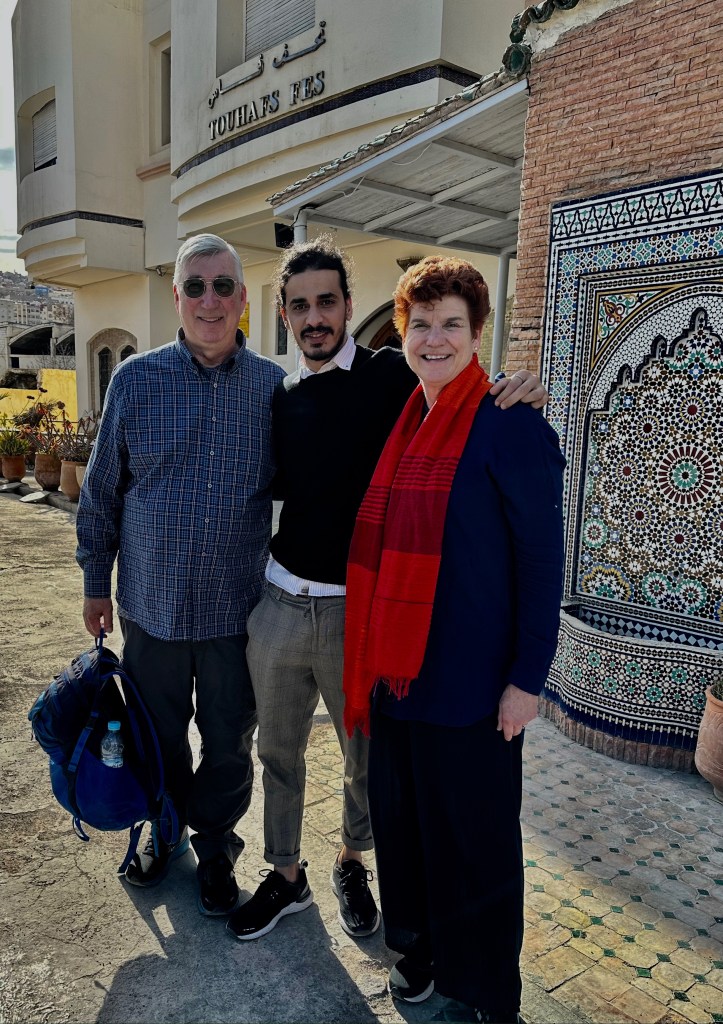
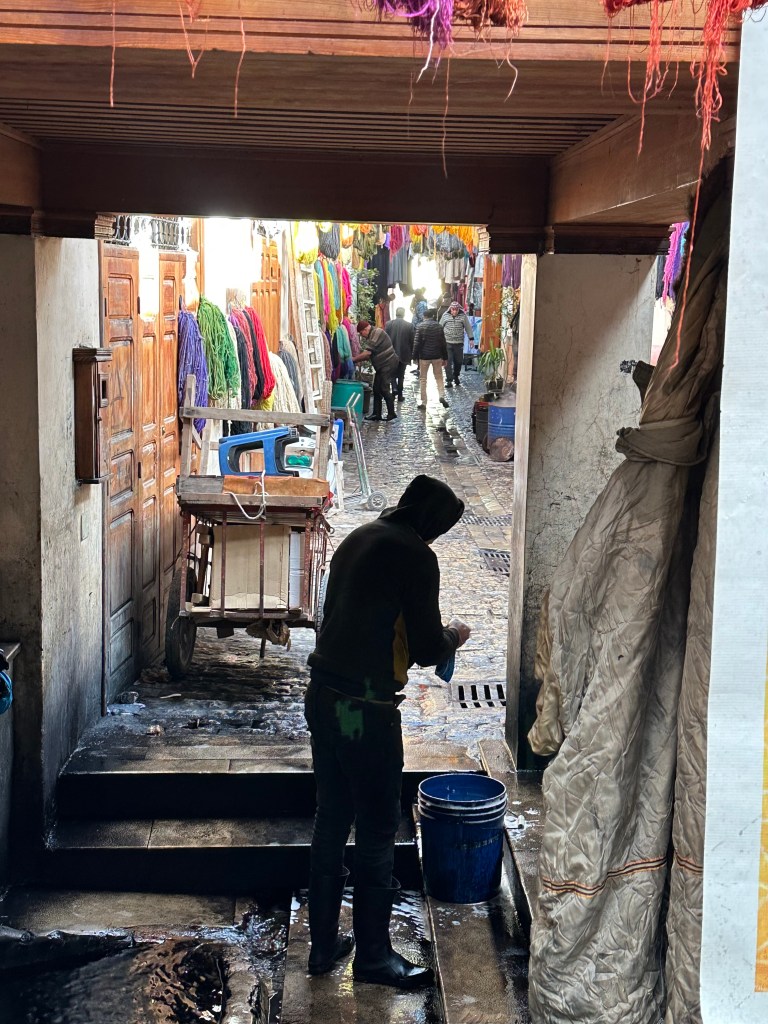
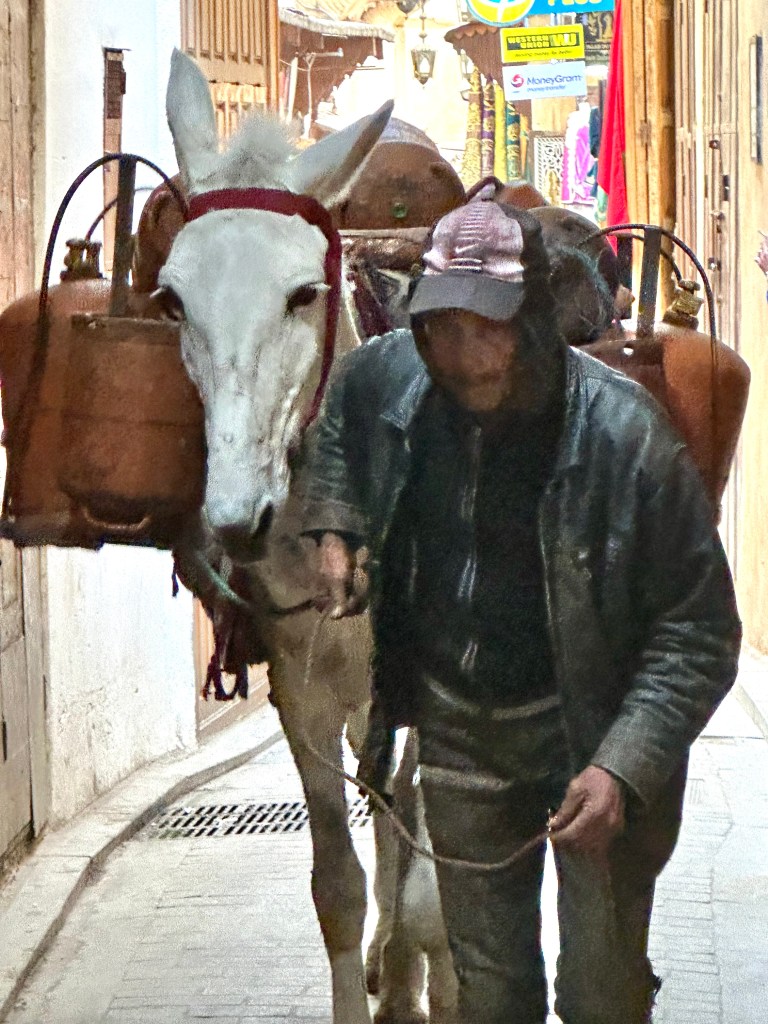
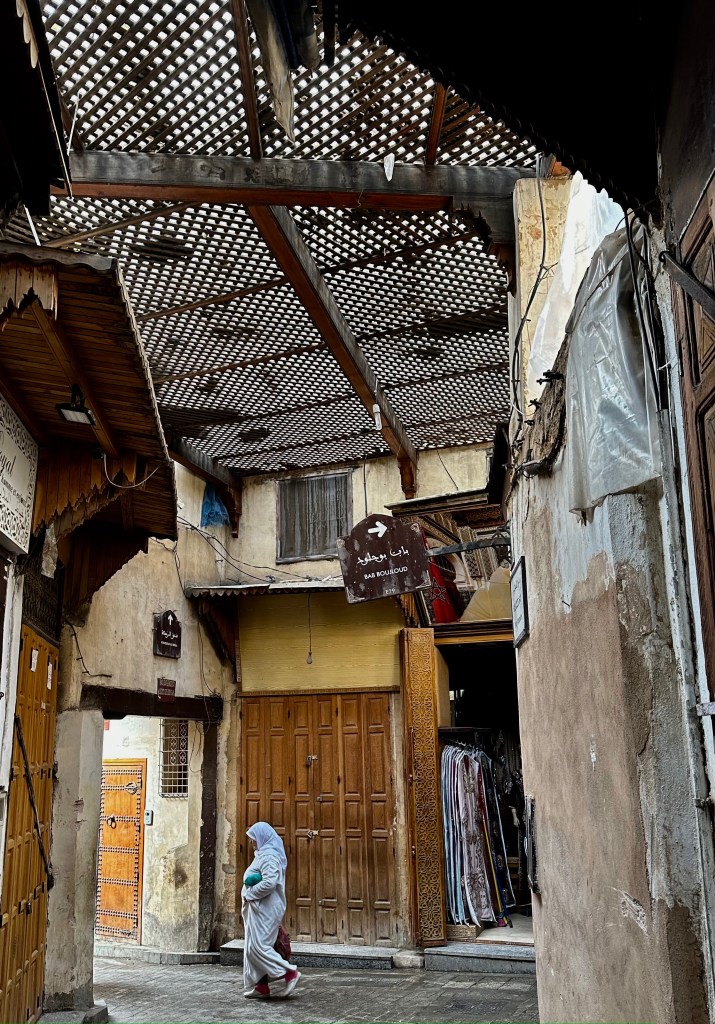
Adam arrived promptly at 9:30, and we were off to the Medina. The Fez Medina (old city) is the largest in Morocco and, reportedly, the one in which you are most likely to get hopelessly lost. There are over 1,000 unmarked streets. Adam was an excellent guide. He knows the Medina and seemingly everyone in it. He showed us where he lived as a child: a one room space in one of the many narrow alleyways. He is from a family of seven children. His parents divorced; leaving his mother in abject poverty. As a teenager, he went to work in a tourist hotel. It was there that he met the Australian couple, who offered to sponsor him. He moved to Australia to live with his adoptive parents and get his education. He is now a successful businessman who exports Moroccan goods to Australia and the USA. He bought his mother a nice home in the new city and his sisters are both doctors. He feels compelled to give back to his people by volunteering his time and support to a widows’ charity.
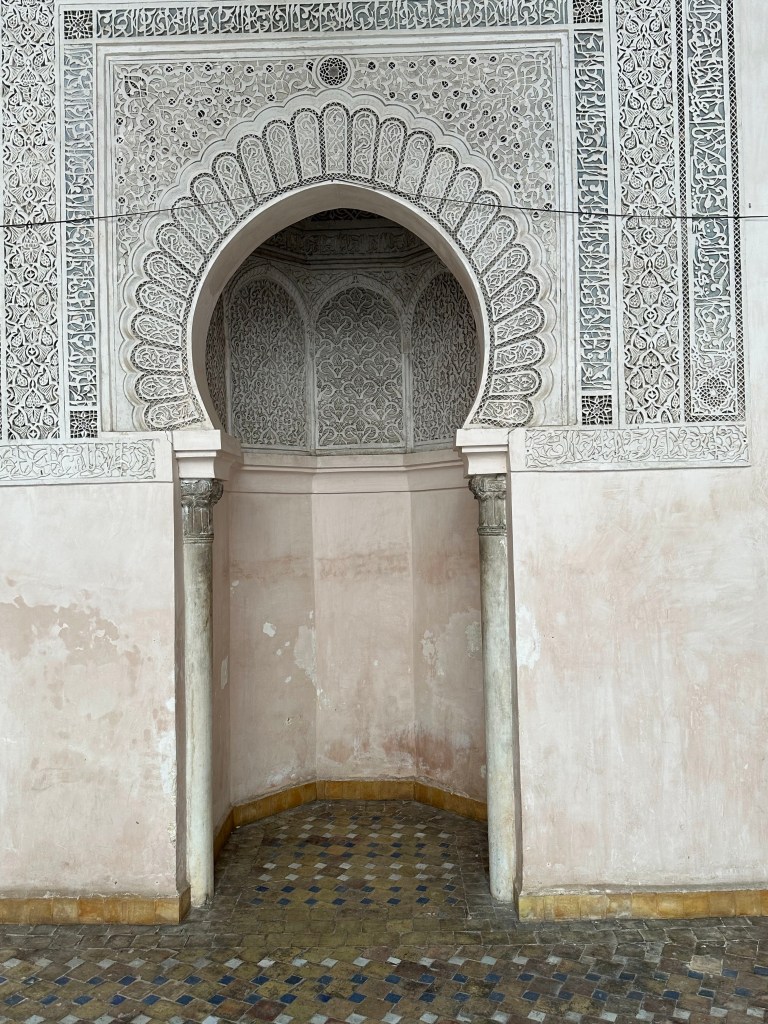
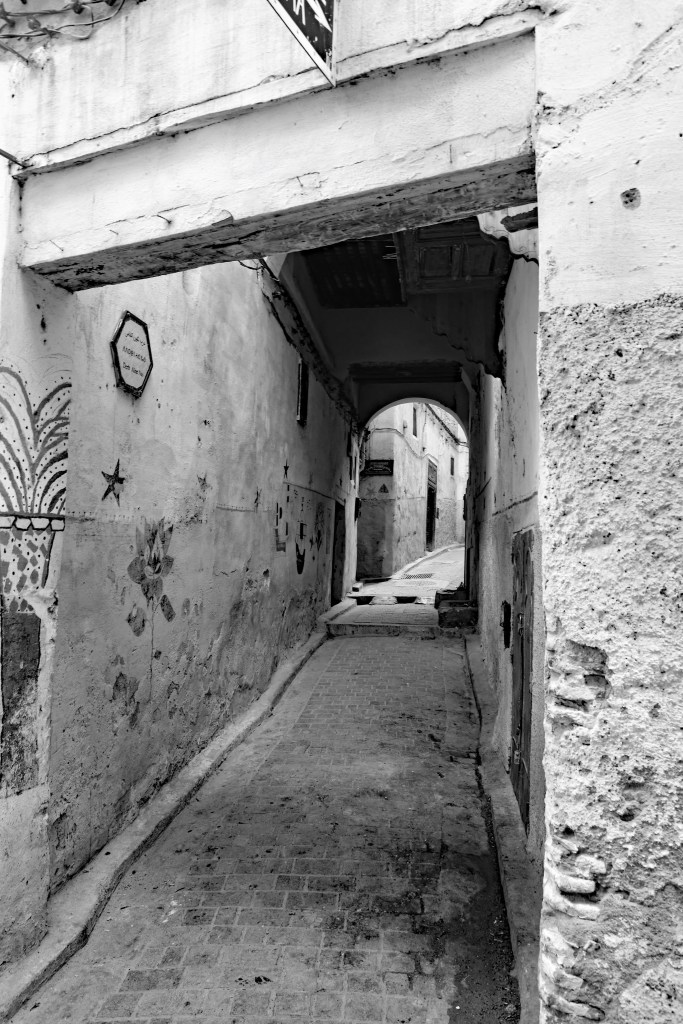
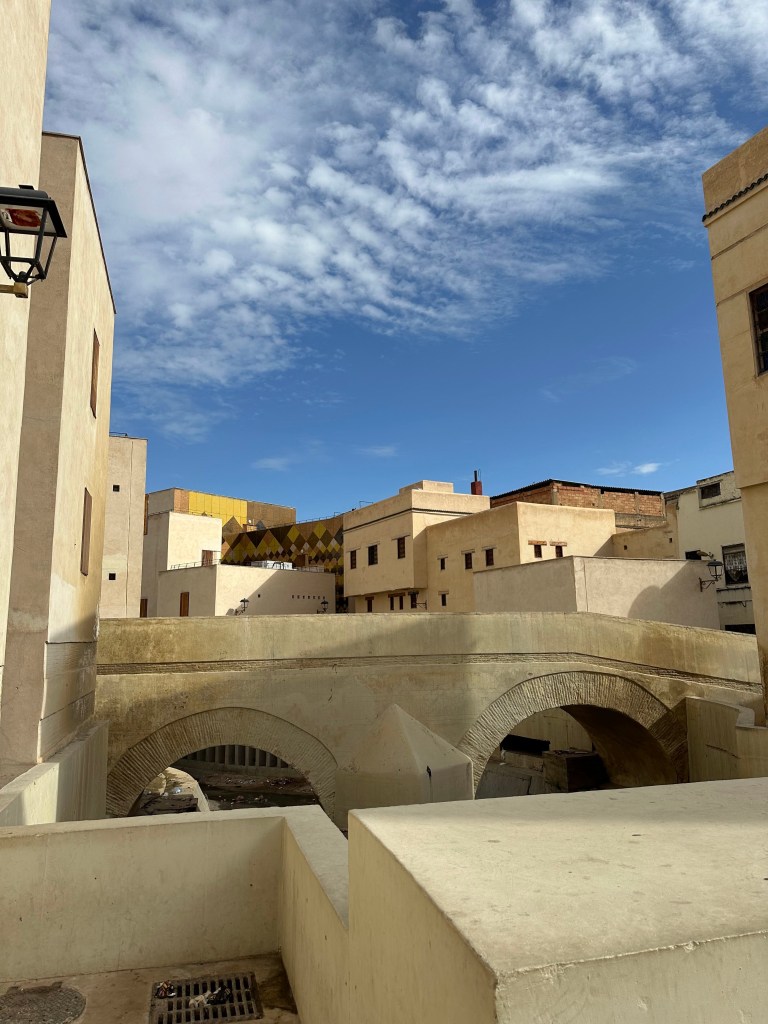
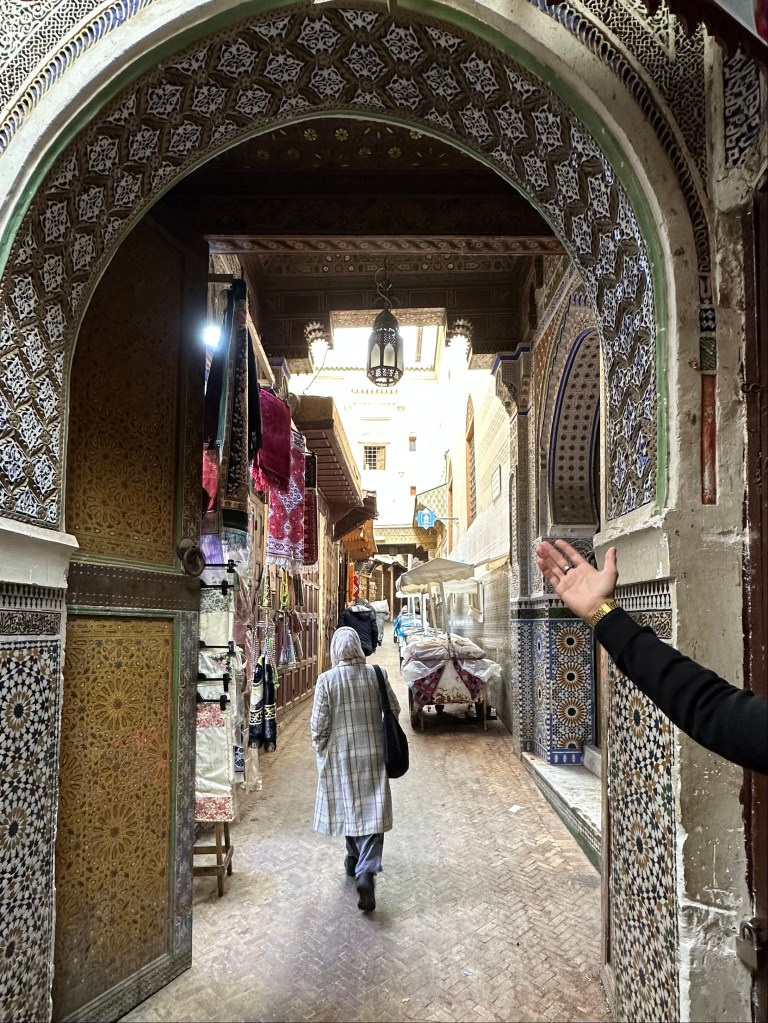
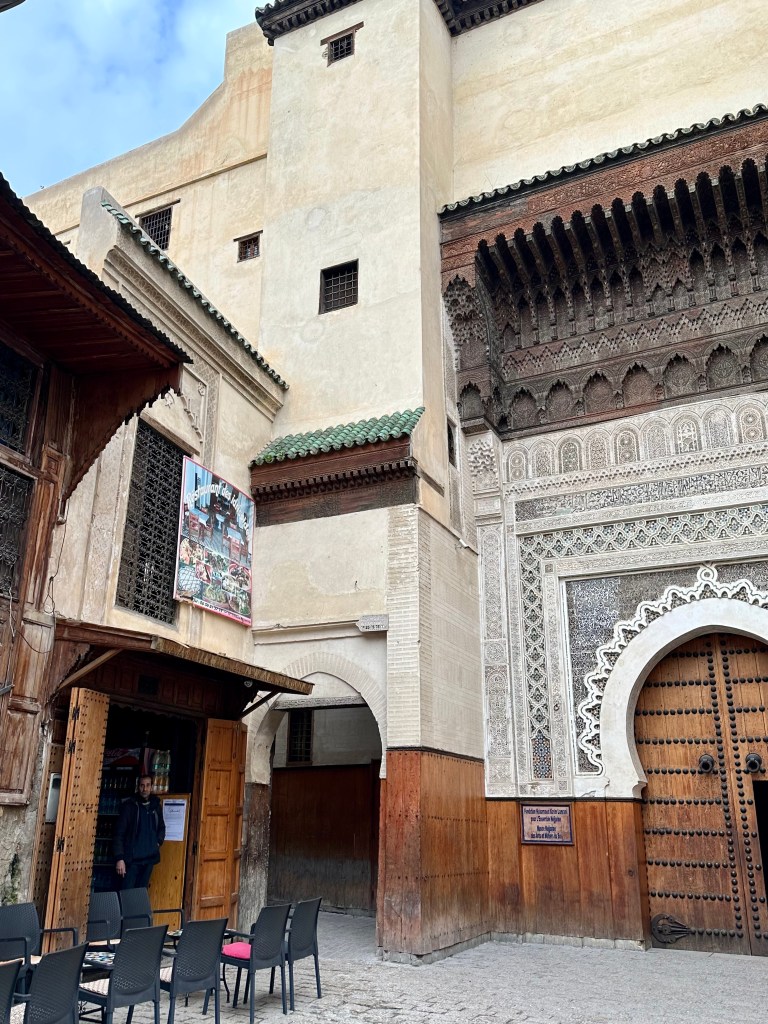
We strolled through a section of the Medina that is being restored by UNESCO. The Fez Medina is over 1,000 years old. The restoration work is painstaking and expensive, but the result is breathtaking. The tile and woodwork honor the history of the artisans who continue the ancient handicrafts today.
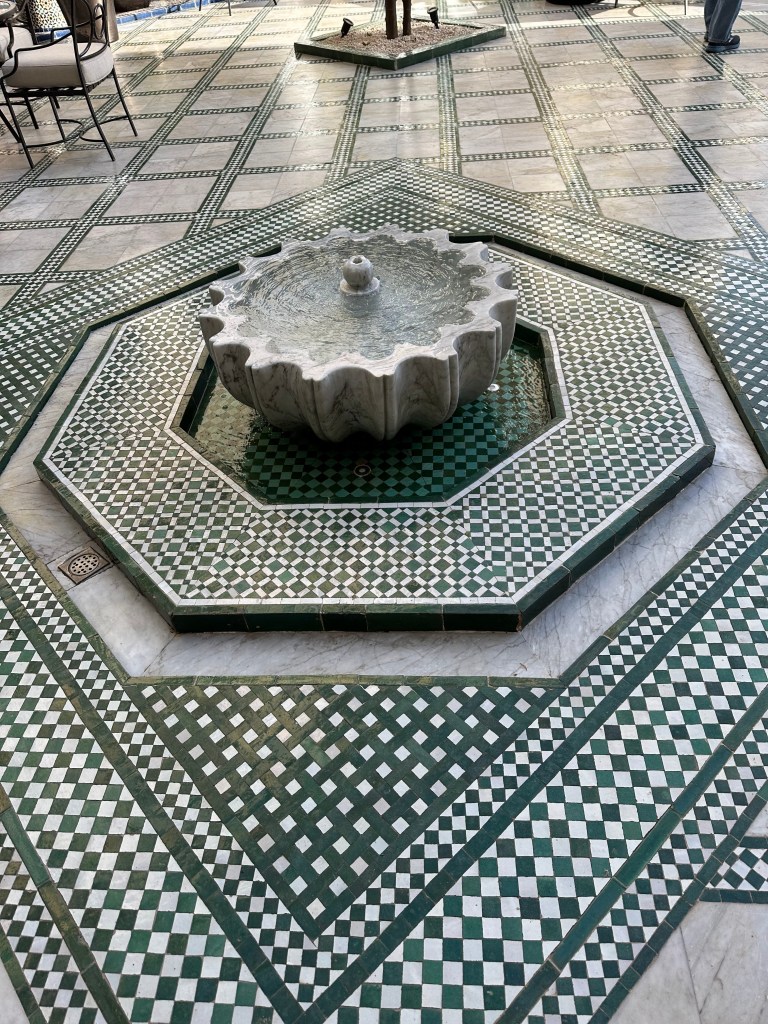
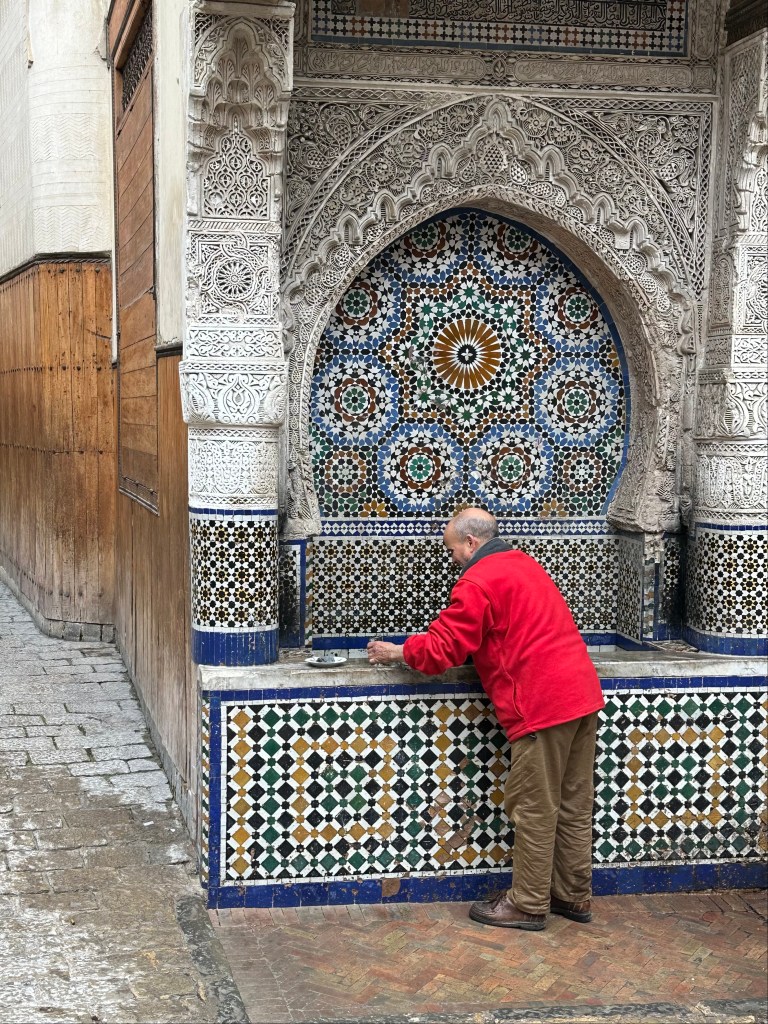
Within any Moroccan Medina are numerous small neighborhoods, each with five important features: a mosque, a school, a hammam (public bath), a bakery, and a fountain.
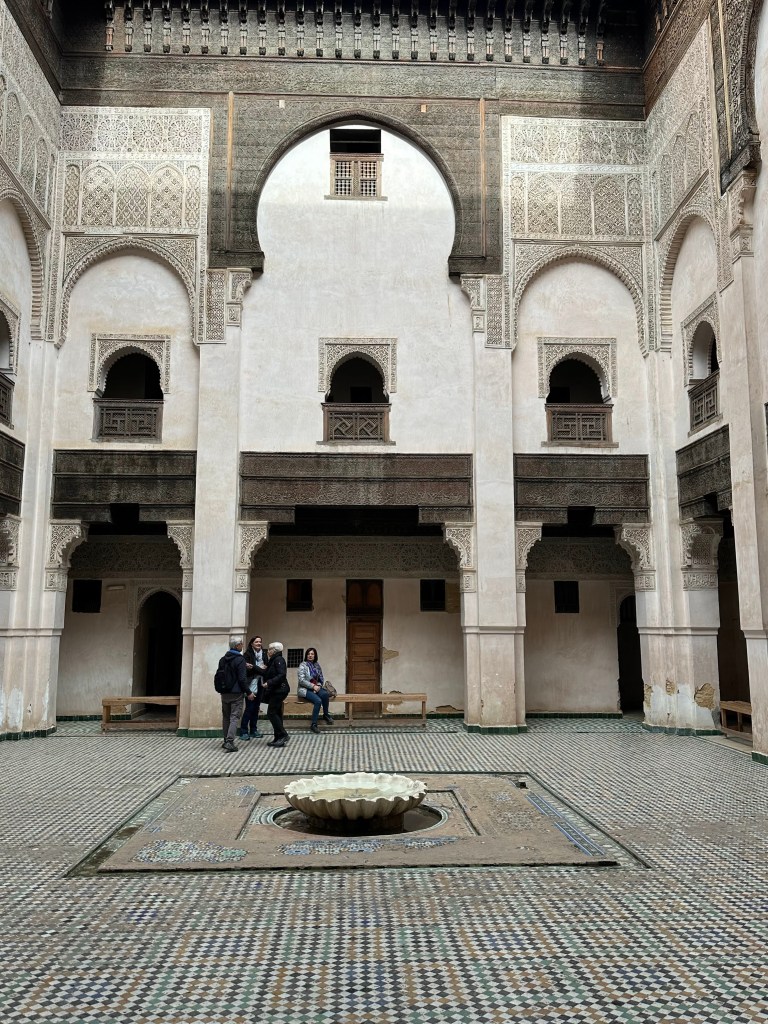
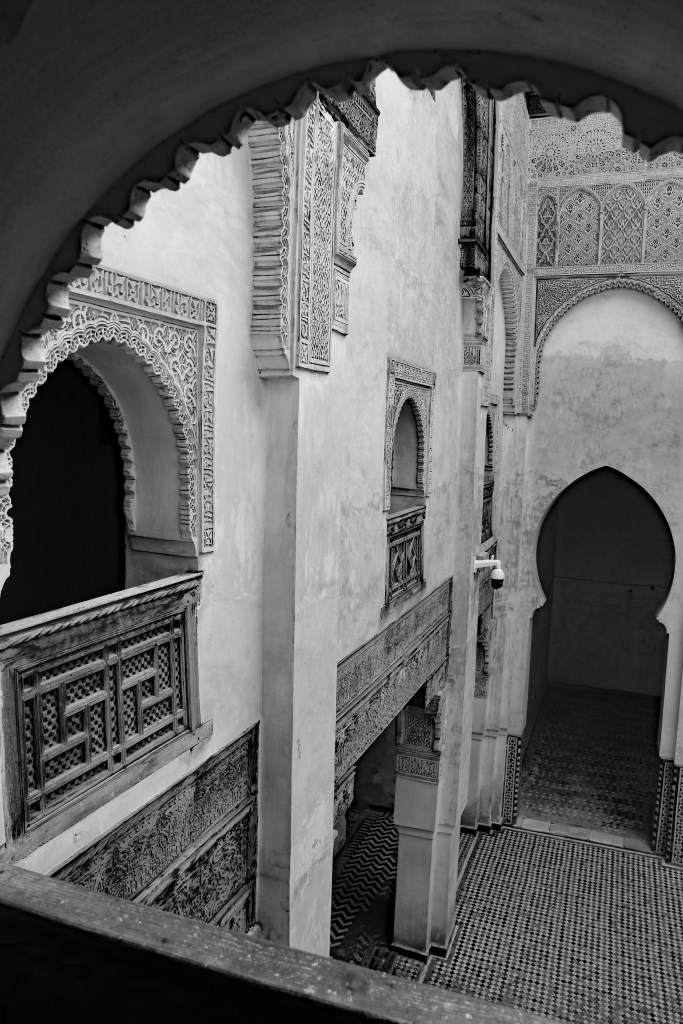
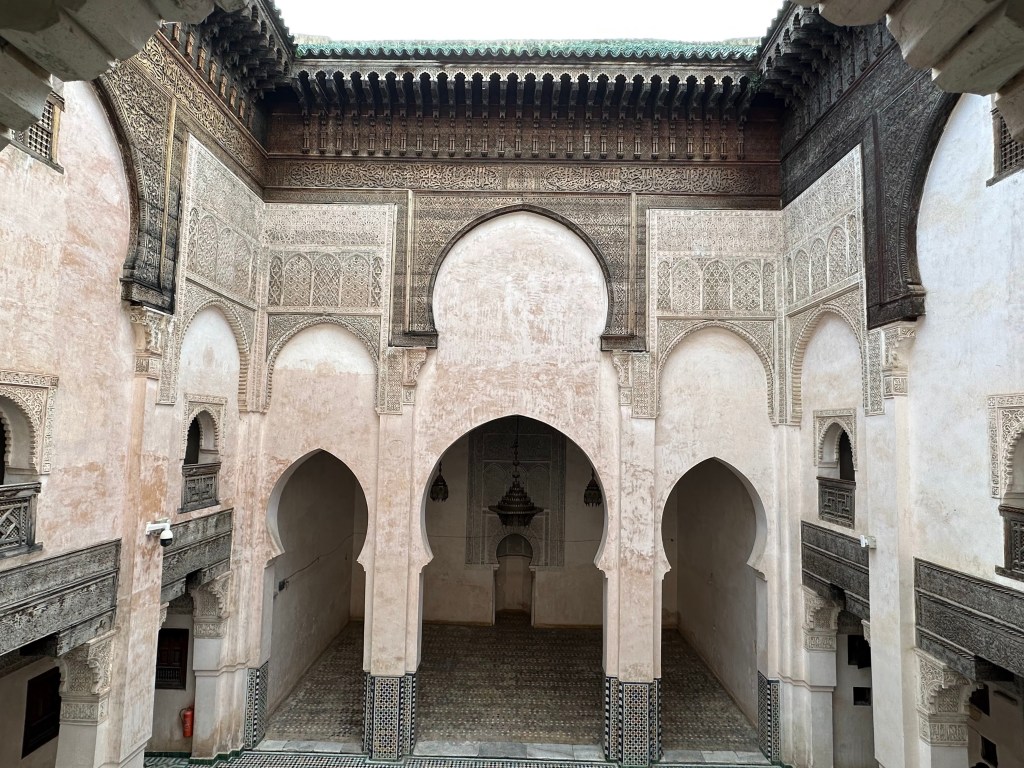
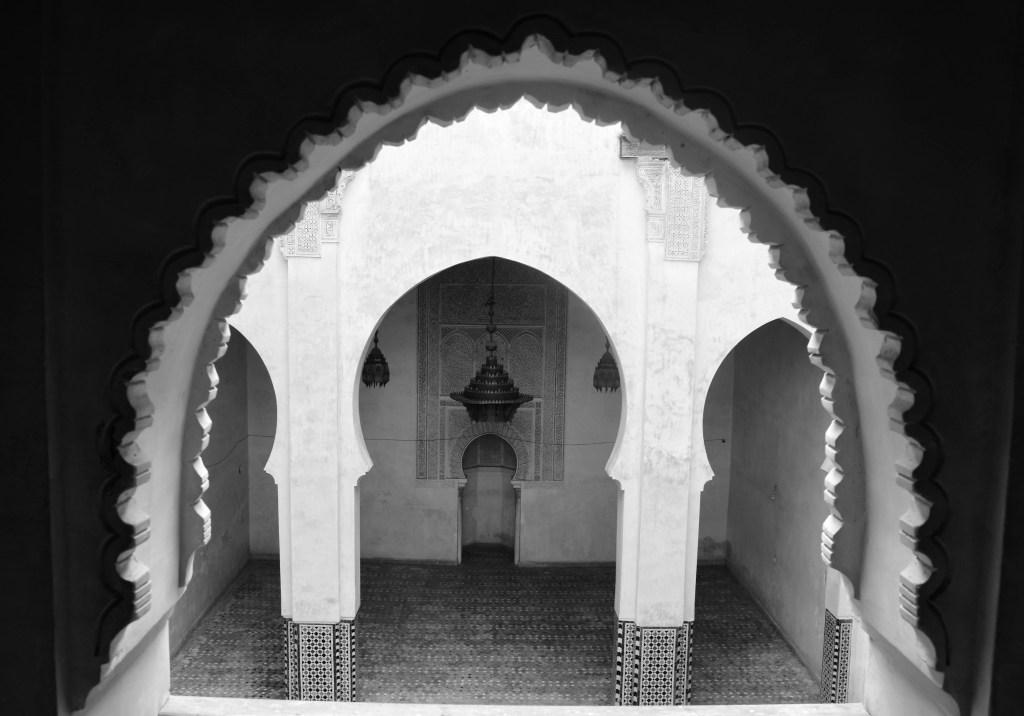
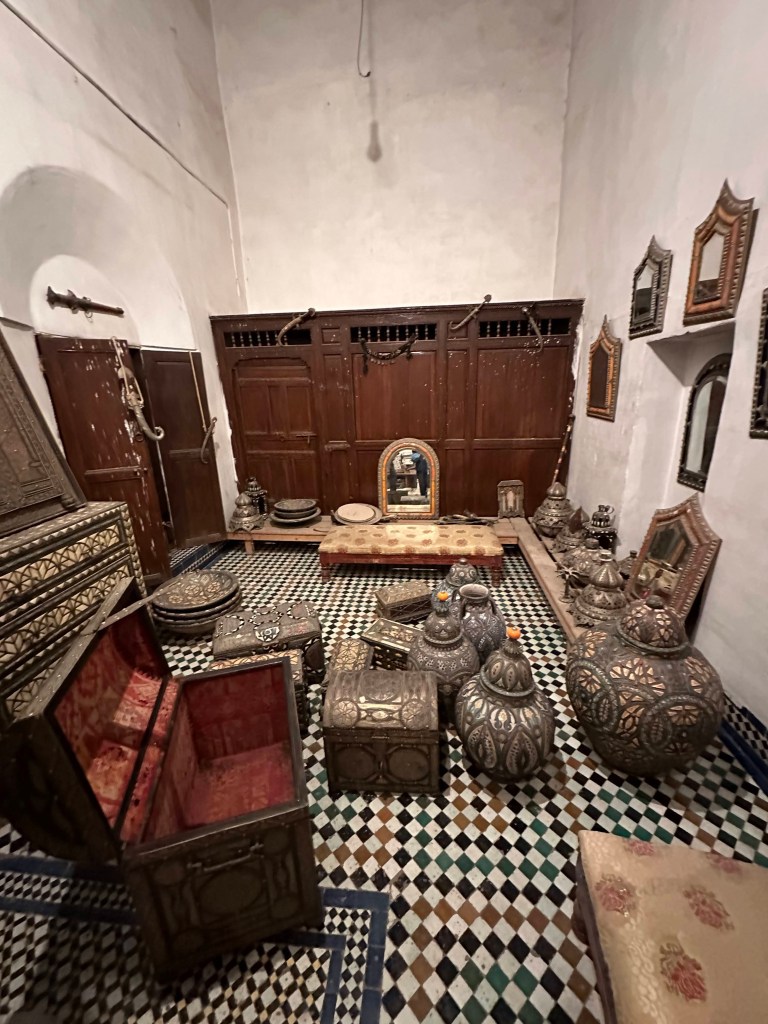
We visited the former School of the Koran, which is now a museum. The architecture is stunning. The student rooms are small; three or four students shared each of them. The better rooms, those with a view of the courtyard and more light, were given to the higher achieving students. This museum and others give non-Muslims an opportunity to see the interiors of historic sites that would otherwise be off-limits. Non-Muslims are not permitted to enter active places of worship.
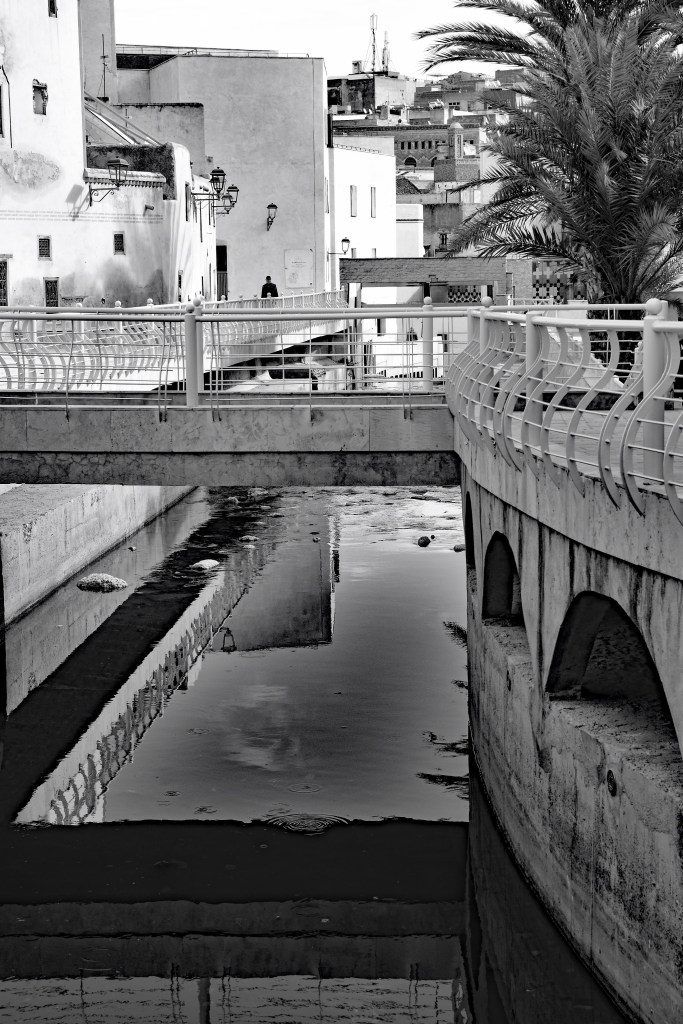
We walked along the river, which ironically, separates the Spanish section of town from the Muslim. Andalusian culture existed for centuries in both Morocco and Spain, due to the Moorish occupation of Spain (711-1492). Having studied and experienced the Moorish influence in the south of Spain, it has been really interesting to come to the source. During and after The Reconquest, there was a huge wave of immigration from Spain to northern Morocco by Jews and Muslims, fleeing persecution by the Catholic Kings.
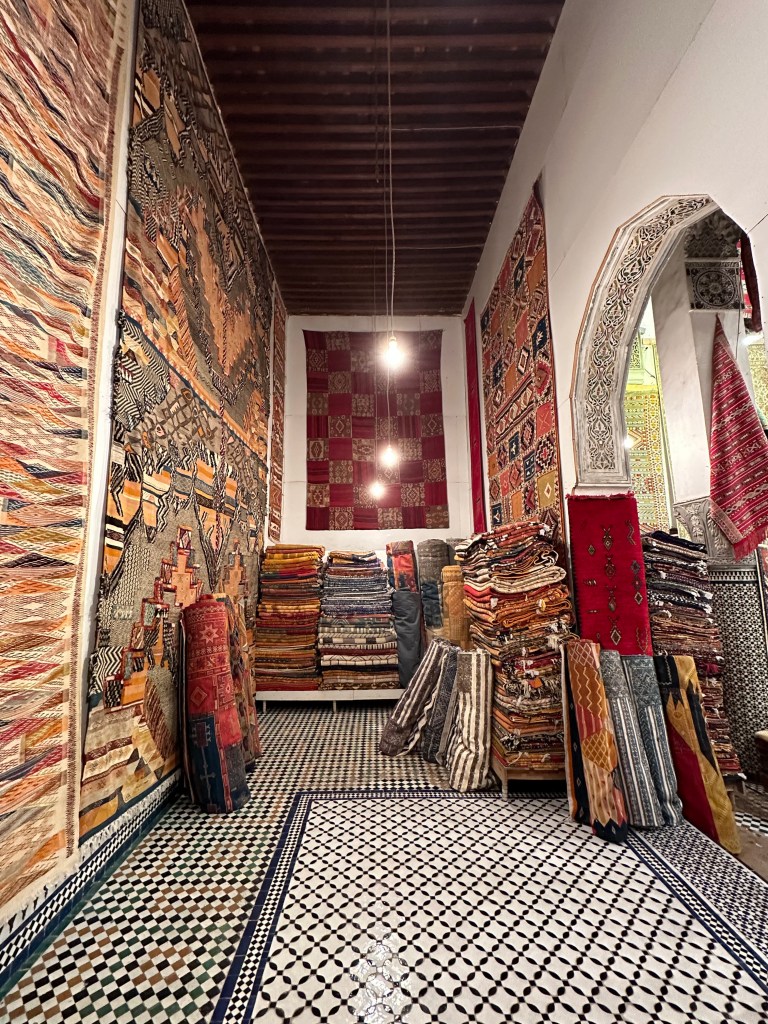
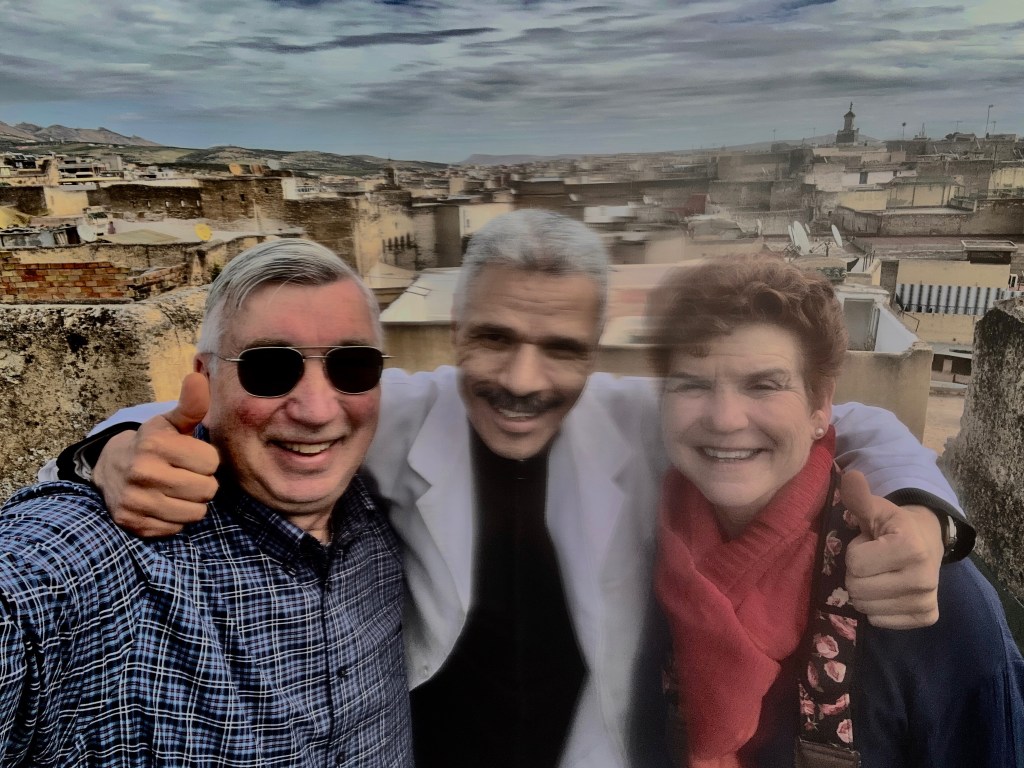
Next, we were off to visit some of the Cooperatives. Adam explained that Fez differs from Marrakech in that, rather than souks, it has Co-ops. I am not sure this distinction would be obvious to us. While there may have been less density of shops in Fez, there were definitely shops. The Co-ops are overseen by the government of Morocco. I was hoping this would mean set prices and no haggling or hard-sell, but no such luck. Our first stop was a Widows’ Carpet Cooperative, First we met Aziz, who took us to the rooftop for sweeping views of Fez. He is a teacher who volunteers at the Co-op. He was delighted to meet American teachers, and we enjoyed asking him questions and taking selfies. Aziz took me to meet the women, and see their home and work space. Bill was taken to the showroom for tea. The woman and their children are given shelter from the streets, although the living space is quite modest. While the children are in school, their mothers learn to make carpets by hand. I was told that a single carpet takes up to two years for completion.
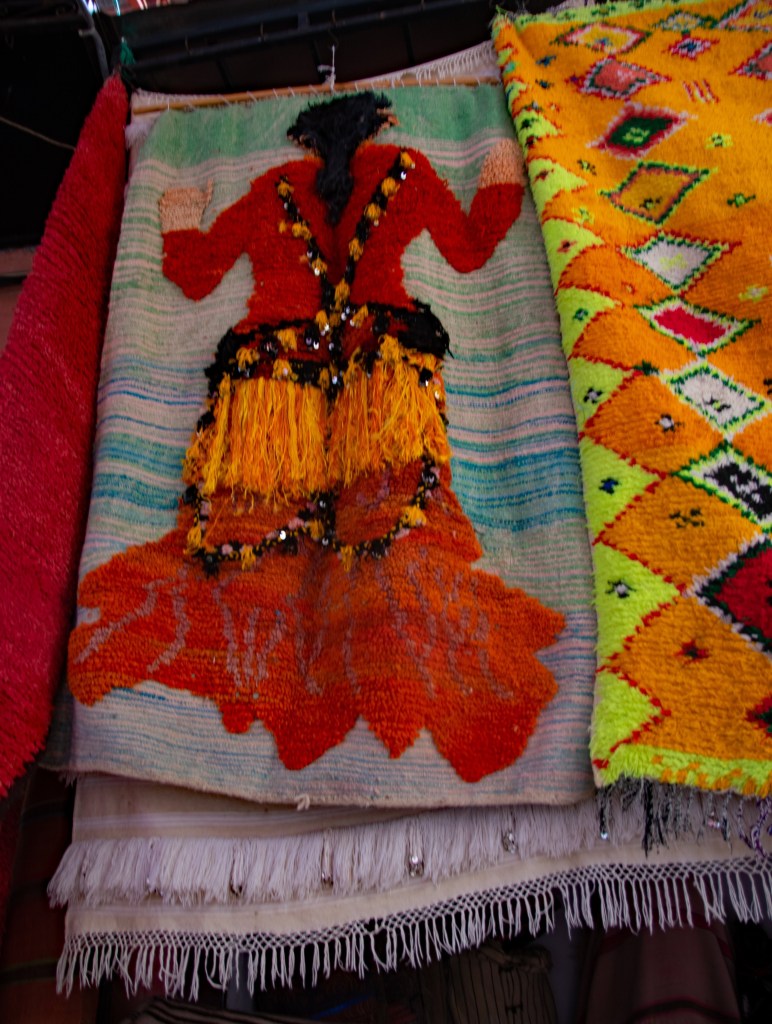
Meanwhile, back in the showroom, Adam and Bill were sipping tea, while a team of men unrolled carpets for us to view. The show was orchestrated by one gentleman, whom I will refer to as the “used car salesman”. Each carpet was unique. I made the requisite comments about their beauty, while Bill sat with his arms folded, and repeated continuously, “We aren’t here to buy a carpet, but I’ll be happy to make a donation to the widows.” “No, we don’t accept donations here, only purchases. Now, what size carpet can you use?” The prices started at $4,000 Euros for a very large rug, which wouldn’t likely do much for our minimalist decor even if we could afford it. The used car salesman told us these carpets were an investment. We could purchase it and resell it in the States, making enough profit to pay for our trip. Bill told them he was not buying a rug and he certainly wasn’t going into the rug selling business. Each time we protested, smaller rugs appeared and the prices got lower. By the time we were exiting (without a rug), the used car salesman was trying to hand me a very small rug and shouting, “Please take it, it’s a gift!”
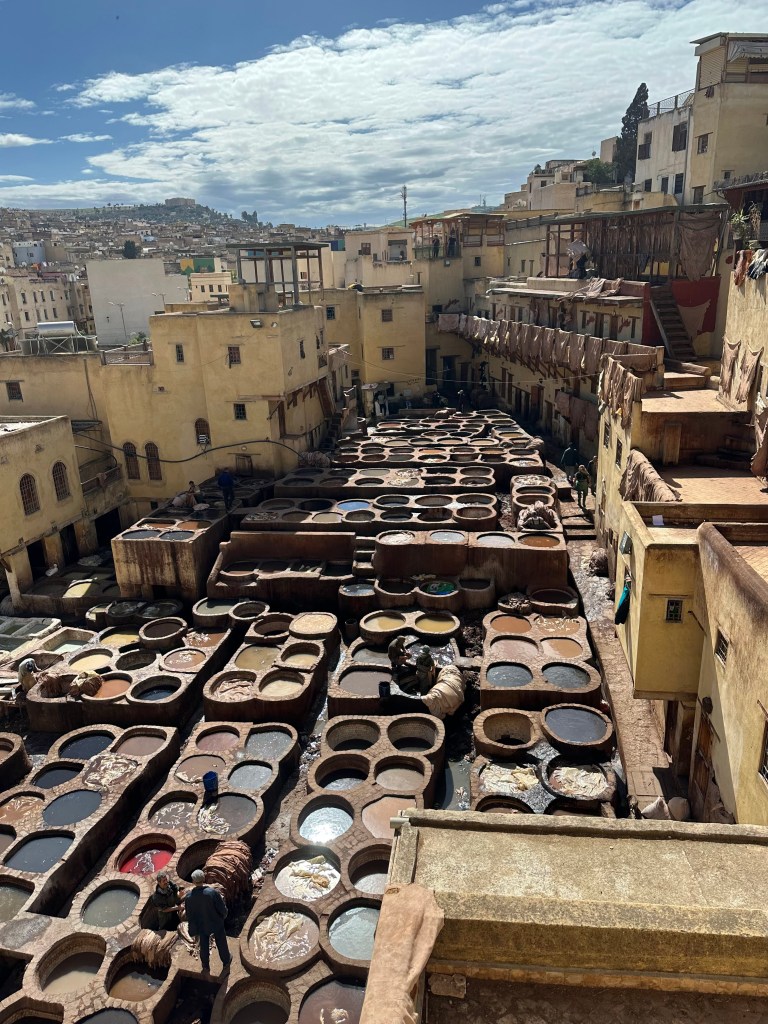
After our escape from the Carpet Co-op, it was on to the tanneries and leather goods shops. Leather was a product in which I had a bit more interest. The sales approach was gentler than the carpets. Again, the asking price is outrageous, negotiations occur, and a settlement is reached. Even Adam bought a jacket, although I’m pretty sure his price was lower than ours. He did help us to negotiate, and in the end, I had two leather handbags, and each of us had a new camel leather coat. We’re pretty sure we overpaid, but not enough to break the bank.
Time for a lunch break! We went to a small family run restaurant, where we were invited into the kitchen to taste the day’s specials before ordering. As soon as we were settled, who walked in and sat next to us, but the used car salesman. Coincidence? You decide. He made one more pitch for us to stop by and get his card for our friends back home.
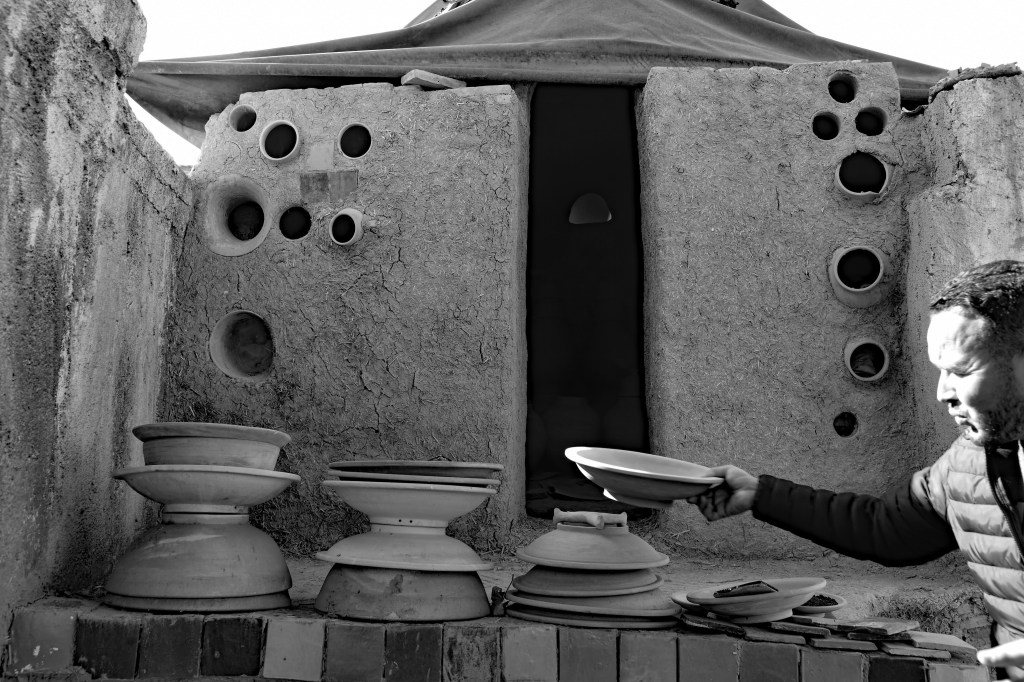
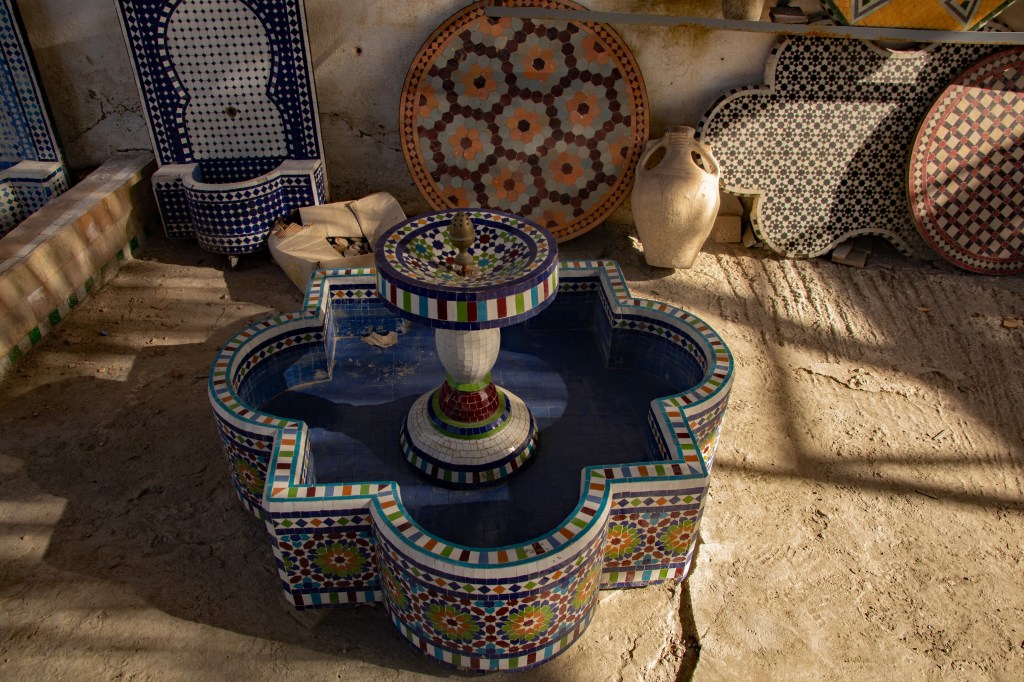
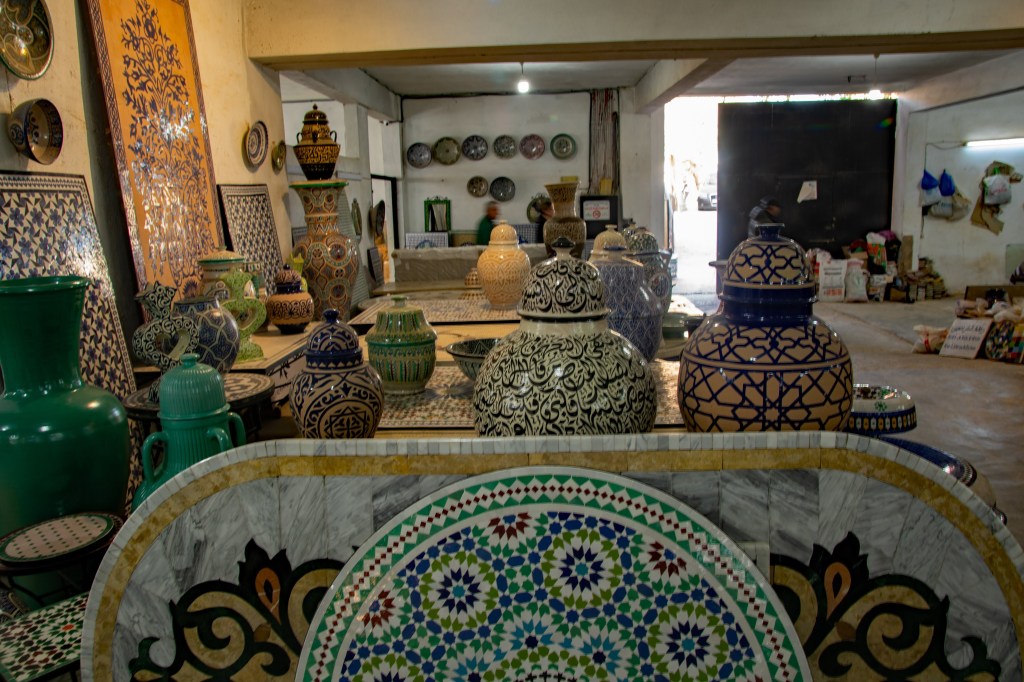
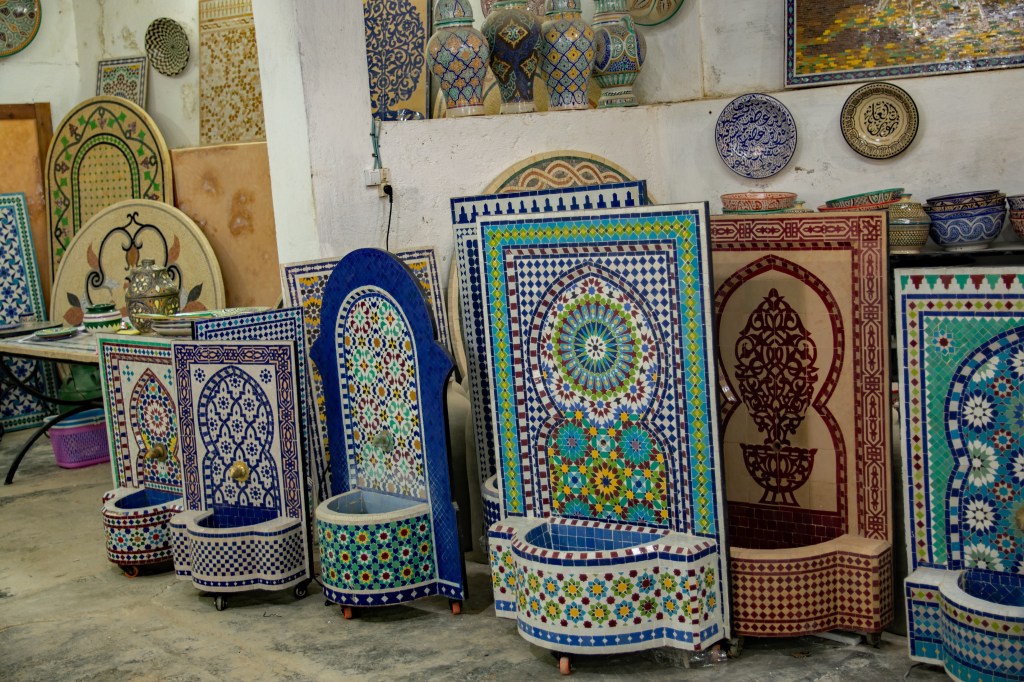
After lunch, we had one more Co-op on our agenda: the pottery artisans. While I was at the point of skipping this one; I’m glad we didn’t. These artisans were amazing! I thought of my ceramic artist friends at home and how much they would enjoy seeing this. The painstaking tile work is done with hand tools. The products are beautiful! Bill was picturing one of those fountains on his deck back home, but it will probably come from Amazon and be made in China.
And so ended our tour! Bill handed Adam a cash donation for his Widows’ charity. Some of you are shaking your heads now at our stupidity. I would like to believe it got to those in need and Bill says it’s in karma’s hands now.
At the end of the day, it felt a bit like we were in a Hollywood movie complete with exotic stage settings, a cast of characters, (with us as the naive tourists), a few twists of fate, and an ambiguous ending. Kind of like “Now You See Me” Was the whole thing a set-up from start to finish? Maybe. Maybe not. But even if it was, no real harm was done. We saw beautiful places, met interesting people, and took memorable photos. I have enough material to write a screenplay. And I’m rockin’ that leather coat!
There is an Epilogue to the leather coats, but that’s a tale to tell over a glass of wine.
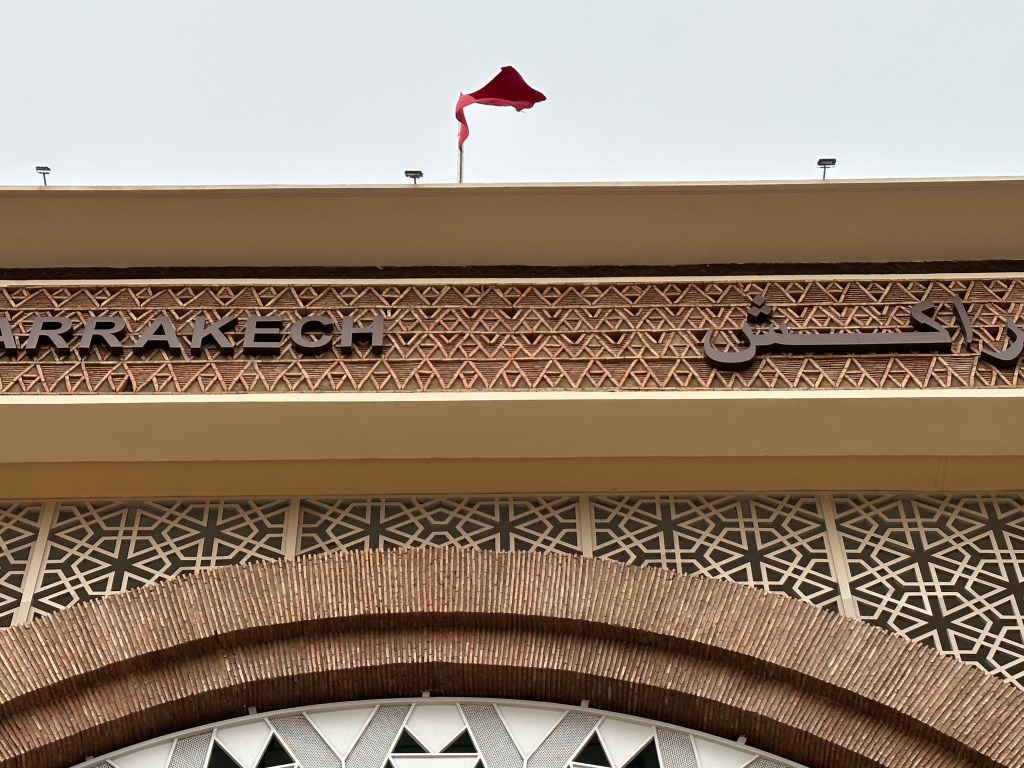
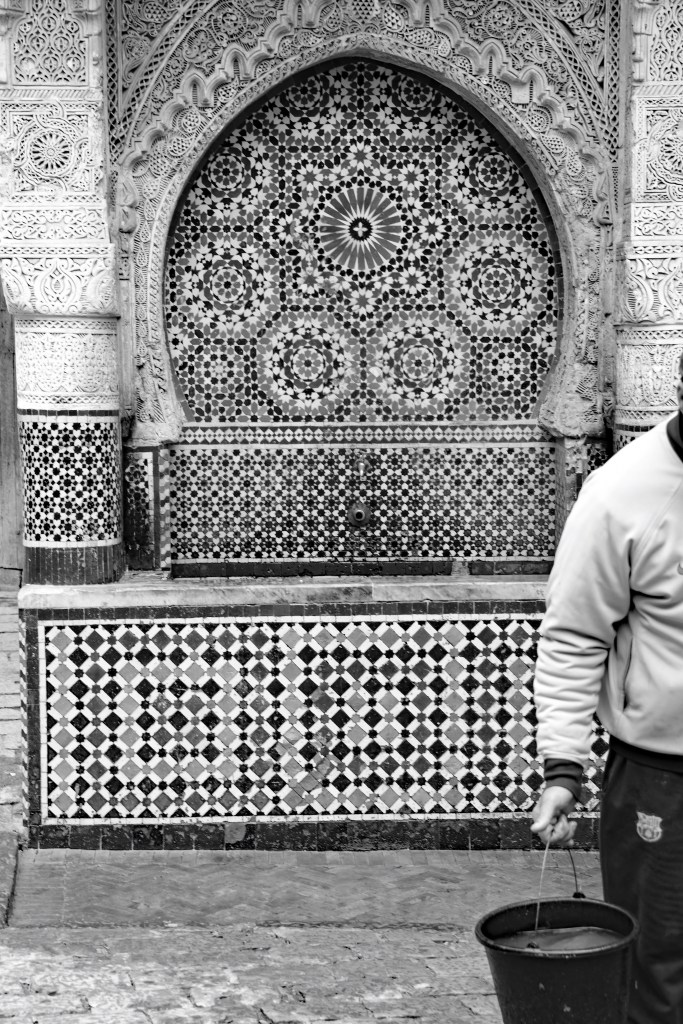
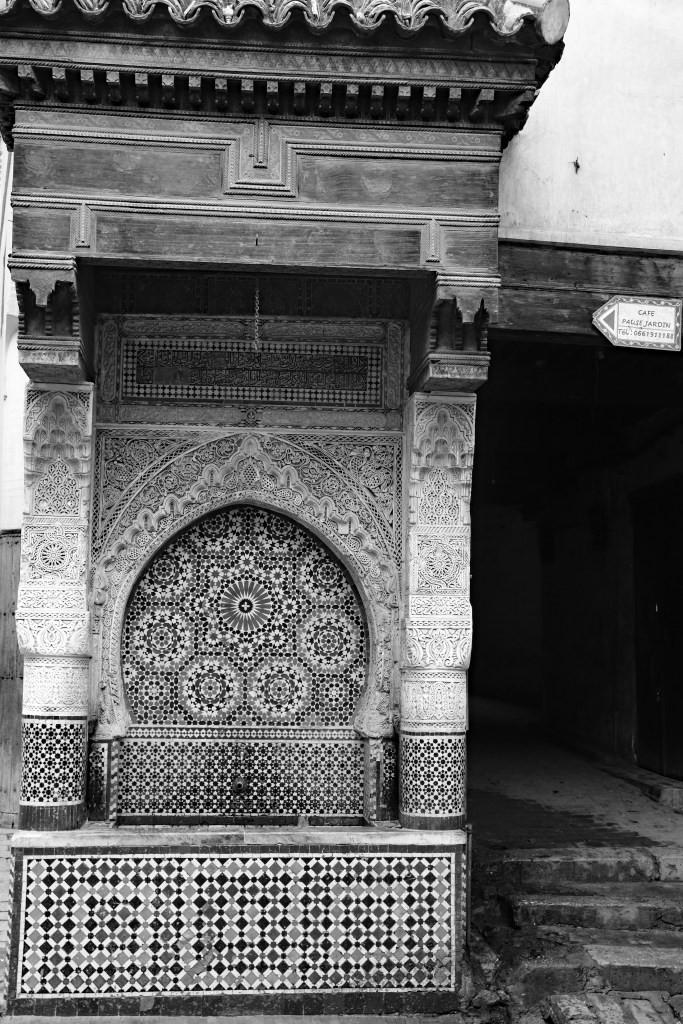
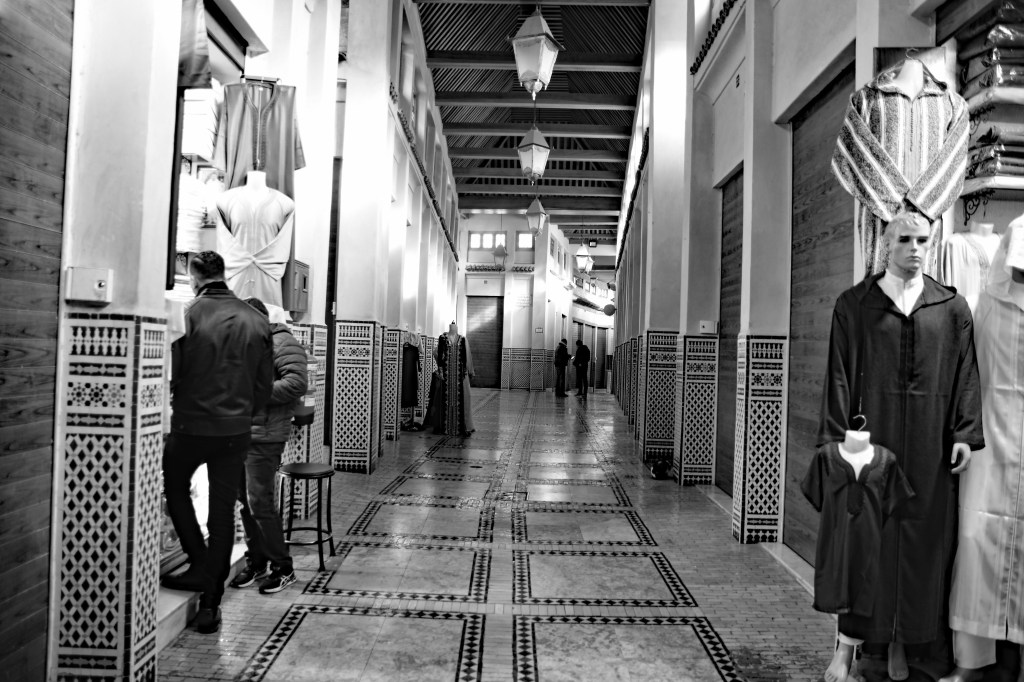
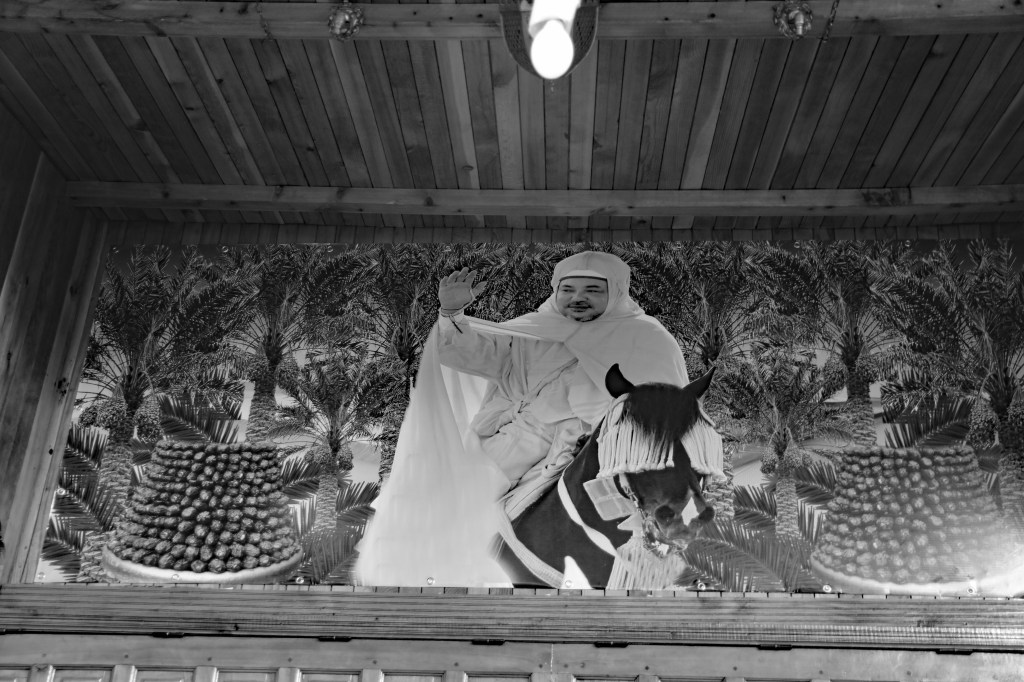
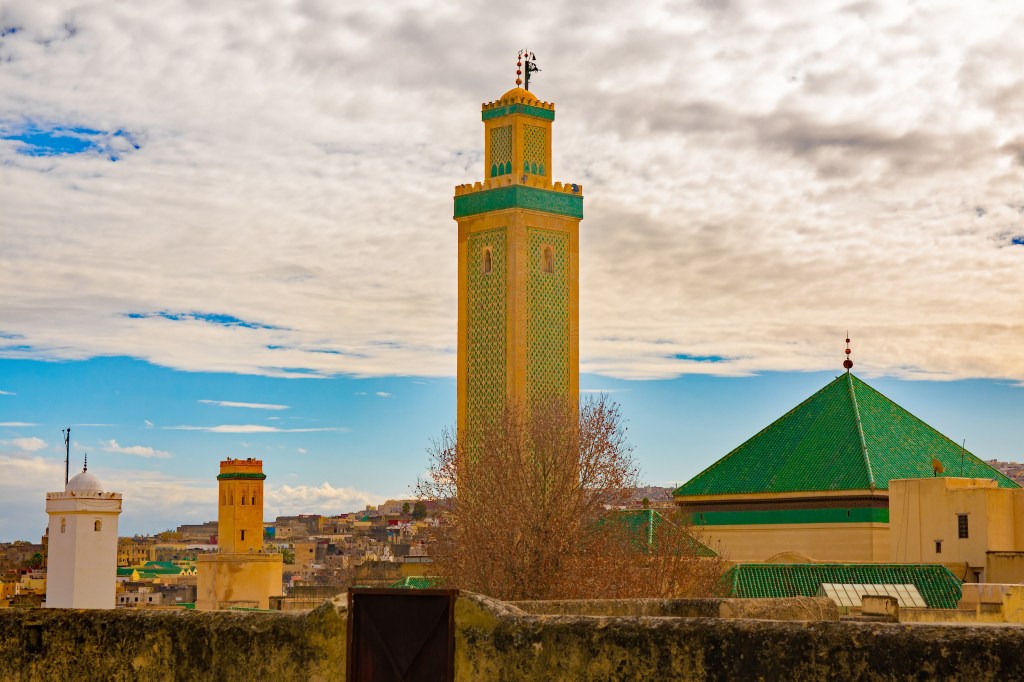
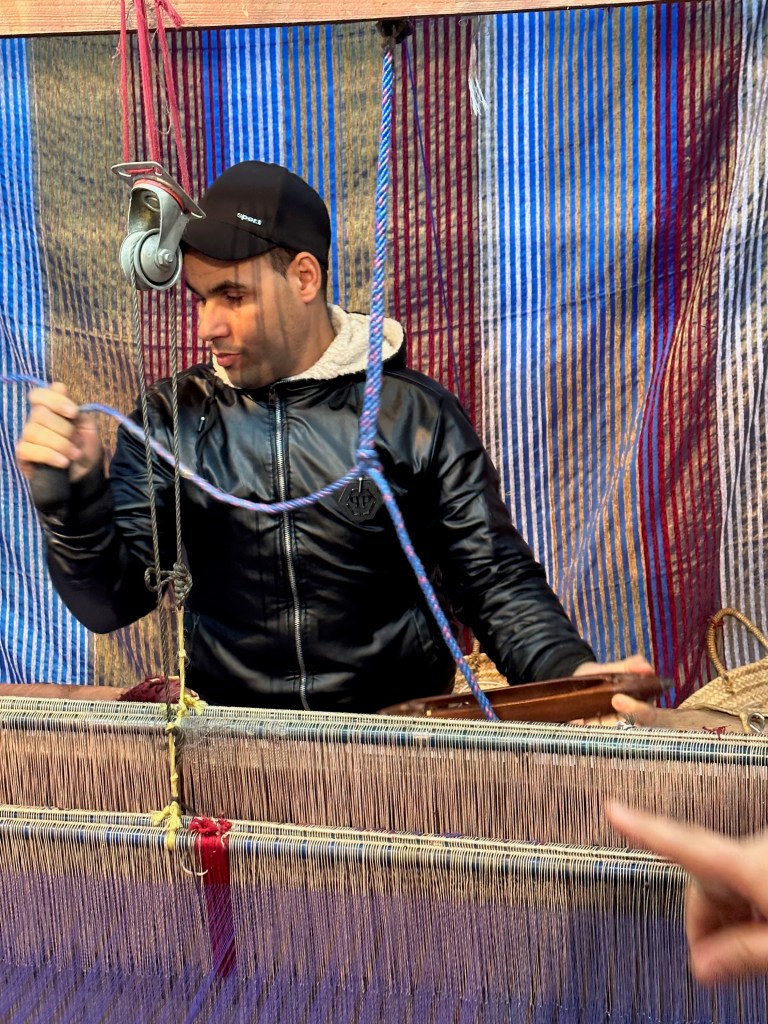
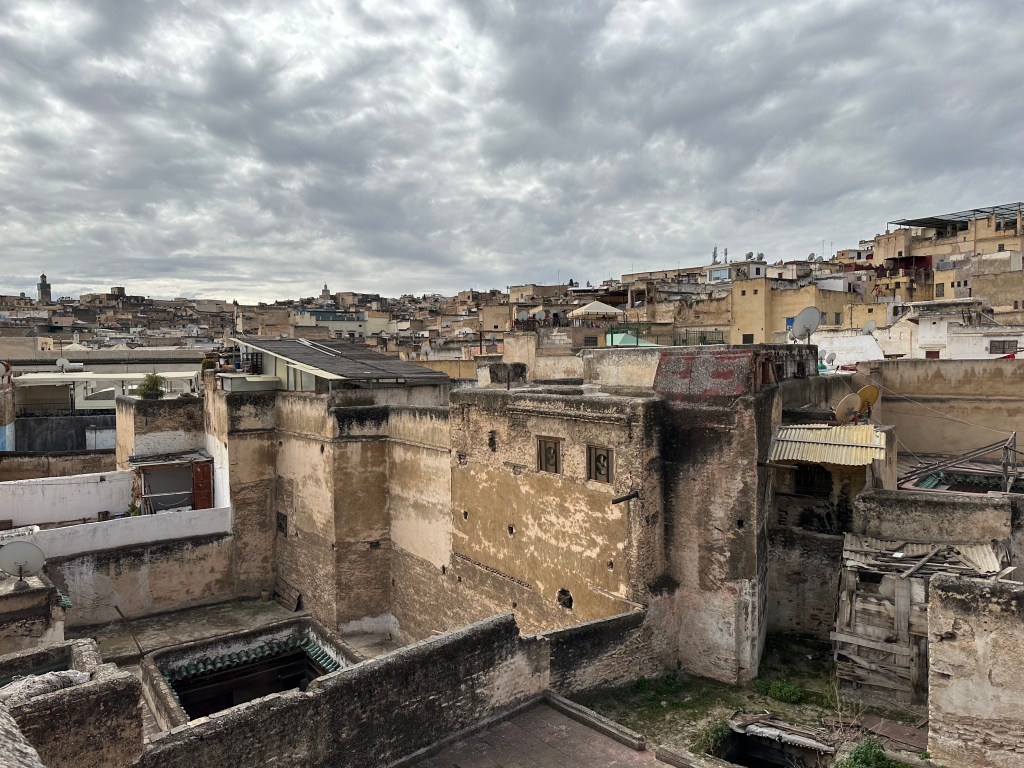
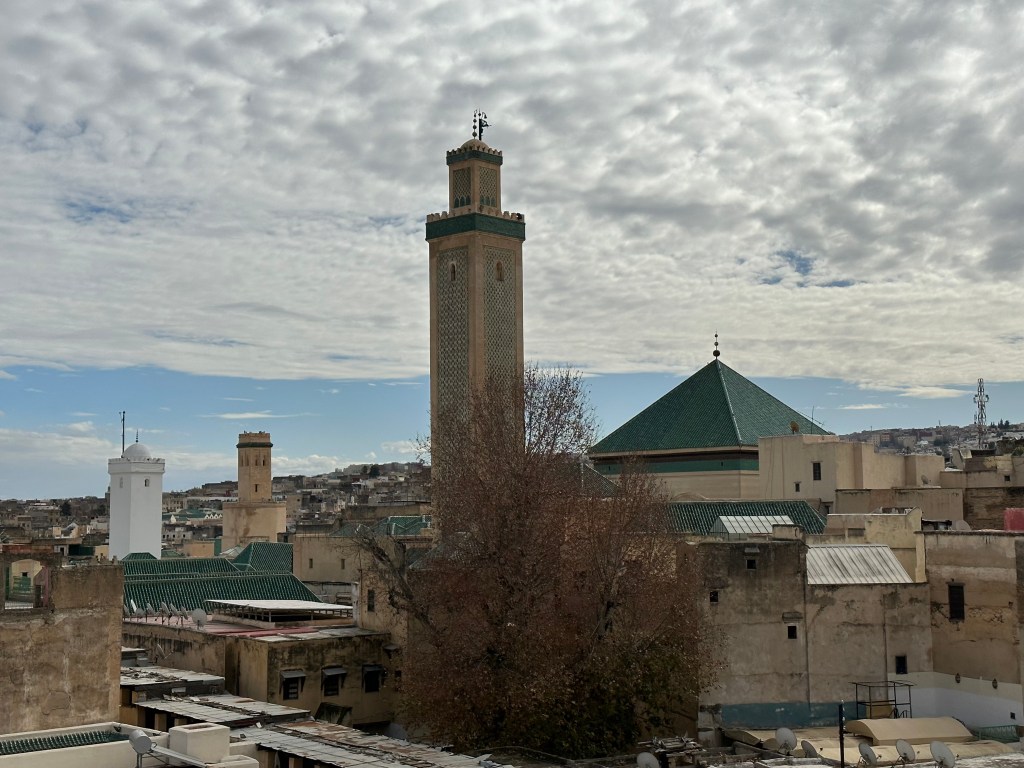
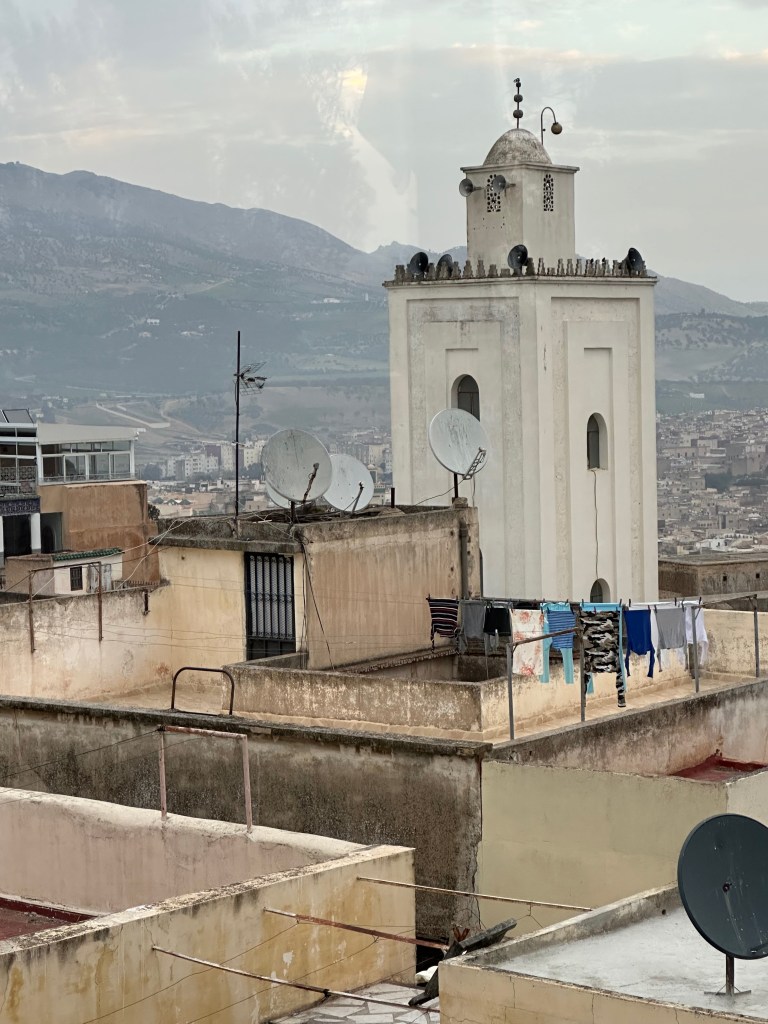
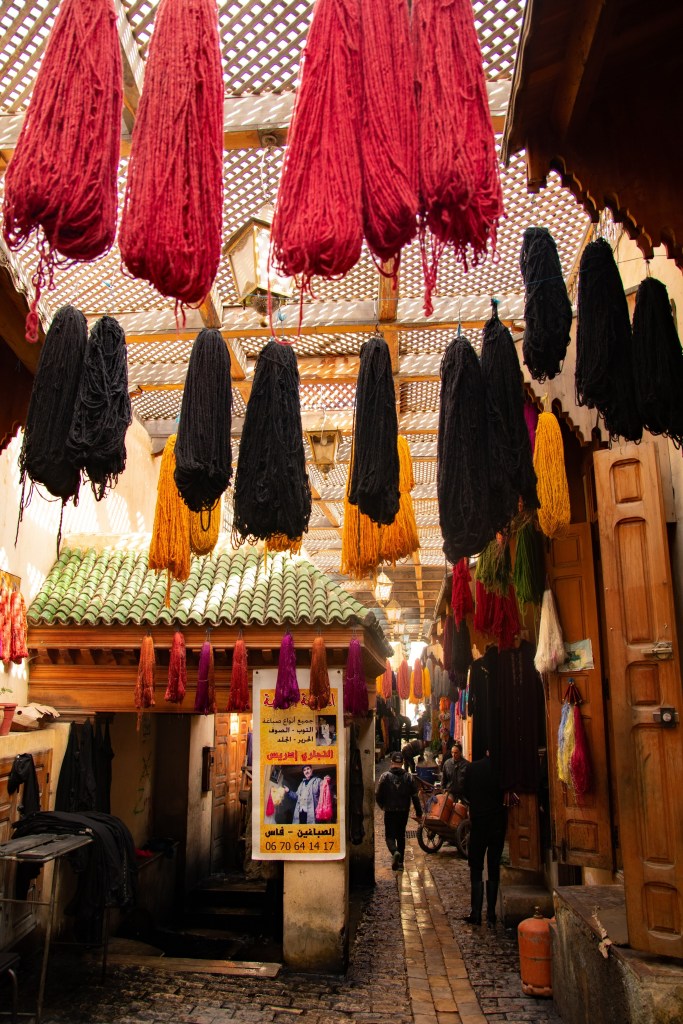
The TrainOur train compartmentMarrakech StationPalaj FarajPalaj FarajPublic Fountain in MedinaA CasketOriginal Walls Circa 1,000 ADRestoration Work by UNESCOMural of the KingFormer School of KoranFacing MeccaSchool of KoranRiver In FezA Peek Inside the MosqueThe TanneriesPottery ArtistThe KilnCutting tilesCarpetsTanneryJewish ArtifactsMosque entranceMosque TowerAdam and UsAziz and UsCloth WeaverLeather SalesmanDyeing Cloth and ThreadMural of the KingTomb of Moulay Idris (Holy Man of Fez)Public FountainMedina CafeRiverbank in FezRooftops of FezAdam on the rightCarpet Thread
I have always wanted to go up in a hot-air balloon. This seems strange for the kid who made them stop the Ferris Wheel at Kiddie Land, because she was too frightened to go through with it. I have evolved, but only to a point. I did ride The Navy Pier Ferris Wheel with the grandkids last summer. However, I still don’t ride rollercoasters, skydive, or get too close to the window in a skyscraper. You’ll never find me on the glass floor skydeck at The Willis Tower. But balloons, yeah, there’s just something about balloons. And maybe something about being far from home in a foreign country that brings out my reckless streak. I have snorkeled in Mexico, walked over a gorge in Spain on a suspension bridge, and climbed countless narrow bell towers while traveling.
Viator Tours has a Hot-Air Adventure Tour from Marrakesh, which includes a traditional Berber breakfast and a camel ride. After a trip to Bryce Canyon in 2019, Bill announced, ” No more horses, no more mules.” So I had to ask, ” How do you feel about camels?”
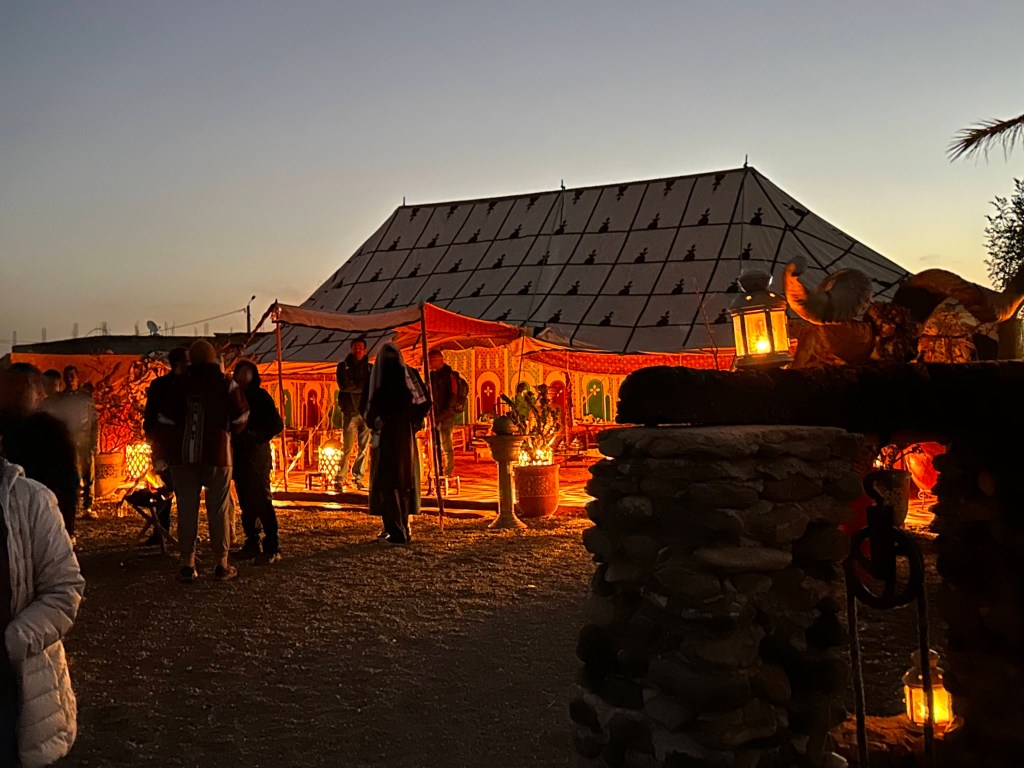
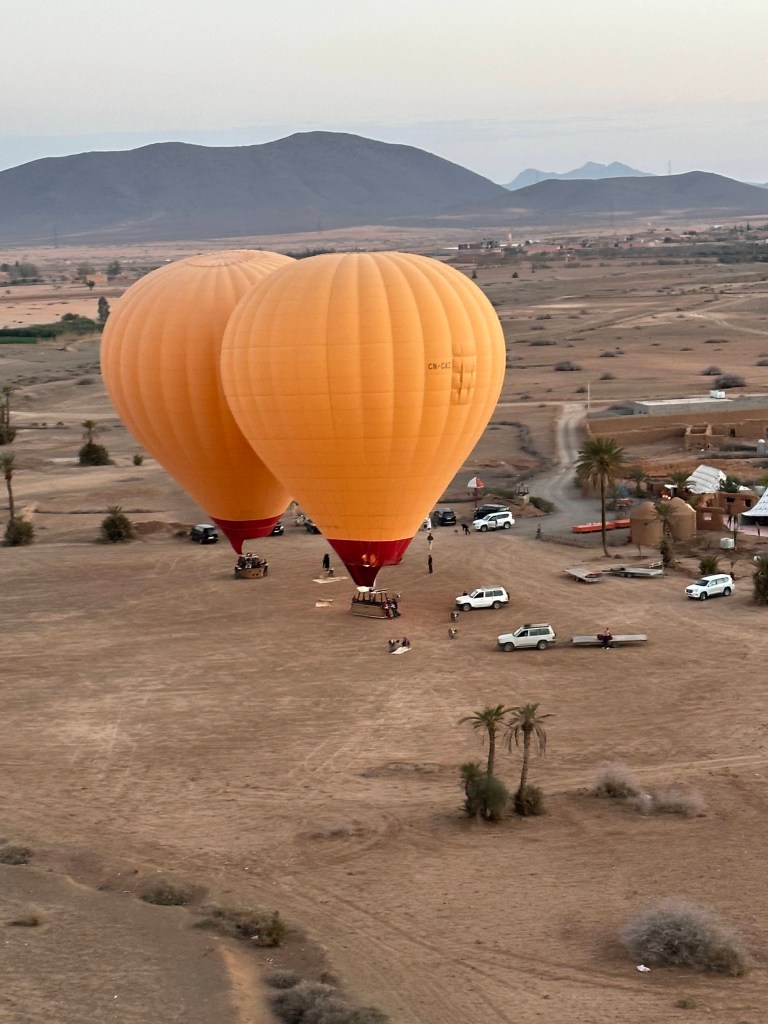
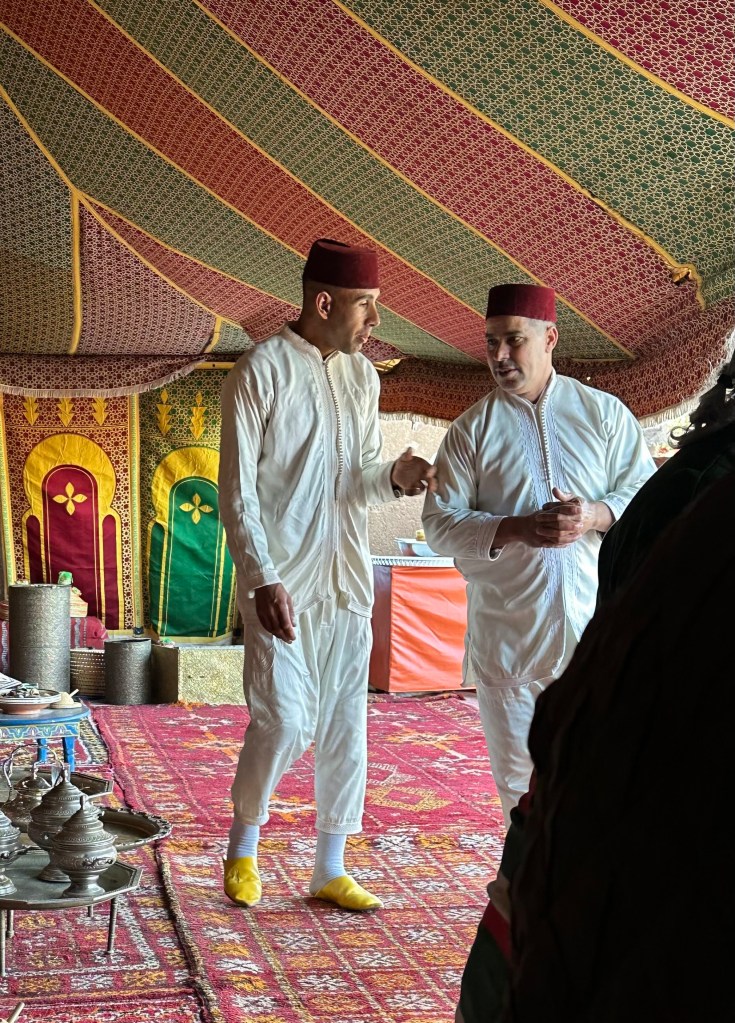
Meeting our tour meant an early alarm and departing in the dark. Once again, Aman escorted us to the parking lot and talked to the driver. We were a group of eight in the van. There was some confusion on our part as to whether we were with the right tour. Attendance taking was pretty lax and we were never asked to show our ticket. But it seemed we were all headed for a balloon ride, so that was good enough. The drive there was actually scarier than the balloon ride. Our driver was going very fast on the highway and when we went off -road, things got pretty bumpy. We arrived at the compound in the dark. There was a huge tent, bathrooms, hot coffee, tea and croissants to enjoy while we watched the crew prepare the balloons. There were three huge balloons in our compound. Later, we would realize that this was one of many balloon launching sites in the area.
The CompoundBerberTentFilling The Balloons
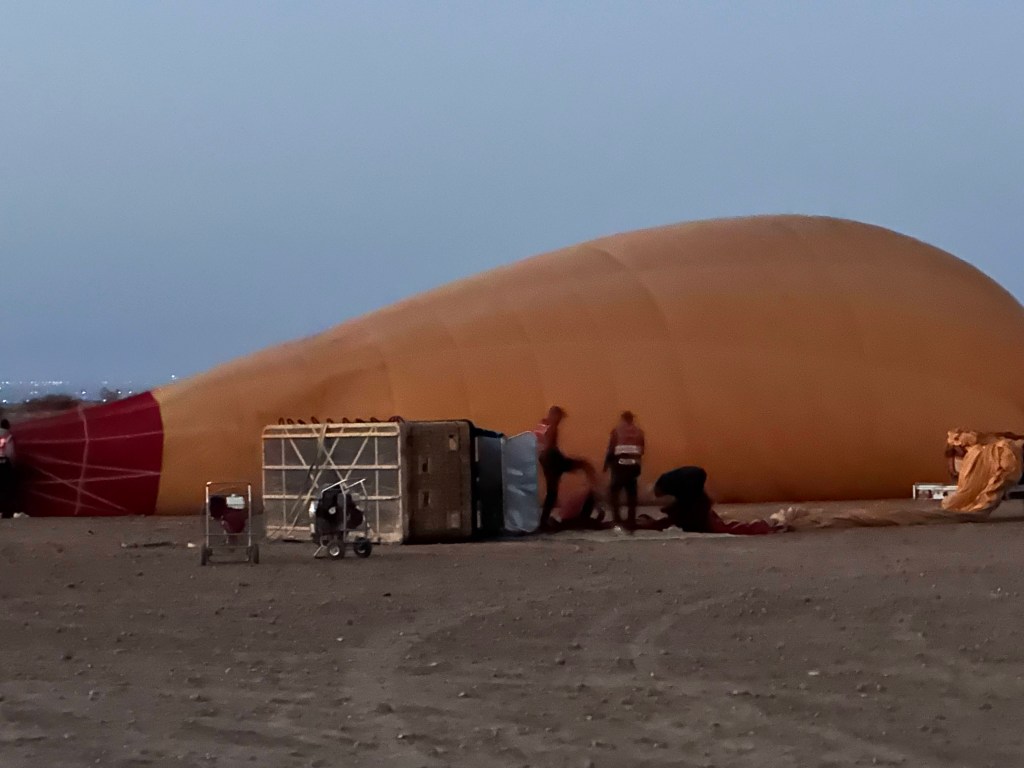
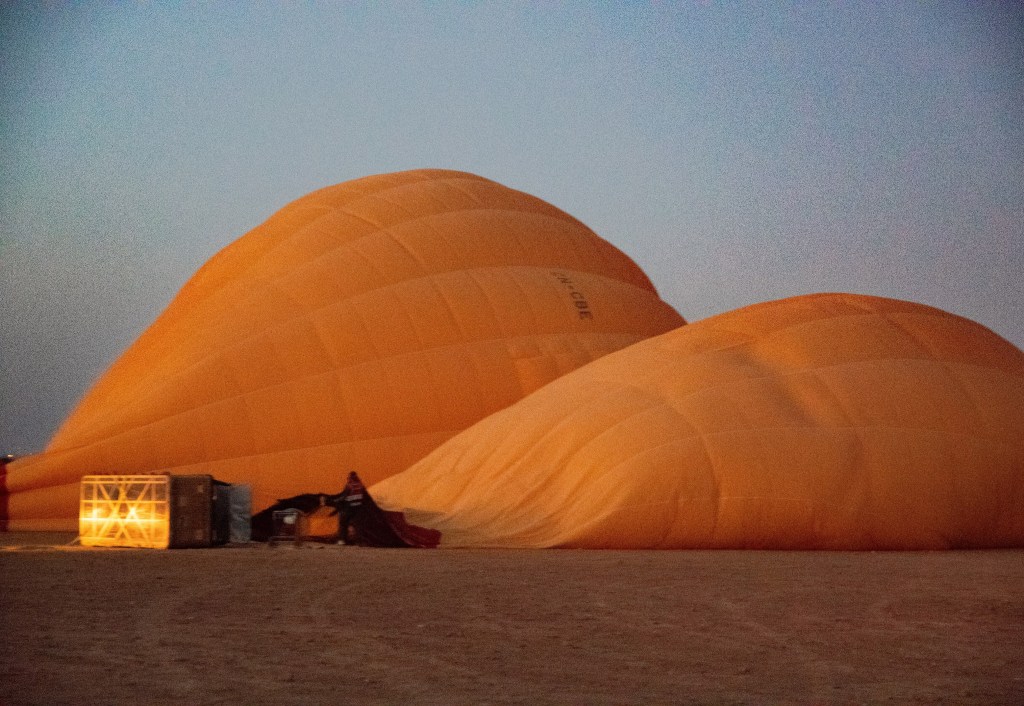
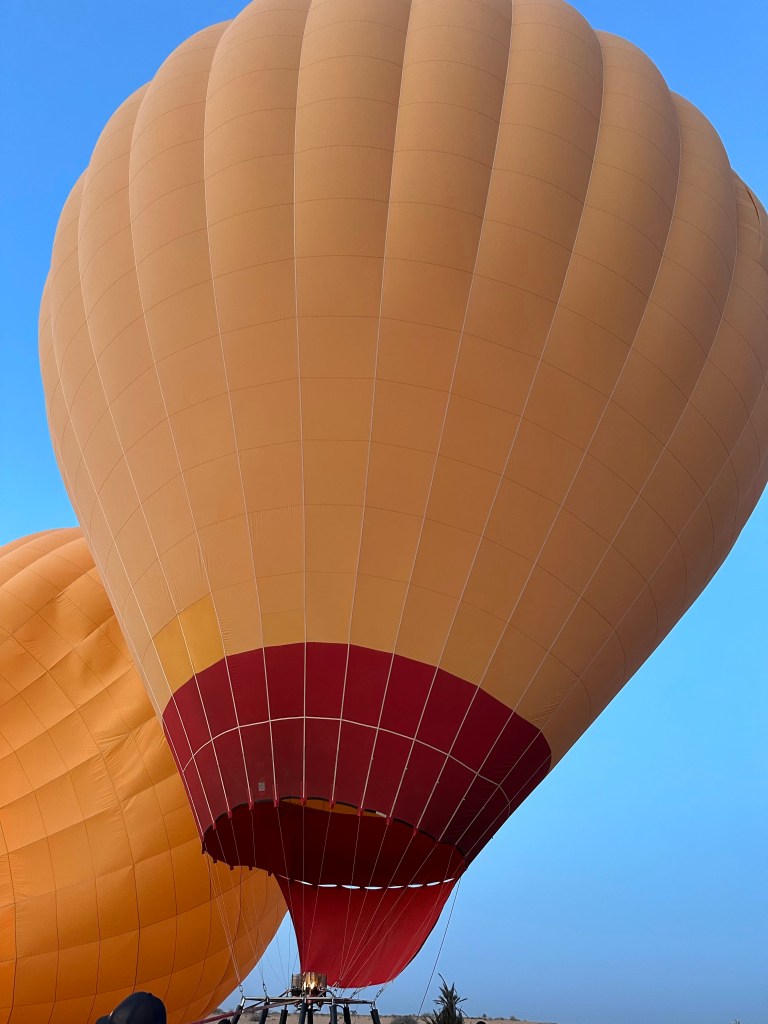
At first light, they began filling the balloons one at a time. They lay on their sides; once filled, the crew rights the gondolas. Once they were prepared, we were signaled to line up to get in a gondola. Twenty people fit in each gondola. You have to climb over the side to get in and it is no small feat, because the gondola walls are pretty high.
(Double click on photos for larger view)
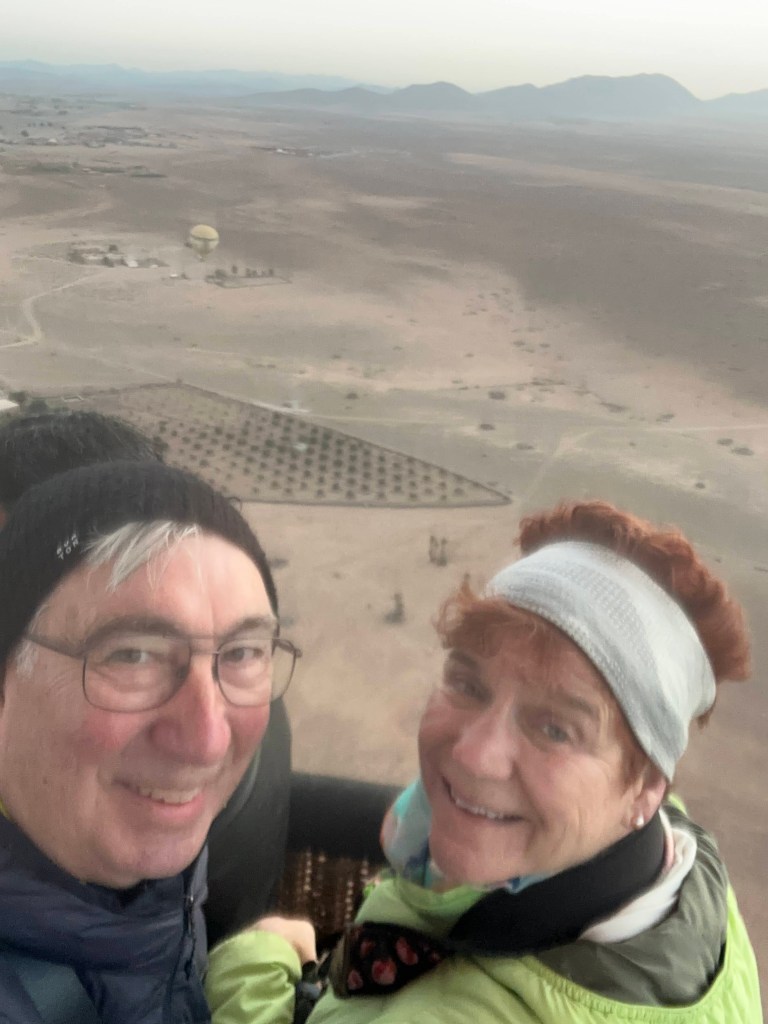
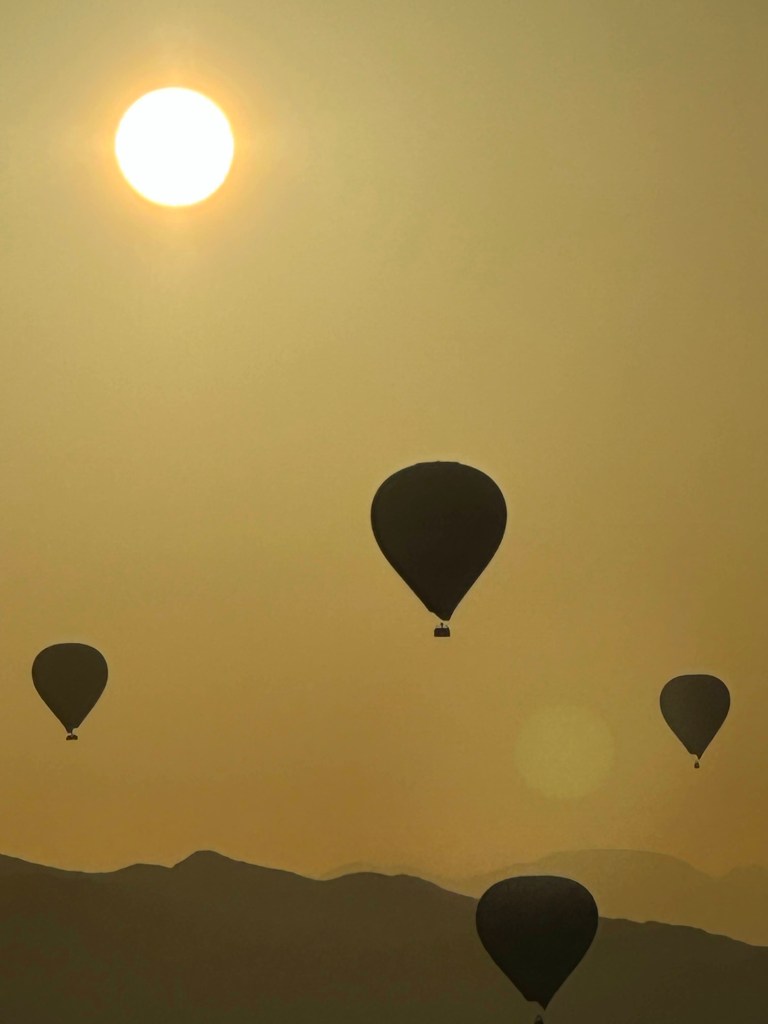
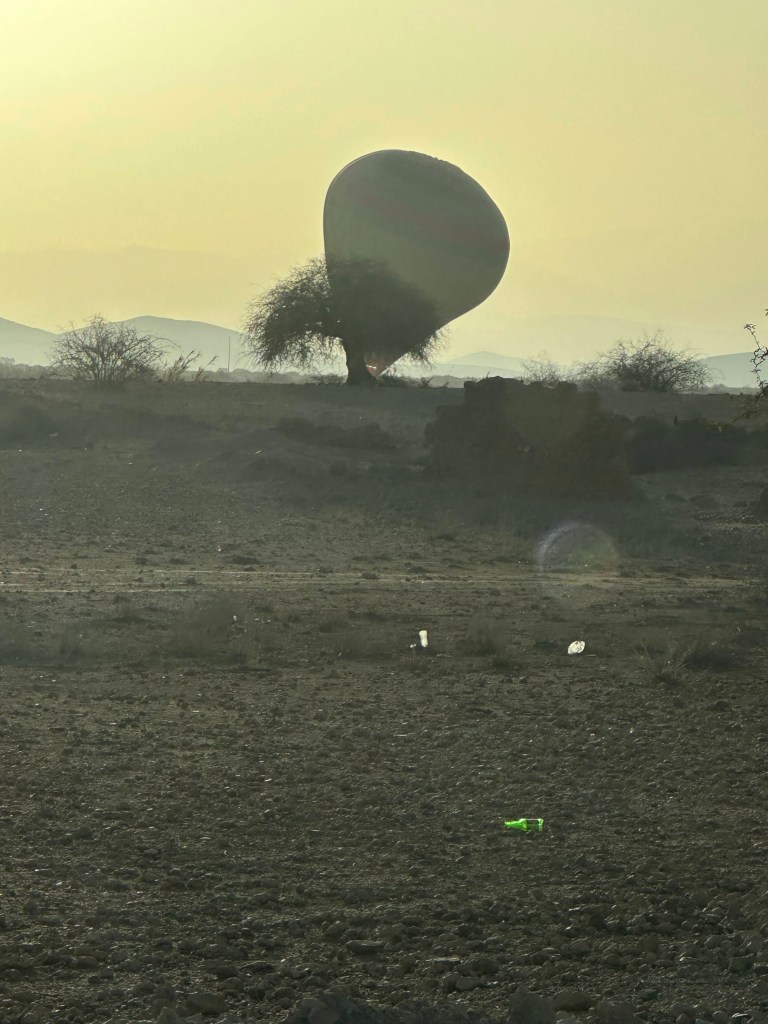
When our gondola was filled and our weight properly distributed, the captain fired up the “engine”, the crew cut the ropes, and we began to rise. It is a gentle rise and so quiet that it wasn’t scary at all. The sensation of floating 1500 meters above the Moroccan dessert is amazing! The sky was filled with balloons as the sun rose over the Atlas mountains. There was some friendly conversation and photo taking in the gondola; but there were also long minutes of silence as we all contemplated the beauty of the experience. We floated peacefully for a good hour.
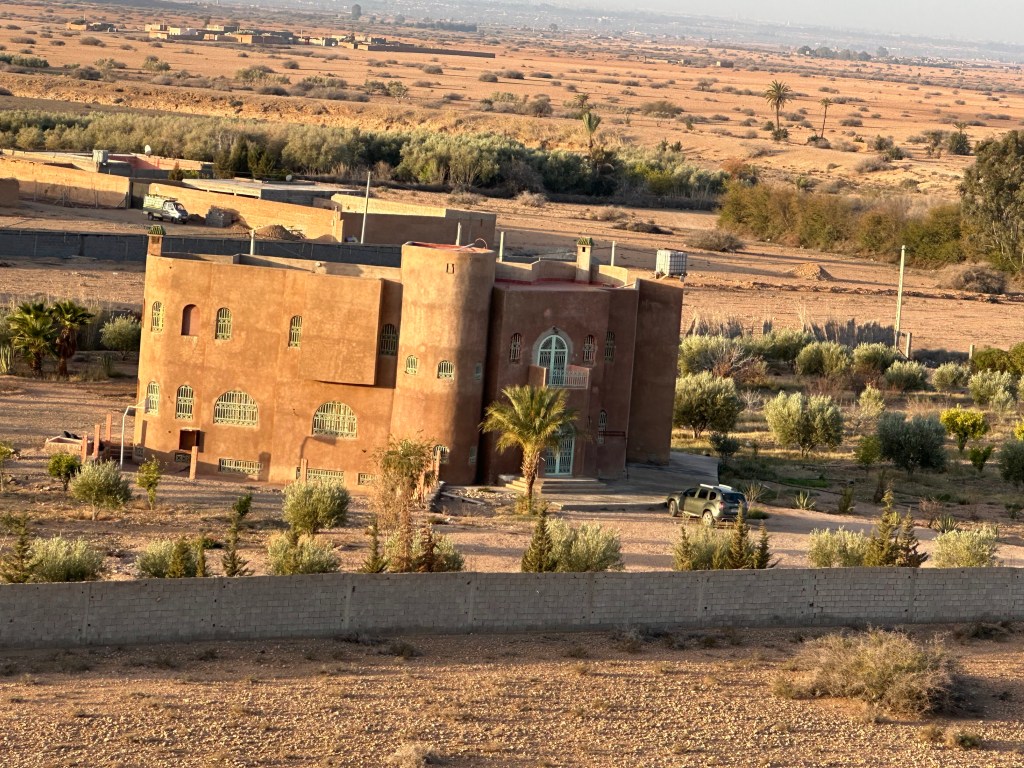
Gradually, we began our descent. We floated over abandoned compounds, small villages, and luxury villas. We could see a caravan of balloon crews following our path. The captain announced, “When we get closer to landing, we will all face one direction, bend our knees and hold on with both hands.” Only then did I consider that the biggest challenge lay ahead: a safe landing. Our captain then told us to take our landing posture and without delay, he “stuck” the landing. The crew ran over and held down the gondola, and began removing passengers a few at a time. Bill and I were among the first. Once on the ground, I looked up and noticed that the balloon was rising again, taking the crew members with it. They were hanging on to the outside as it went air born. I have to say, I was relieved to be out of the gondola. It didn’t take long for it to land again, this time for good, and everyone exited safely.
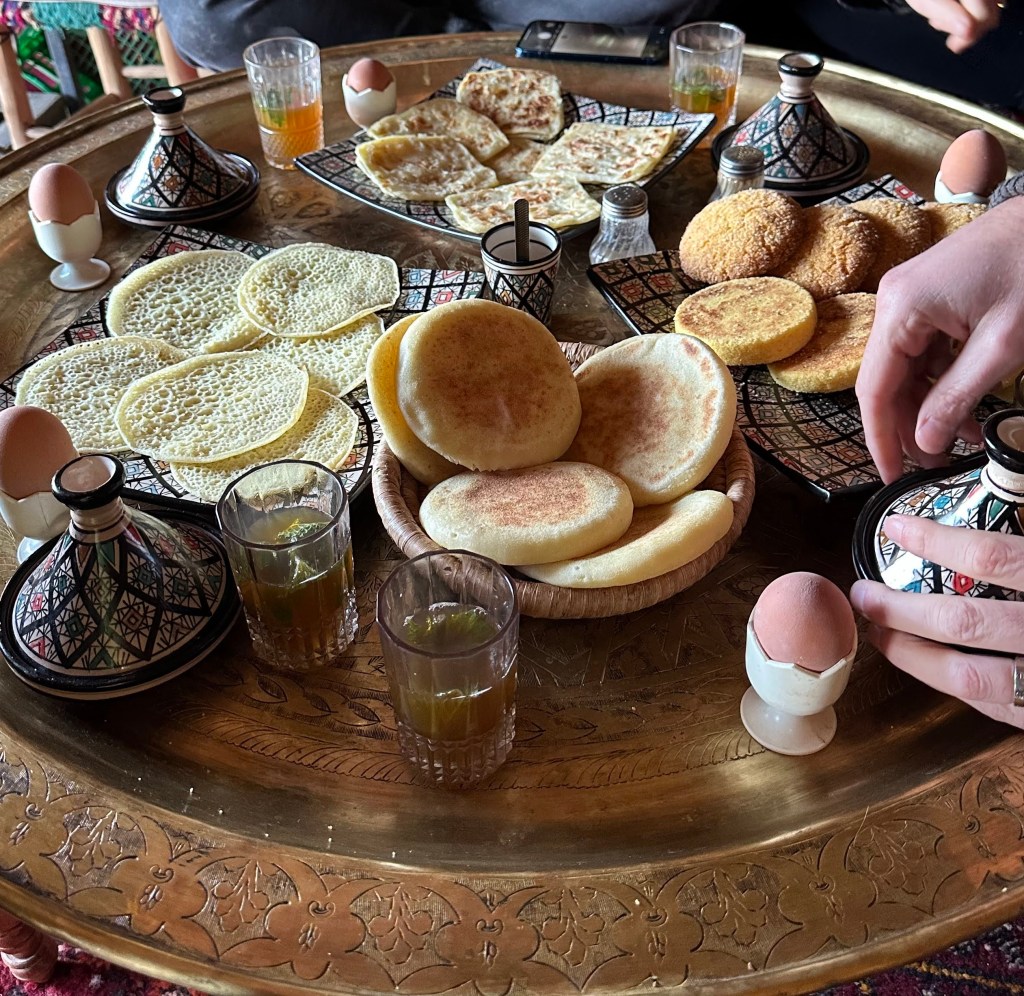
Now, it was time for breakfast. Moroccan breakfast is a carbohydrate heavy feast. There are always at least two kinds of bread and two kinds of pancakes, along with donuts, coffee and tea. Usually, an egg is offered, and often fresh fruit.
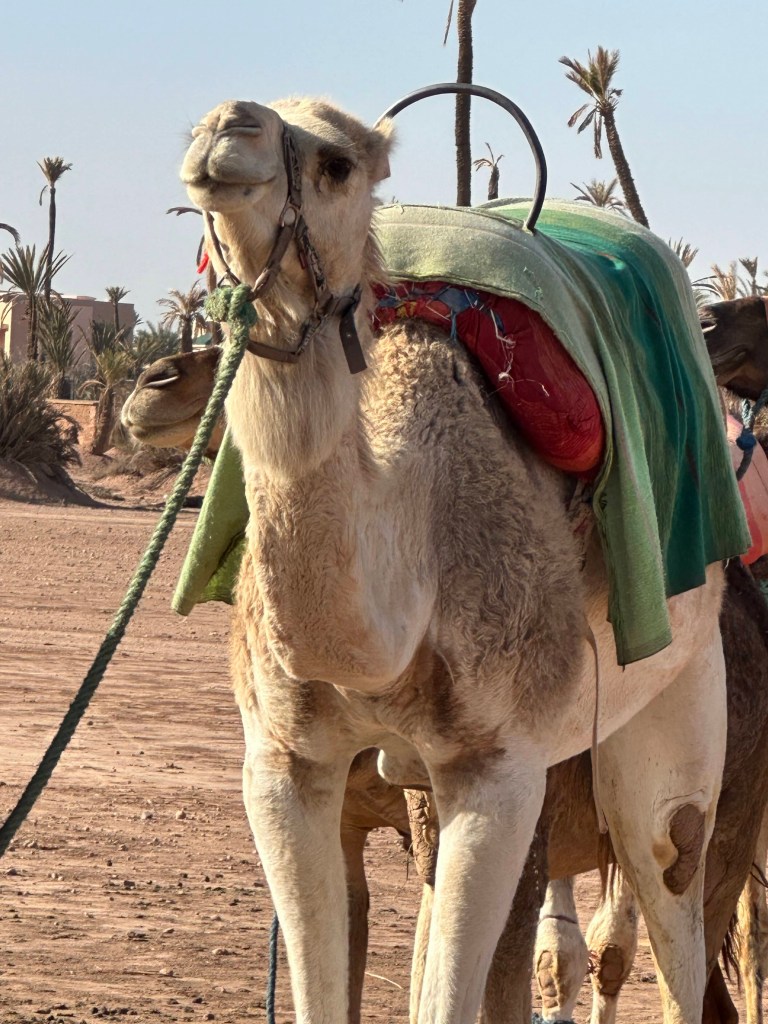
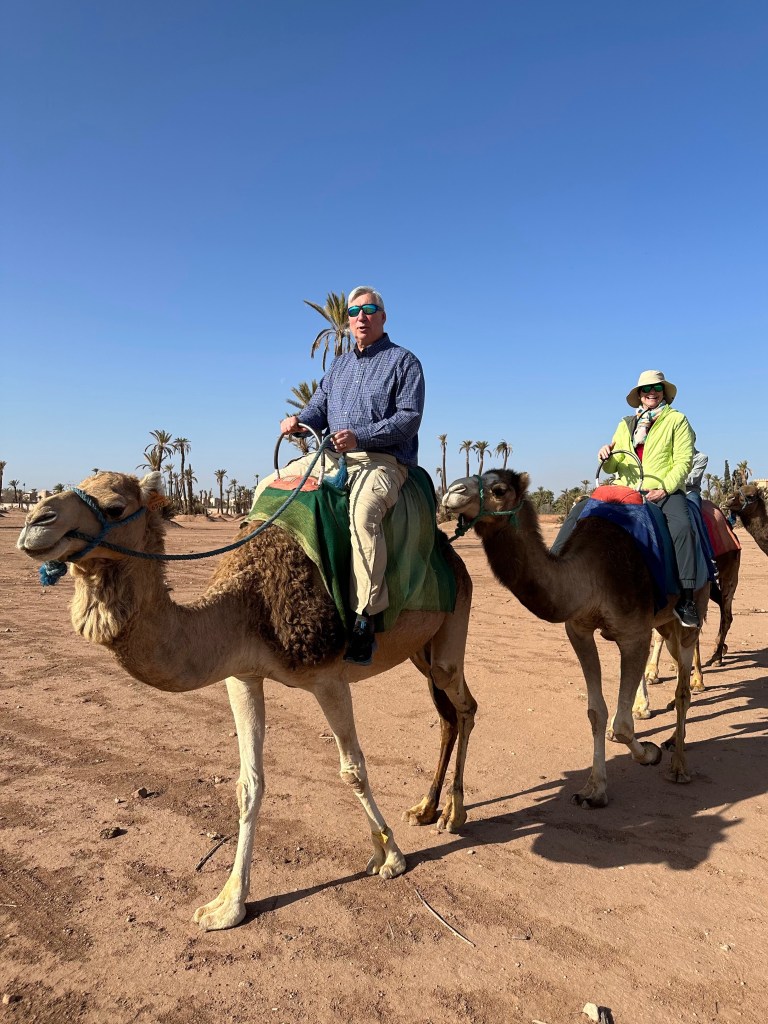
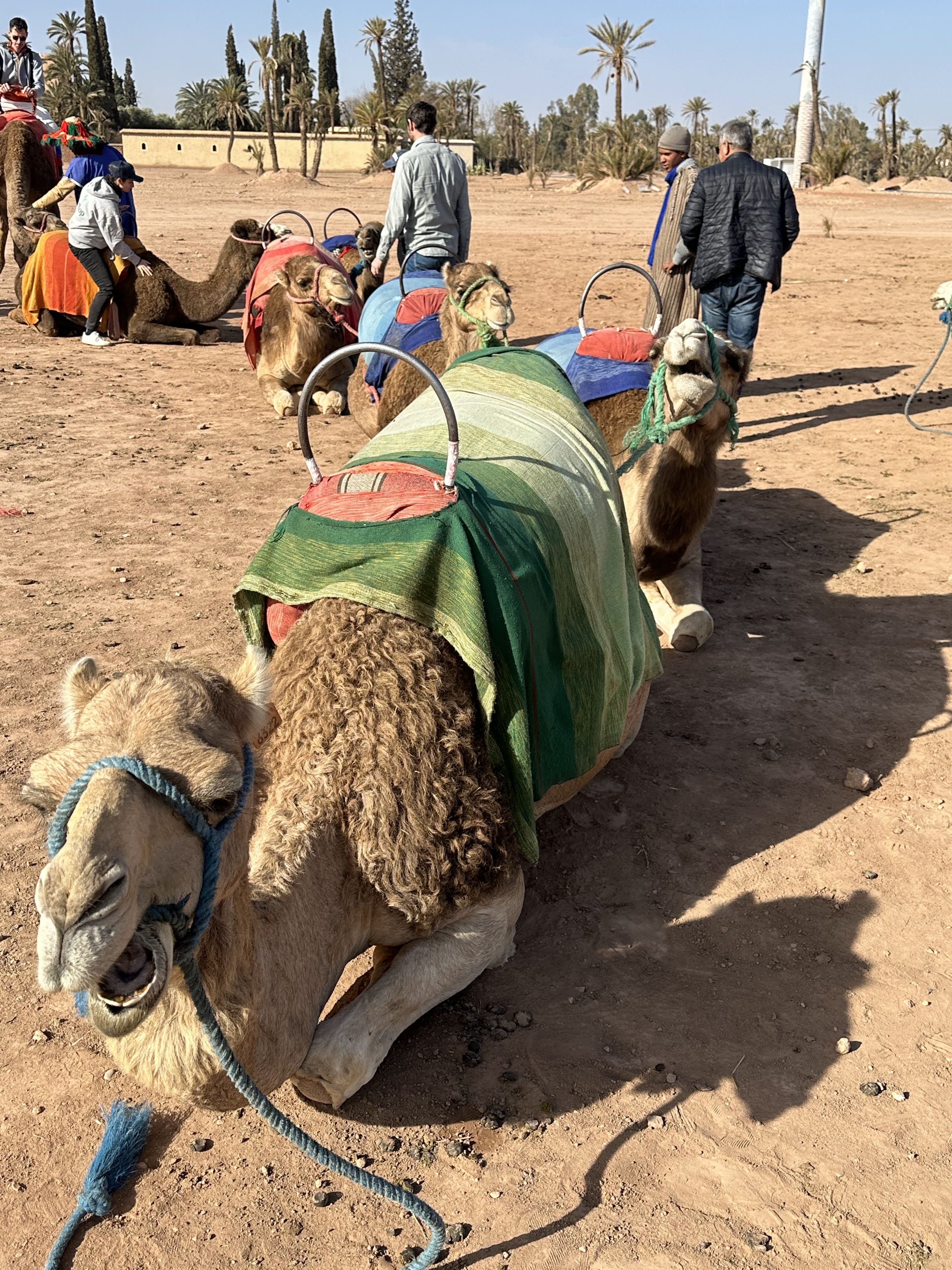
After breakfast, we were headed to the camel compound. Bill had not yet decided if he was riding. When we got there, one group was departing and another arriving. Things looked pretty tame. The camels were tethered together and they get down low to the ground for people to mount and dismount. Truthfully, that didn’t look very comfortable for the camel. The guide assured me that the animals are well-treated and only work mornings. The next thing I knew, Bill was aboard the lead camel! The ride was only about twenty minutes, which was probably just enough. To dismount, you have to lean back, way back. There is a brief moment that feels like you might get thrown, and then the camel is down and you climb off.
After our camel ride, we had an uneventful ride home. Another bucket list item accomplished!
By now we were feeling pretty comfortable in Marrakech. We wanted to go out for a nice Saturday night dinner, perhaps with entertainment.
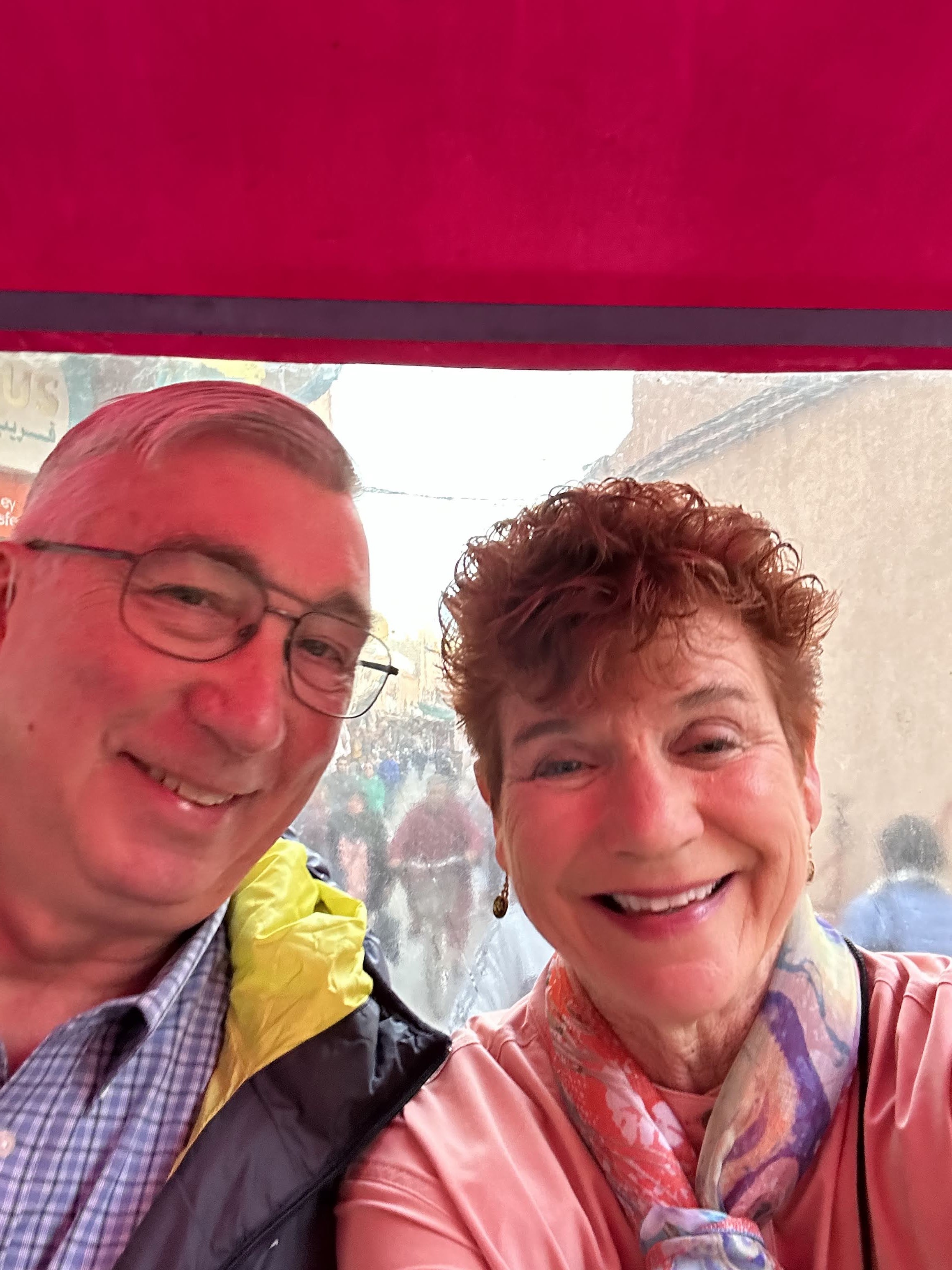
Sana suggested La Tanjia in Place des Ferblantiers, the main square in the Jewish quarter. She also suggested we go by Tuk-Tuk, since it was over a half an hour walk each way. That seemed like a good idea. Aman from the Riad walked us down to meet the driver and explain where we were going and that he should return to pick us up after dinner. The restaurant hostess would call him when we were ready. We climbed into the back of the Tuk-Tuk and greeted our driver. A moment later, we were careening through the Medina, tires bouncing, horn beeping, narrowly missing people and banging into the door of a souk. Dirty looks were directed our way. Our driver was shouting in Arabic the whole time, as we held on for dear life. It was like a carnival ride; frightening and fun at the same time. We arrived at La Tangia and my heart rate returned to normal.
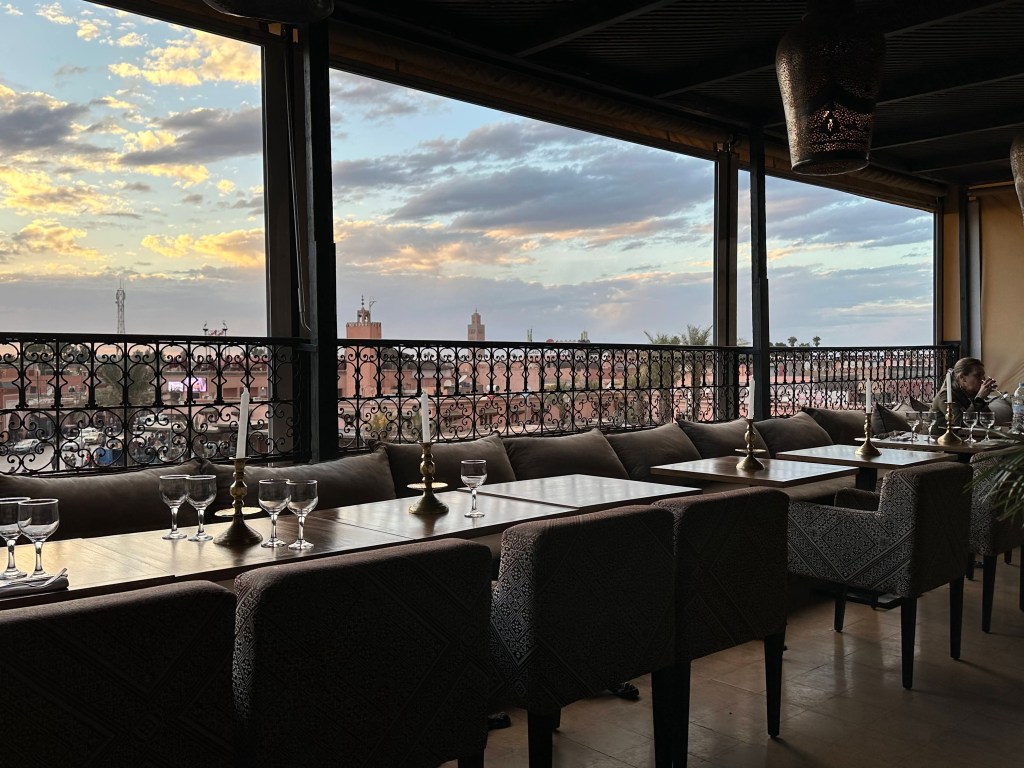
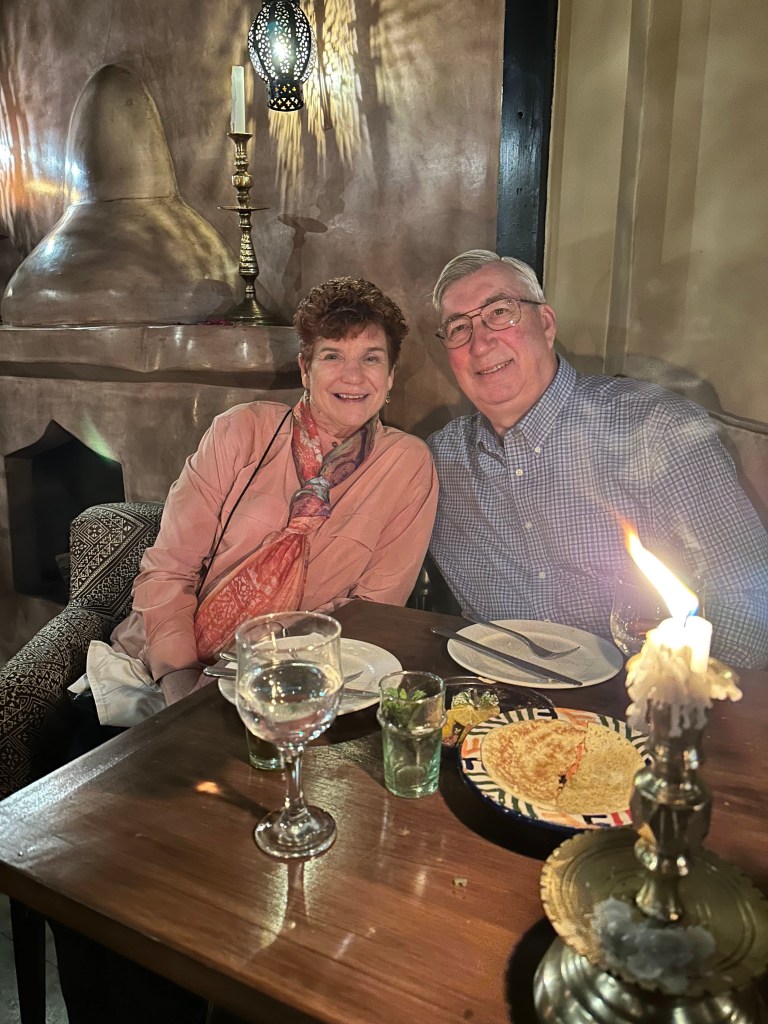
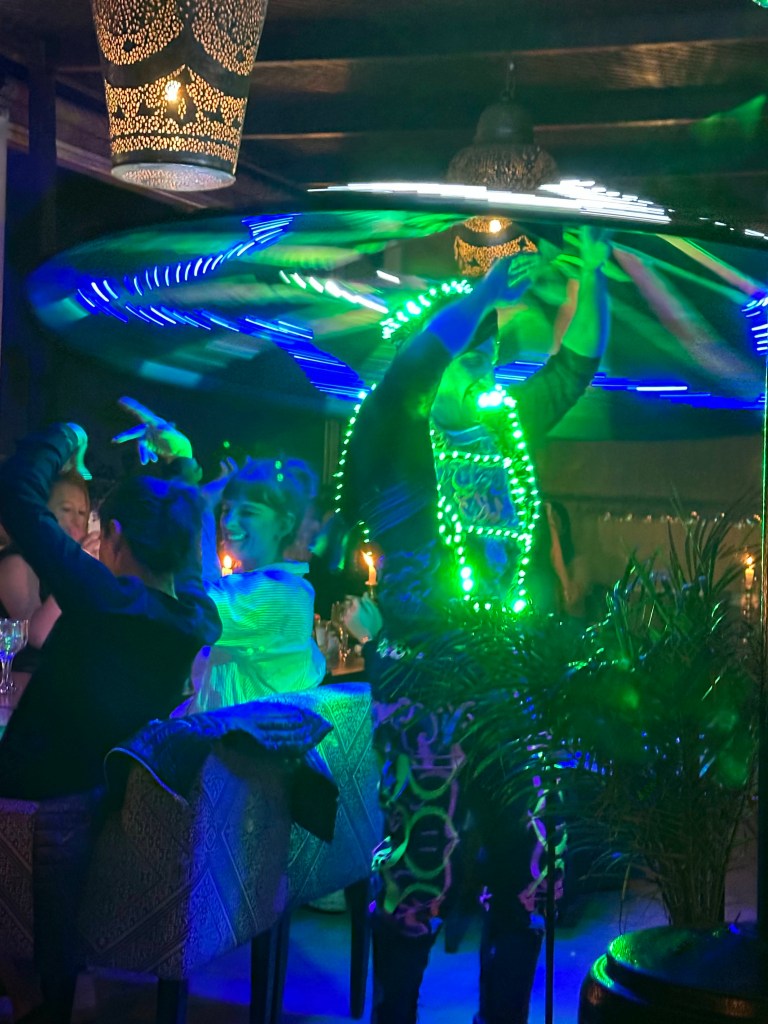
Dinner was delicious and the view was spectacular. Toward the end of our meal, the entertainment began. Joyful Moroccan music, belly dancers with candles on their head, a wildly illuminated dancer who swung a large neon umbrella over the tables. Patron participation was encouraged. After dessert, it was time for our return ride in the Tuk-Tuk. Our driver asked if we could pick up another couple nearby. Sure, why not? We went out of the Medina onto a modern boulevard, and then parked in front of a hotel. The driver was talking to us in some mixture of Arabic and French with a little English in the mix. He raved about what a grand hotel this was, a really grand hotel. “The president stays here when he comes to Marrakech.” he bragged, so I asked, ” Is the president going to ride in the Tuk-Tuk with us?” He understood me enough to think that was uproariously funny. He must have been referring to the French president, because Morocco has a king.
A fashionable French couple approached the vehicle and we welcomed them to the back seat. The woman was upbeat, but we sensed that her husband was pretty horrified to be riding in the back of a Tuk-Tuk with AMERICANS. We learned that they were from Marseilles. The wife had been in town for three days for an art exhibition and her husband was joining her for the weekend. He probably had visions of a luxury evening at the grand hotel, but she was dragging him out to visit friends who were renting a place in the Medina.
We drove into the Medina and turned down a narrow street. Another vehicle had parked to unload crates, and was blocking our progress. I’m not sure of the protocol here. There are no one-way streets, stop signs, or no parking signs. If two vehicles come face to face, someone has to back up. Our driver had no intention of being that someone. He aggressively drove toward the other vehicle, yelling the whole time. A couple of guys came to his window to discuss the situation. In moments, we were surrounded by angry men. I began to imagine an international incident. The French couple seemed quite amused by it all, and actually applauded when the other vehicle backed up for our Tuk-Tuk. And just like that, the crisis was averted and we were home a few minutes later. I can’t help but wonder if some of the posturing is theatrics to entertain the tourists.
Place des FerblantiersLa TangiaView of the SquareLa TangiaDancerTuk- Tuk Selfie
Tuk-Tuk Video
We survived the Tuk-Tuk! Next: The Hot Air Balloon.
A Private Photography Walk with Omar (February 11, 2023)
We found Omar’s tour on Air B&B Experiences. He is a local Photographer who offers two types of private experiences: You as the Photographer or You As the Model. Apparently, he makes a decent living doing photoshoots of Instagramers in the exotic settings of Marrakech. I think you can guess which tour we chose.
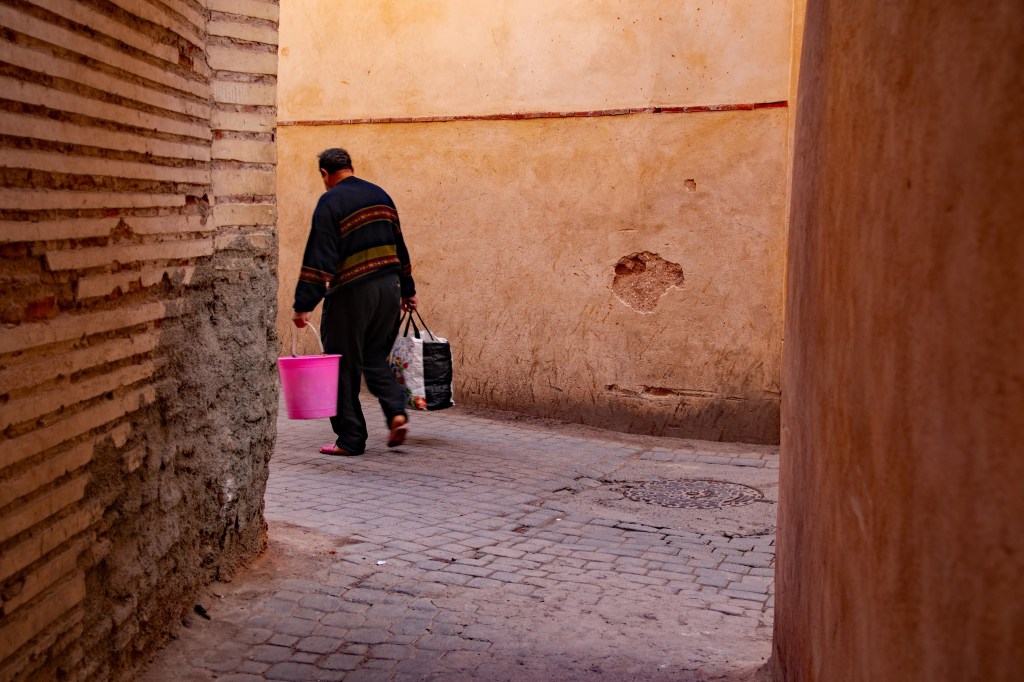
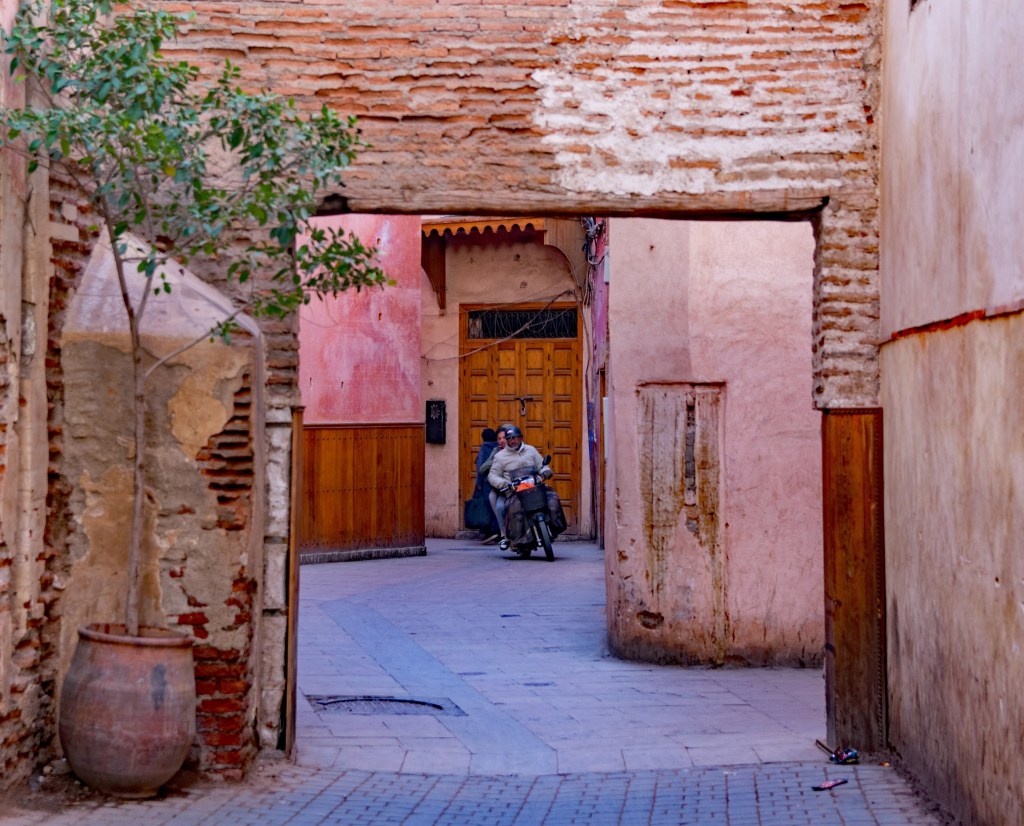
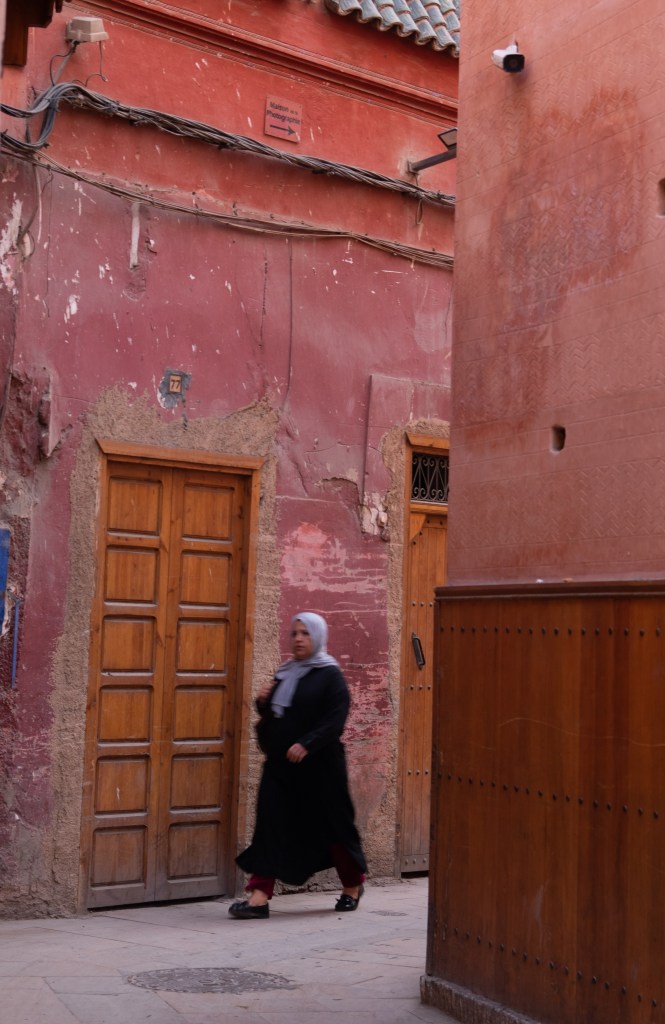
We were scheduled for 8:00 AM, so our Riad served us breakfast early (of course they did). Omar arrived before first light and off we went. Omar explained Street Photography etiquette in Morocco. I had been hesitant about it, not wanting to go against the cultural norms. Omar said it is fine to photograph the architecture, and if people happen to enter your frame, that’s fine too. A quick, unobtrusive shot of someone is fine; just don’t be sticking a camera in their face while you adjust your settings. The artisans and Medina workers we would be meeting have a relationship with Omar; he has paid them for welcoming us to their space.
Early morning is quiet in the Medina. Walking is much more tranquil than later in the day. The souk keepers are slowly setting up shop and drinking their morning tea. The morning light is soft.
This is Omar (He grew up in the desert and has lived in Marrakech for 11 years)
Look who walked into my frame! Remember to double click if you want a larger image.
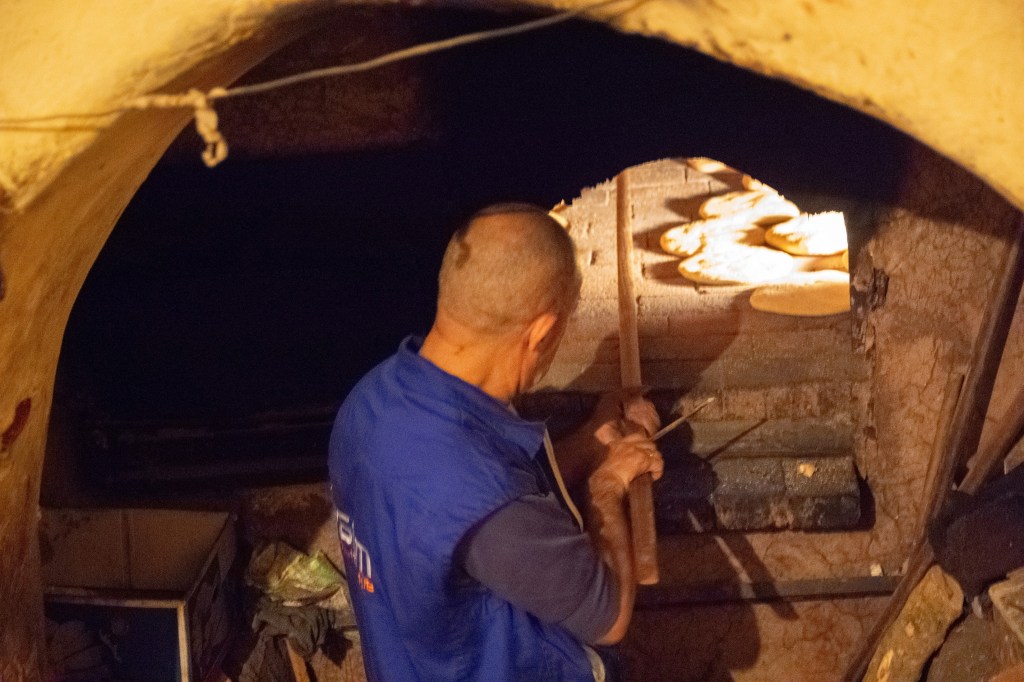
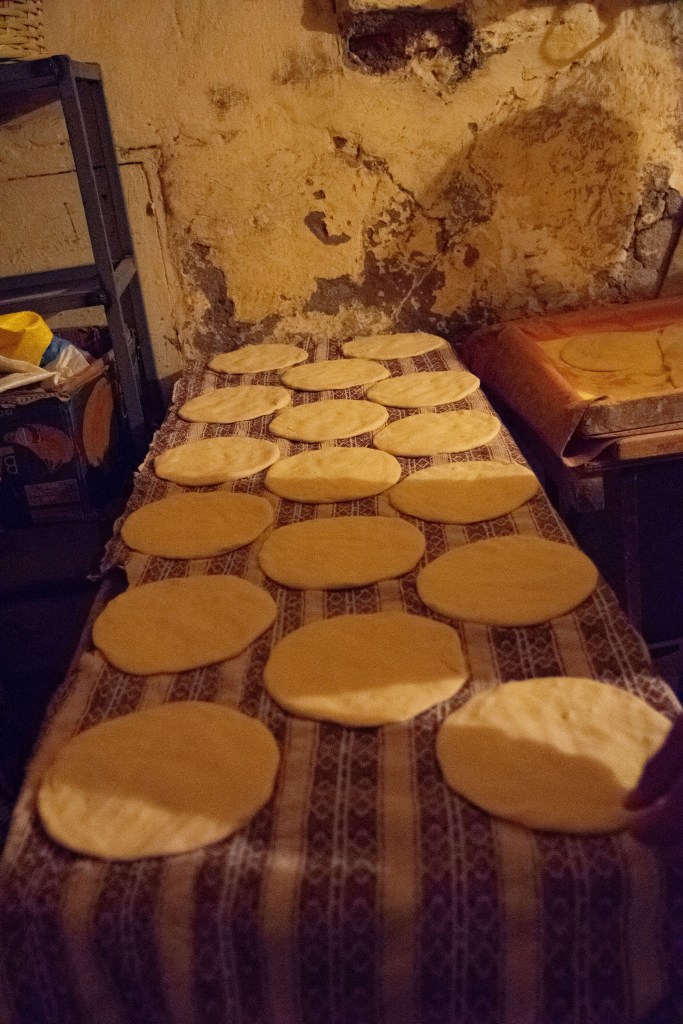
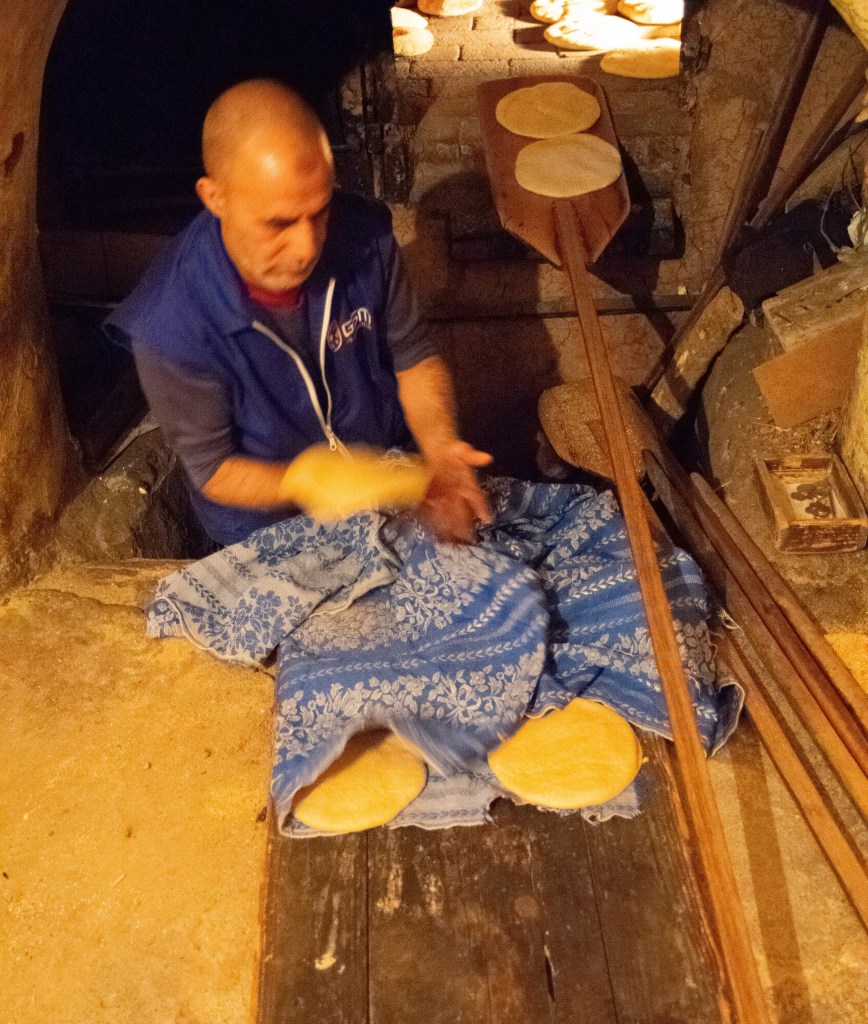
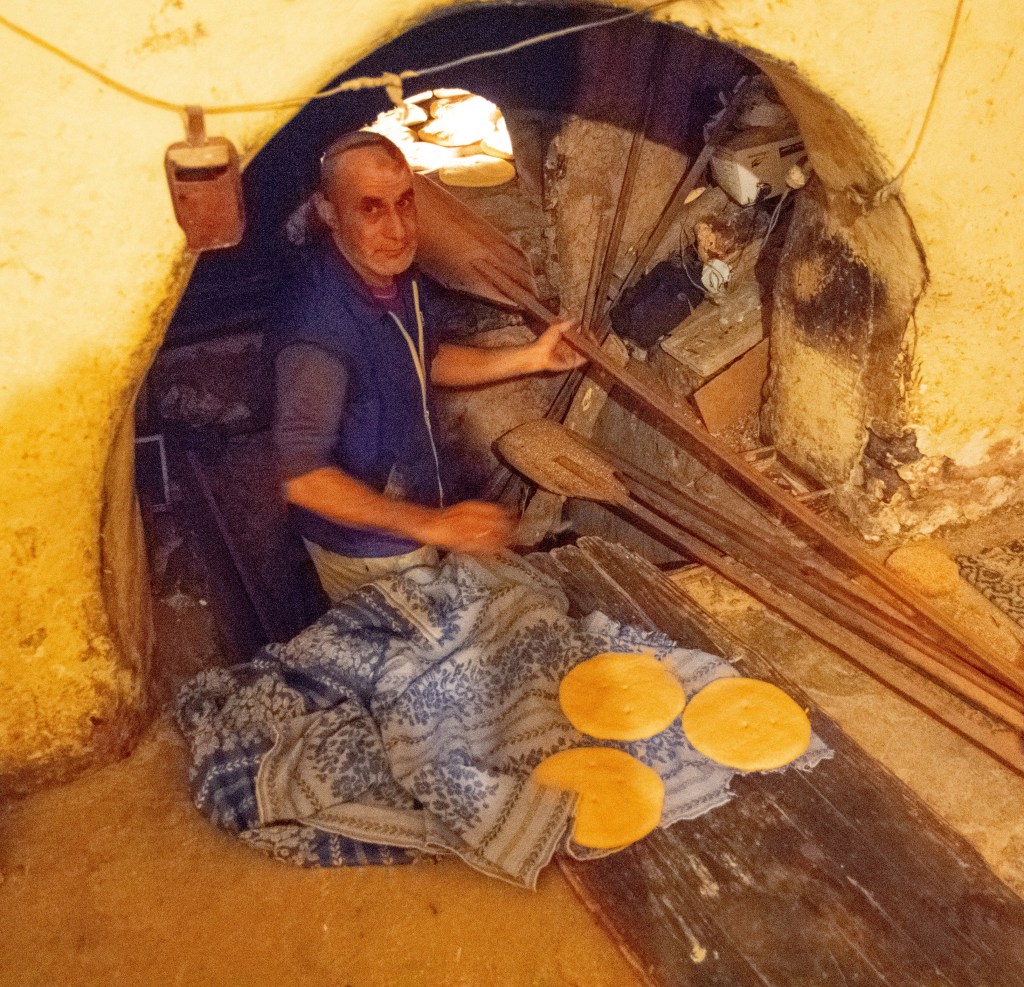
Our first official stop was a bakery. We entered a cave-like space where one baker was forming loaves of fresh dough and placing them onto large wooden paddles for his colleague to bake in the roaring wood burning fire. We ate fresh warm bread while we watched the process. It smelled fantastic in there!
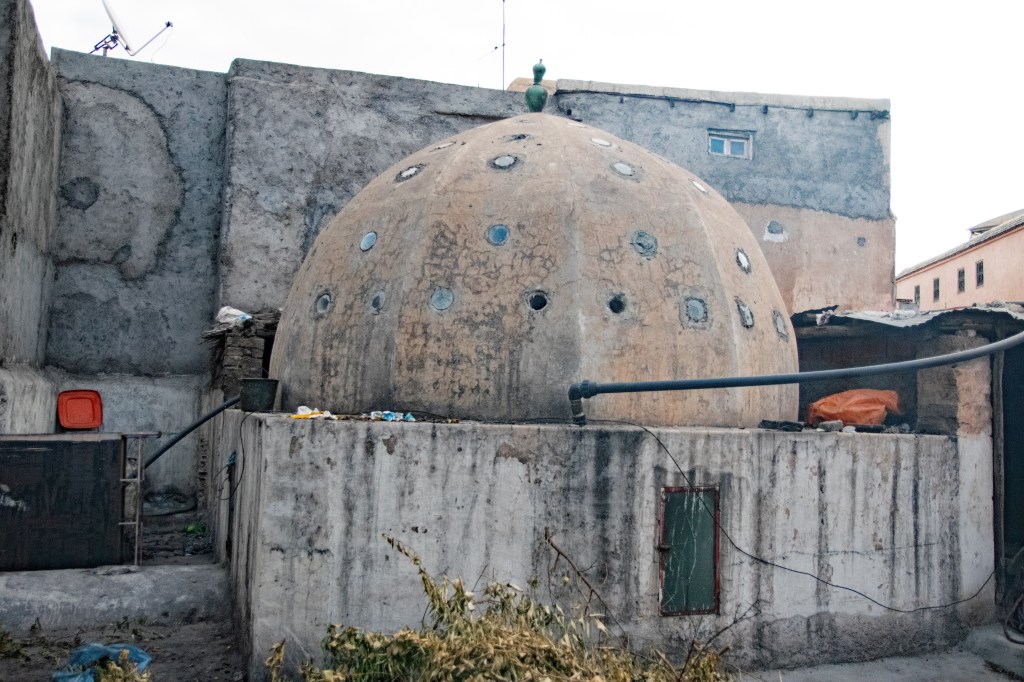
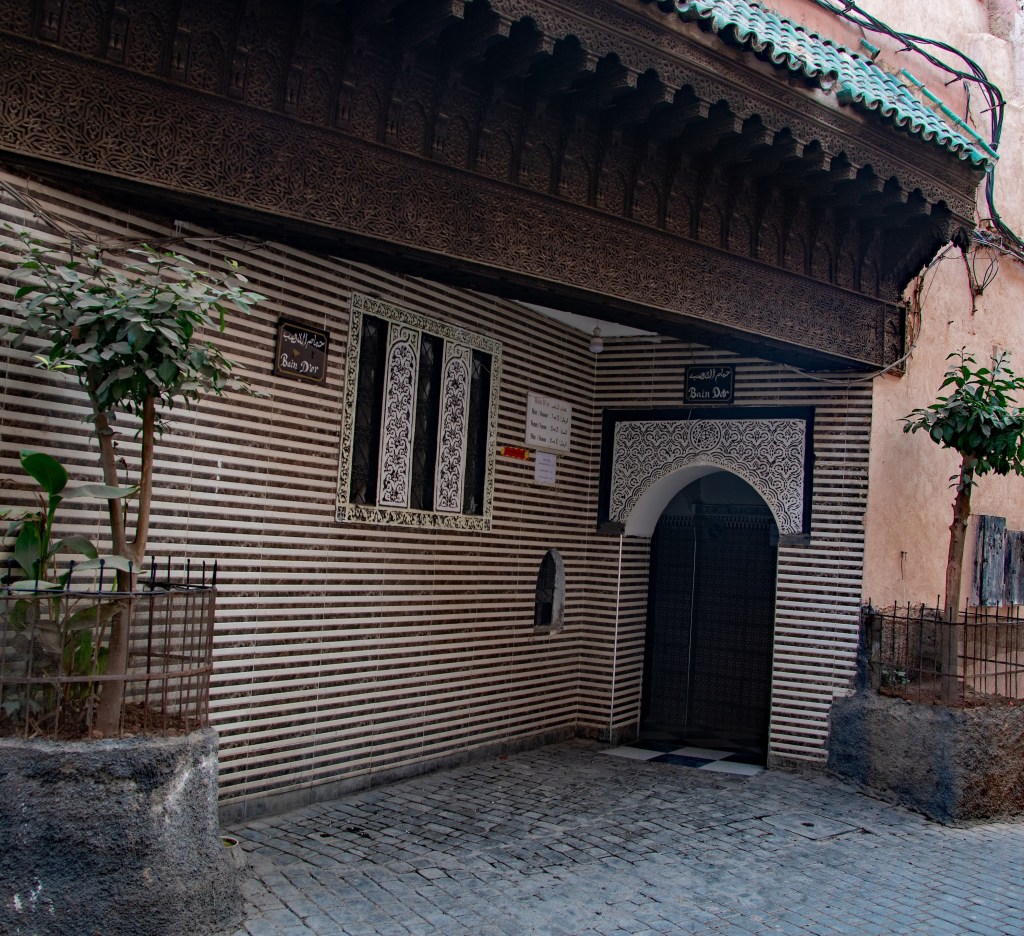
We resumed our walk, and Omar pointed out the neighborhood hammam. The hammam is the public steam bath. In Muslim culture, people visit the baths on a regular basis. Men and women have separate hammam hours. The experience involves three steam rooms of varying temperatures, scrubbing the skin with black soap, applying argan oil to the skin, and relaxing in a cooler room.
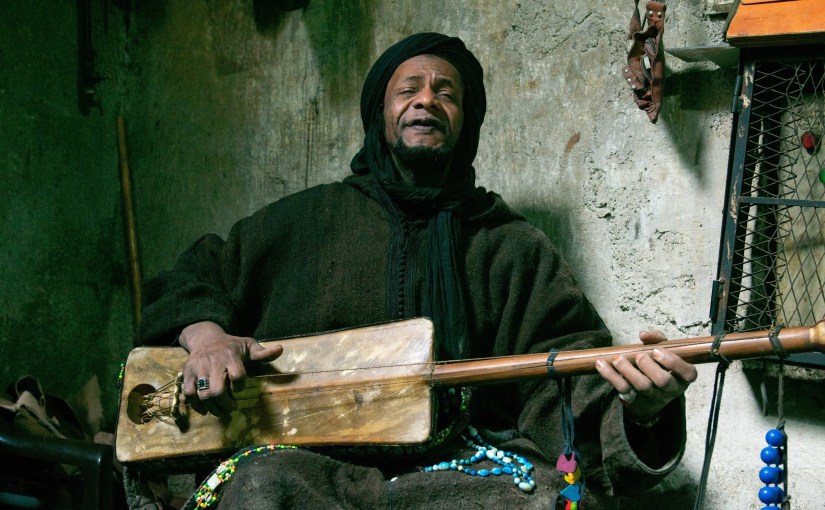
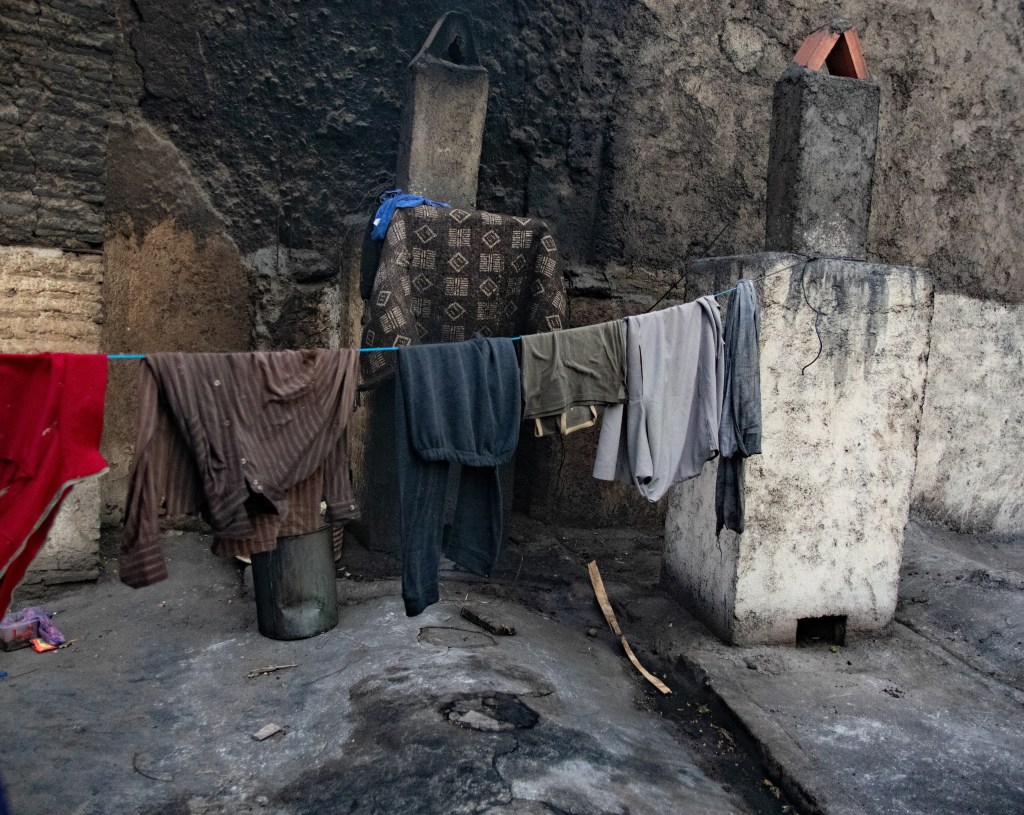
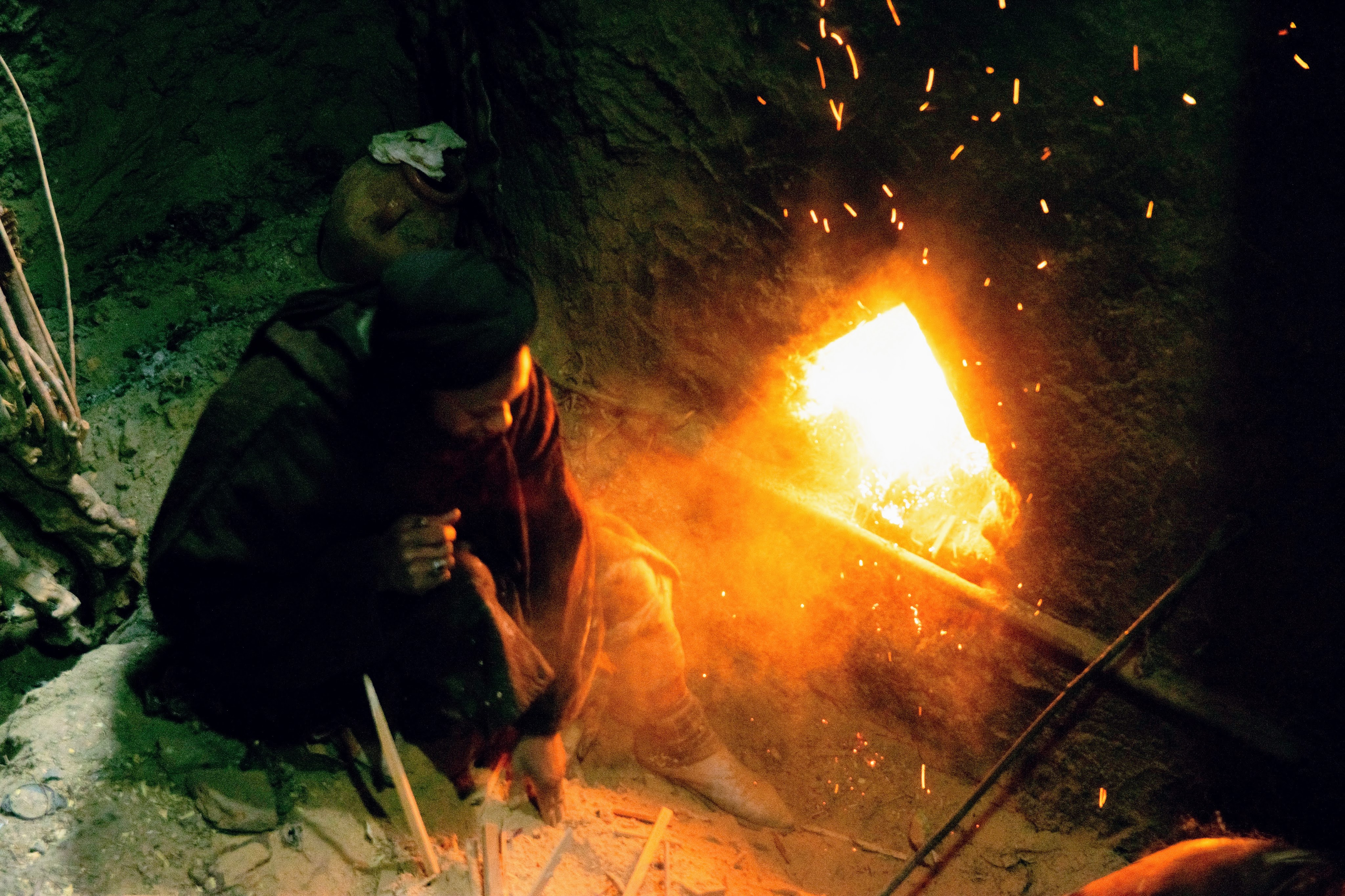
After explaining the importance of the hammam in Moroccan culture, Omar took us into another cave-like space. There was a gentleman living there, who we assumed (wrongly) was homeless and squatting in the space. He immediately offered me his seat and served us hot mint tea and bread with oil. It turns out, he is responsible for keeping the fire that heats the pipes that make the steam for the hammam. That fire needs to burn continuously. We watched him tend his fire, and then he played his traditional Moroccan guitar and sang for us. What a beautiful person!
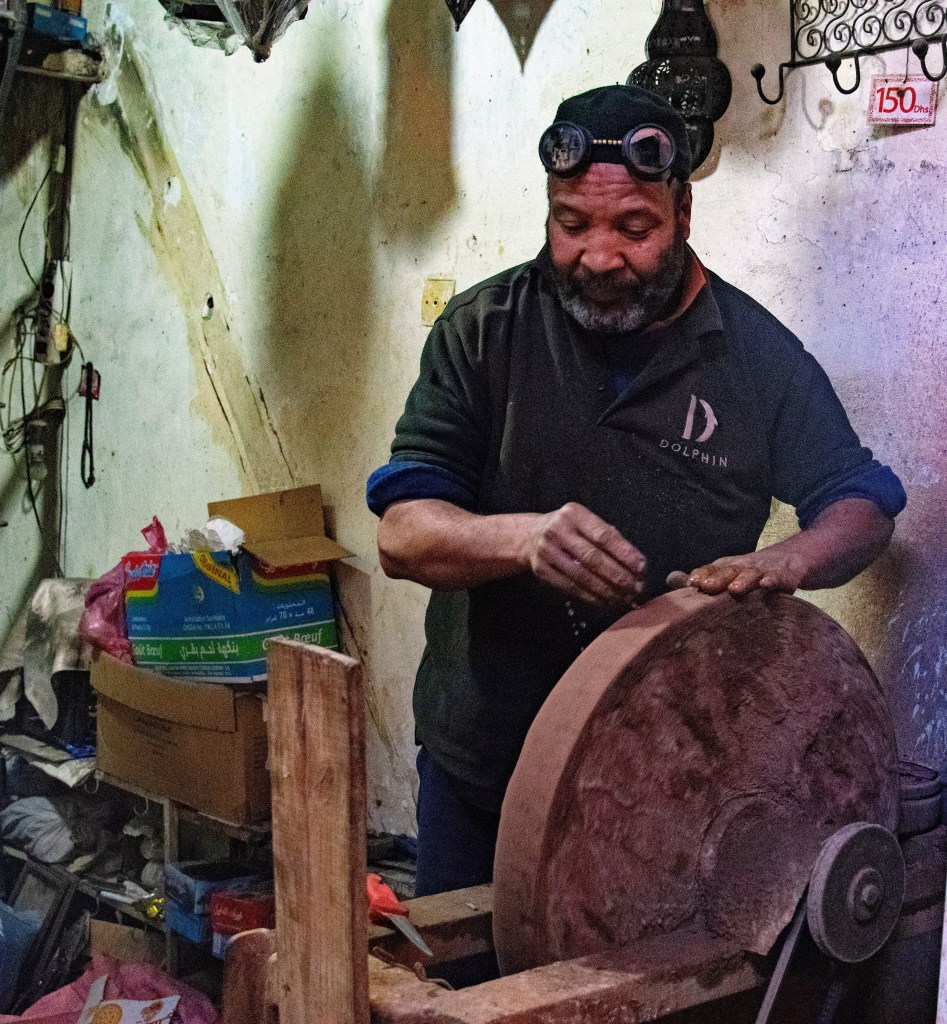
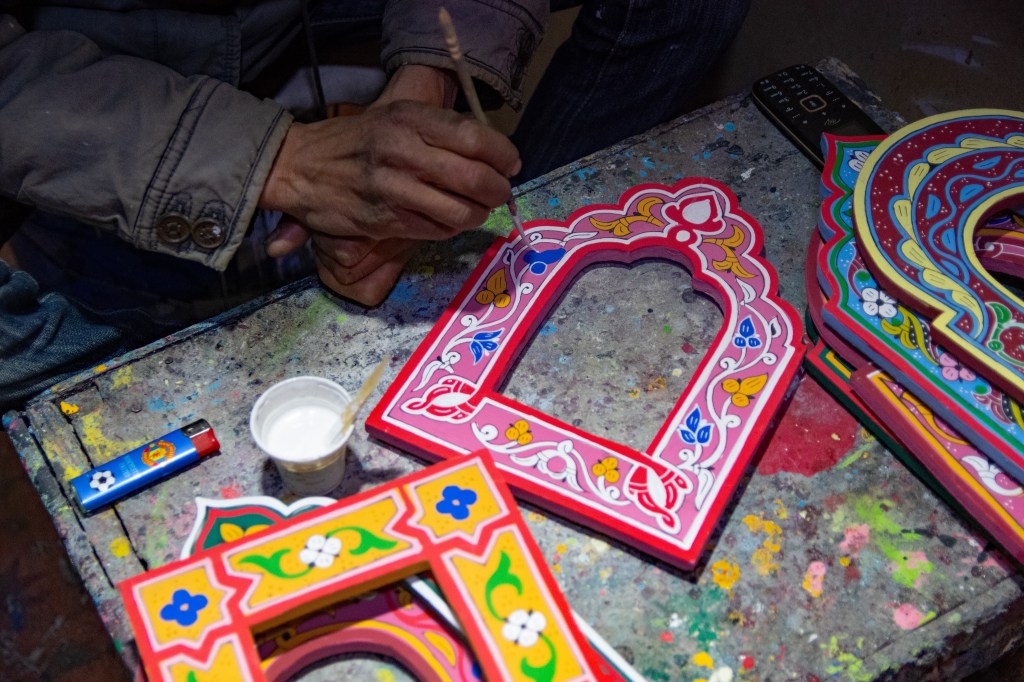
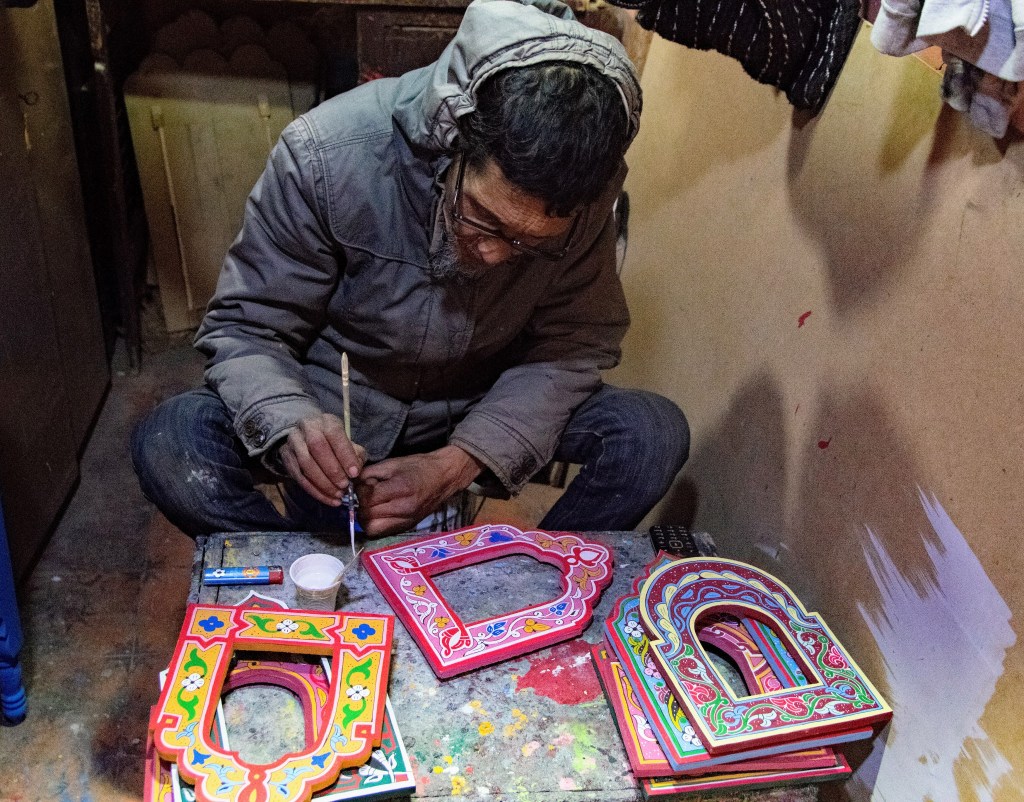
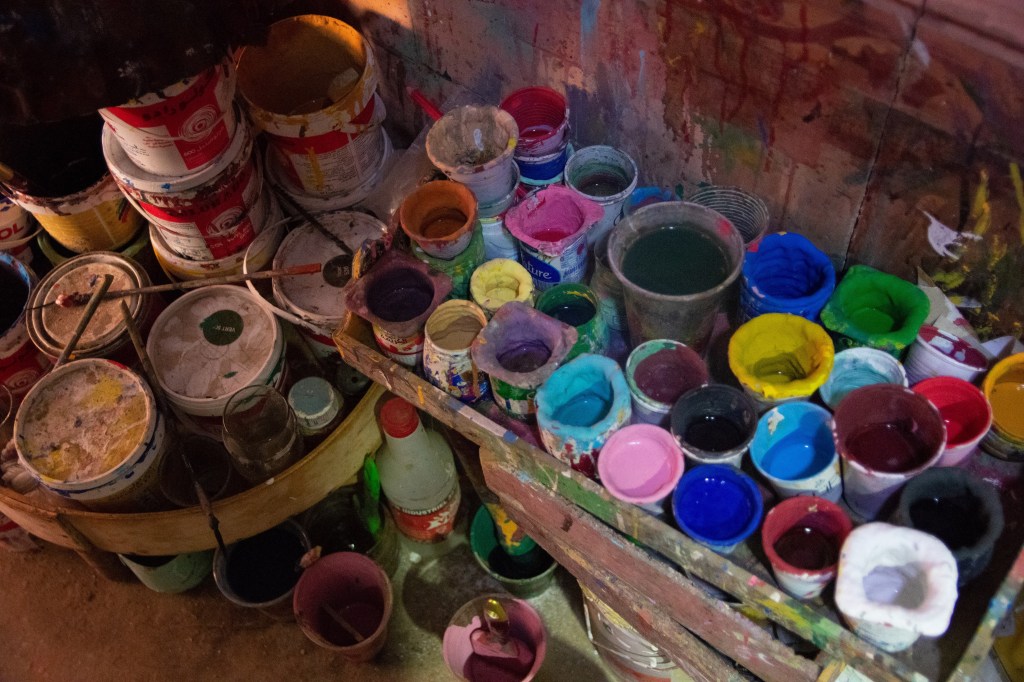
Roof of the HammamRoof of the HammamHammam EntranceHe Keeps The Fire BurningSouksMetal WorkingBlade SharpenerPainterShoesMetal LampsThe PlateCarpetsSpices and More!Mixing Up Some Magic
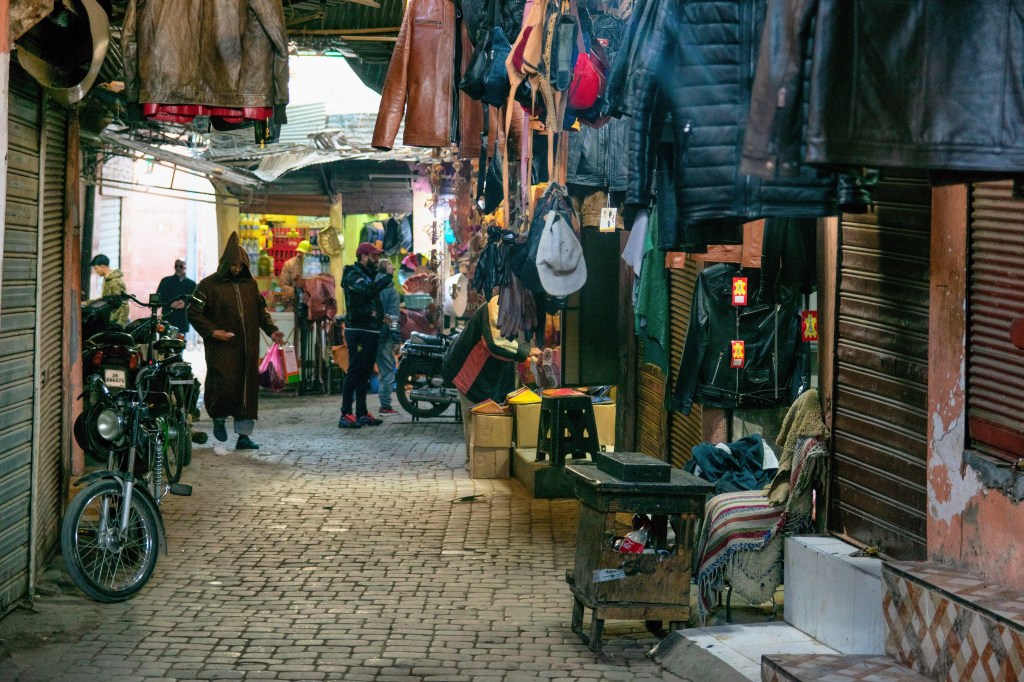
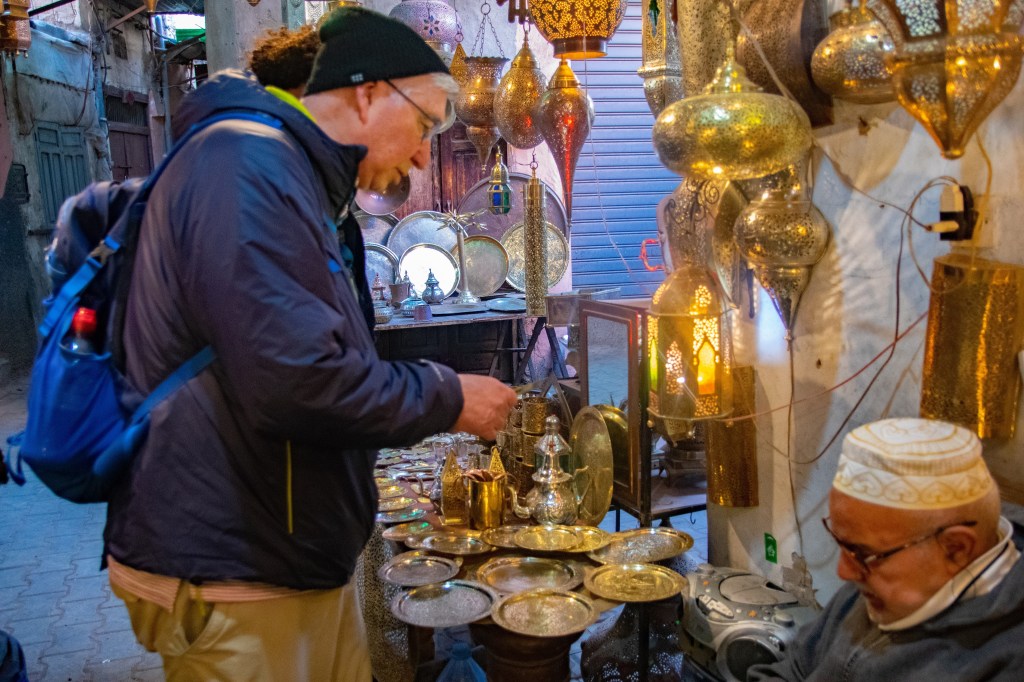
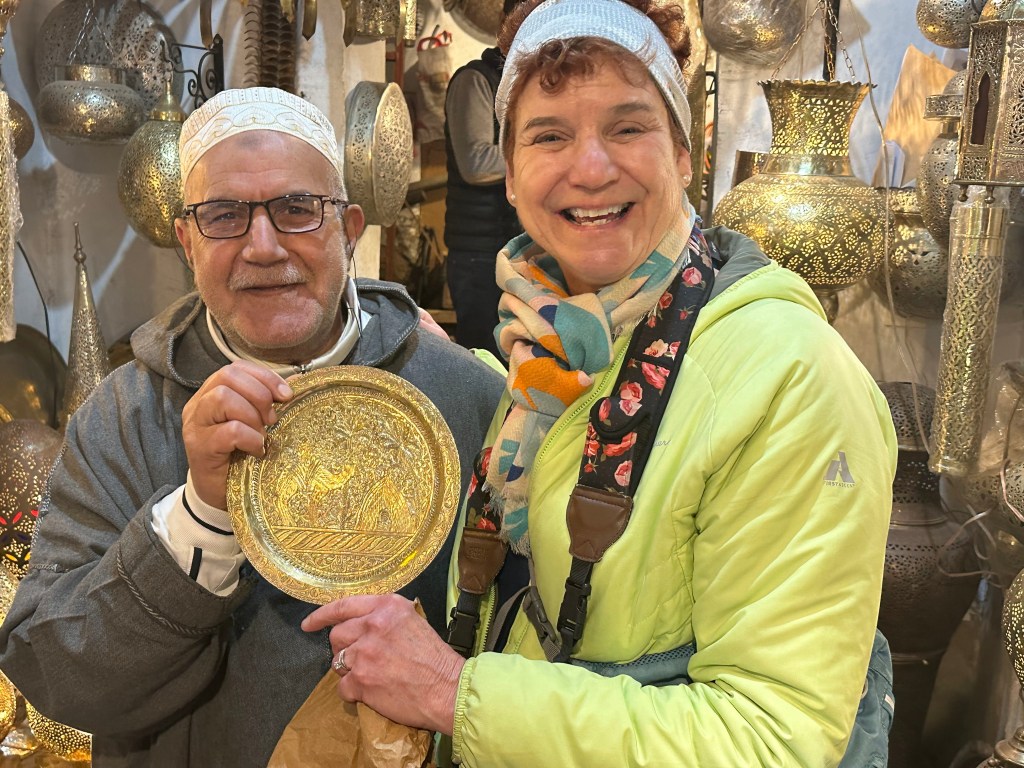
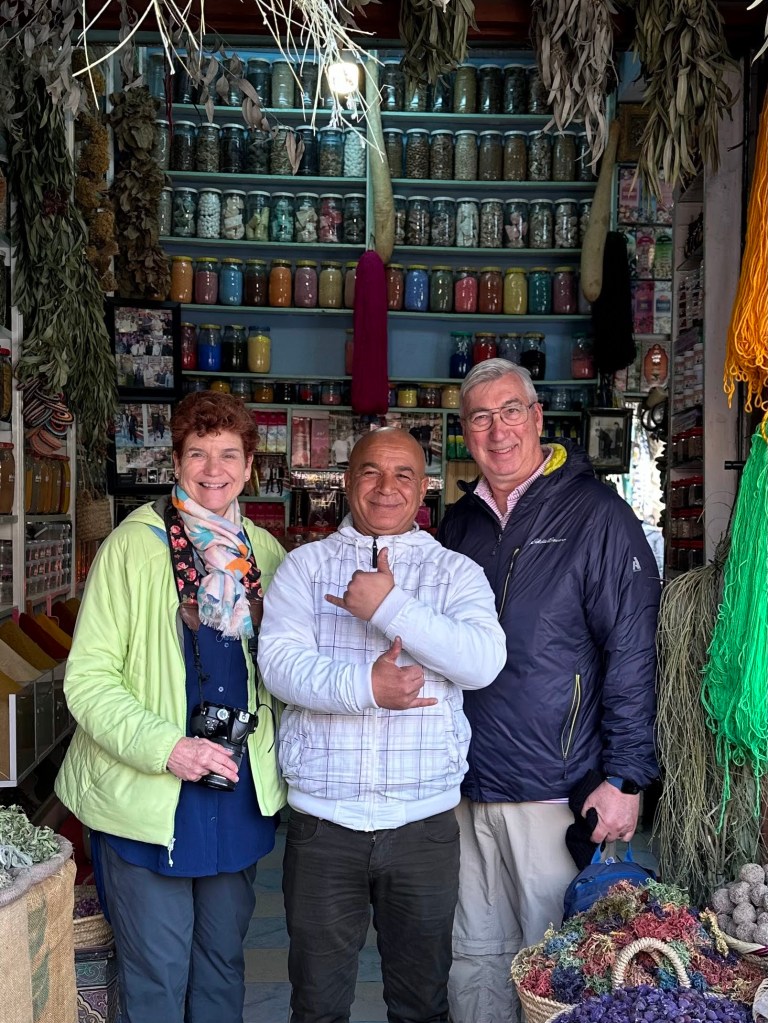
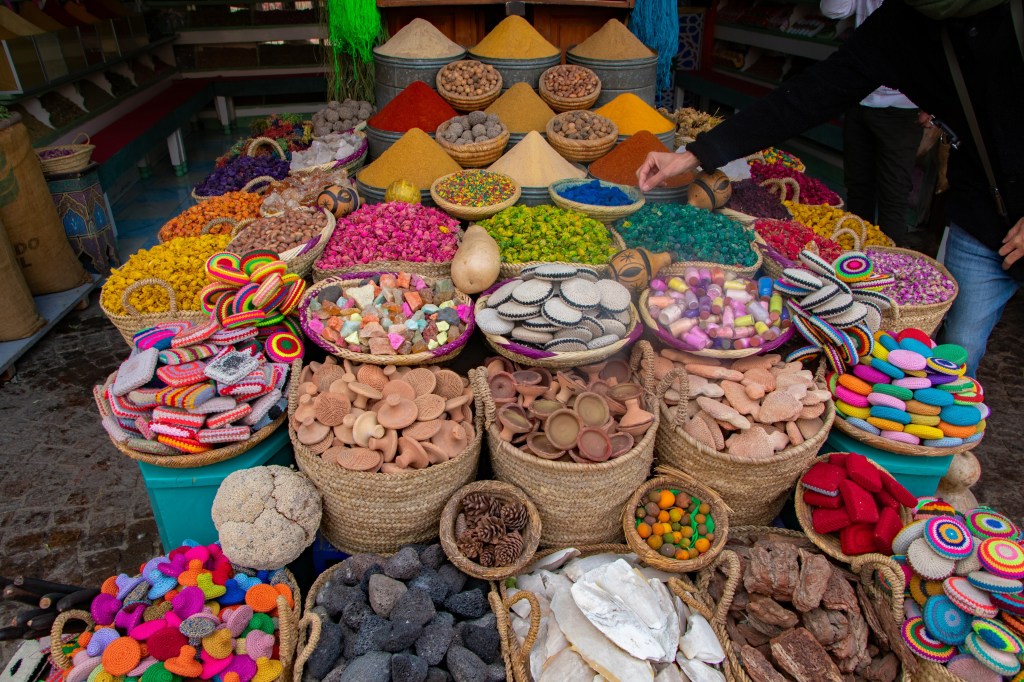
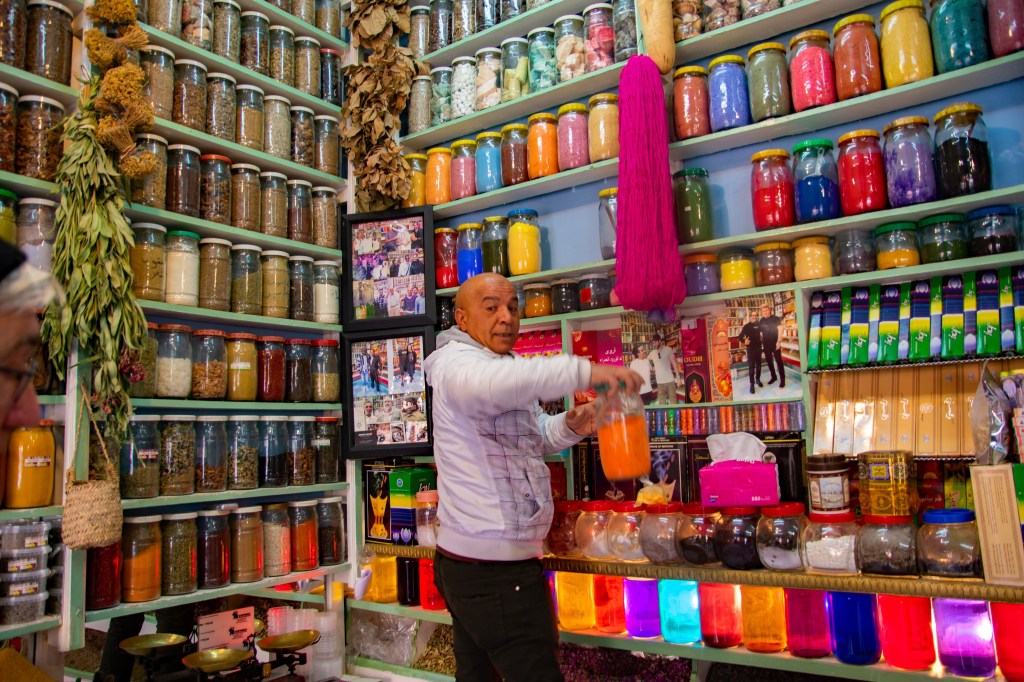
After our visit, we headed back out to the Medina, where the souks were opening up. We visited some artisans: a metalworker, a blade sharpener, a carpet warehouse, some artists’ workshops, and a spice and pigment store. Omar continually assured us that we did not need to buy anything, but we couldn’t resist a few items. I’m not sure why I need a pounded gold dish with a camel motif, but in that moment, I had to have it. Bill bought some tea glasses, almost bought a painting, and we did a little damage in the spice, soap, pigment, etc. shop.
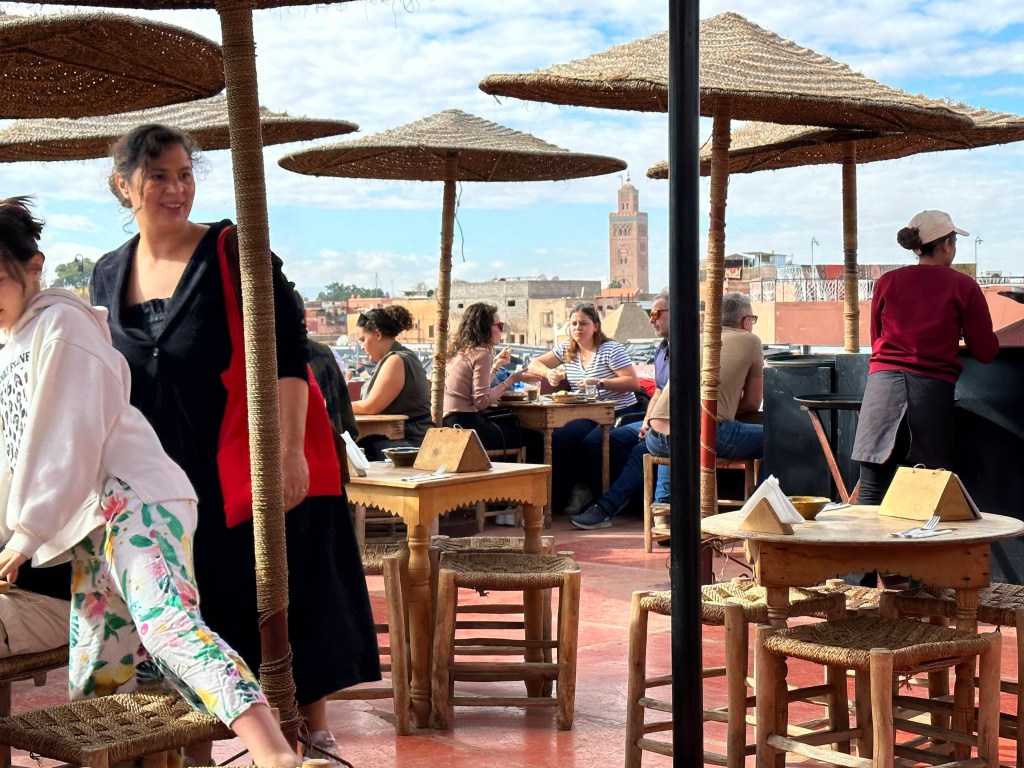
We ended our tour by enjoying a rooftop brunch with Omar. He is a delightful conversationalist and speaks perfect English. I am continually impressed by the language skills of so many Moroccans. It is a privilege to spend time with local citizens and definitely one of the joys of travel.
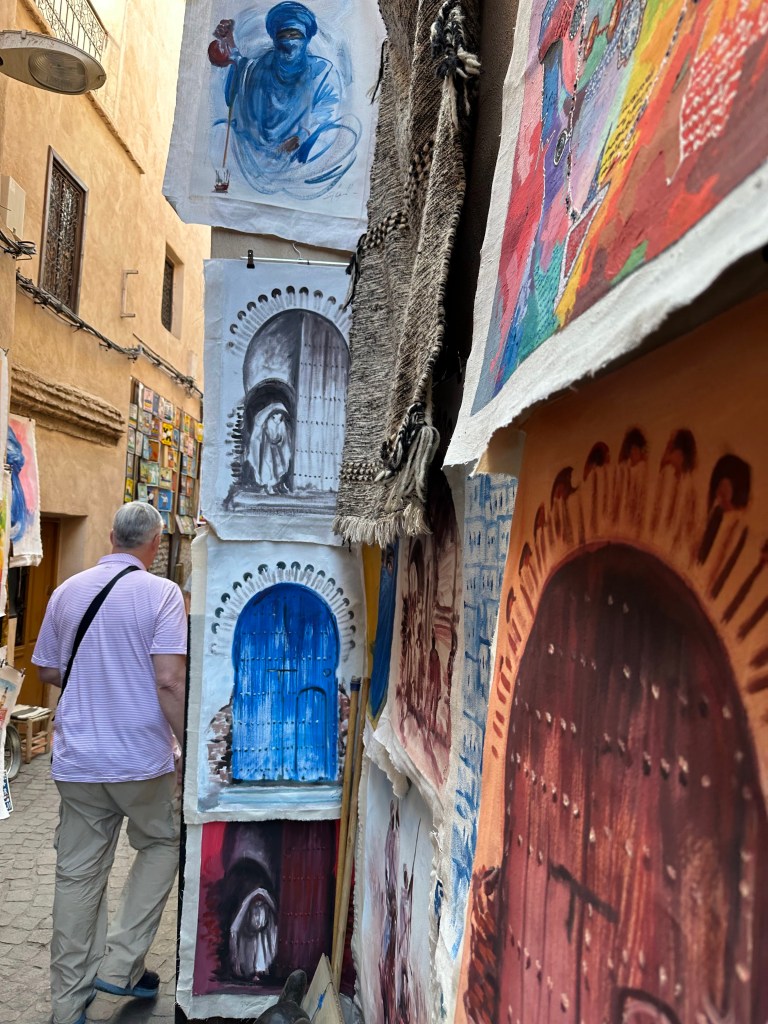
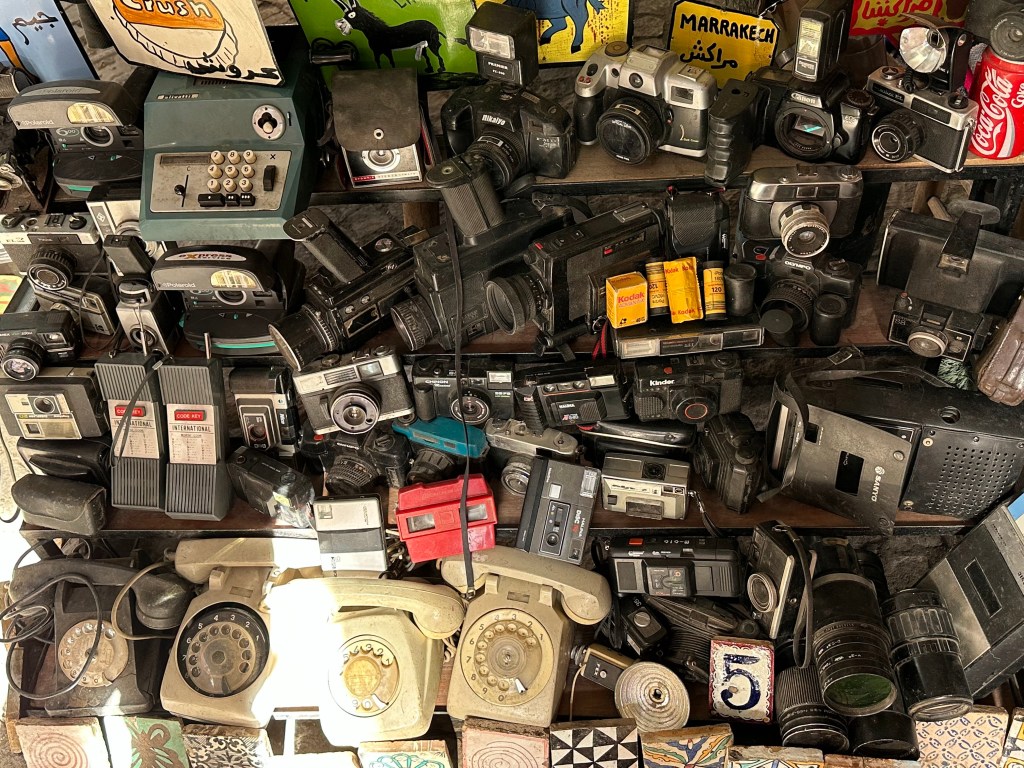
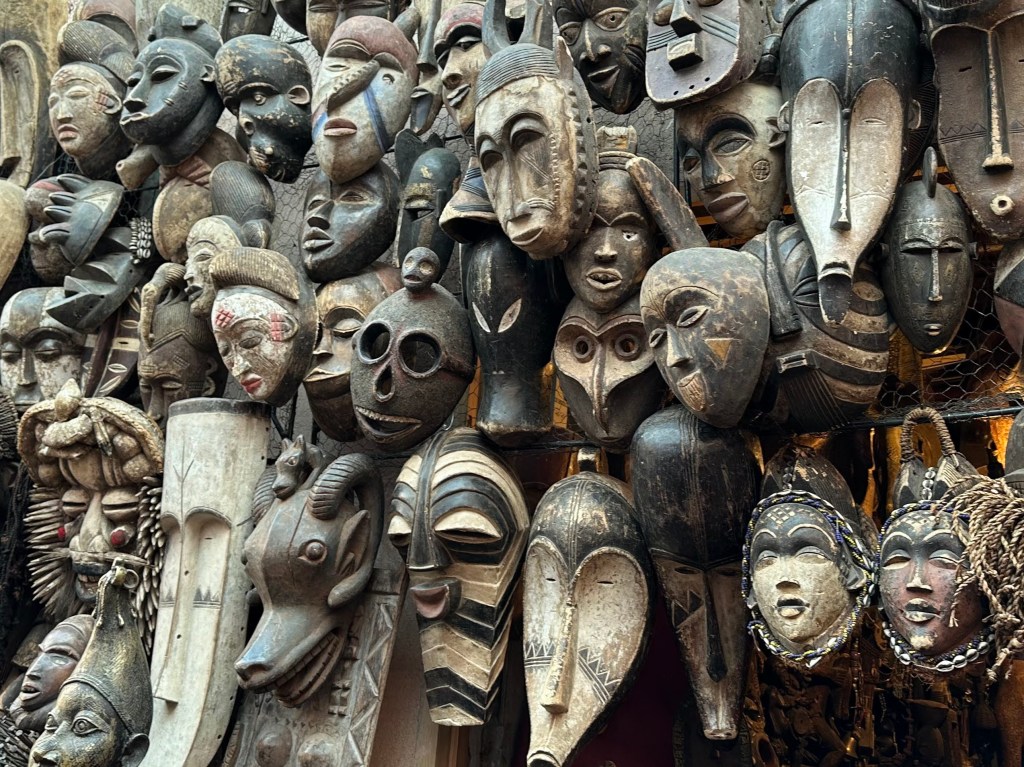
I’ll just leave you with some more photos of the Medina.
Rooftop BrunchVintage TechMasks
Join Me Next Time for Adventures In A Hot Air Balloon and a Tuk-Tuk.
Adventures In the South of Spain Goes Further South- To Morocco!
Double click on photos for larger view.
First View of MedinaThis is where the taxi stopsBen Youssef MosqueHowdy NeighborOur StreetHome for four nightsThe Big SquareThe Big SquareInside the RiadView of the Spice Square from Spice Cafe
Ticket on Ryan Air -$100 Euros each plus fees for the privilege of carrying on a small cabin bag. Pay that fee when you buy your ticket, because it’s super- expensive to add it later. Does anyone travel with NO luggage? $35 Euros for said cabin bag purchased at the “China Store” (Sorry, that’s what the Spaniards call it) in Valencia. The suitcase is lightly packed with tiny toiletries and light weight clothing; leaving room for a few purchases.
The flight was short and uneventful. Oh, except for the announcement, ” Is anyone onboard a doctor?” A young man across the aisle from us answered the call and headed back a few rows to attend to a woman who was experiencing dizziness. Next, there was a call for a blood pressure cuff and perhaps a sugar packet. It seems that a basic first aid kit was not on board, but the duty-free cart still made its way down the aisle. Fortunately, after landing, the ill passenger was able to walk to the front of the plane for her wheelchair ride to a waiting ambulance.
I had passed much of the time chatting with the Morrocan businessman next to us. He gave me a few tips about Morocco, and the story of his nine children from various ex-wives in various countries. He was proud to tell me of his American family in LA.
Passport control was easy; we have our first stamp from the African continent! I had to keep reminding myself that I was really in Africa.
A driver was waiting for us with a sign for Riad Hazid. This was only the second time in my life, I have been met with a sign. The first time was Beijiing 2008. Both times, it was a welcome comfort.
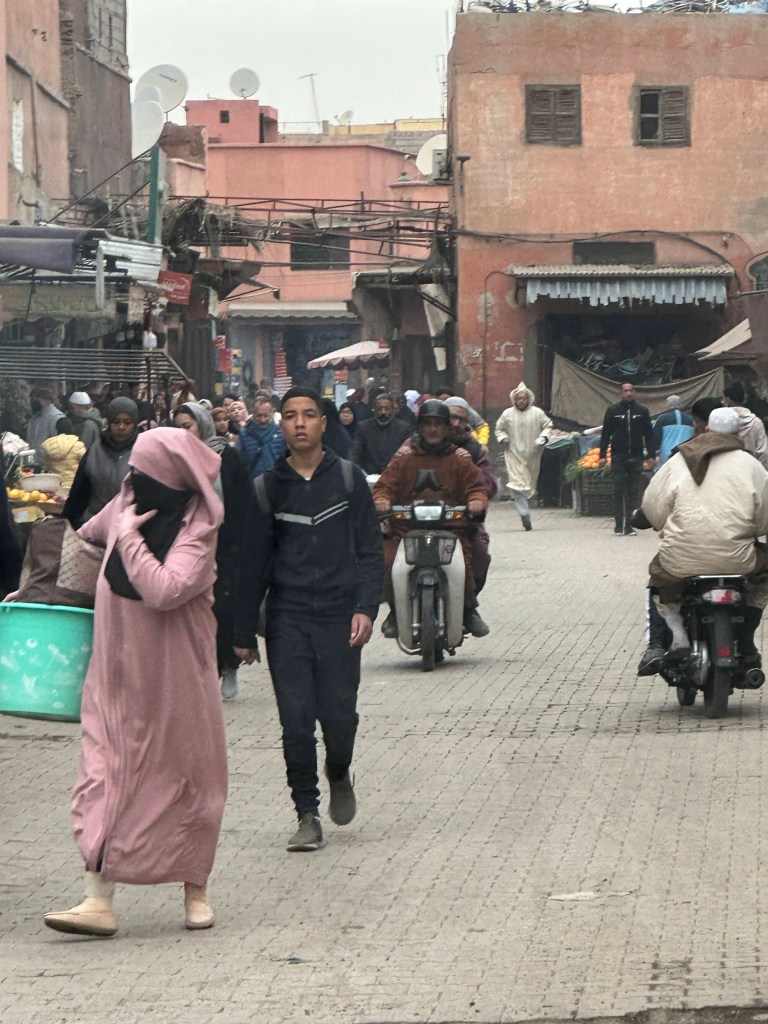
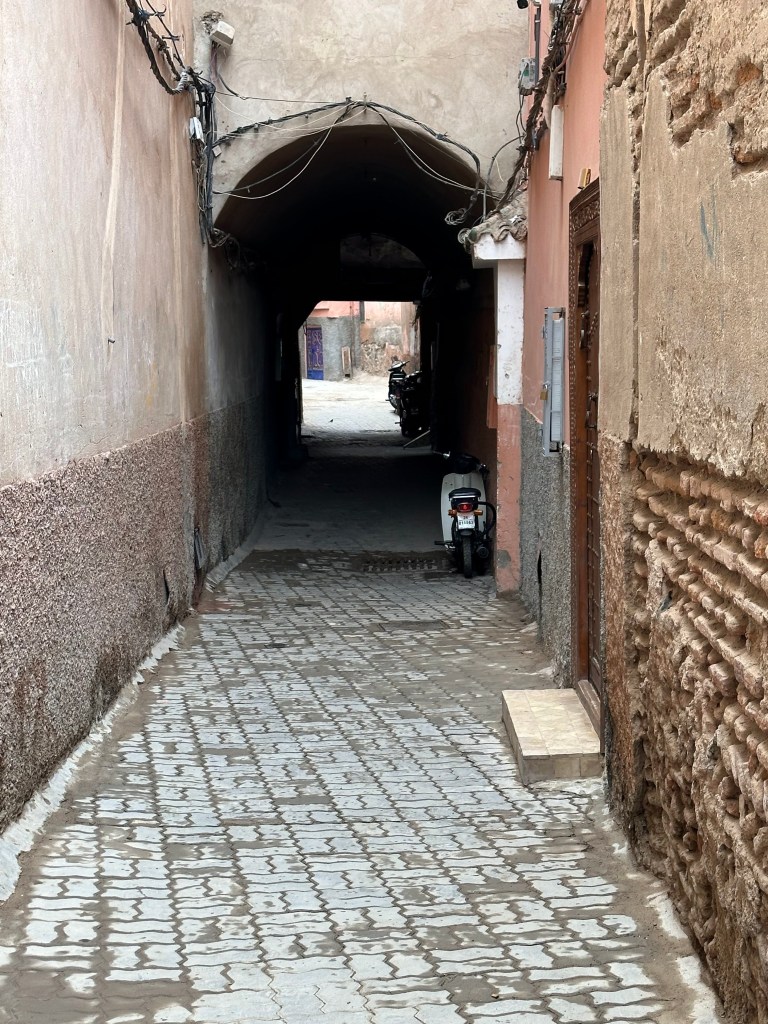
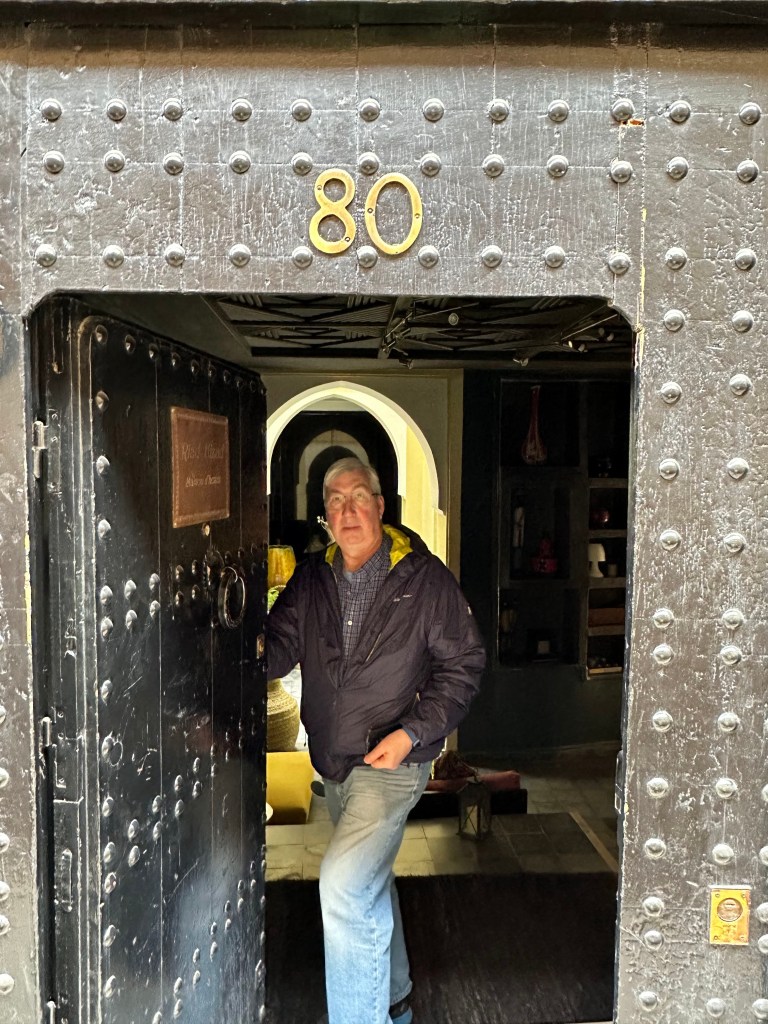
The ride through the city was amazing! So many people and so many motorcycles! The “new city” outside of the Medina (old city) is large and modern. Once we entered the walled city, it was as if we had crossed a portal to the past; long past. The streets are narrow alleyways lined with endless souks (shops) and motorbikes are whizzing past everyone on foot. We parked at the Ben Youssef Mosque, where a young lady from the Riad met us and walked us to our lodging. A short walk, but long enough to have me wondering just what the hell we had gotten ourselves into. We turned down an even narrower alleyway with crumbling walls and pavement; then stopped at a door marked number 80. That’s all. This is it.
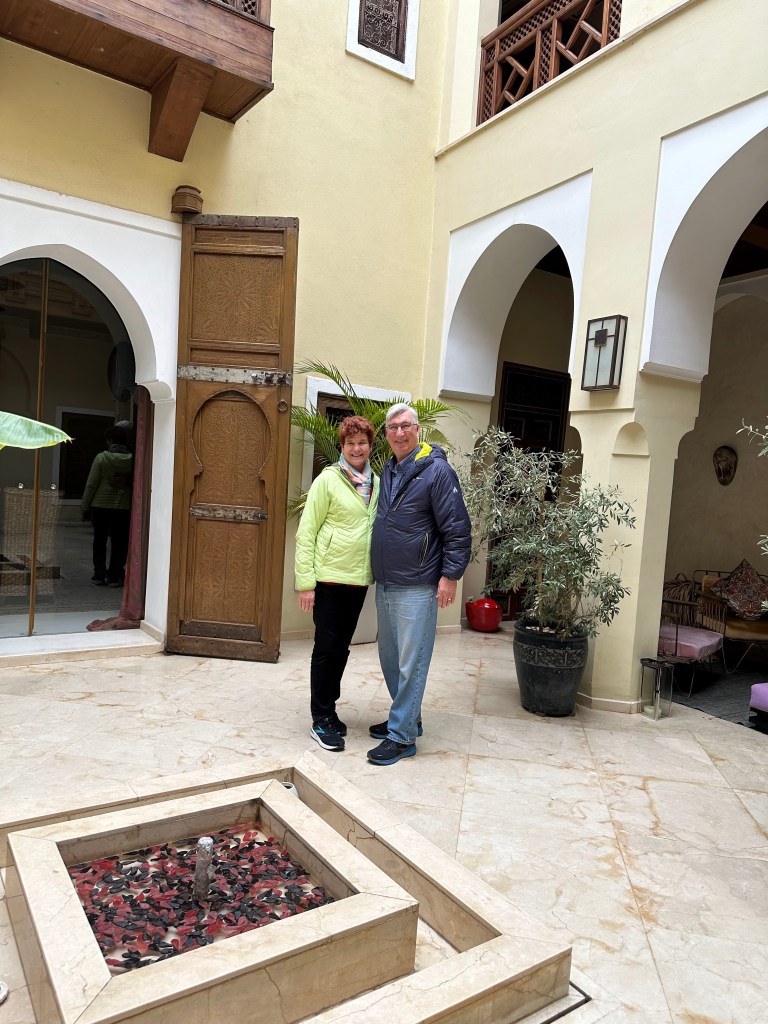
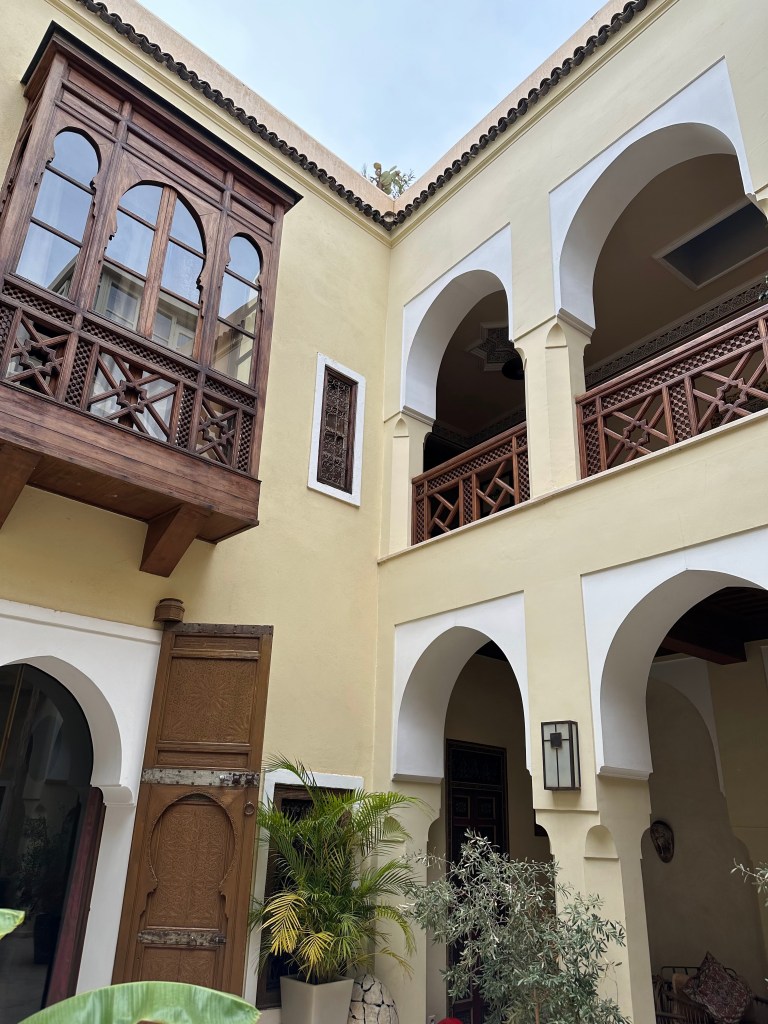
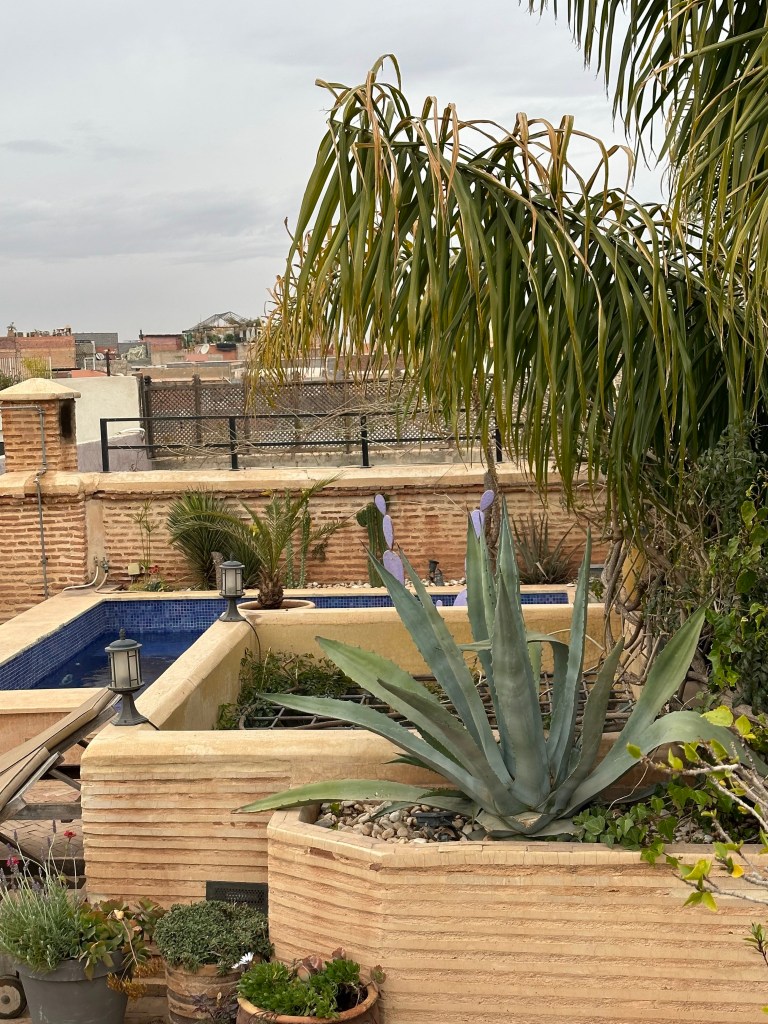
Inside portal number 80, was a haven of quiet luxury. We met with Sana, who served mint tea and cookies in a cozy lounge area, while she registered us. She also provided us with maps and the very helpful Maps.me app. She downloaded the Medina area to our phones and now we could access directions offline. During our four-night stay, she assisted us with train reservations, dinner reservations, a local guide, taxi drivers, and one unforgettable Tuk-Tuk ride (more about that later). She also cooked and served breakfast every morning. There were moments when her attentiveness bordered on overbearing, but if there was ever a time to upgrade our travel style, this was the time. We settled into our room, and then headed up to explore the rooftop. There was a pool with extremely cold water. Since the weather outside was a comfortable 70 degrees Fahrenheit, we never felt the need to take the plunge, but we did enjoy the lounge chairs a few times.
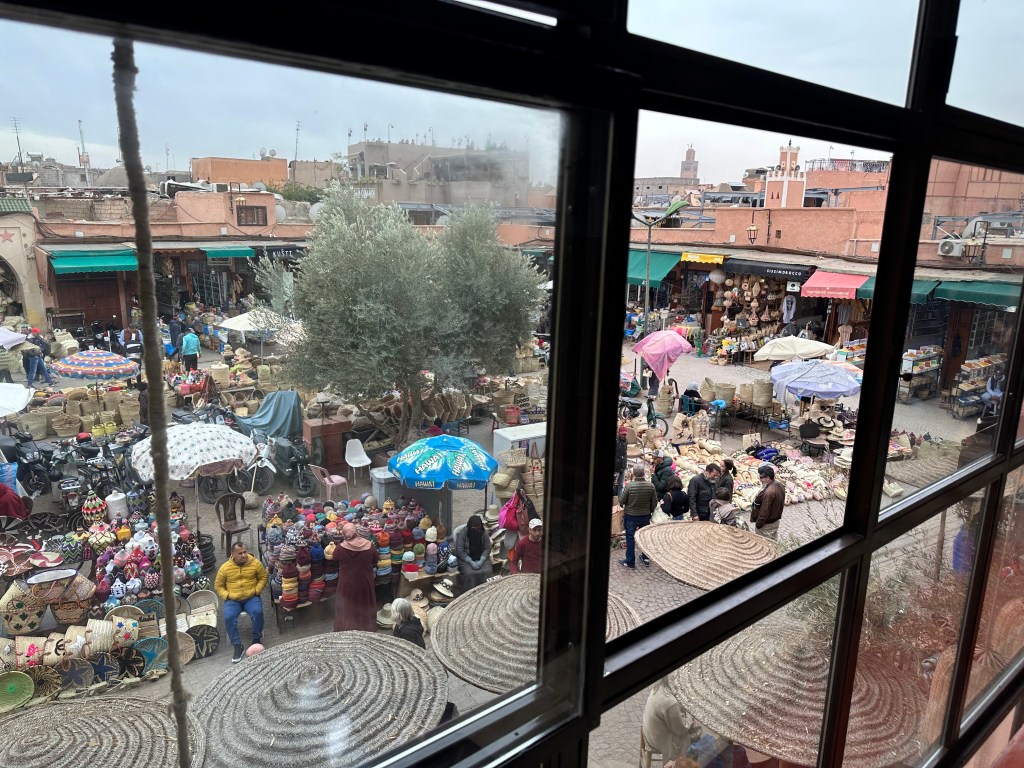
Now it was time to find lunch. Sana recommended Cafe Spice, so with Maps.me on Bill’s phone, we headed out for our first solo Medina adventure. Without Bill’s tech skills and sense of direction, I probably would never have left the Riad. Walking single-file on the right, looking down to avoid tripping on crumbled tiles, hoping not to get whacked by a motorcycle, it was difficult to take everything in; let alone to photograph it. The Medina is one big marketplace with stall after stall selling food and handicrafts. The vendors weren’t as pushy as I expected, and I never felt threatened or uncomfortable. We are obviously foreigners and tourists, so attempting to blend is impossible. But since Morocco’s economy depends on tourism, most Moroccans our welcoming. Many speak excellent English and seem to generally like the U.S.A. There are strict laws against harming a tourist. Still, it is wise to keep your wallet and phone secured and your wits about you. As to wardrobe, visiting women do not need to cover their hair, but it is respectful to cover your shoulders and knees.
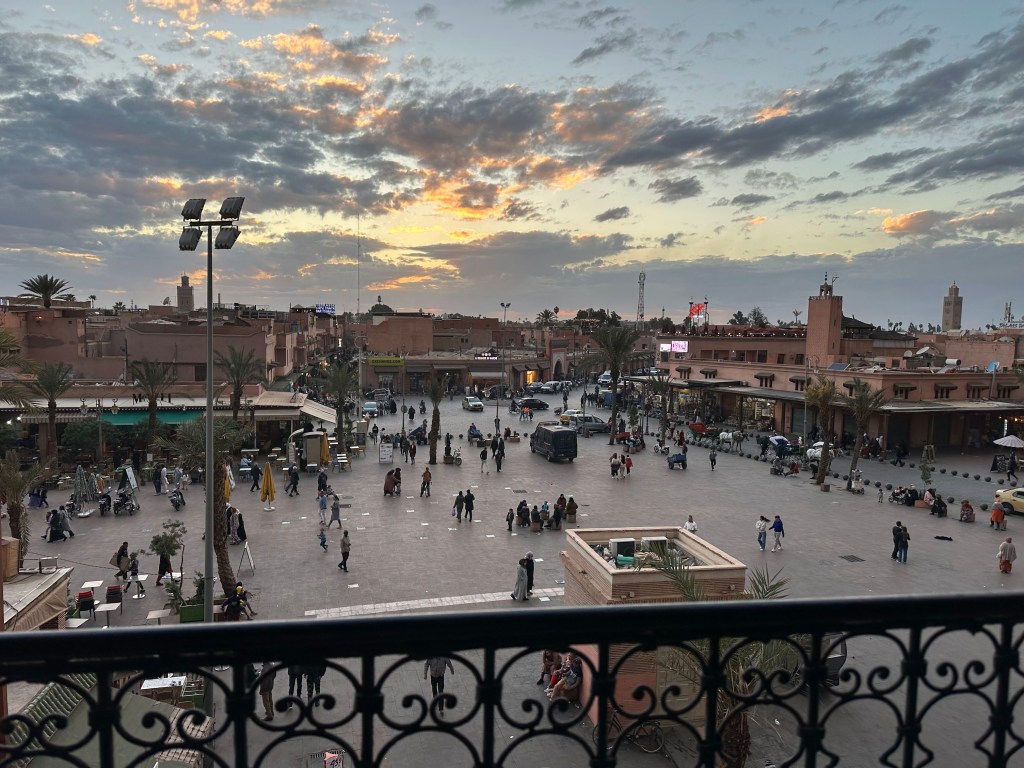
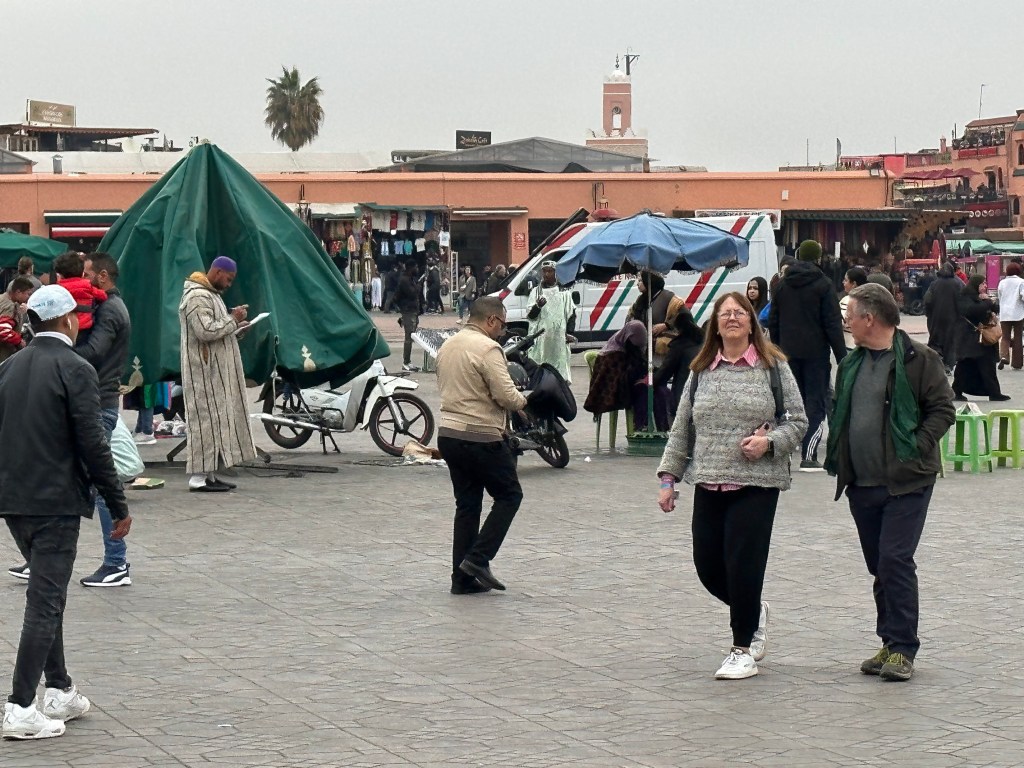
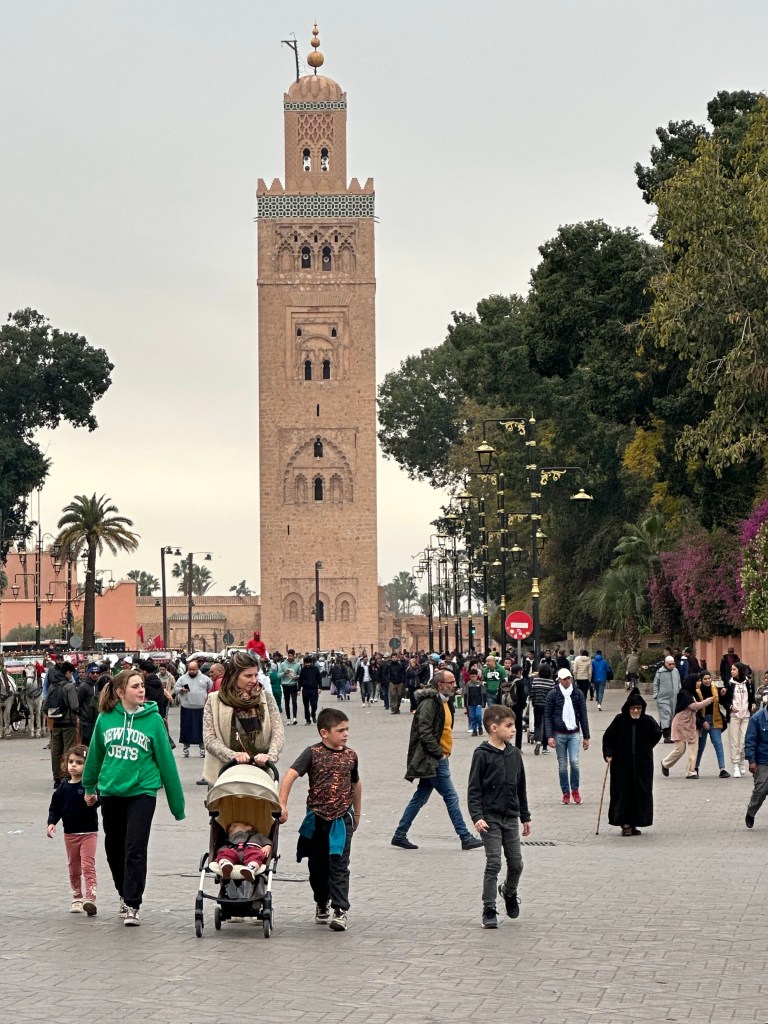
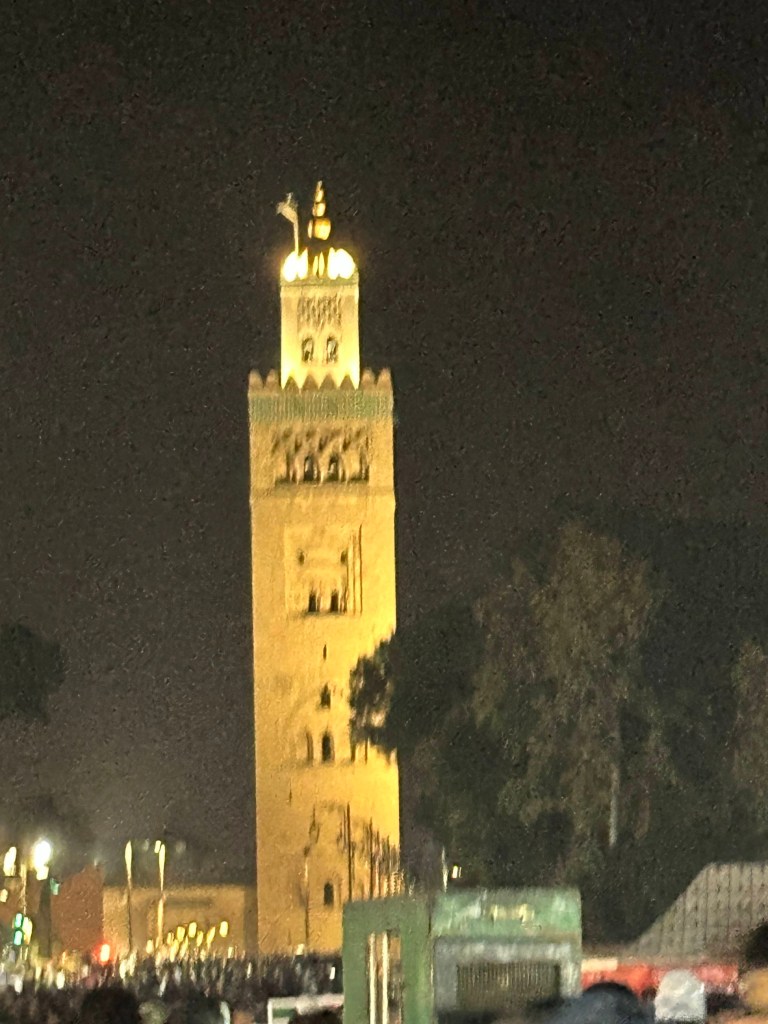
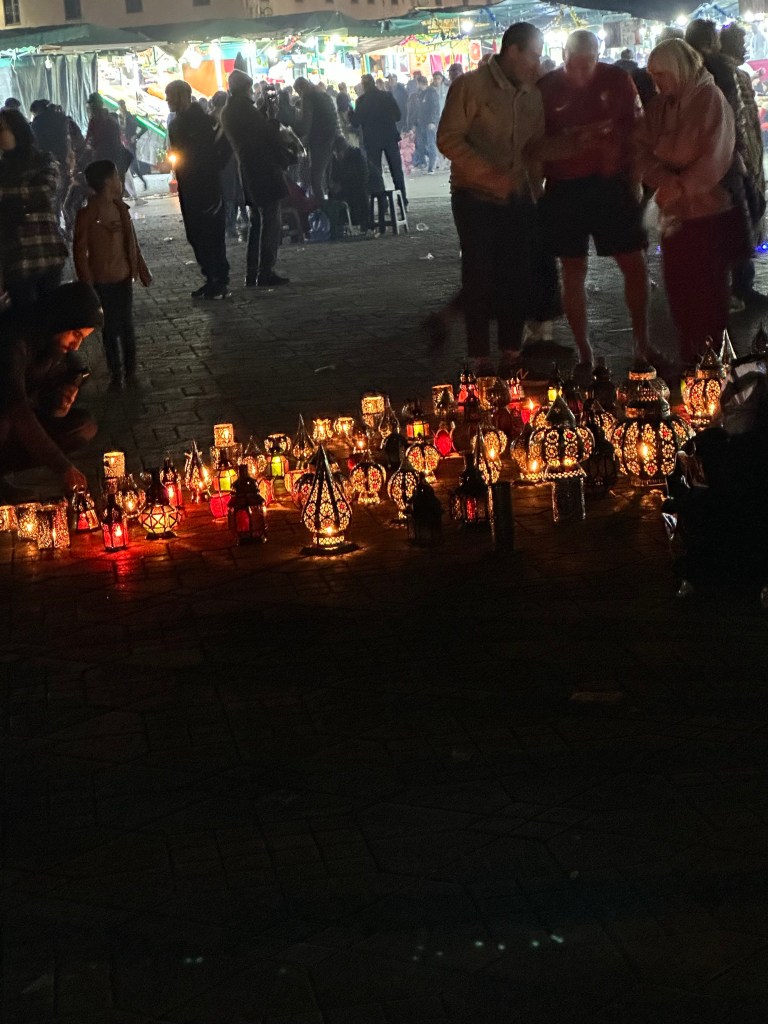
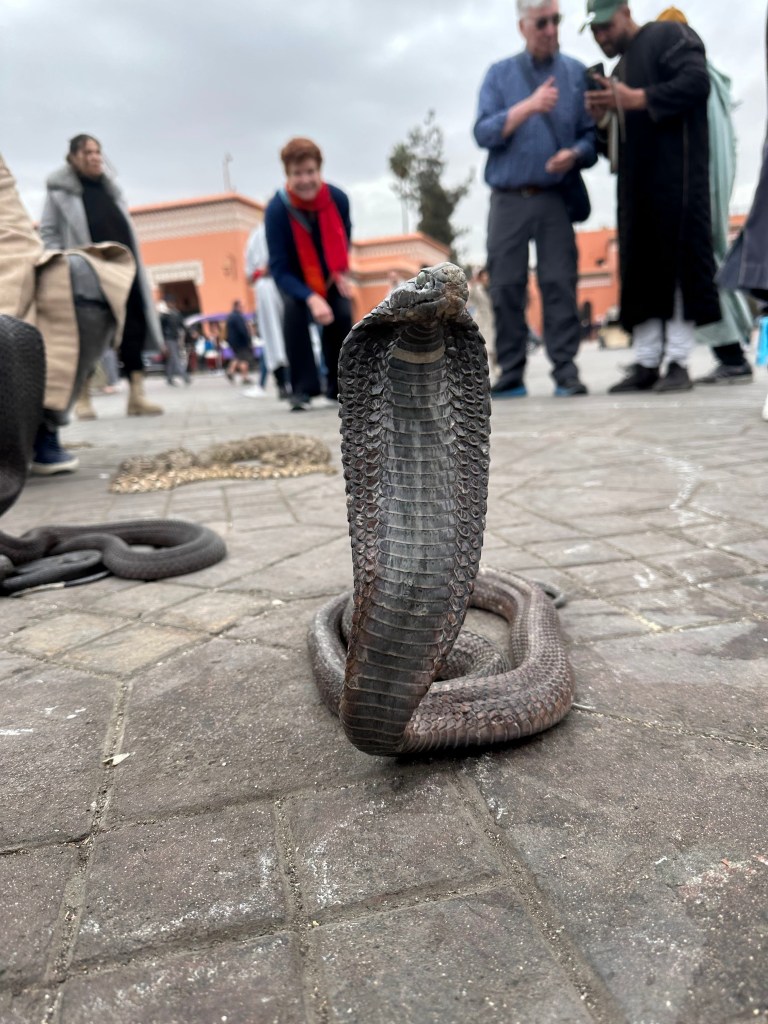
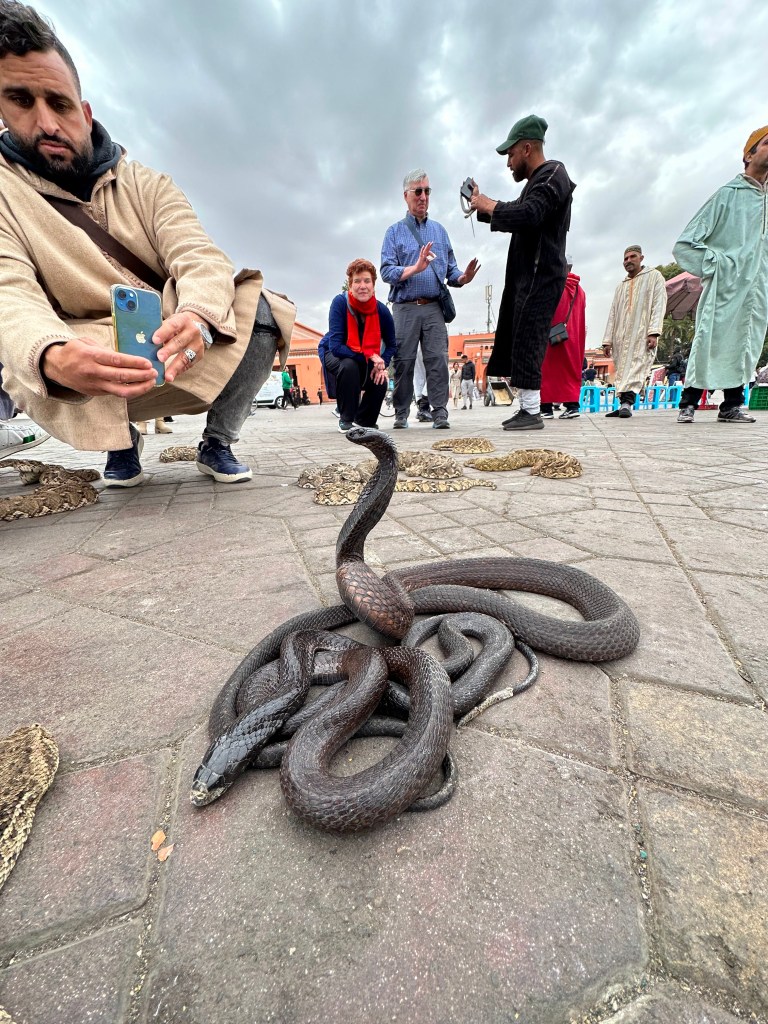
We found Café Des ´´Epices ( Spice Cafe) in the Square of Spices. Lunch was tasty and reasonable, and the dining room has a great view of the square. The clientele was mostly tourists. After lunch, we strolled around the square; I was beginning to feel more comfortable. We found our way to Jamaa el Fna Square, commonly known as The Big Square. This is where you will find ATM machines for changing money; you will need cash in Morocco! In Marrakech, most restaurants will take credit cards, but in Fez and Chefchauen, many places were cash only. The Moroccan dirham is about 10 to the dollar, so 100 dirham is 10 dollars. It is a good idea to get some small bills and coins for tipping, although the ATM machine will give you only big bills. The Big Square is also where you will find snake charmers, musicians, street food, and sellers of everything! It’s a bit sleepy during the day, but come back at night when things get really wild. The whole square is smoky with food cooking, people are dancing to drum beats, and gambling games abound.
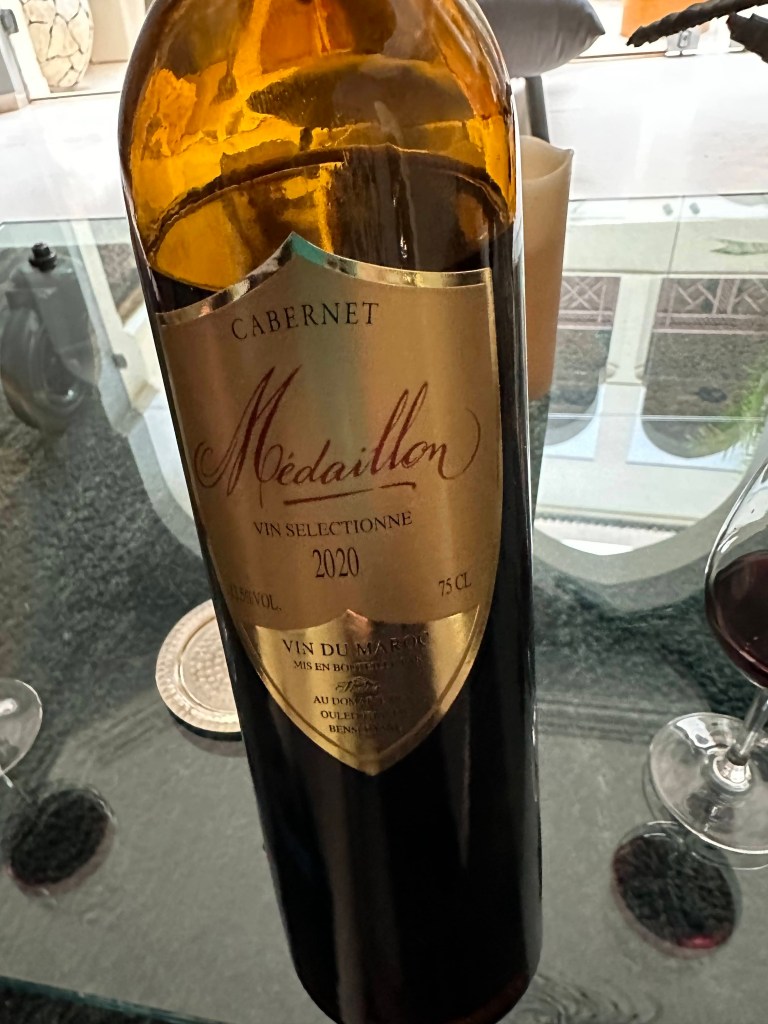
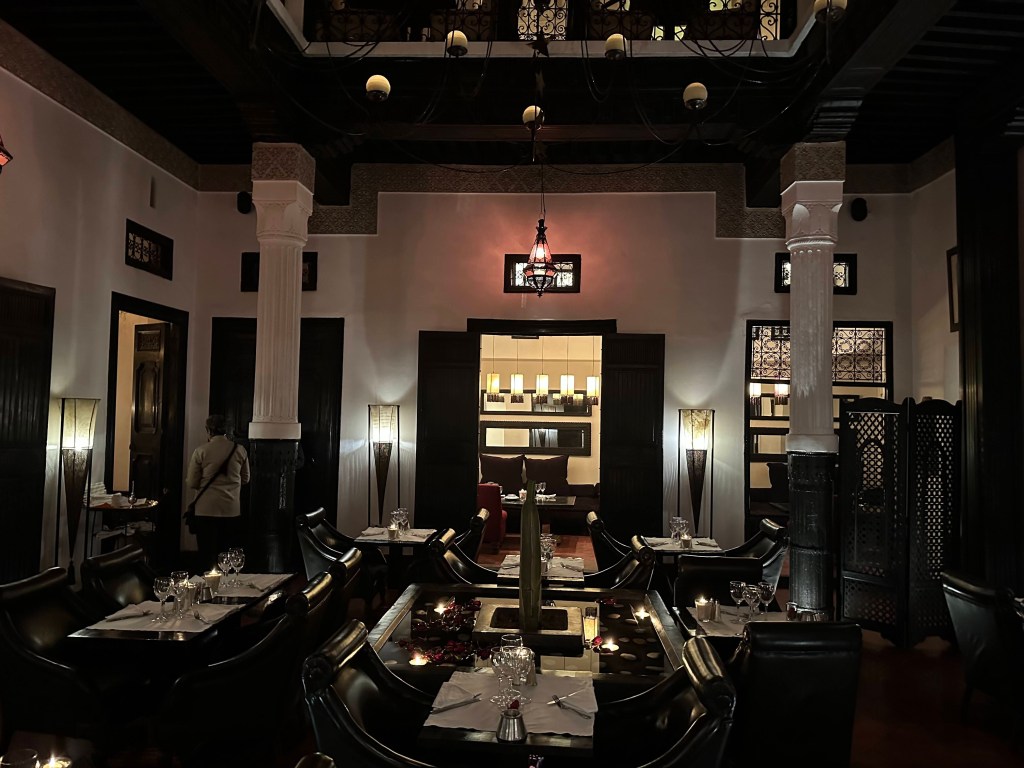
After the Big Square, we headed back to Riad Hizad for a late afternoon siesta. Sana reserved a table for us at Le Foundouk for a French/ Morrocan fusion dinner. The atmosphere was lovely, the food very good, and they had a nice wine list. We tried a Moroccan red. Morocco produces some good wines, even though they are a Muslim country. Since they were previously French territory, French is still widely spoken, and there is a definite tolerance for European ways. I mention this, because later in our trip, adult beverages were basically unavailable.
That wraps up Day 1 of our Moroccan adventure. I’ll leave you with some more photos. Tune into my next post for “Adventures with Omar.”
Moroccan WineLe FoundoukRiad GardenThe PoolRooftop SelfieInside Door #80Riad BreakfastBig Square at NightMain Mosque Lit UpBig Square at NightBig Square at NightBig Square at NightCharmed SnakeBill haggling the price of the Photo
My fascination with Spanish towns has everything to do with the juxtaposition of the ancient and the new. Nowhere is this more on display than in Valencia, Spain’s third largest city.
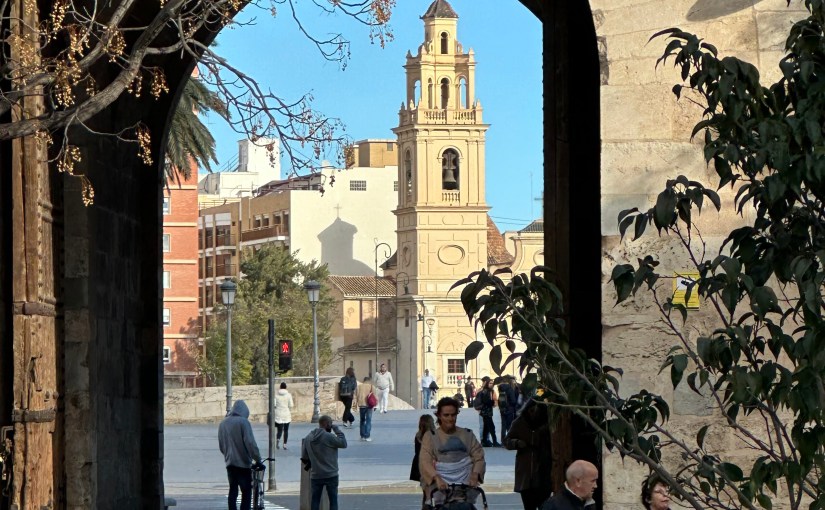
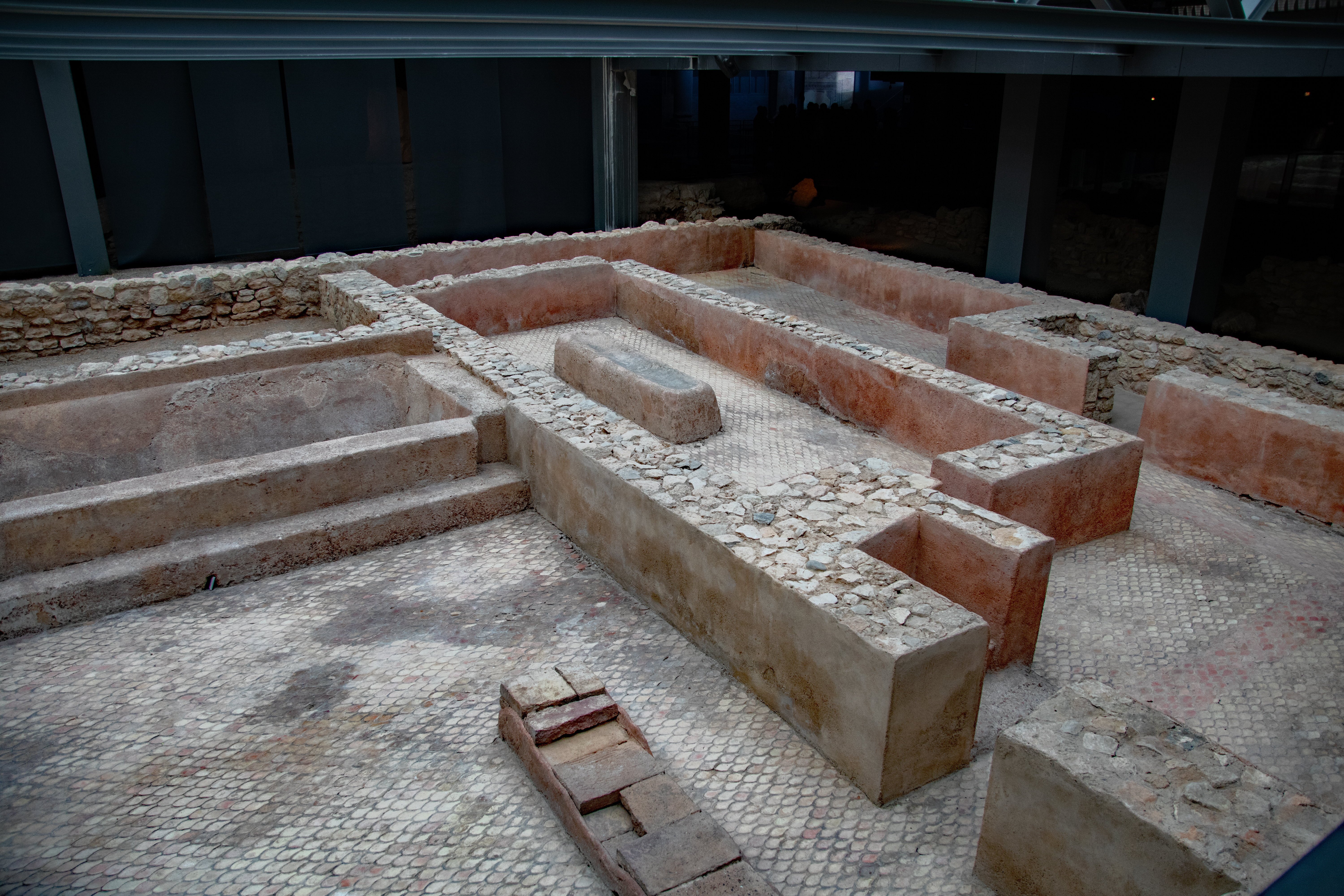
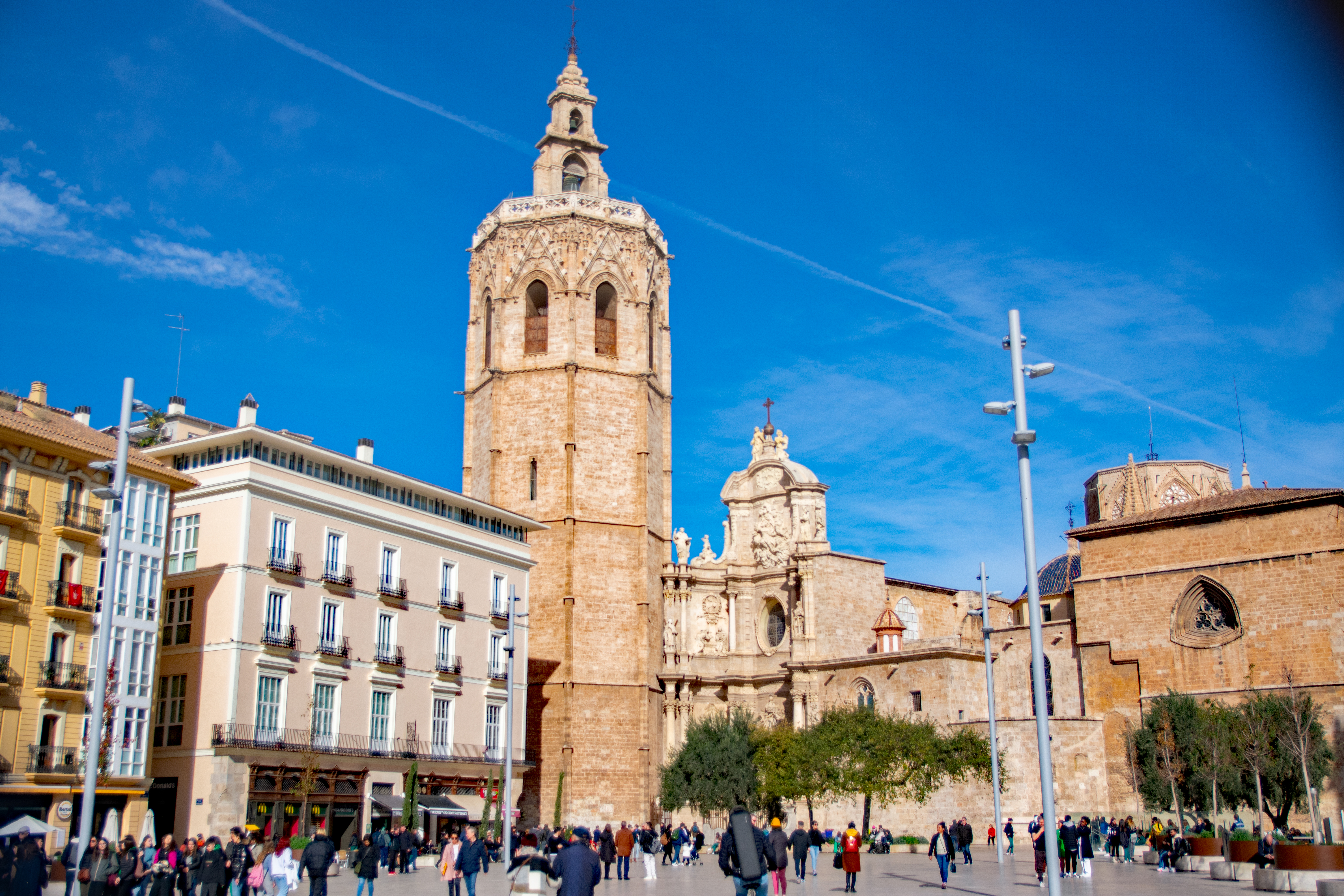
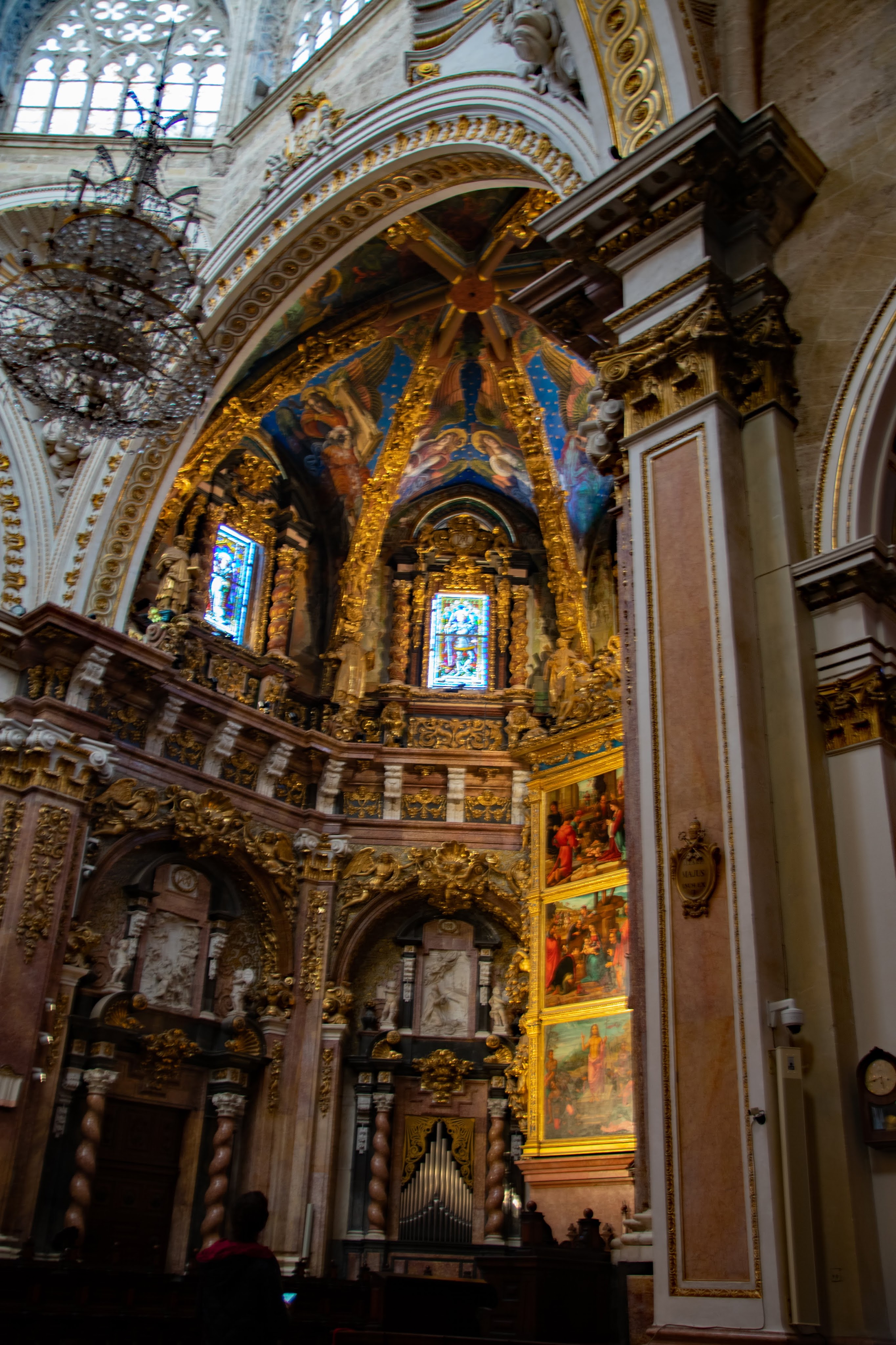
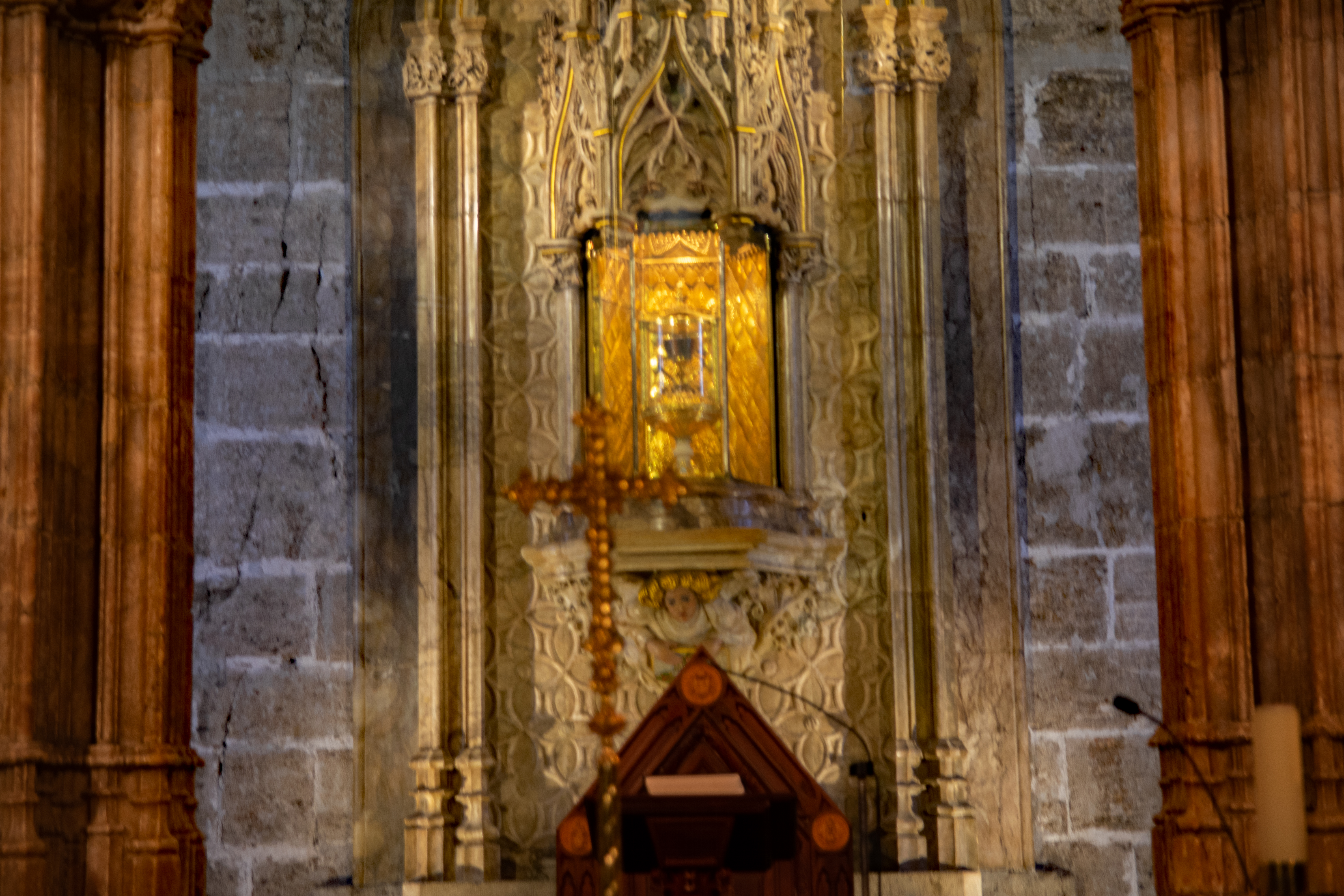
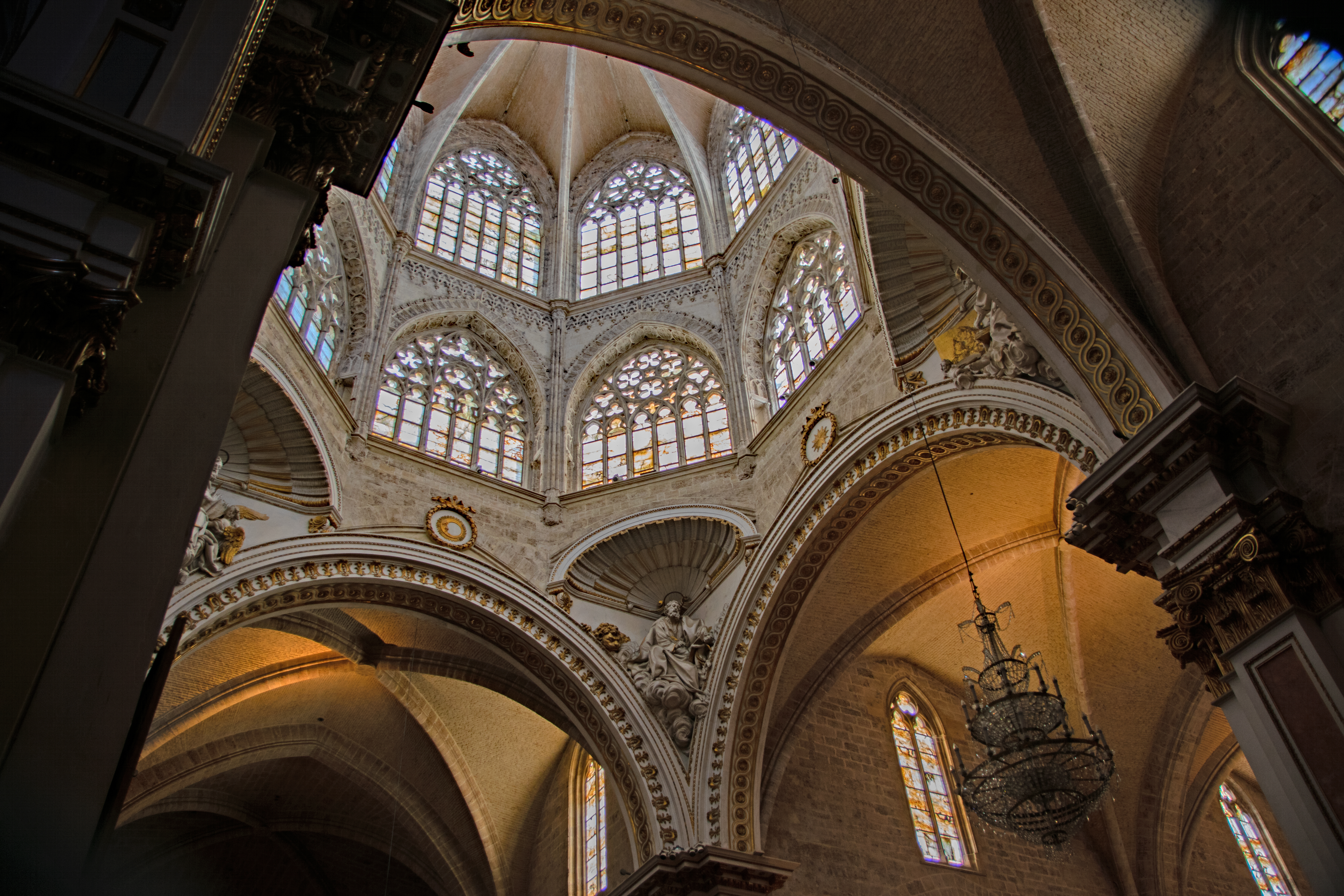
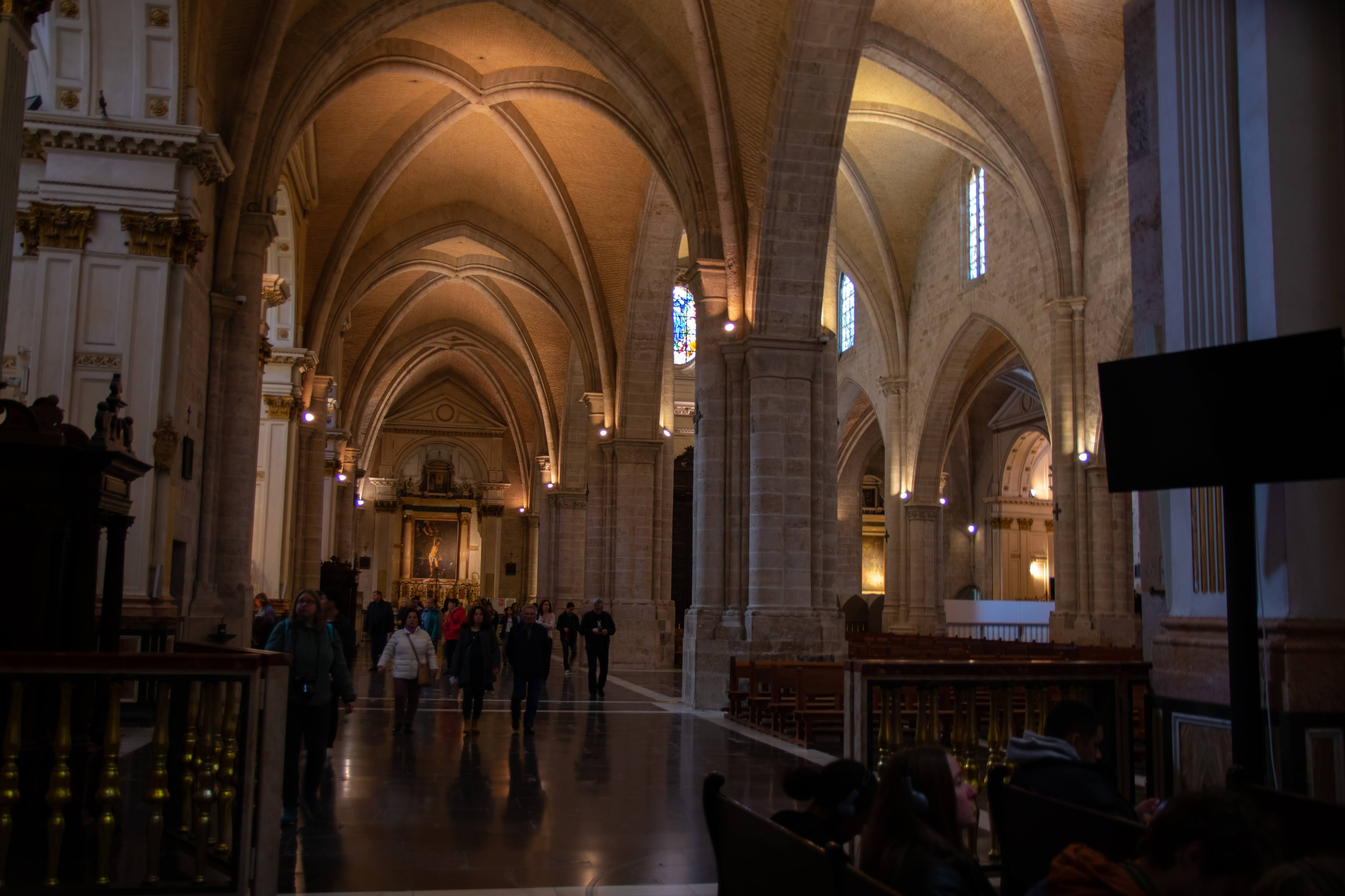
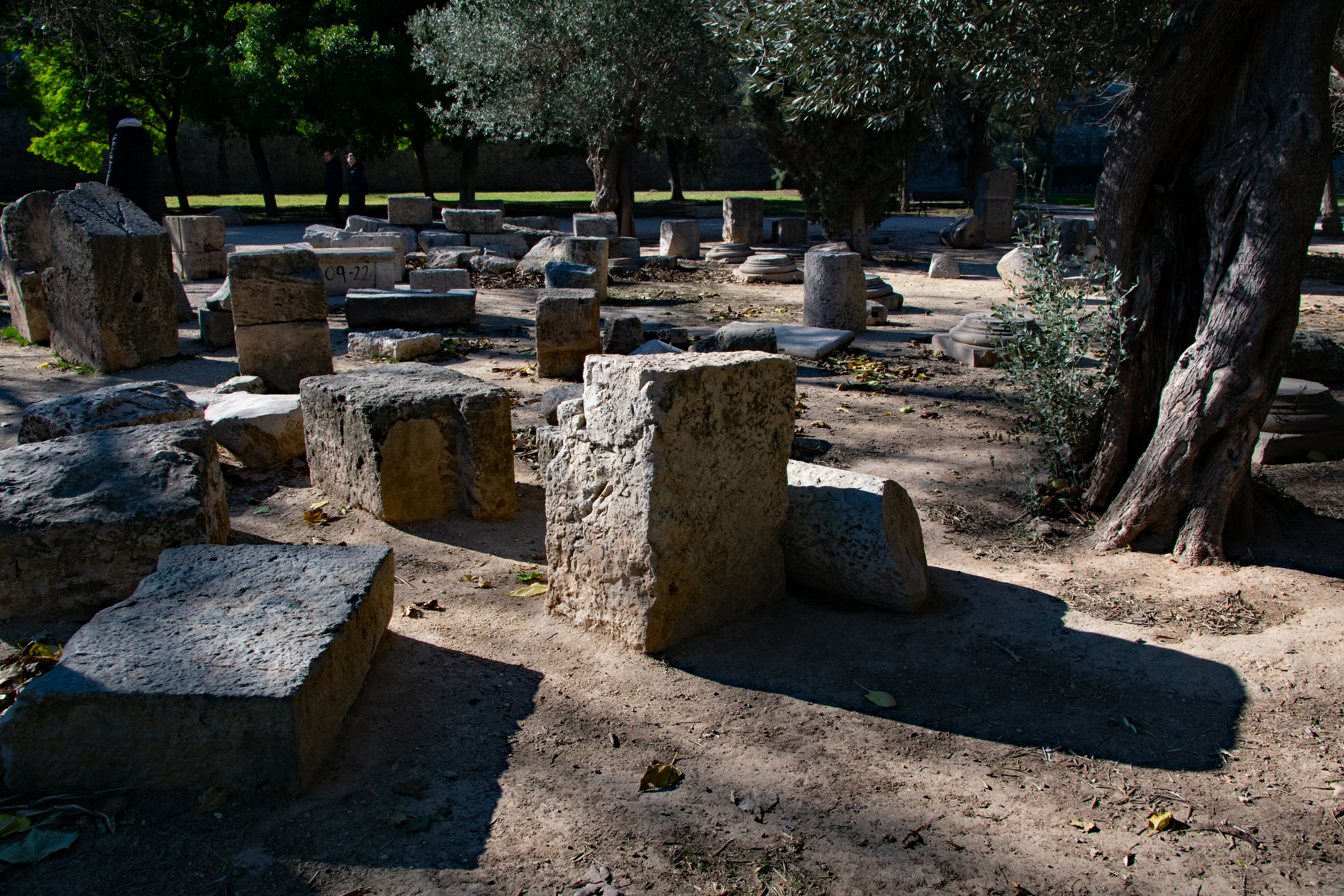
Roman ruins are steps from the Cathedral, which has been a site of worship for 1,000 years. Previously, it was a Roman temple, Visigoth Cathedral, and an Arab Mosque. The Cathedral spans centuries of architectural and artistic styles. The Capilla del Santo Cáliz (Chapel of the Holy Grail) proclaims to display the actual chalice used at the Last Supper.
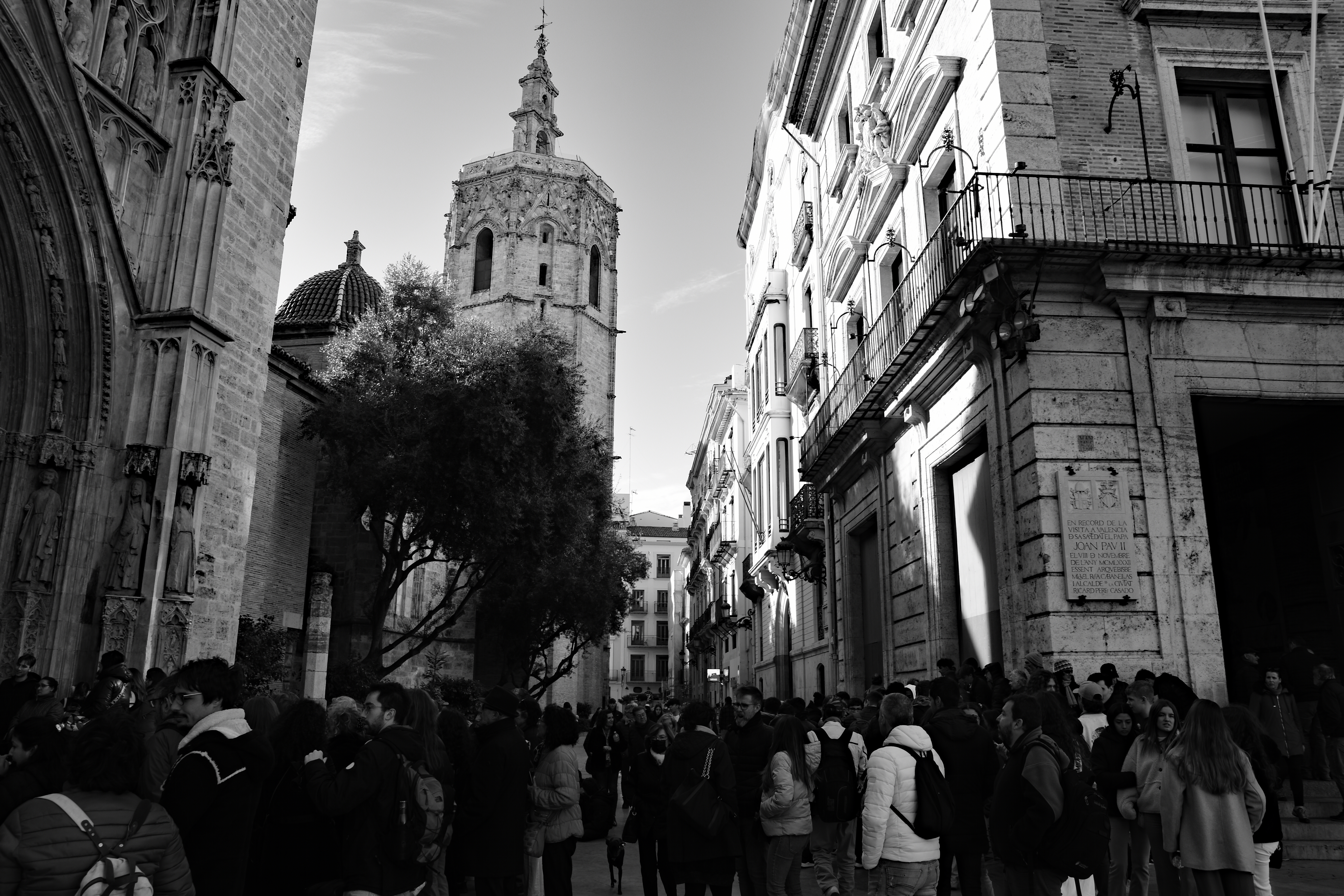
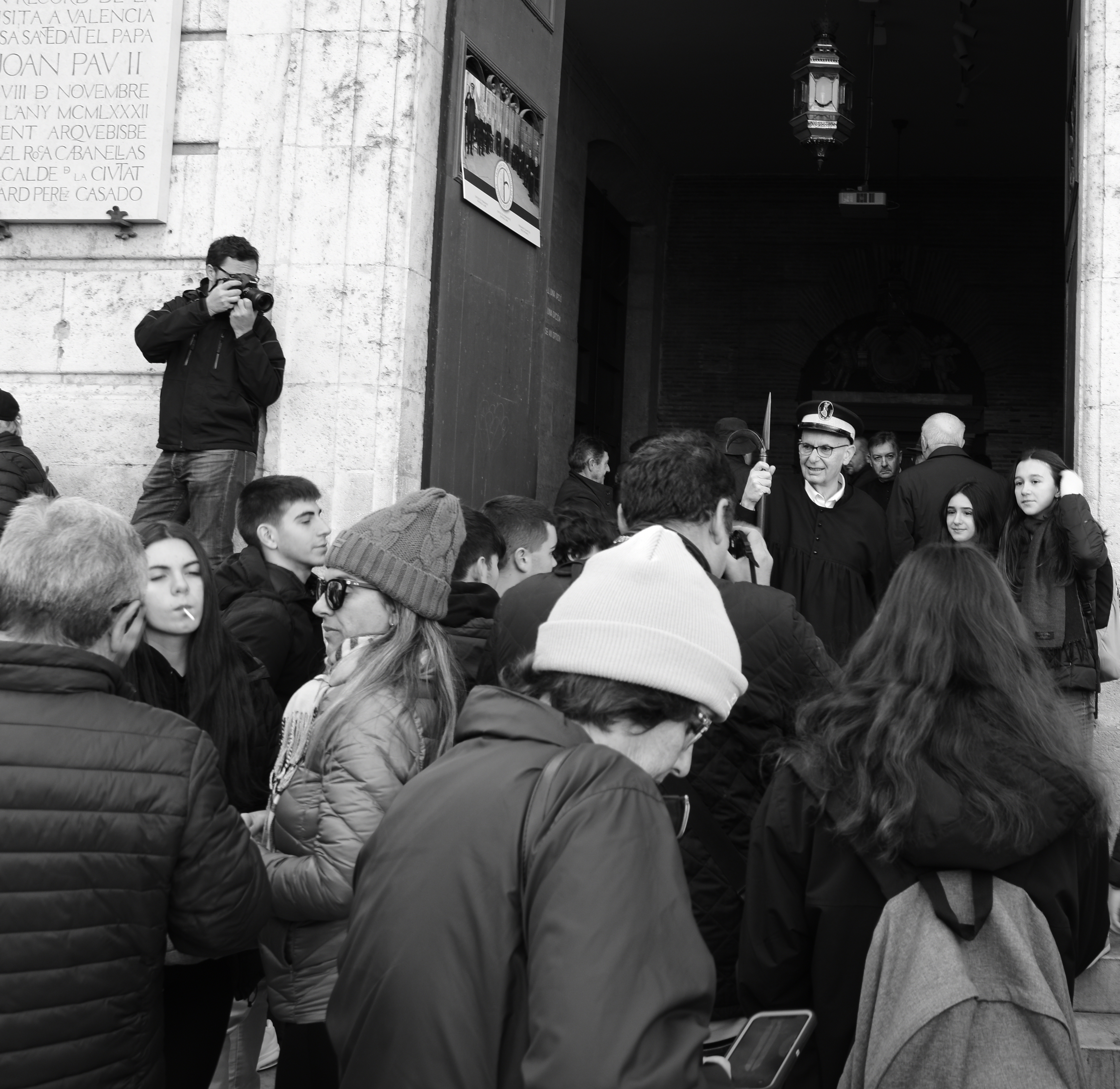
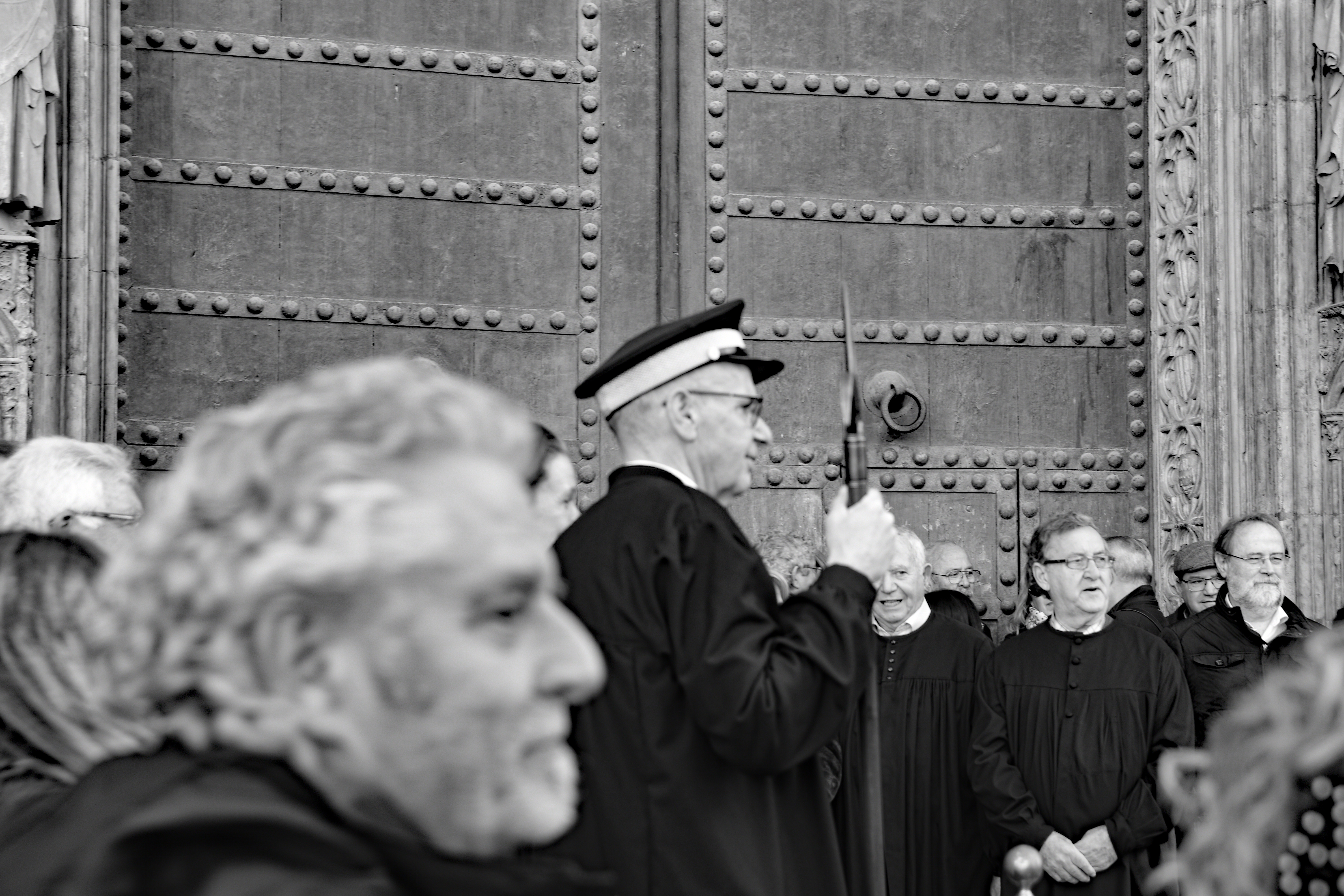
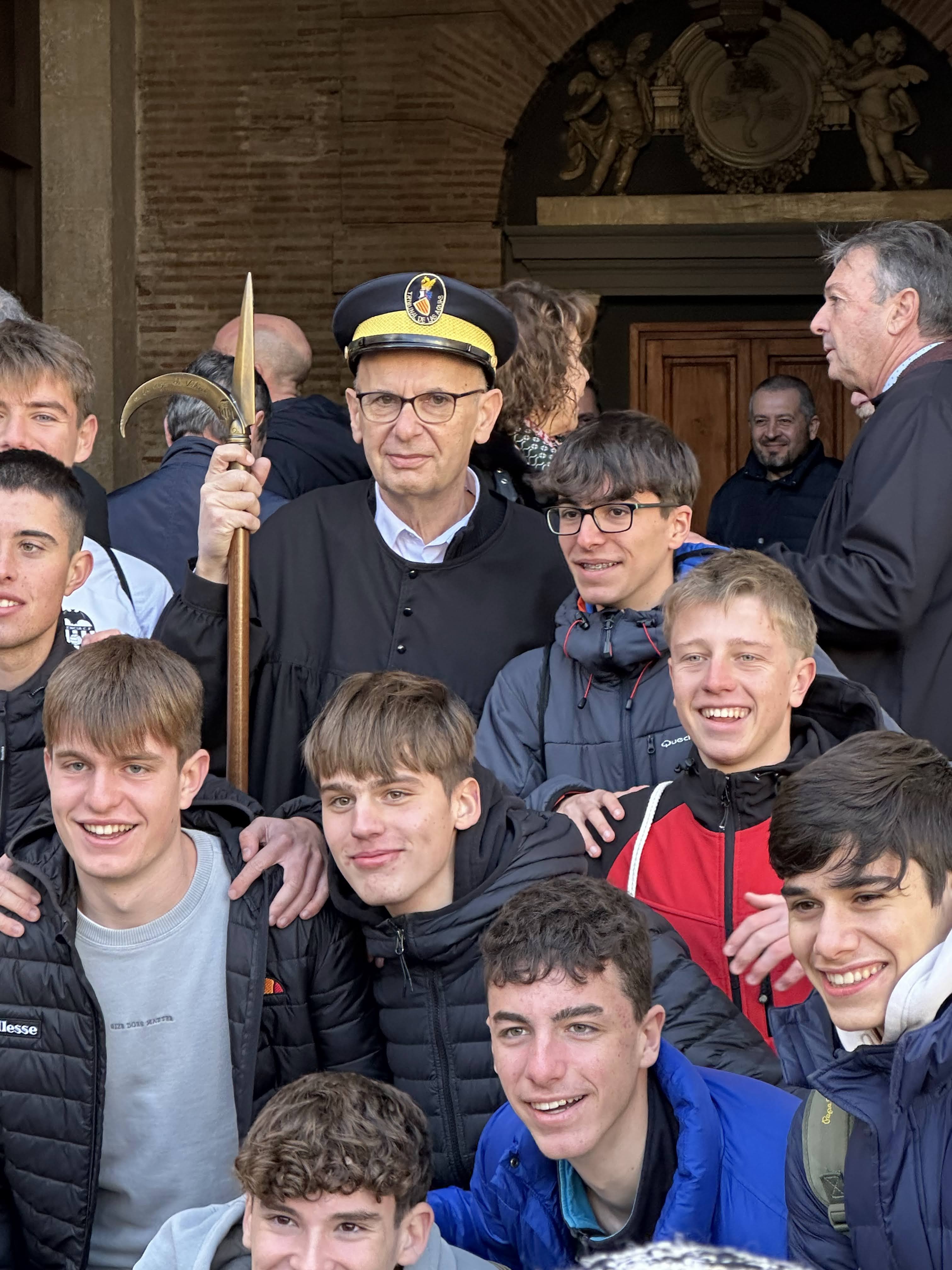
Every Thursday for 500 years, the “Water Council of Valencia” has held a meeting to determine which canal lock will be opened to irrigate the rice fields outside the city. The council is an elected body; agricultural districts each get one representative. The local farmers can plea their case to the council, who then decides, and the verdict is announced by the head councilman (see below- with the staff) at exactly noon. As the church bells are tolling twelve o’clock, the council members walk to the doors of the church, where the decision is chanted in Valencian. The weekly event draws a crowd. In addition to the interested parties, there are school groups, locals, and curious tourists like us. The vibe is festive: selfies with the “judge,” cheers, and jockeying for the best view.. Once the decision is announced, there is applause and the crowd begins to disperse. Just like 500 years ago, but with selfies and videos.
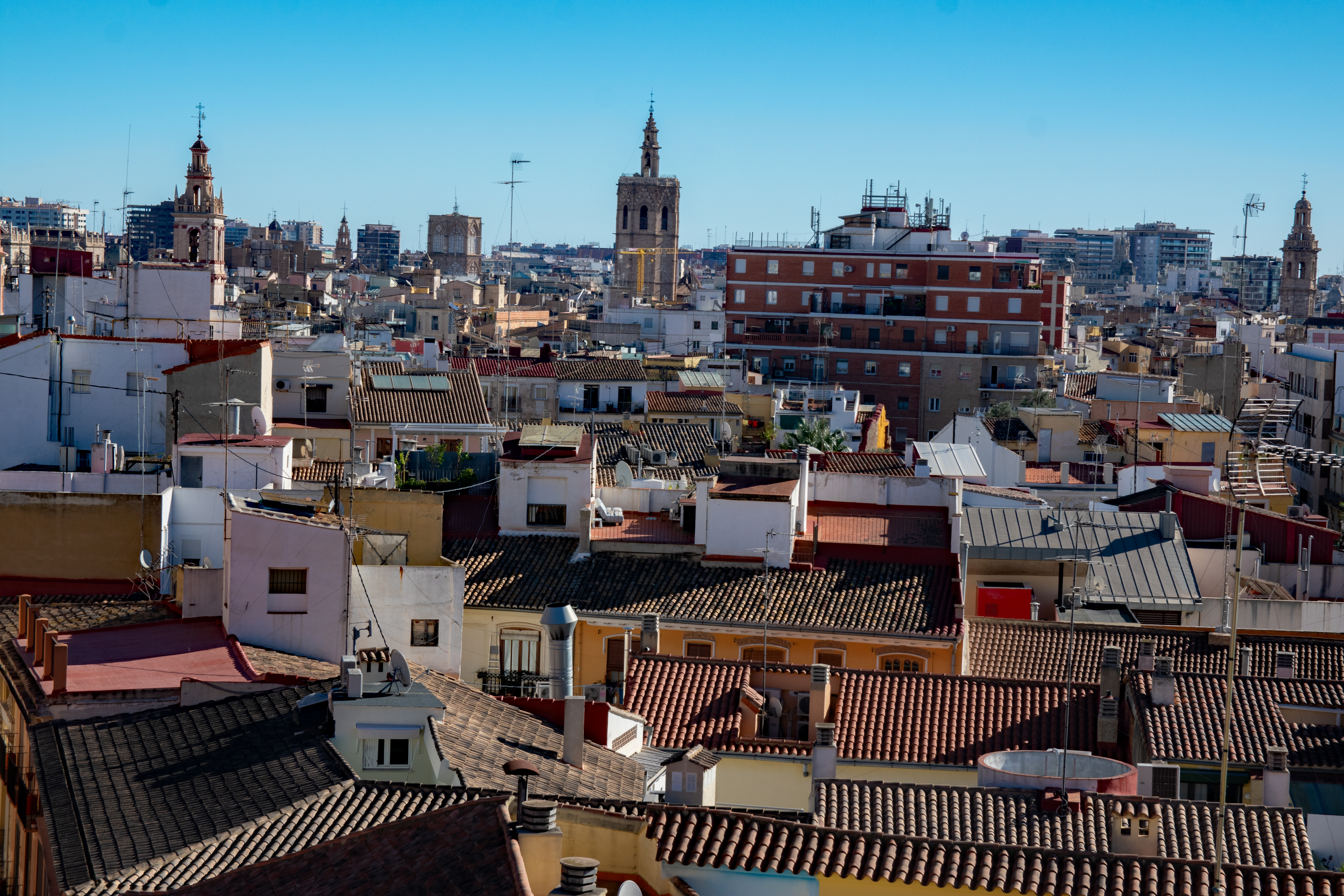
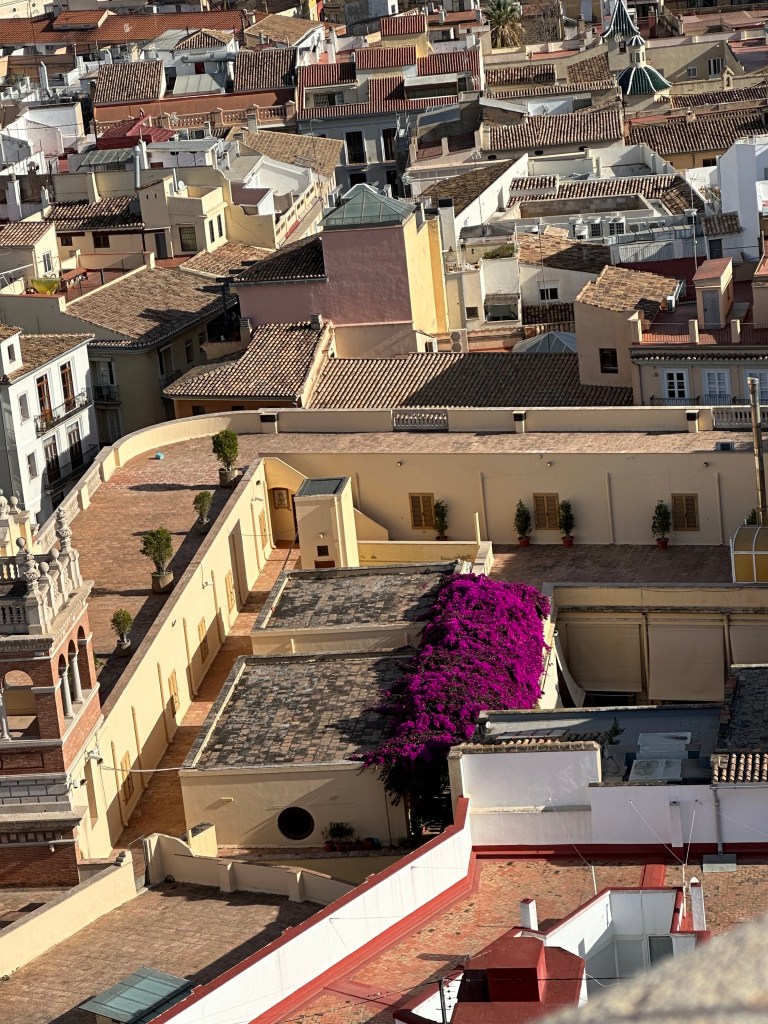
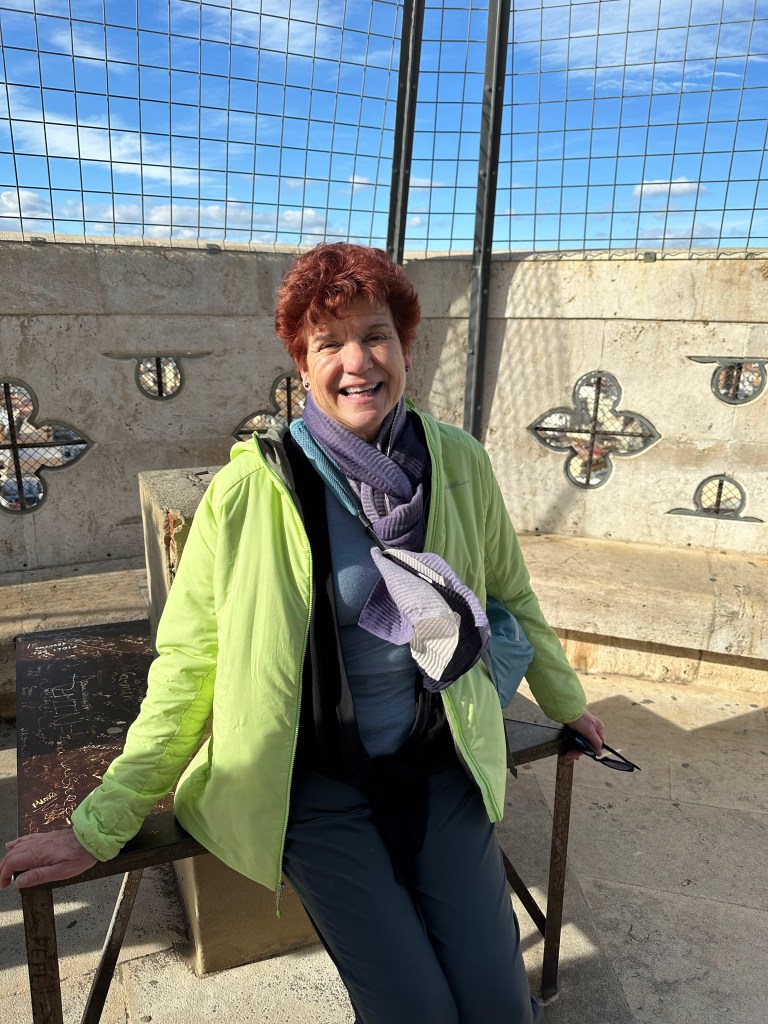
Rooftop View from El MigueleteI made it to the top of the bell tower (207 winding stairs!)This guy is a rock star!
Beyond the remains of the historic city walls, is the ultra-modern, fashion-forward city, where art, architecture, music, and cuisine are celebrated daily. Valencia is home to numerous study abroad programs and supports a large ex-pat community.
The City of Arts and Sciences
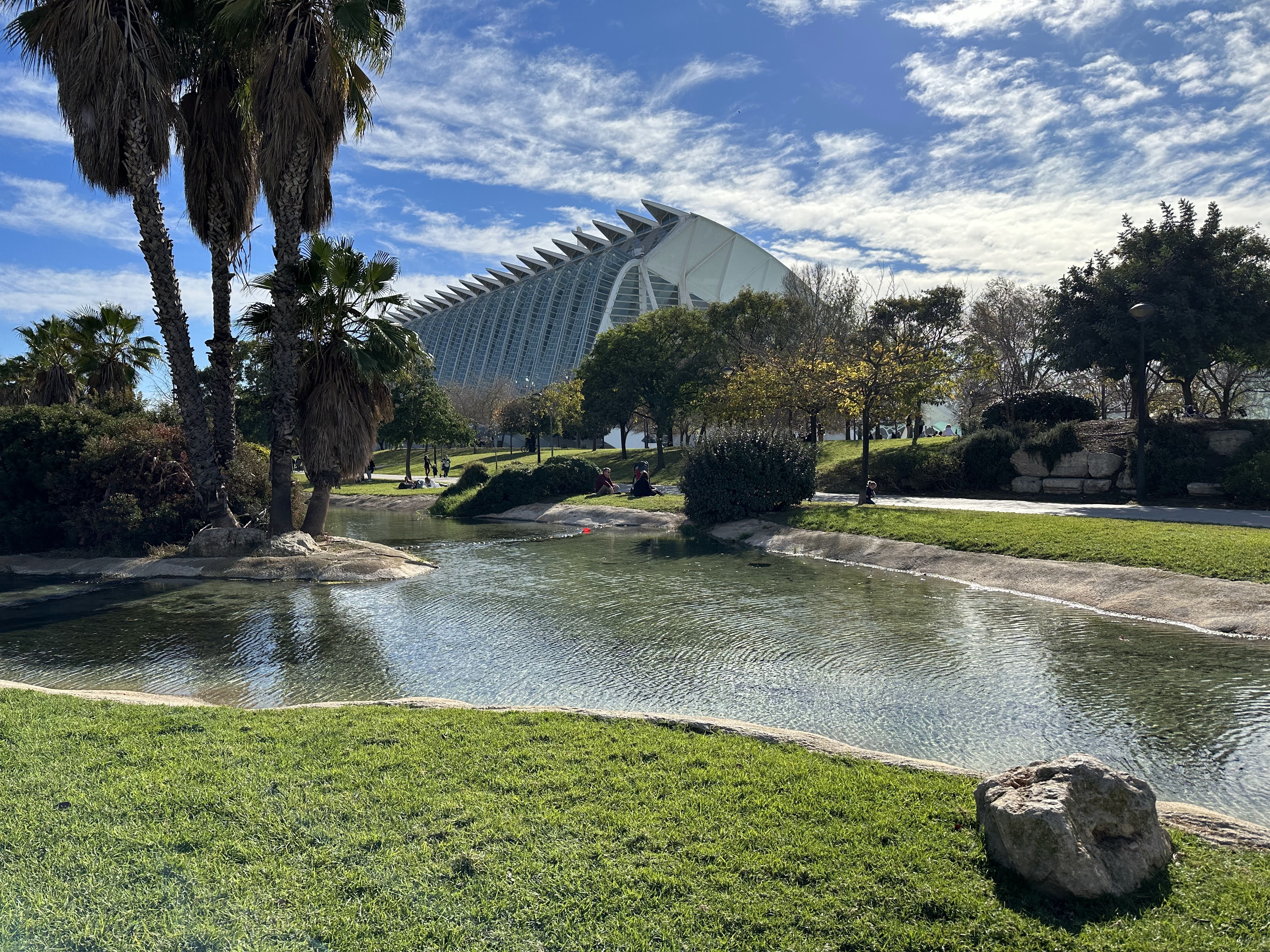
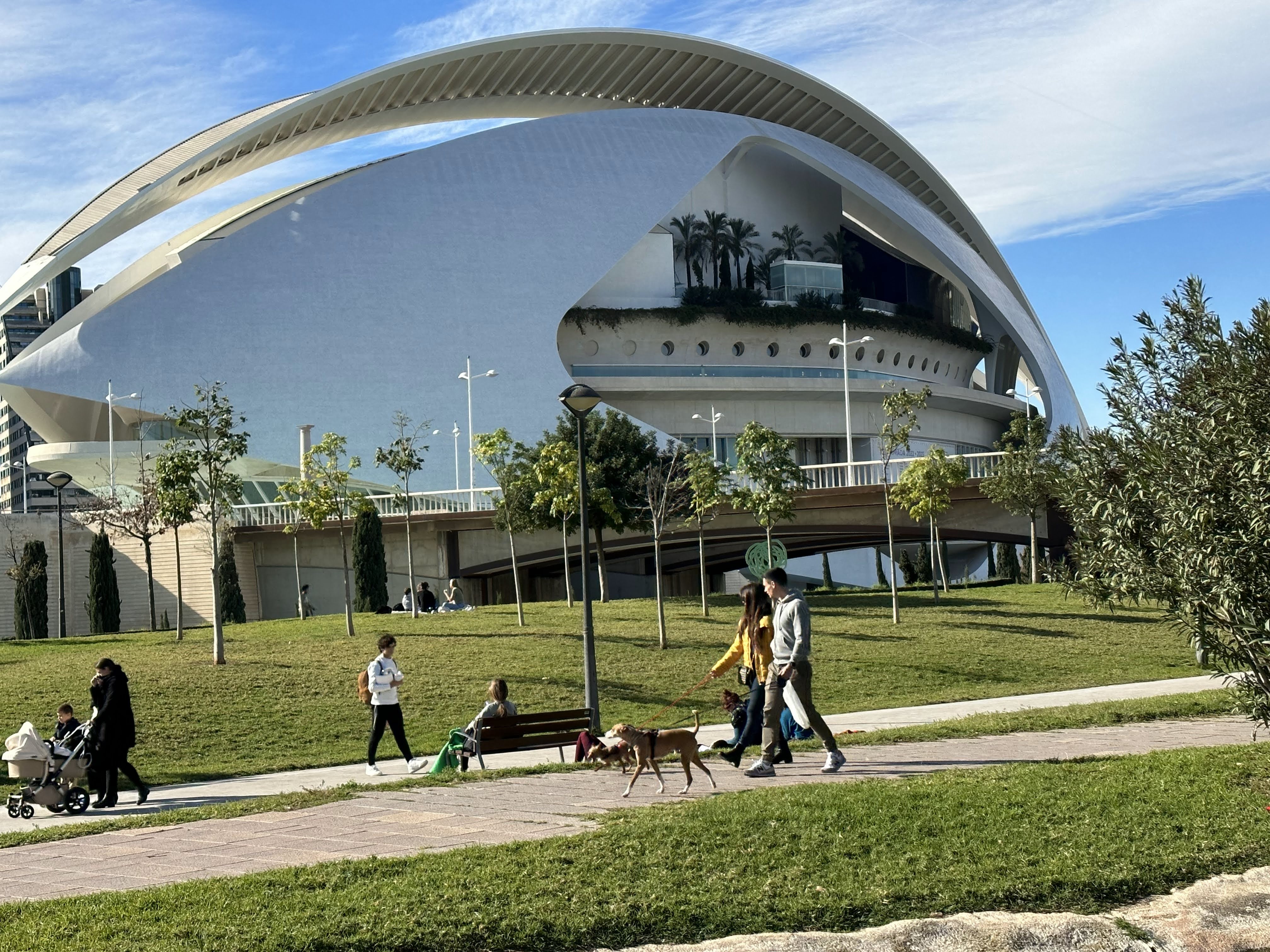
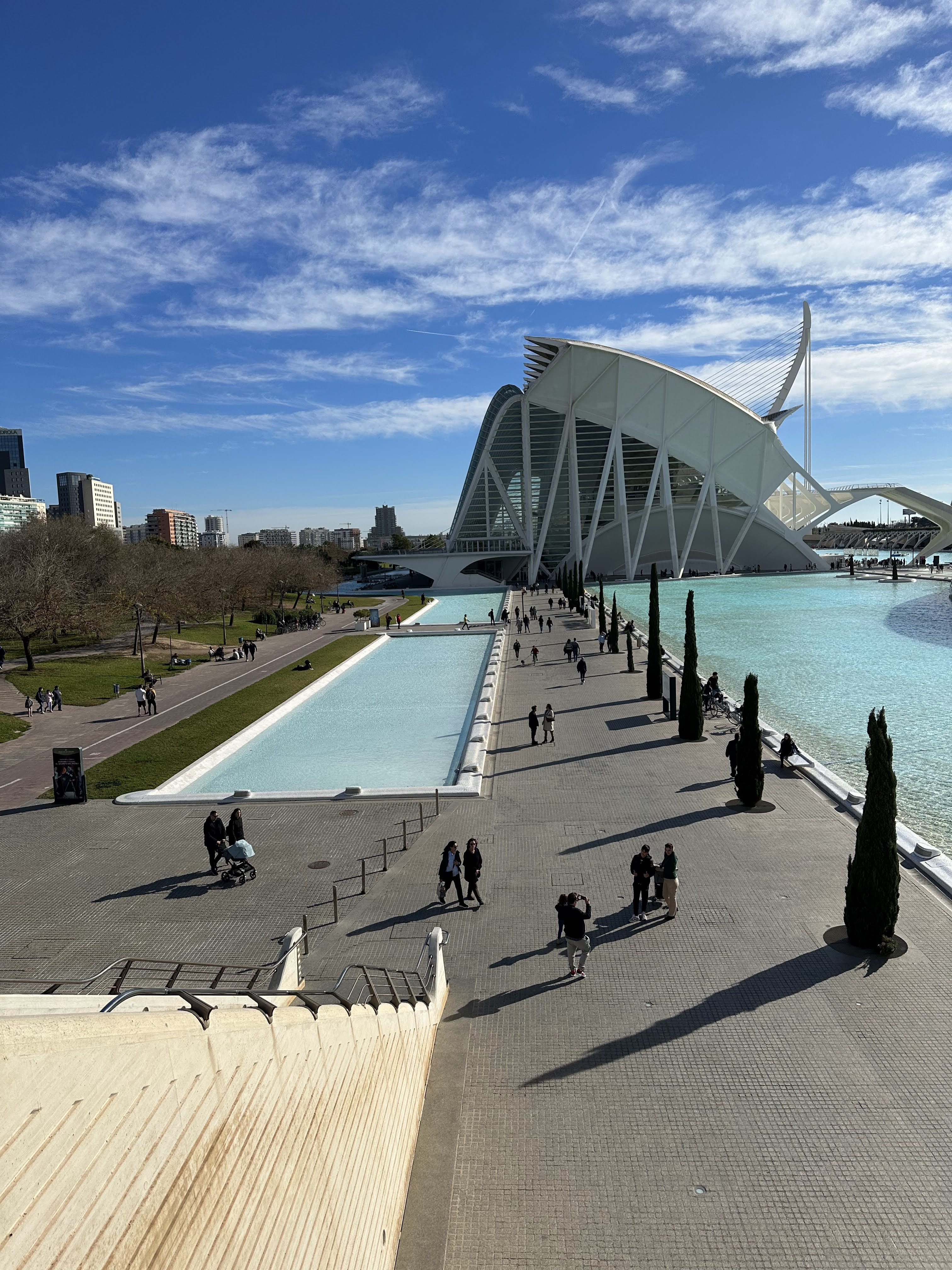
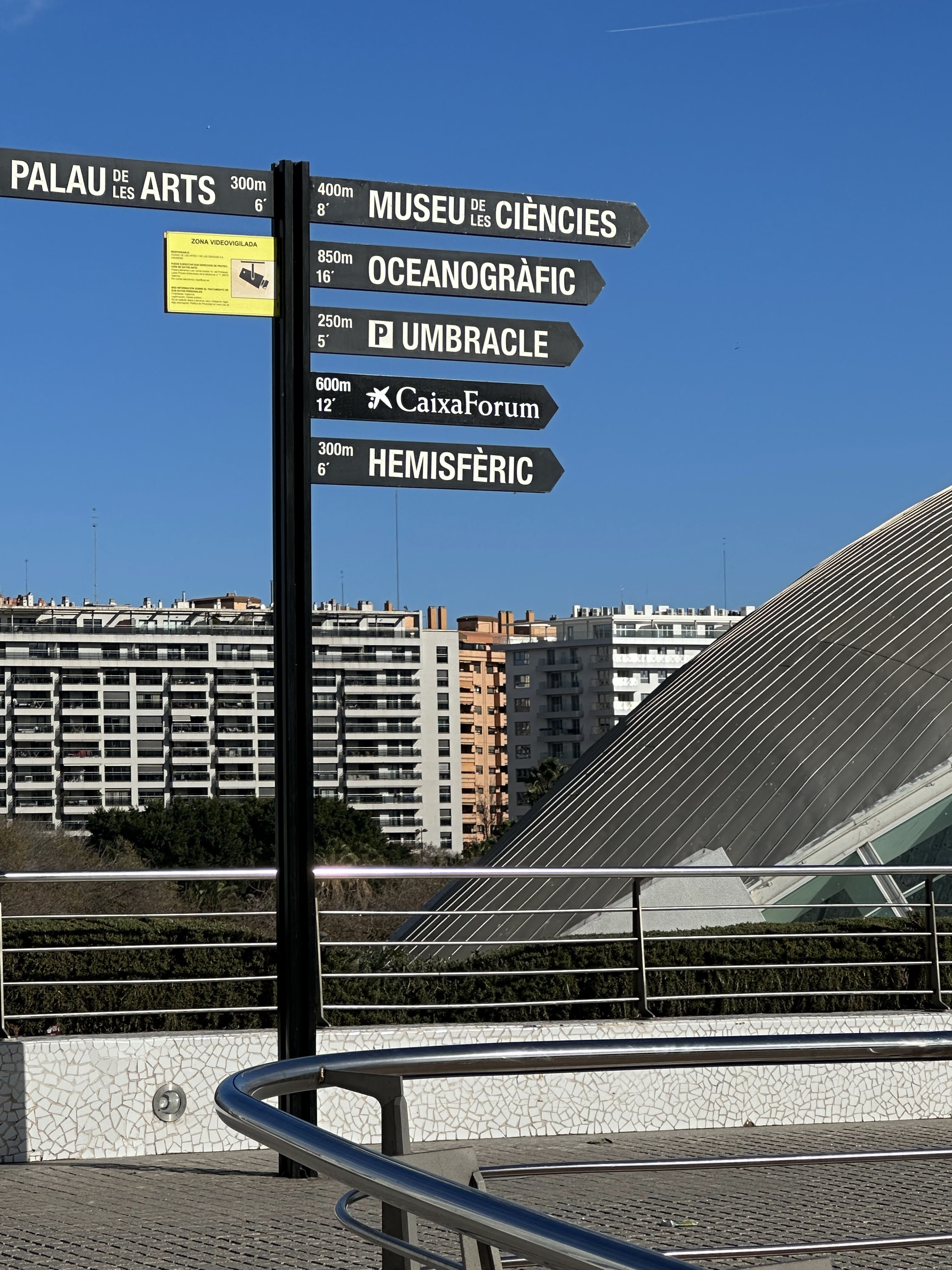
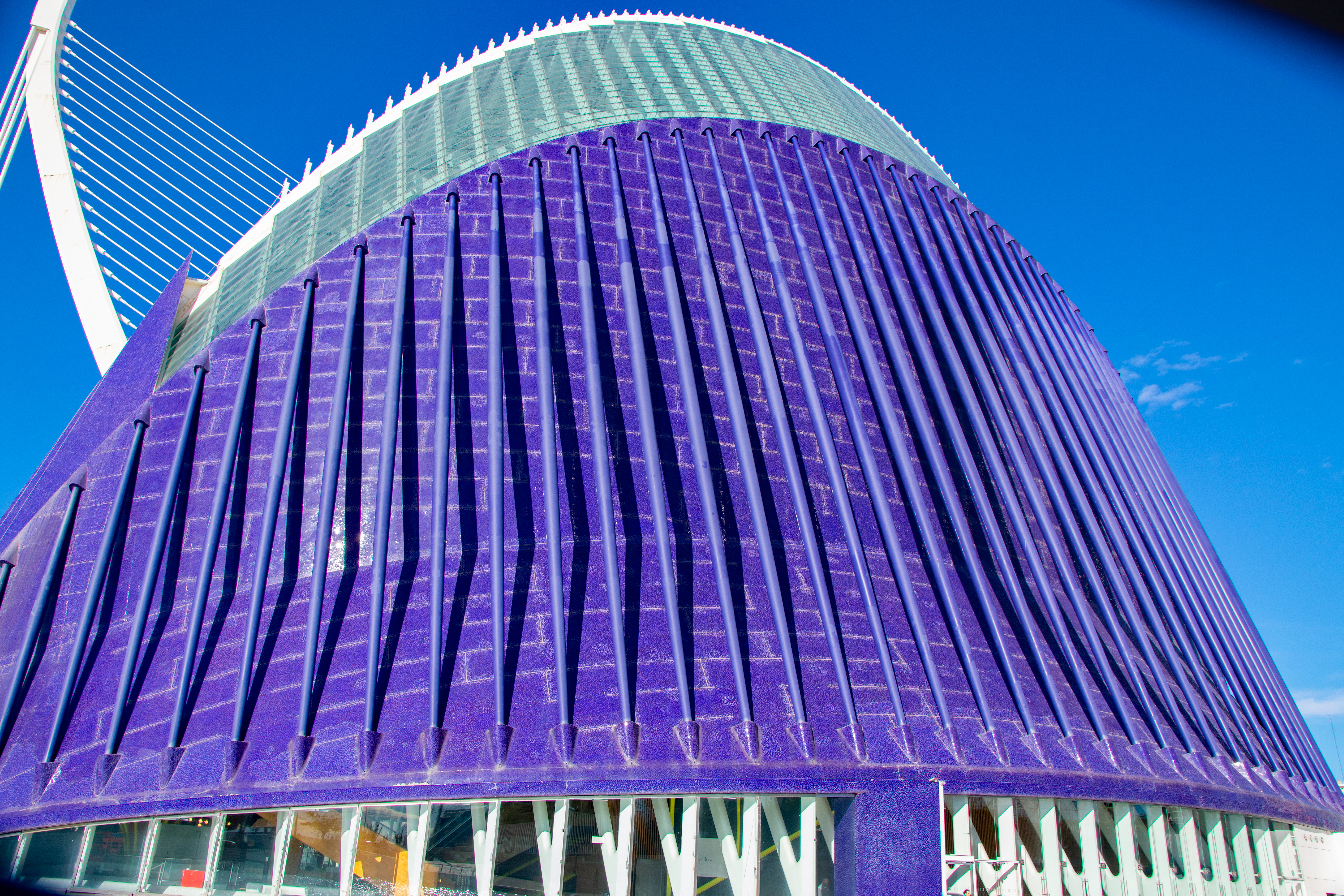
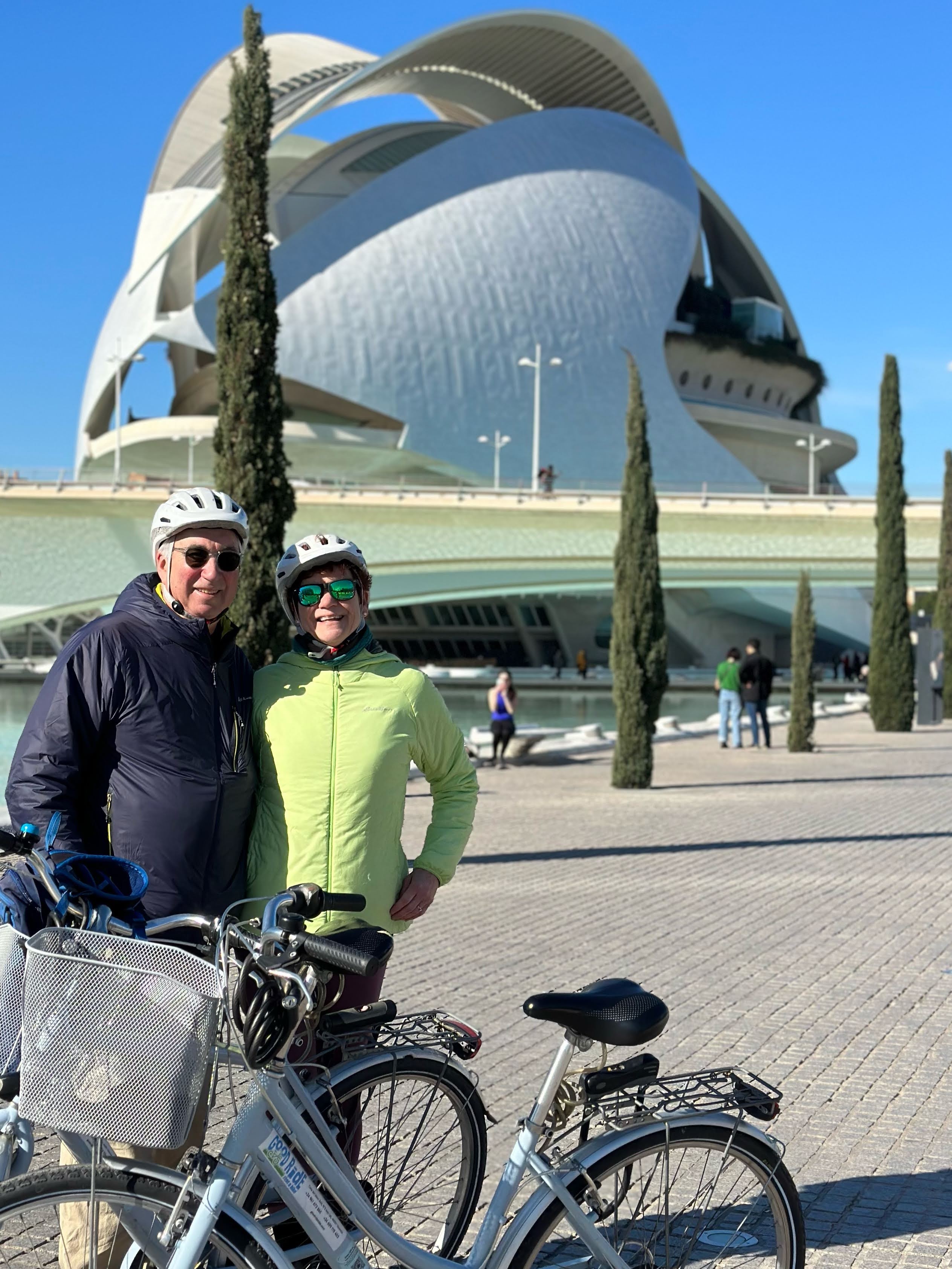
This was previously a neglected area of Valencia. In 1991, Valencian architect Santiago Calatrava was commissioned to design a museum campus. The 7 buildings took 13 years to build. The huge area is stunning! The “city” can be accessed from Turia Gardens (next gallery) or from street level. The museums and performing art center are state of the art. Since it would take days to see every museum, we chose to visit the Oceanarium, which had a great dolphin show and amazing habitats of the 7 Oceans.
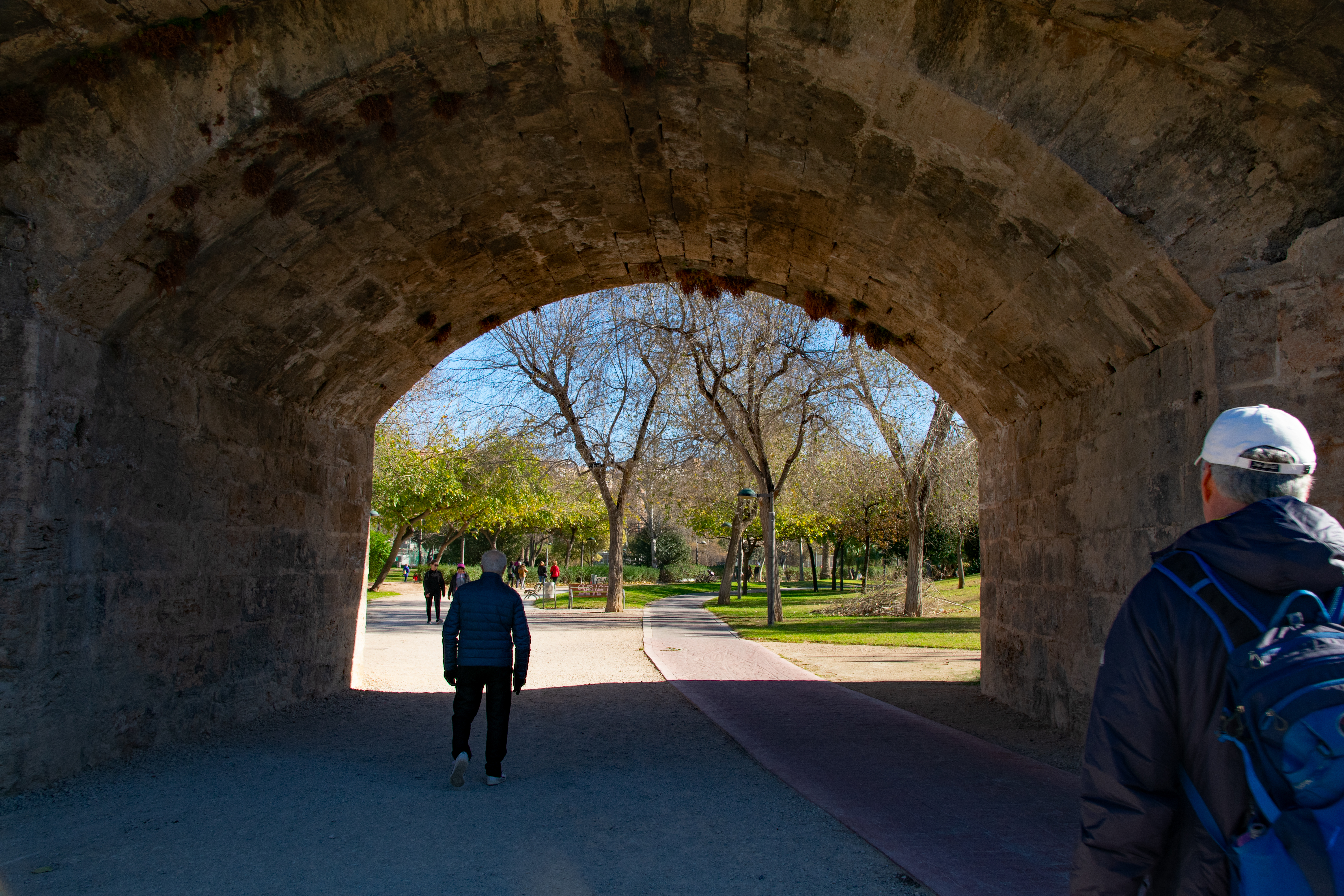
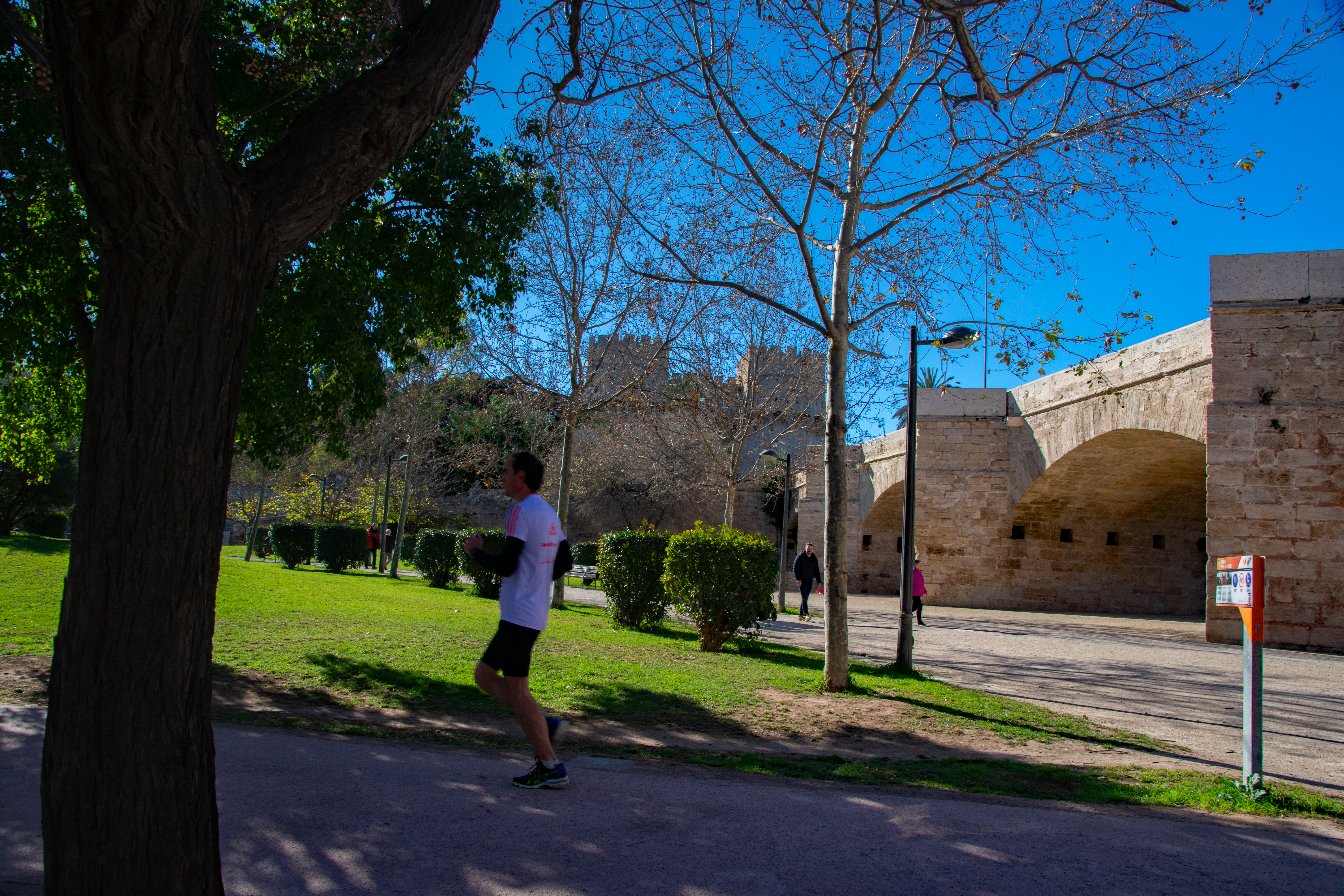
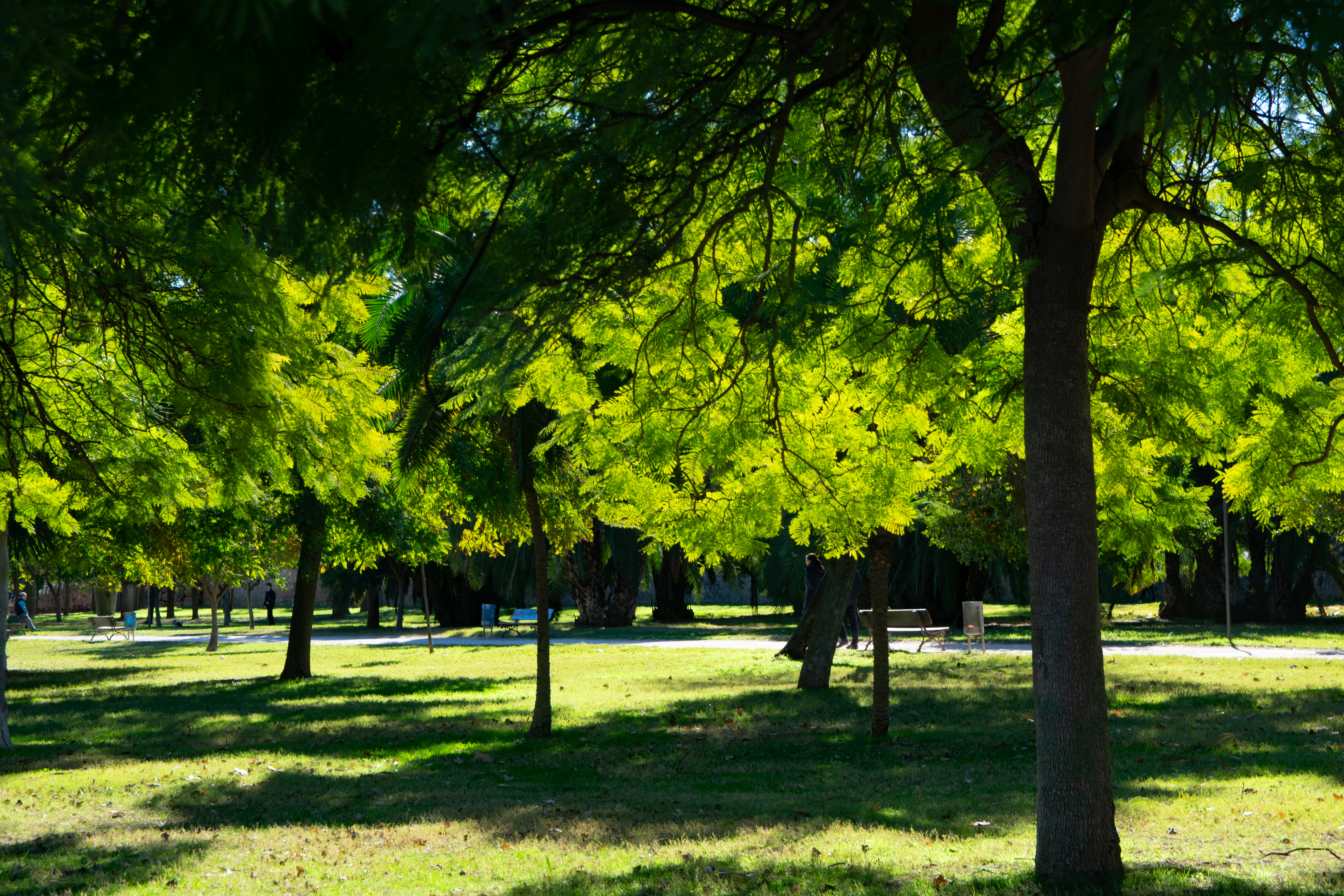
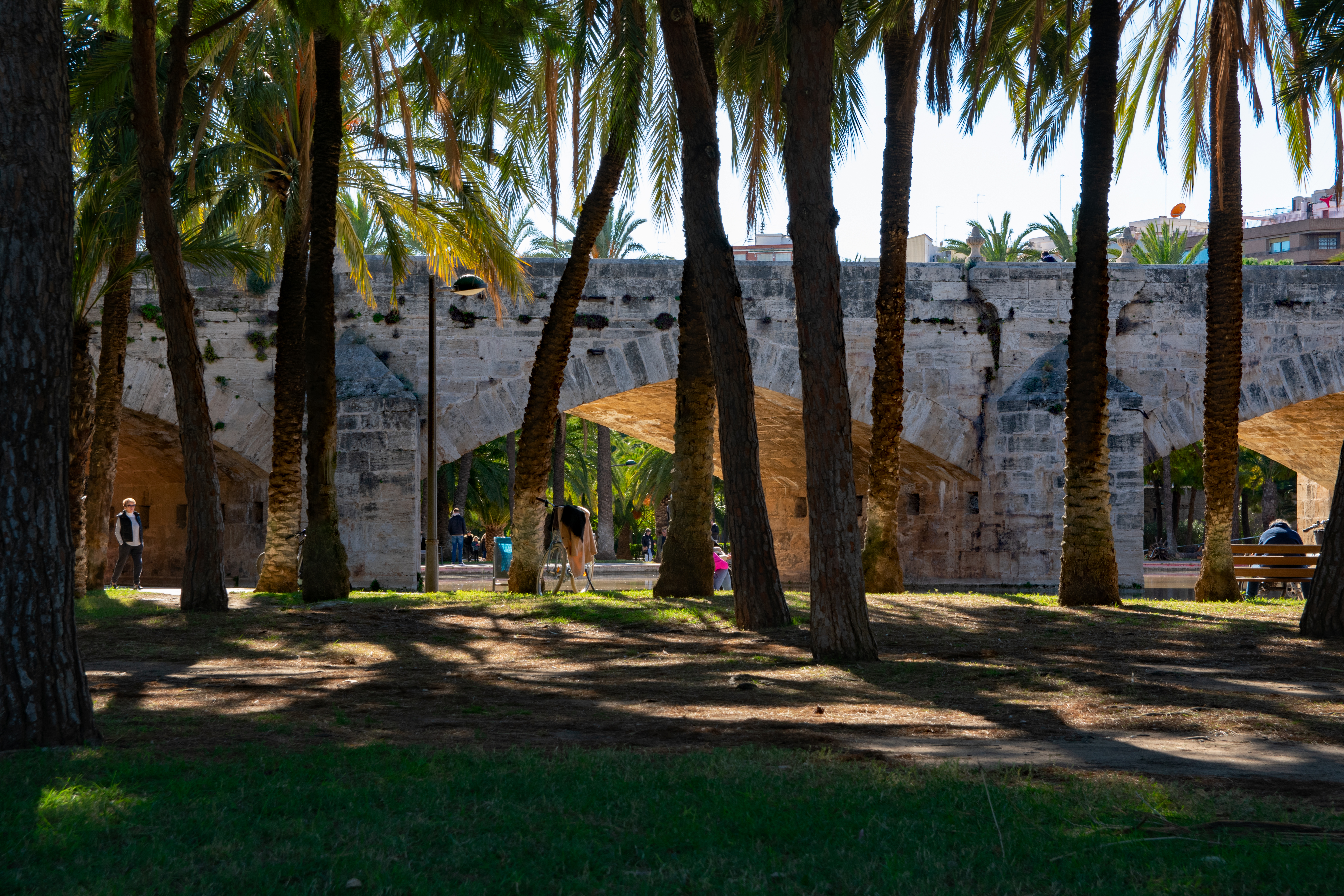
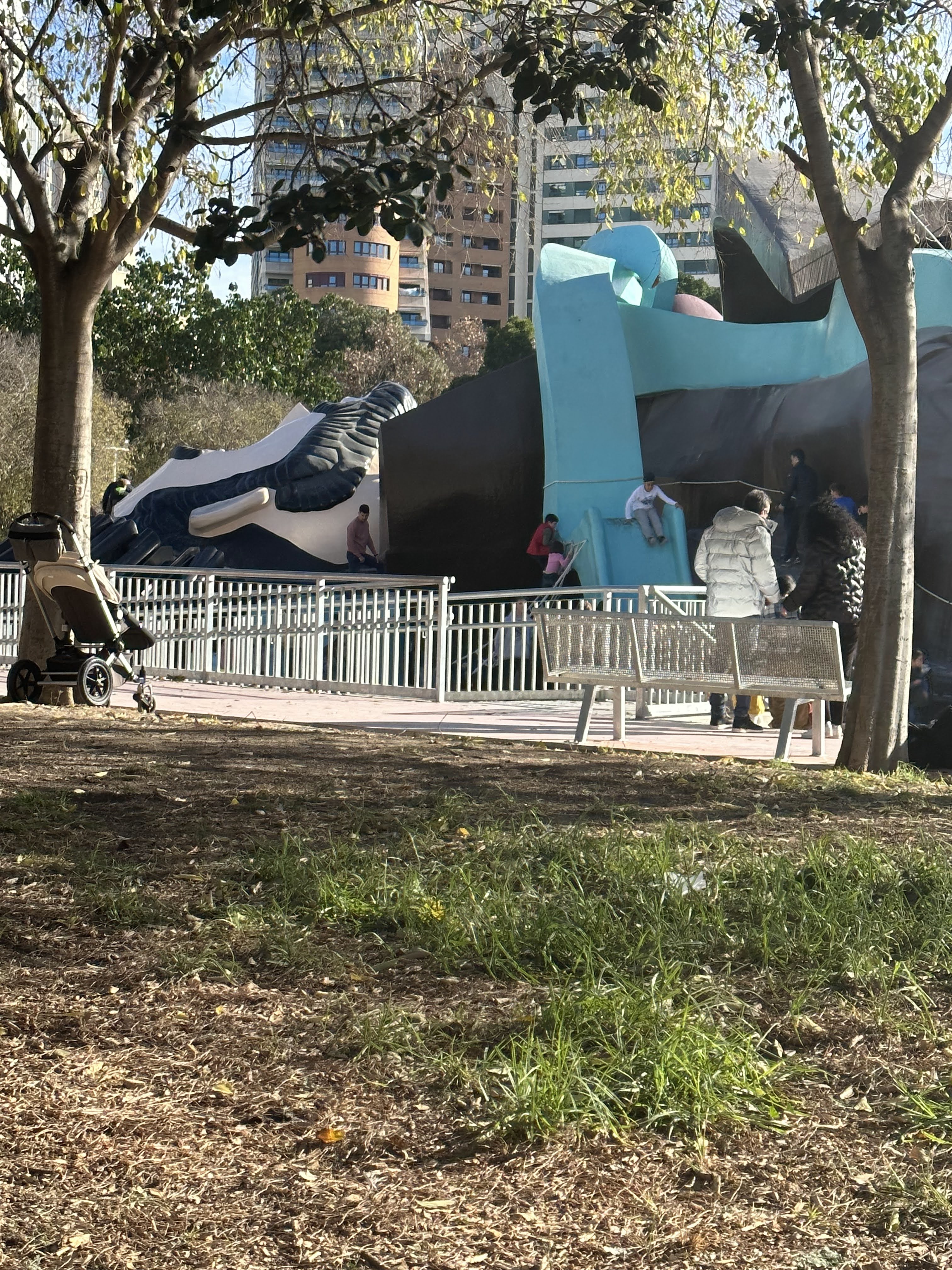
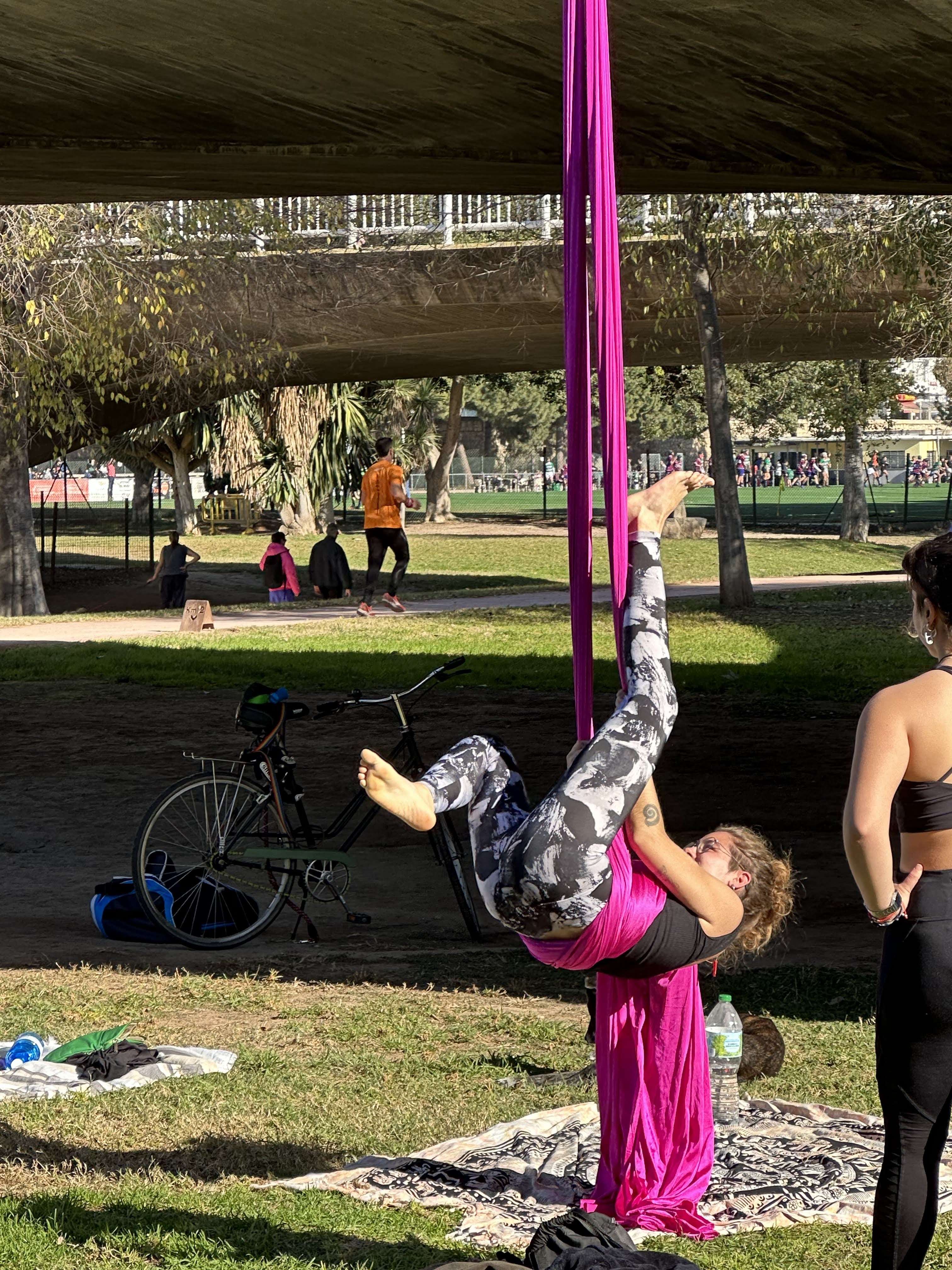
Above are scenes of Jardín de Turia. ( Turia Garden). It is a 5.5 mile long park that follows the former path of the Turia River. In 1957, the river overflowed its banks and flooded much of the city. Authorities had the river diverted to south of the city, and the dry riverbed was repurposed to green space. It is a fabulous place to bike or walk. It is home to multiple sports fields for soccer, rugby, and baseball. As you walk, run, or bike, you will see people practicing yoga, dance, and a form of pole climbing using fabric ropes hanging from the bridges.
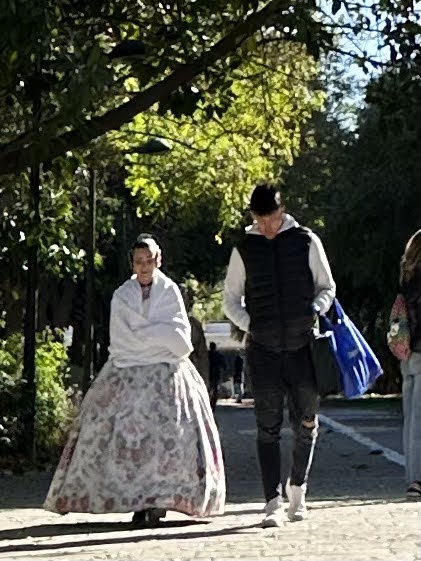
Biking Through Turia GardensYoga Class in Turia GardensBe a Lilliputin in Gulliver Park in Turia GardensStroll the Gardens in Traditional ‘Las Fallas” DressHang From the Bridges in Turia Gardens
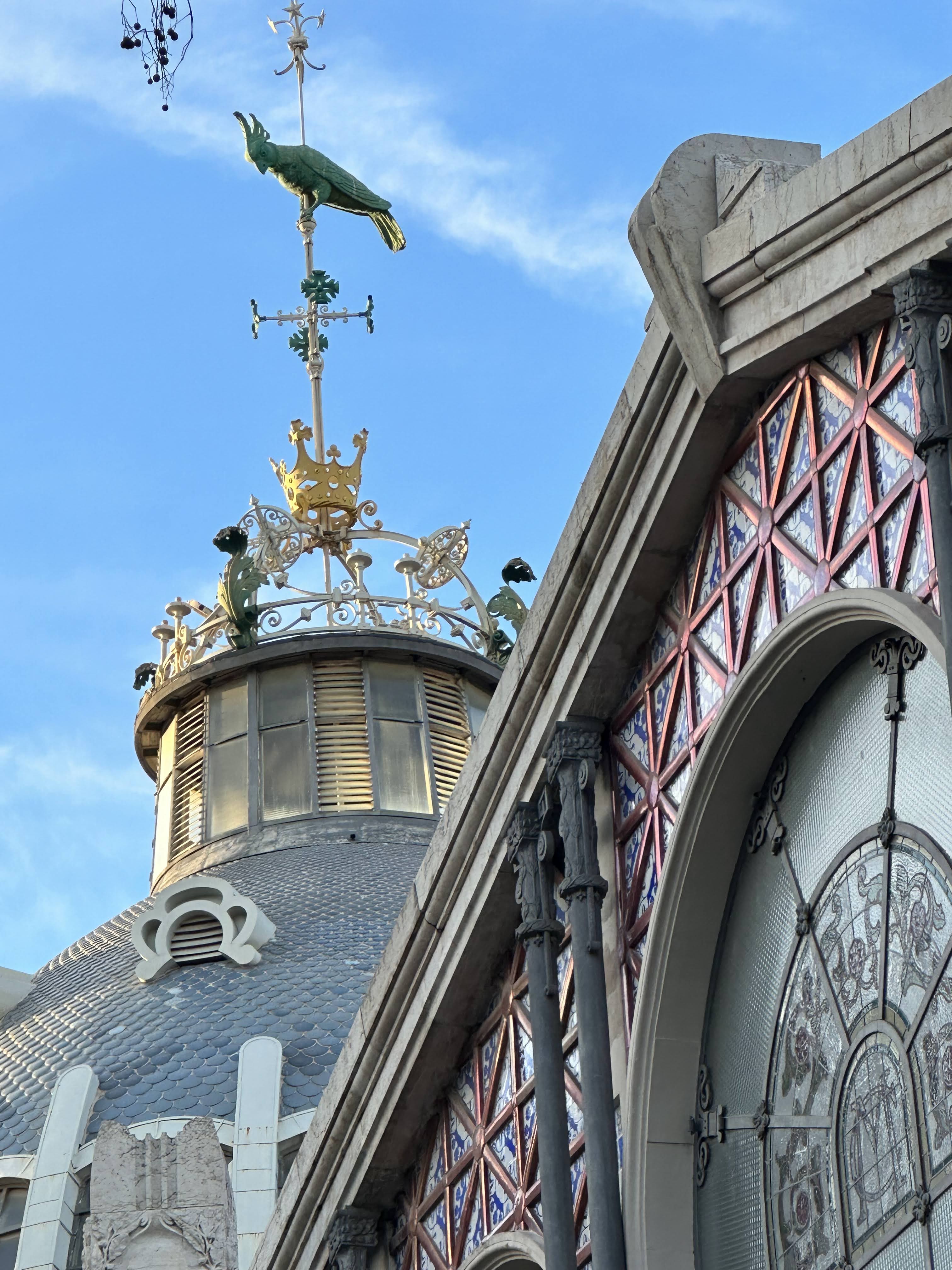
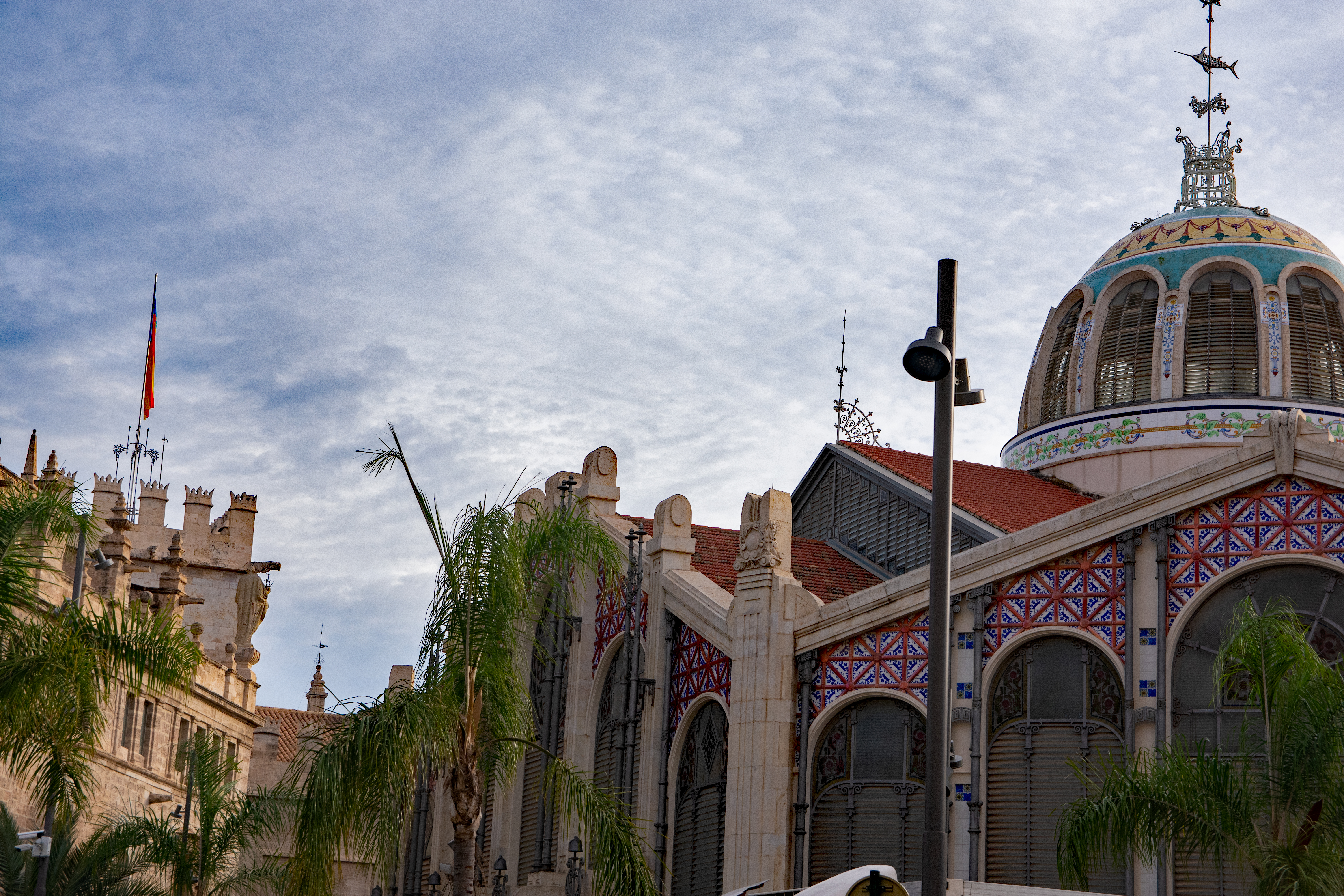
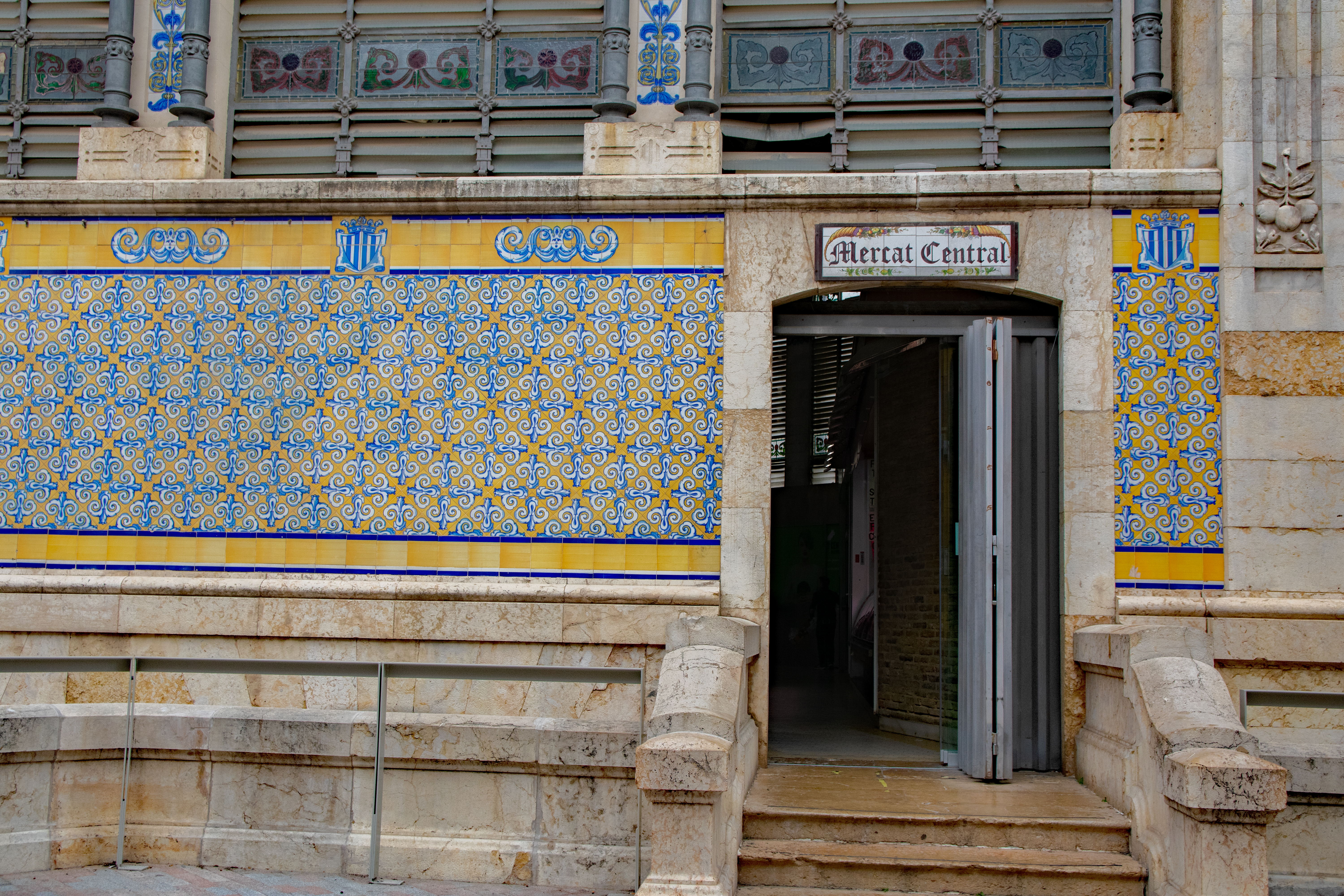
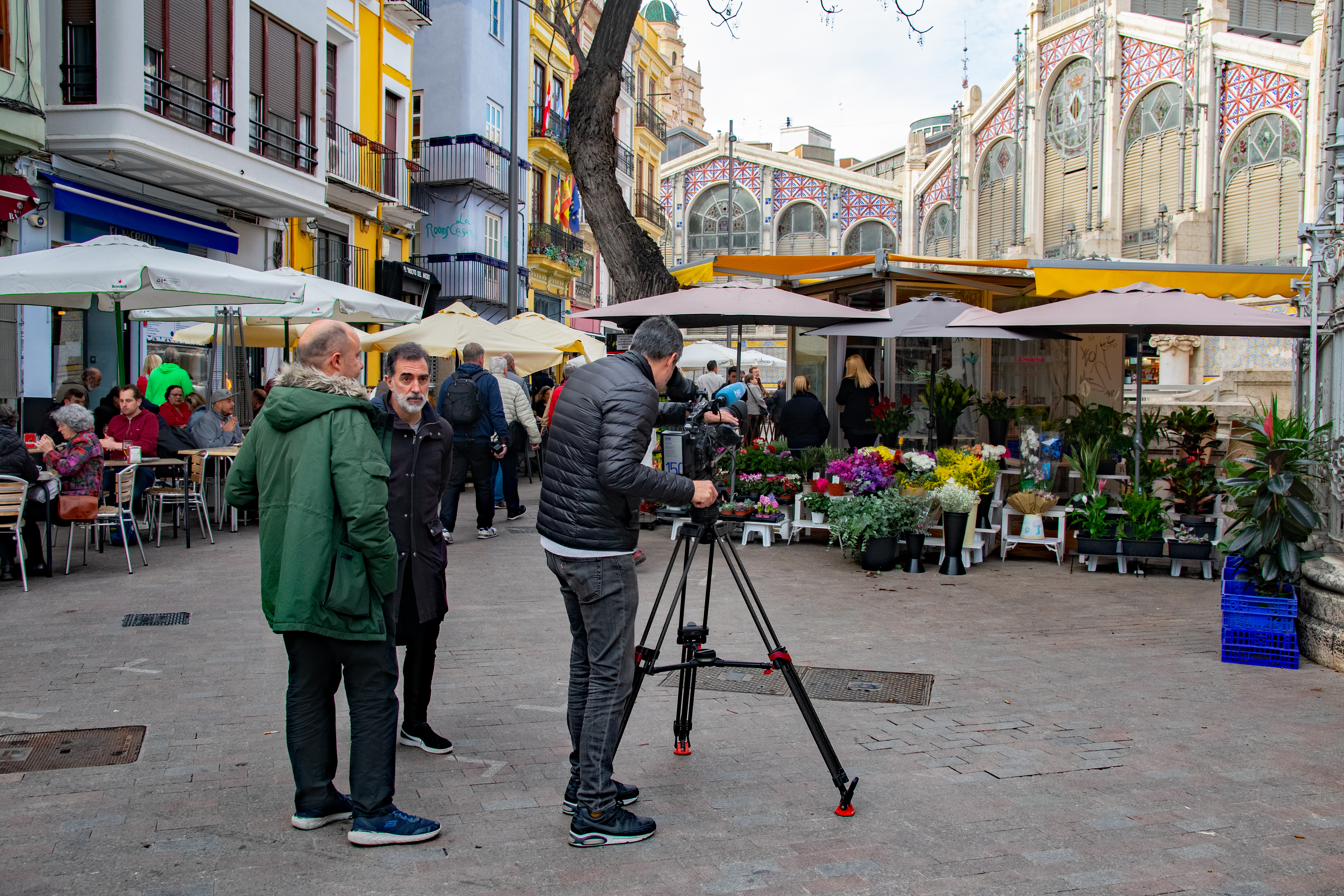
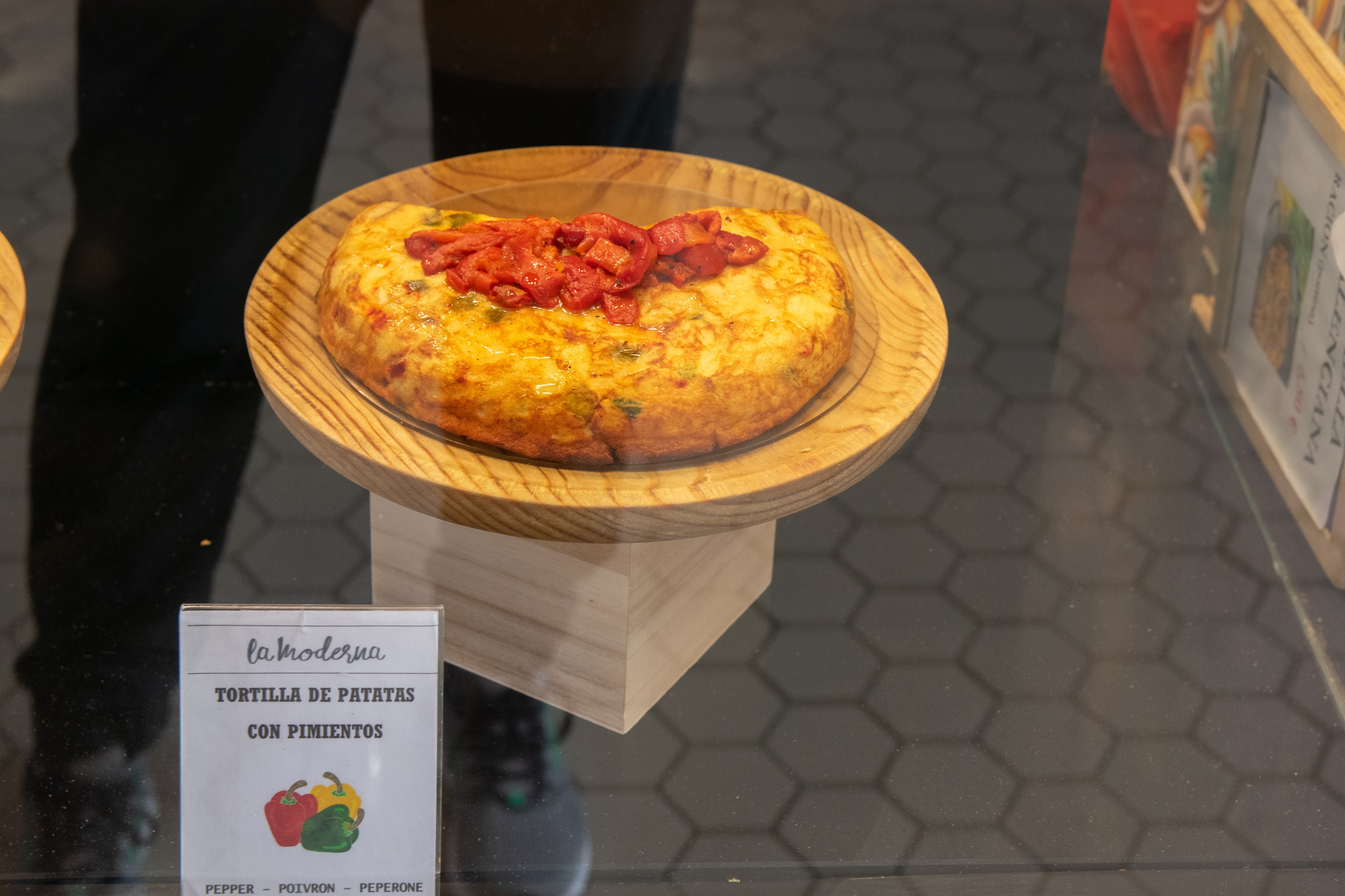
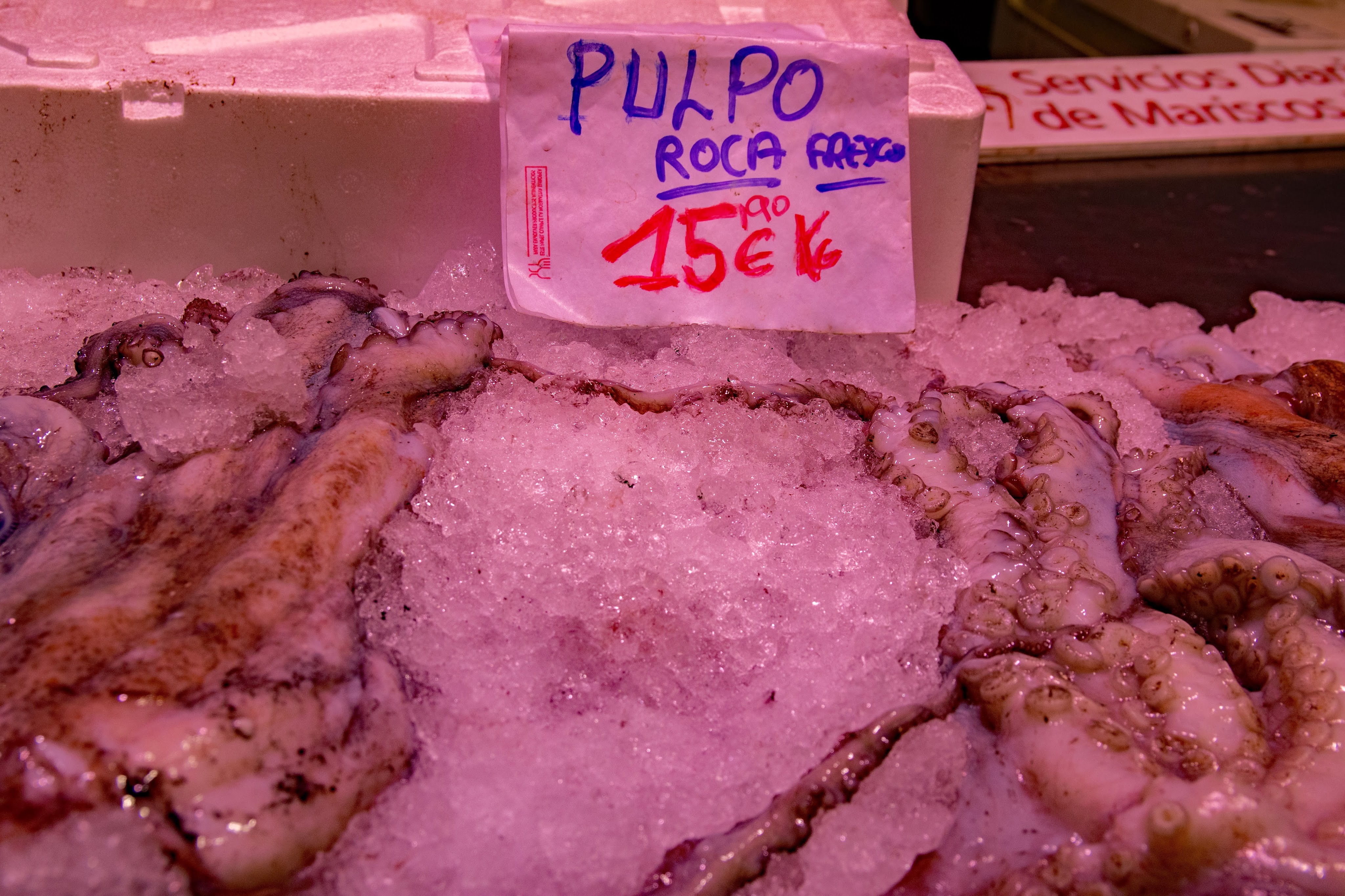
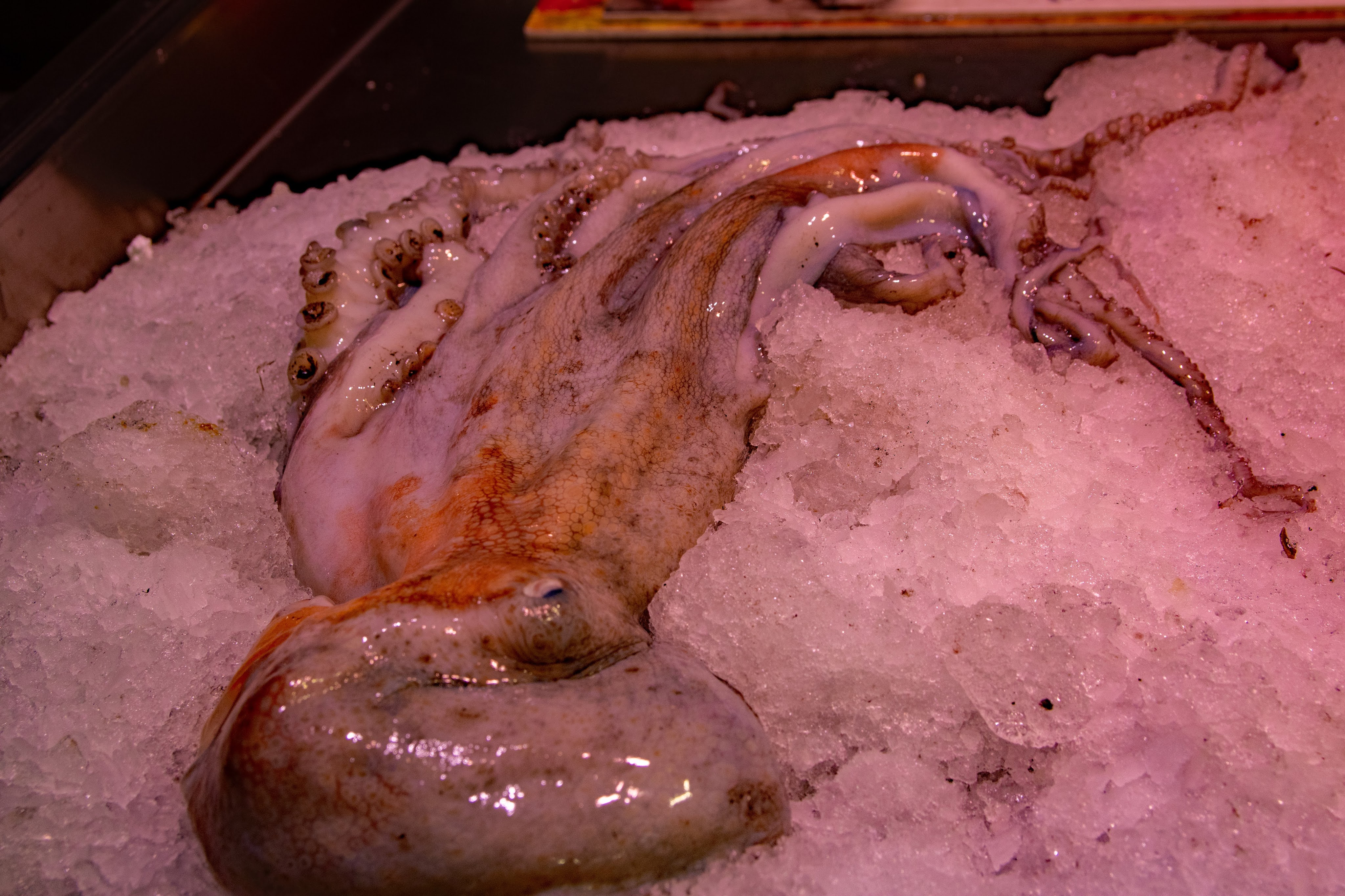
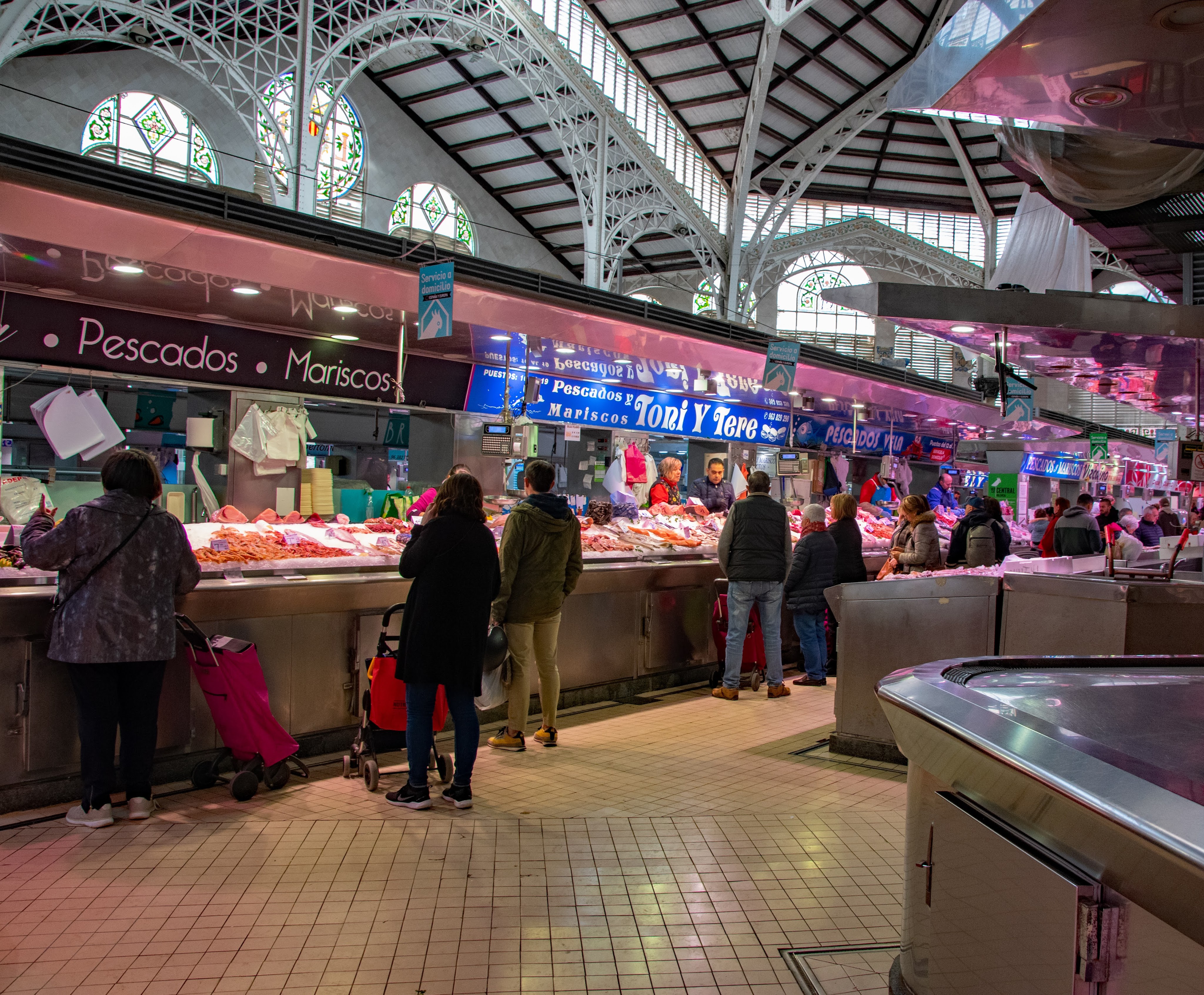
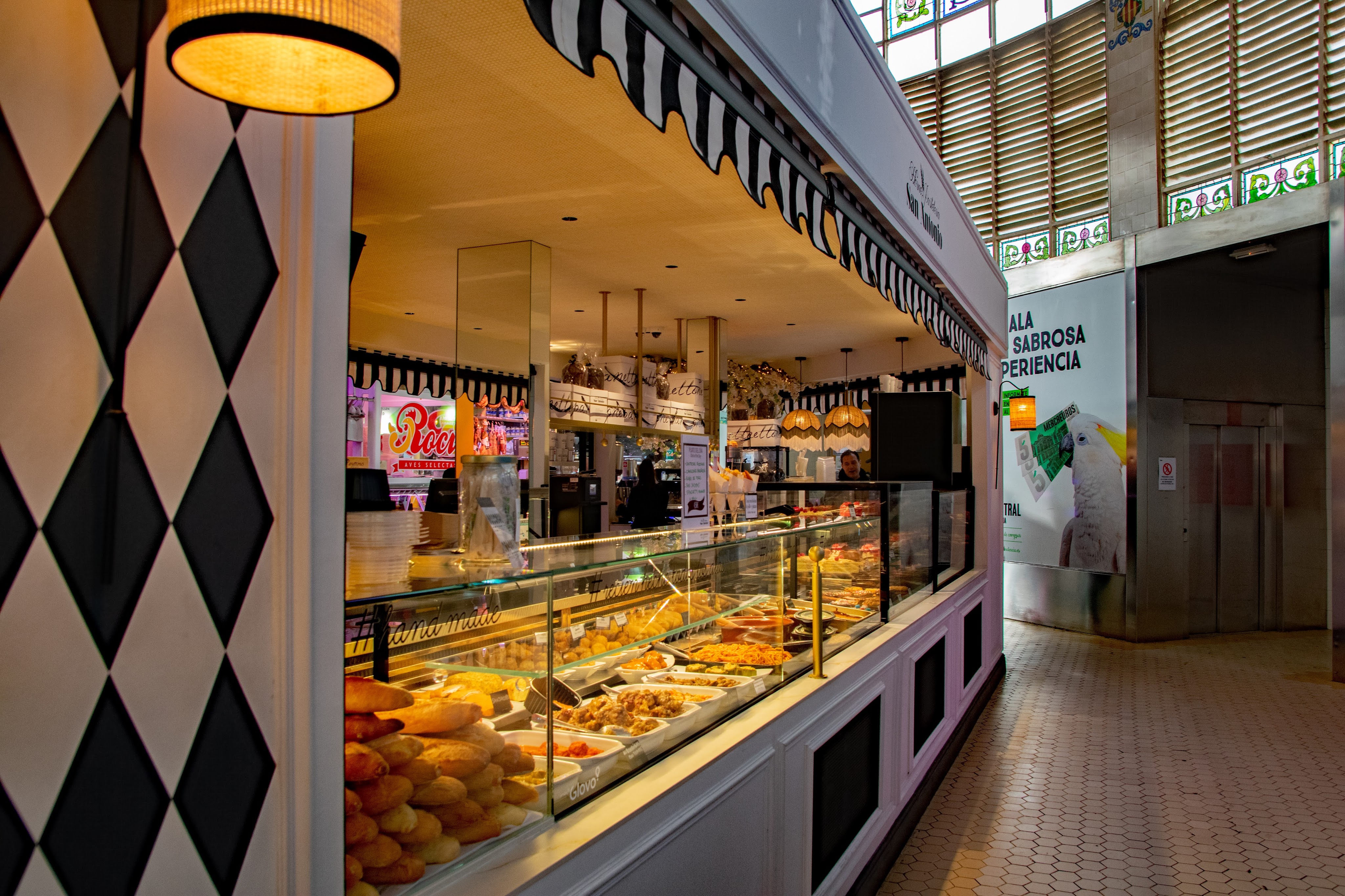
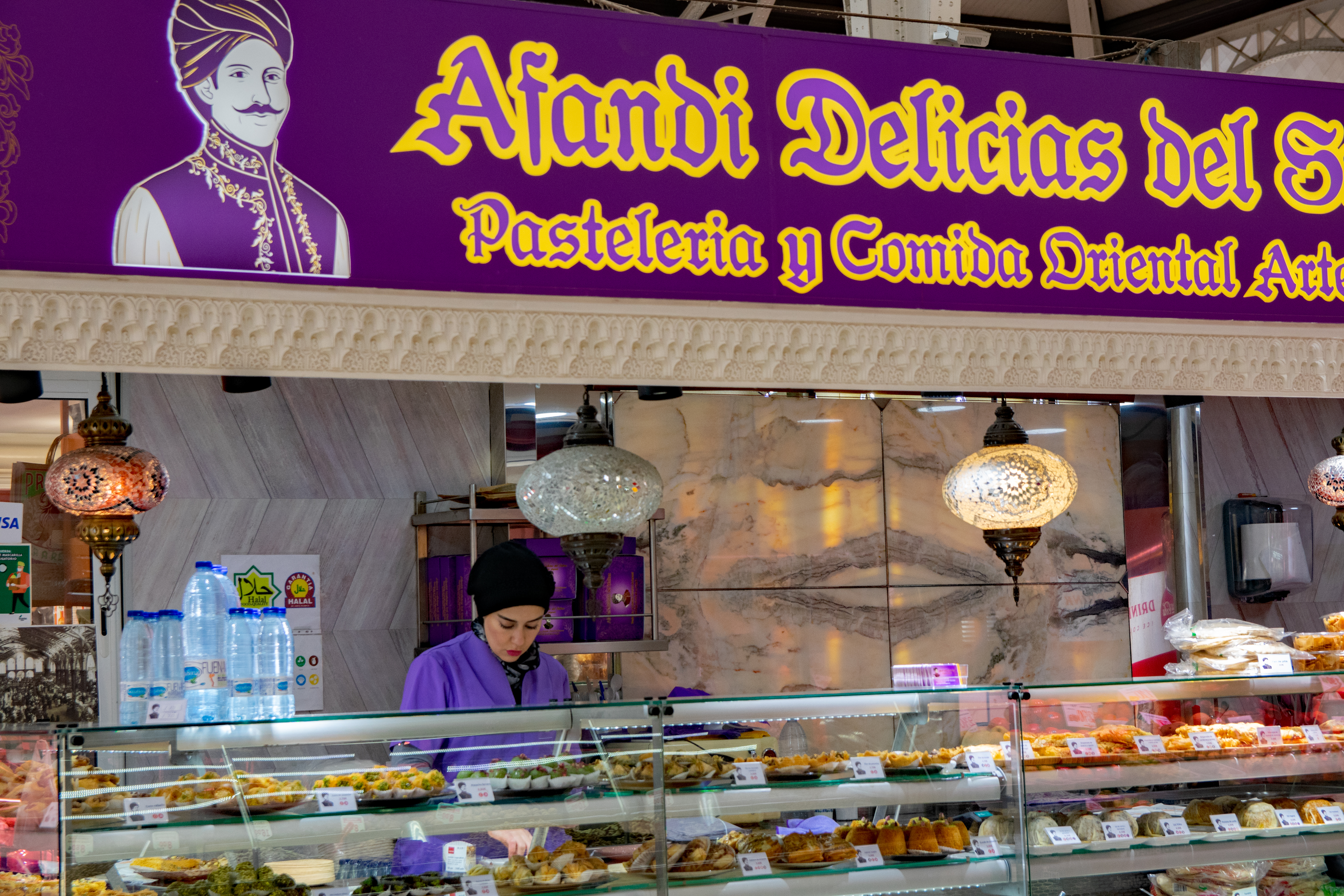
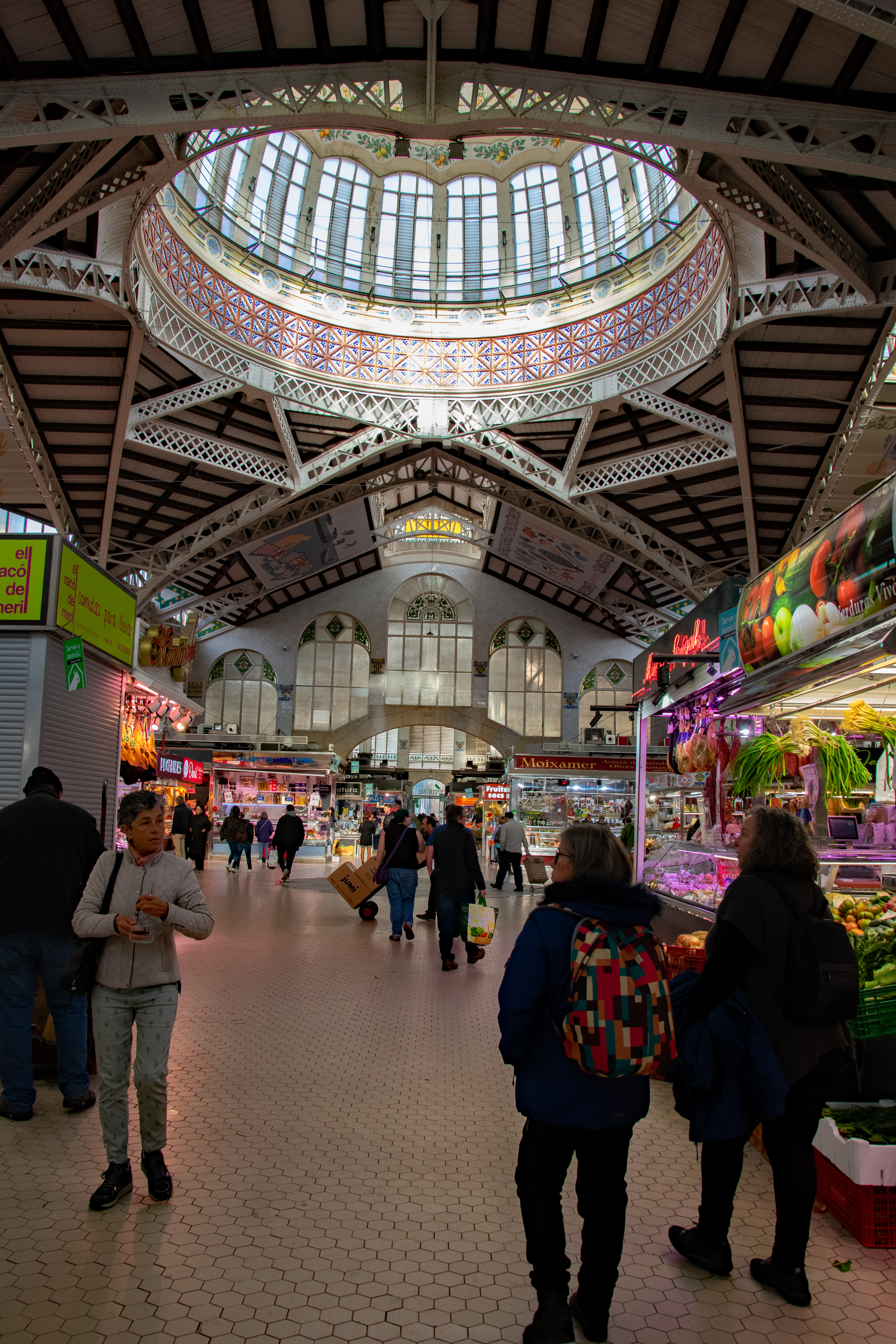
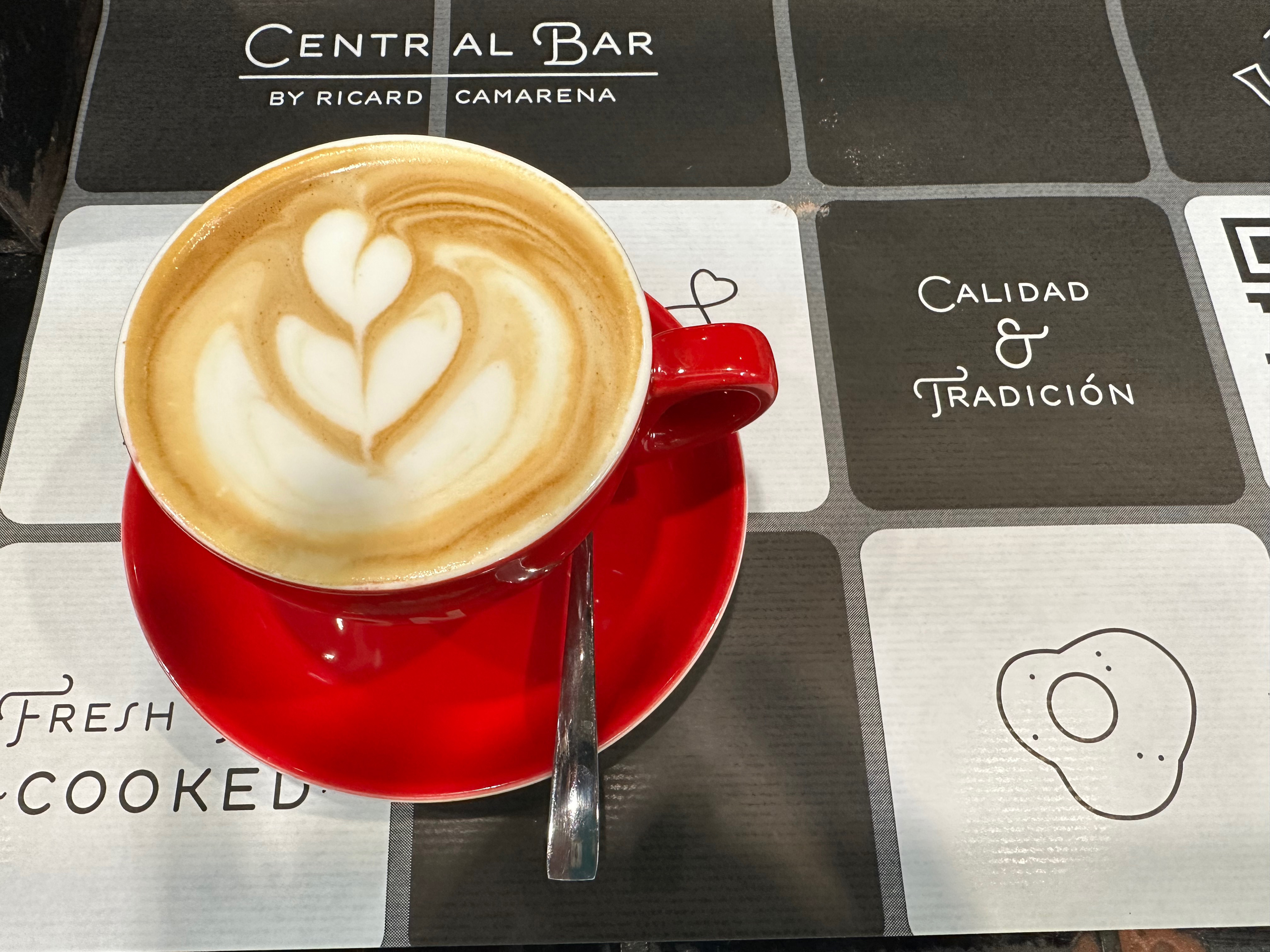
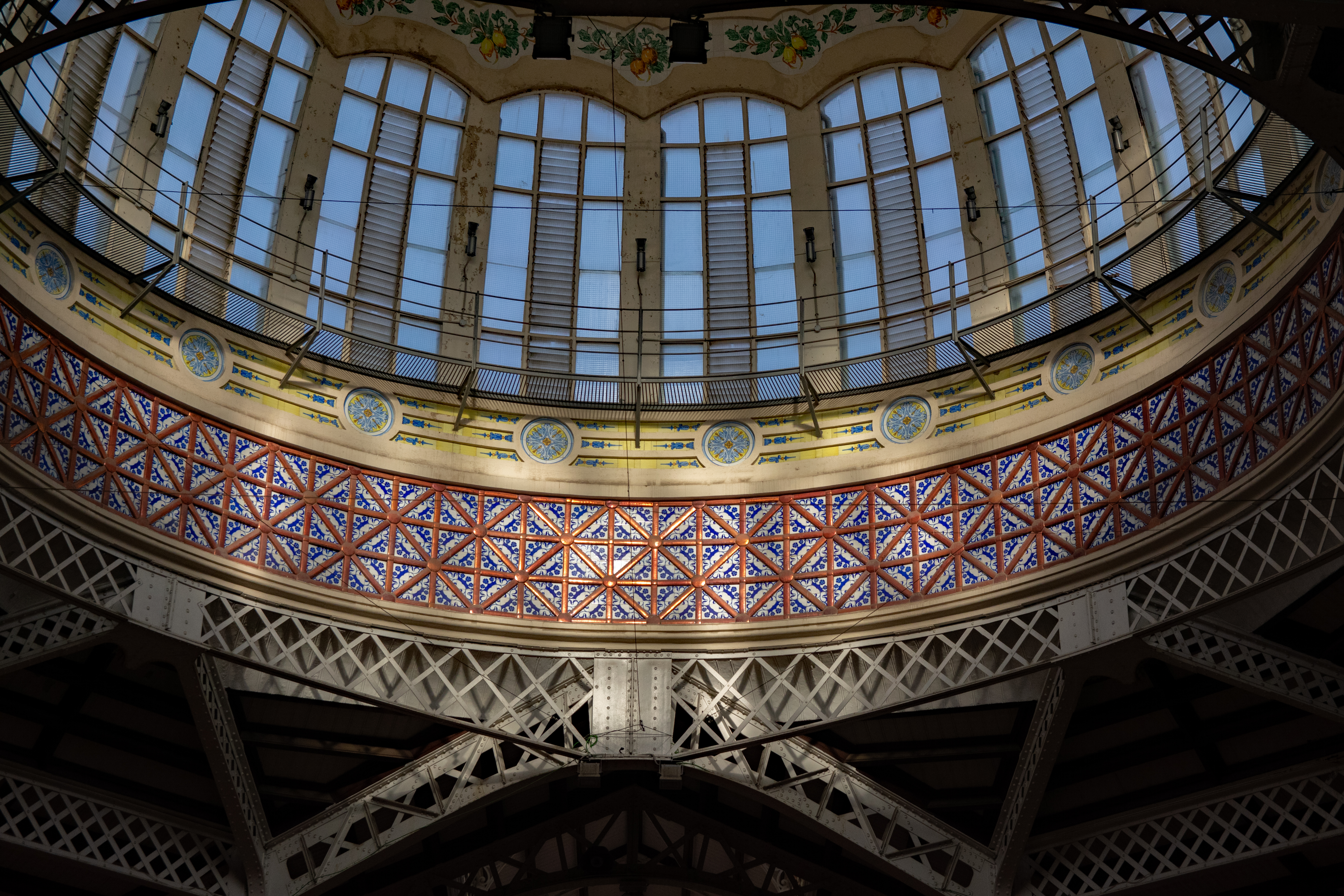
On our first morning in Valencia we headed out to the Central Market; a short walk from our apartment. The Modernist structure was completed in 1928 to bring the street market indoors. On Saturdays, there is still an outdoor flea market between Central Market and La Lonja de Seda (Silk Market) across the street. There you can buy anything from coins and war medals to vintage clothing. There are also orange juice stands and, of course, cafés. The market is a tourist attraction, but it is where the locals go to buy the freshest food at the fairest prices. At this time of year, the locals far outnumber the visitors. We walked through the entire market and on our second lap, we bought olive oil, red peppers, strawberries, oranges, cucumbers, cheese, bread, olives, etc. We stopped at Central Bar for a coffee and a montadito (small sandwich). This is Michelin chef Ricardo Camarena’s humblest location. The daily specials are written on the chalkboard. The food is ultra-fresh, tasty, and cheap!
Mercado Central is not the only place to shop in Valencia. There are several fresh markets in neighborhoods throughout the city. In addition to market stalls, there are small fruit and vegetable shops (fruterías), bakeries (pastelerías), and grocery stores (supermercados). Supermercados are generally much smaller than what we are used to in the States, but you will find the basics and your bill will be much less than what you are used to as well.
Double click on gallery photos to read captions.
La Lonja de Seda- The Silk Market
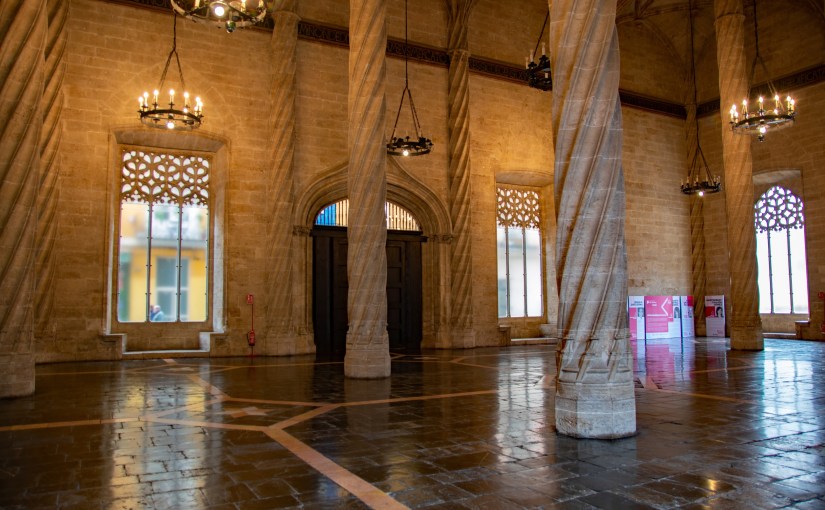
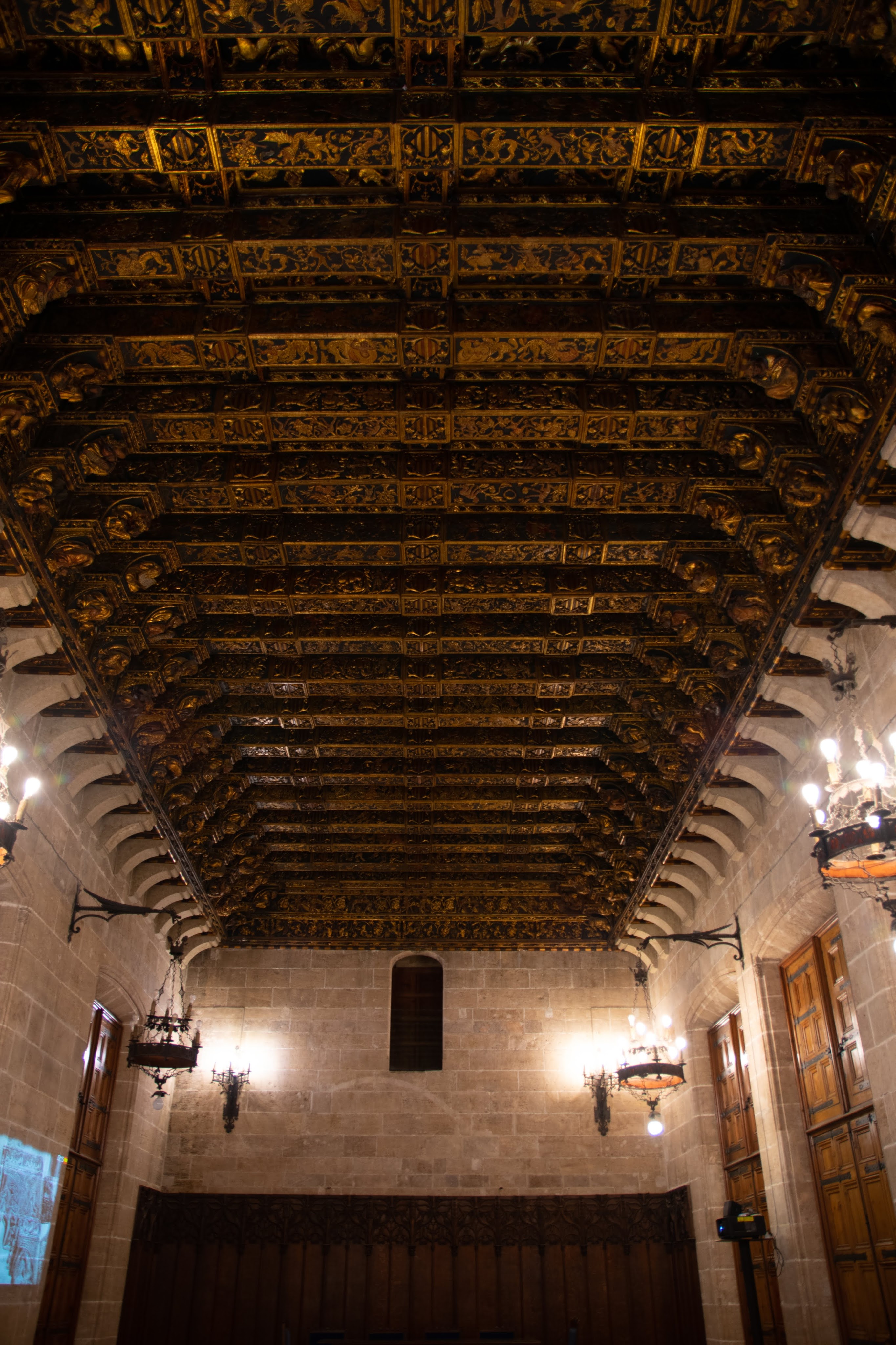
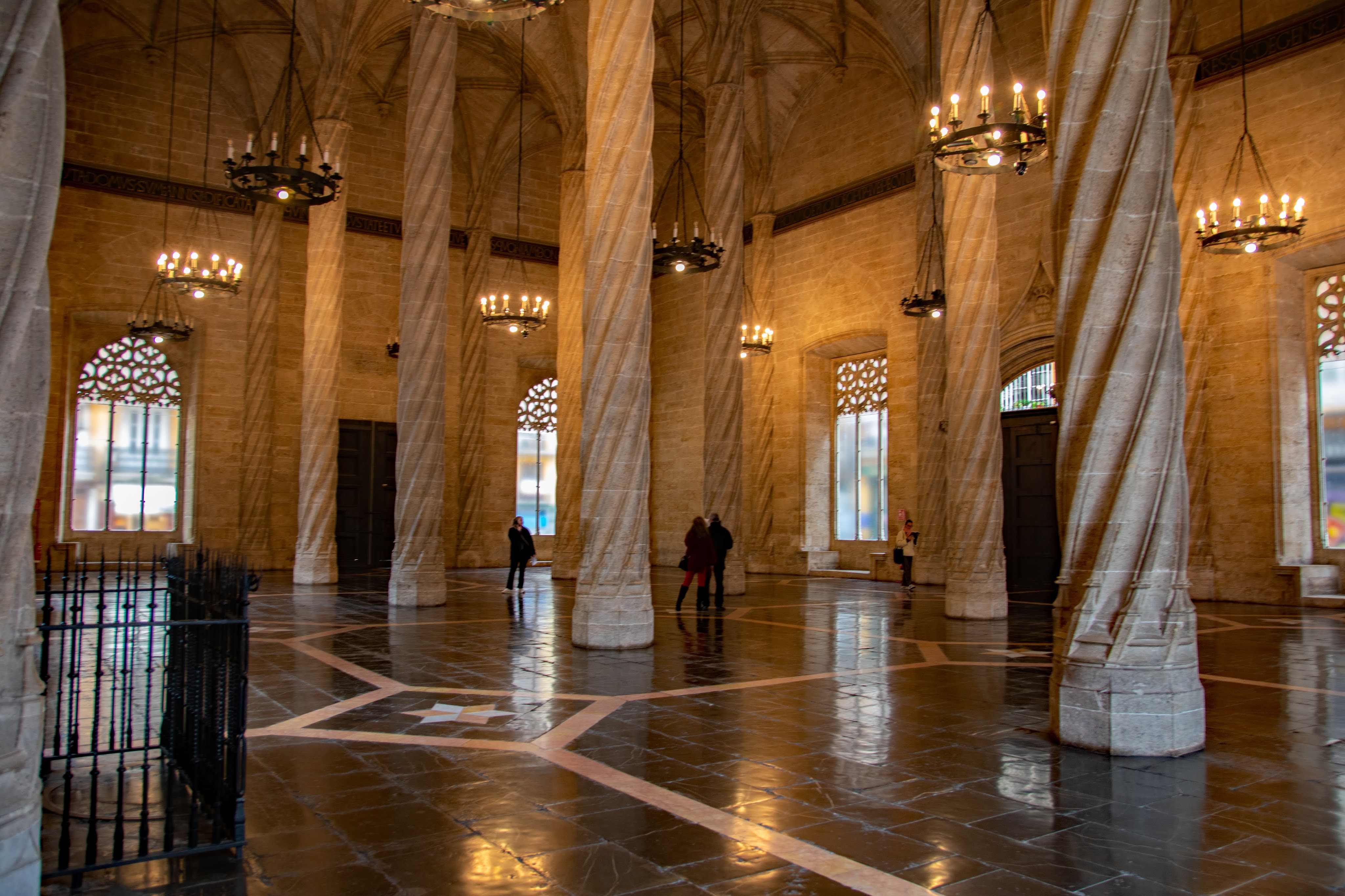
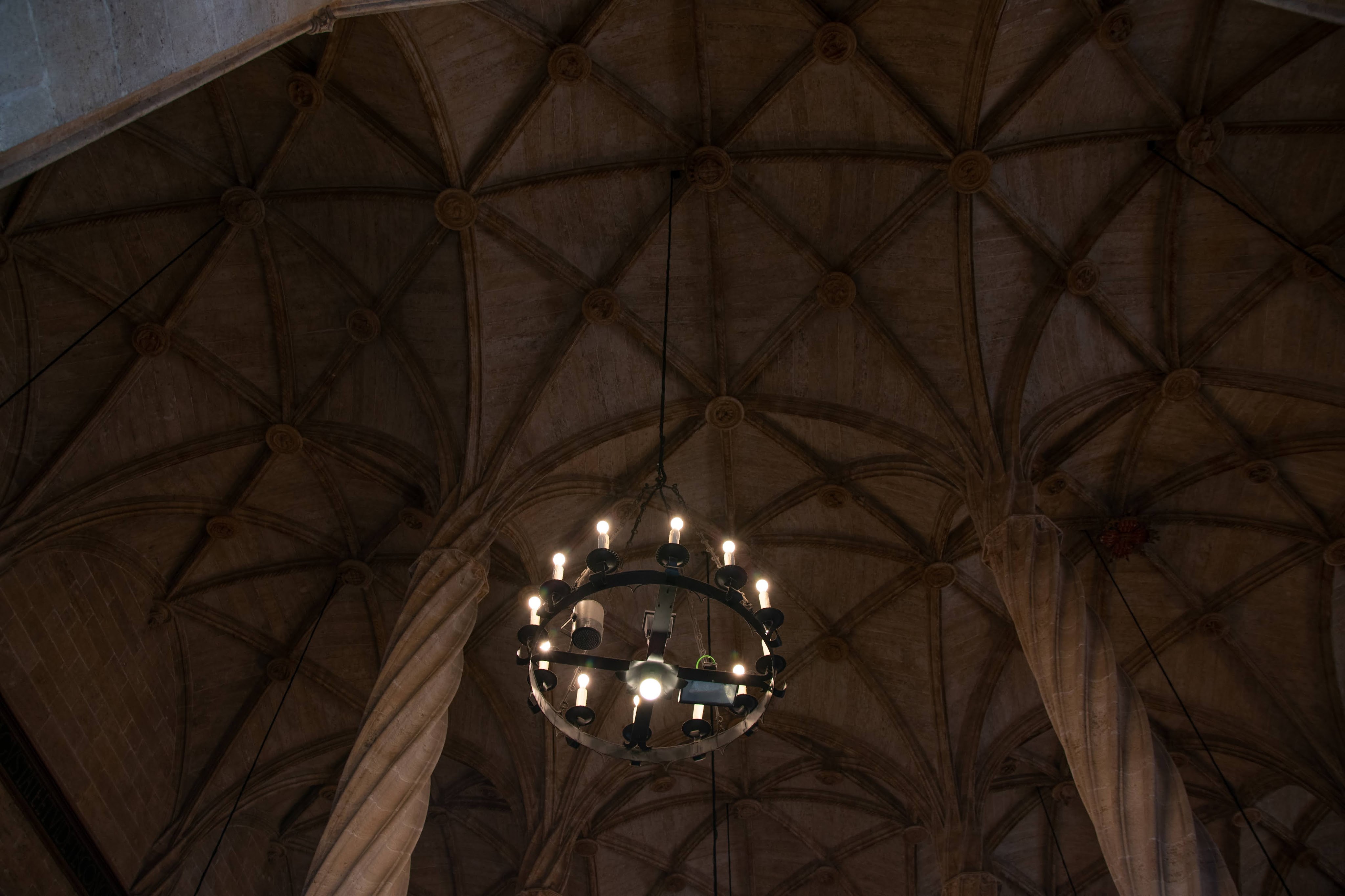
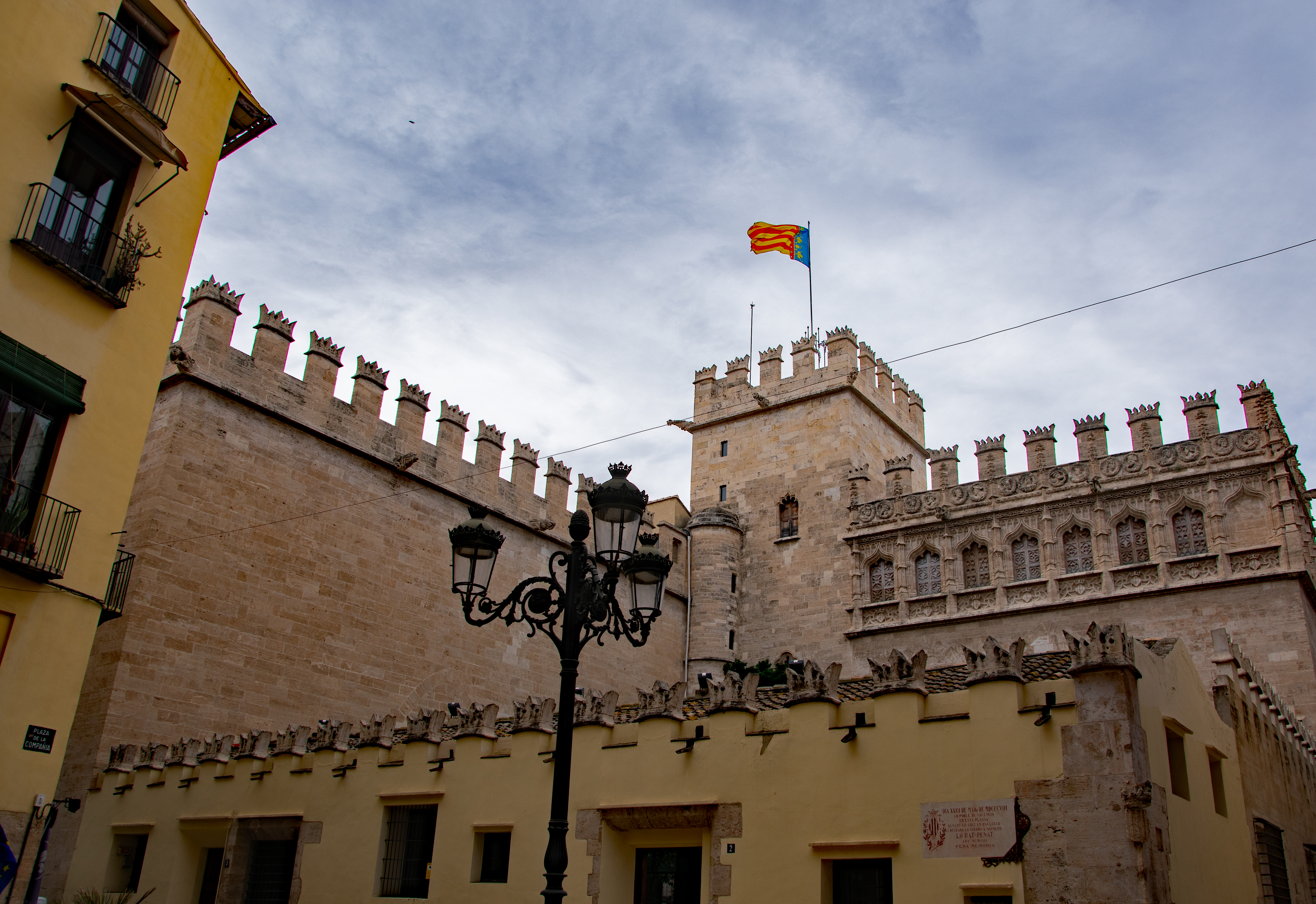
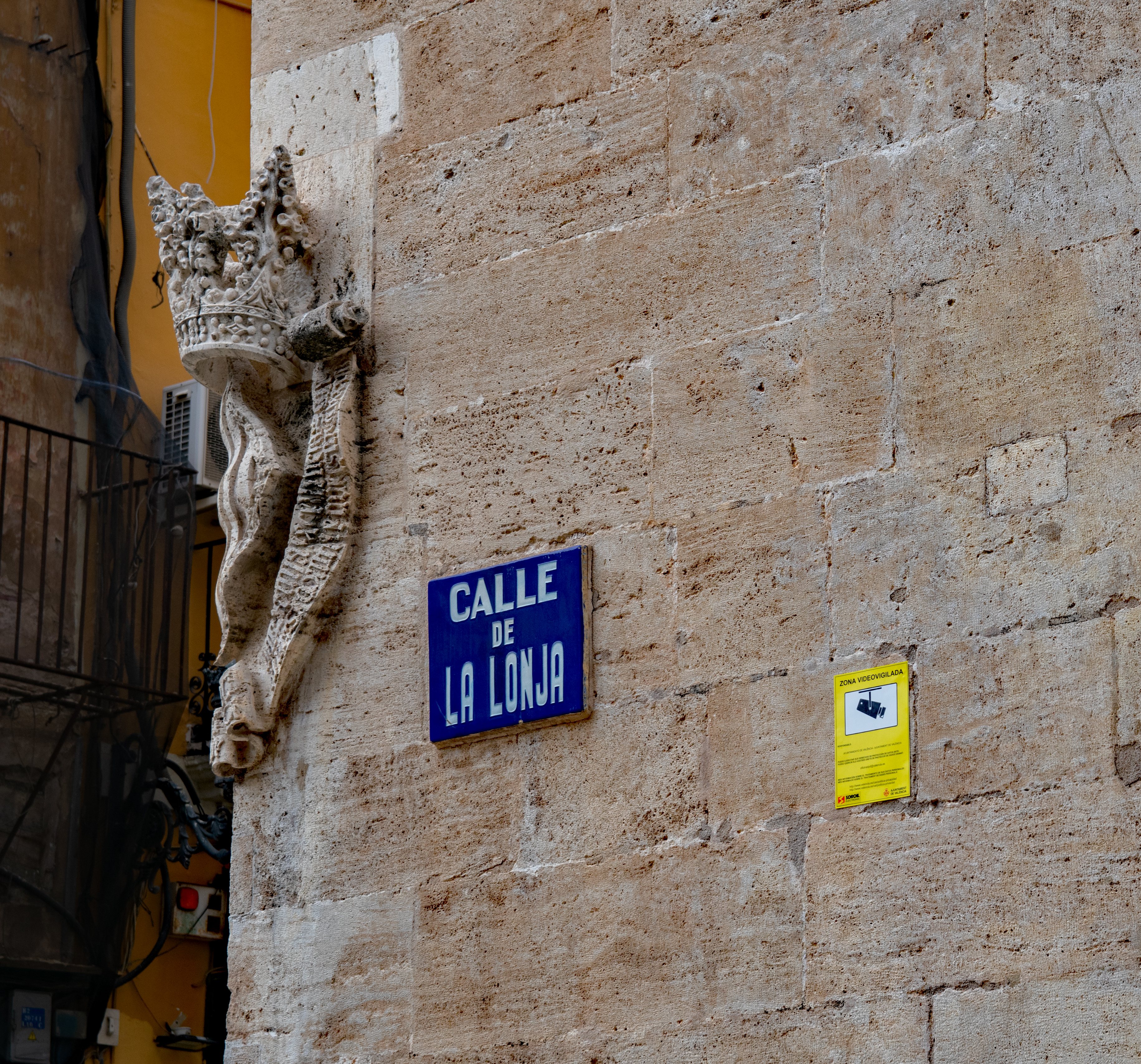
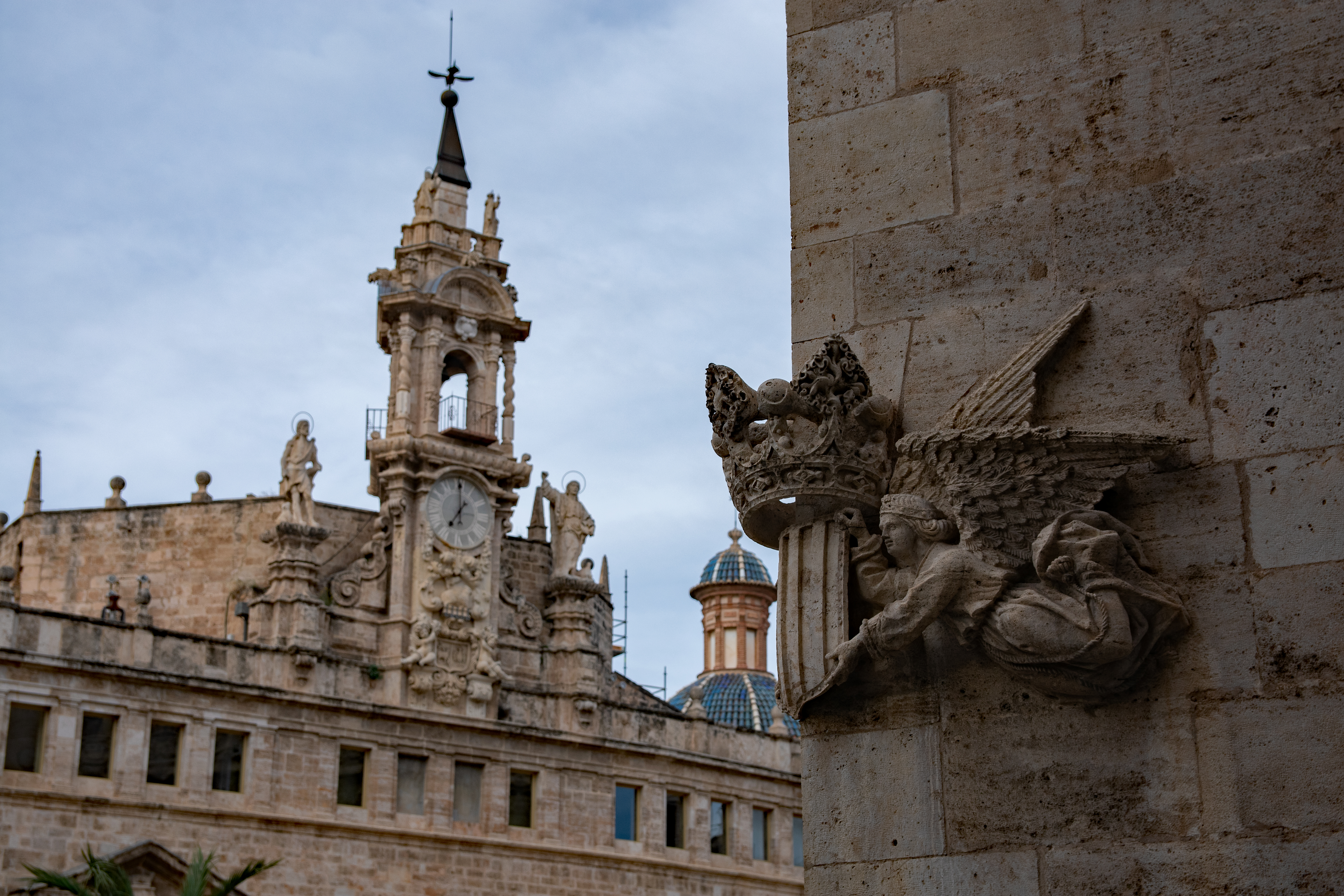
Across the street from Mercado Central is La Lonja de Seda, the Silk Exchange. This huge structure was built between 1482 and 1548. Previously, trade took place in the Plaza de la Lonja. (see above). In the 15th and 16th centuries, Valencia was a prominent economic center, due largely to its large Mediterranean port. The thriving silk industry brought great wealth and power to the city. La Lonja was built to reflect that dominance. In 1996, it was designated a UNESCO World Heritage Site.
We took the audioguide tour of the building. It begins on the exterior with highly detailed explanations of each doorway. Since it was chilly in the shade, I’ll admit we fast forwarded a few of the descriptions. Once inside, we were mesmerized by the architecture, the columns, the ceilings and the floors. The audioguide explained the purpose of each room as we walked. The huge columned trading floor is the main event. We tried to imagine what the scene was like in its heyday. Did the traders have tables; did they stand in circles? How does the size of the room compare to The Chicago Board of Trade floor (now closed)? There is also a large space that housed the Council of the Sea, the decision making body for maritime laws. Between the two large salons was a small chapel; religion was present in all aspects of life. Speaking of religion, we’ll visit the Valencia Cathedral next.
To see a larger image and the caption of the photos in this gallery, double click on the image.
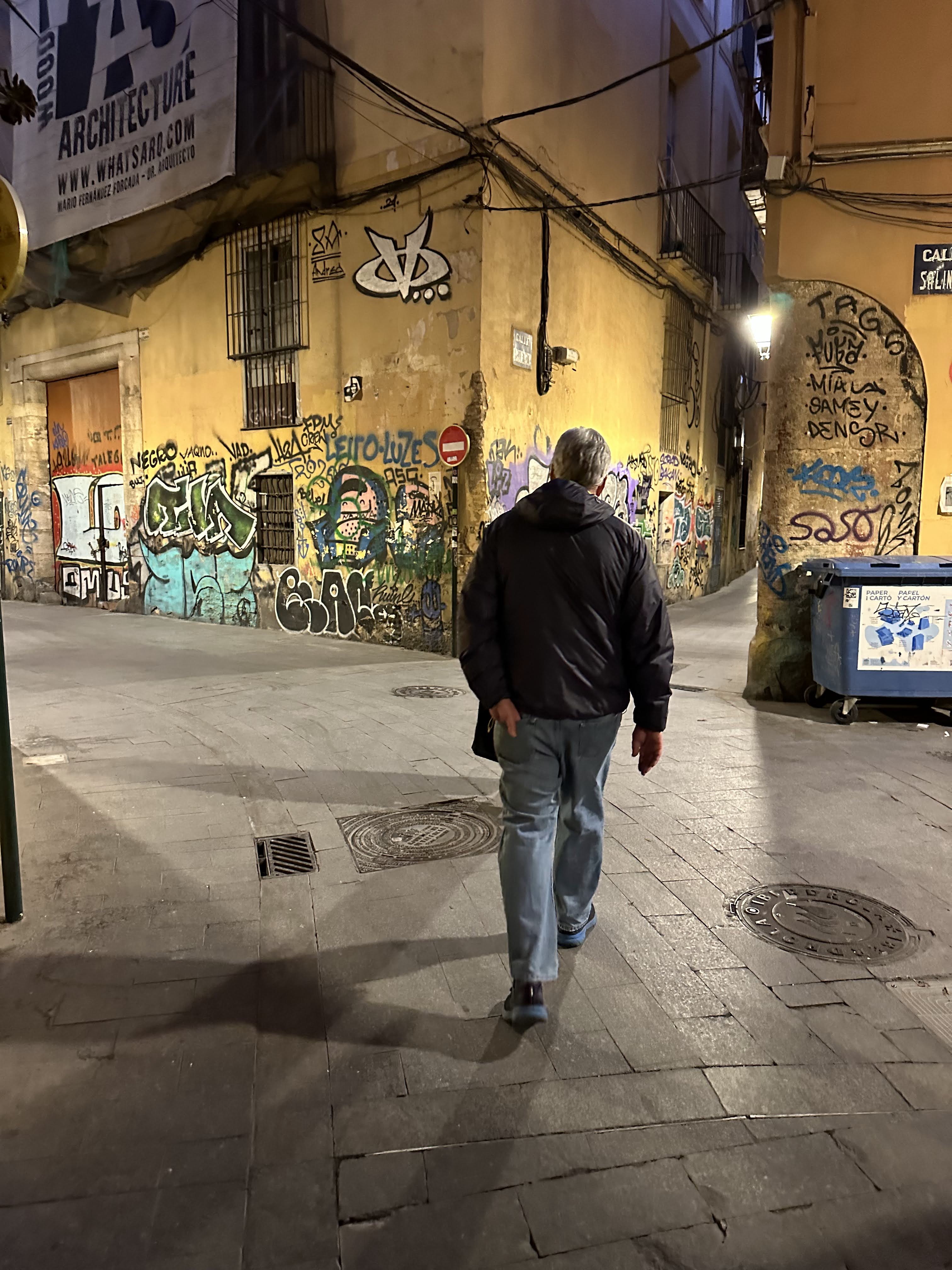
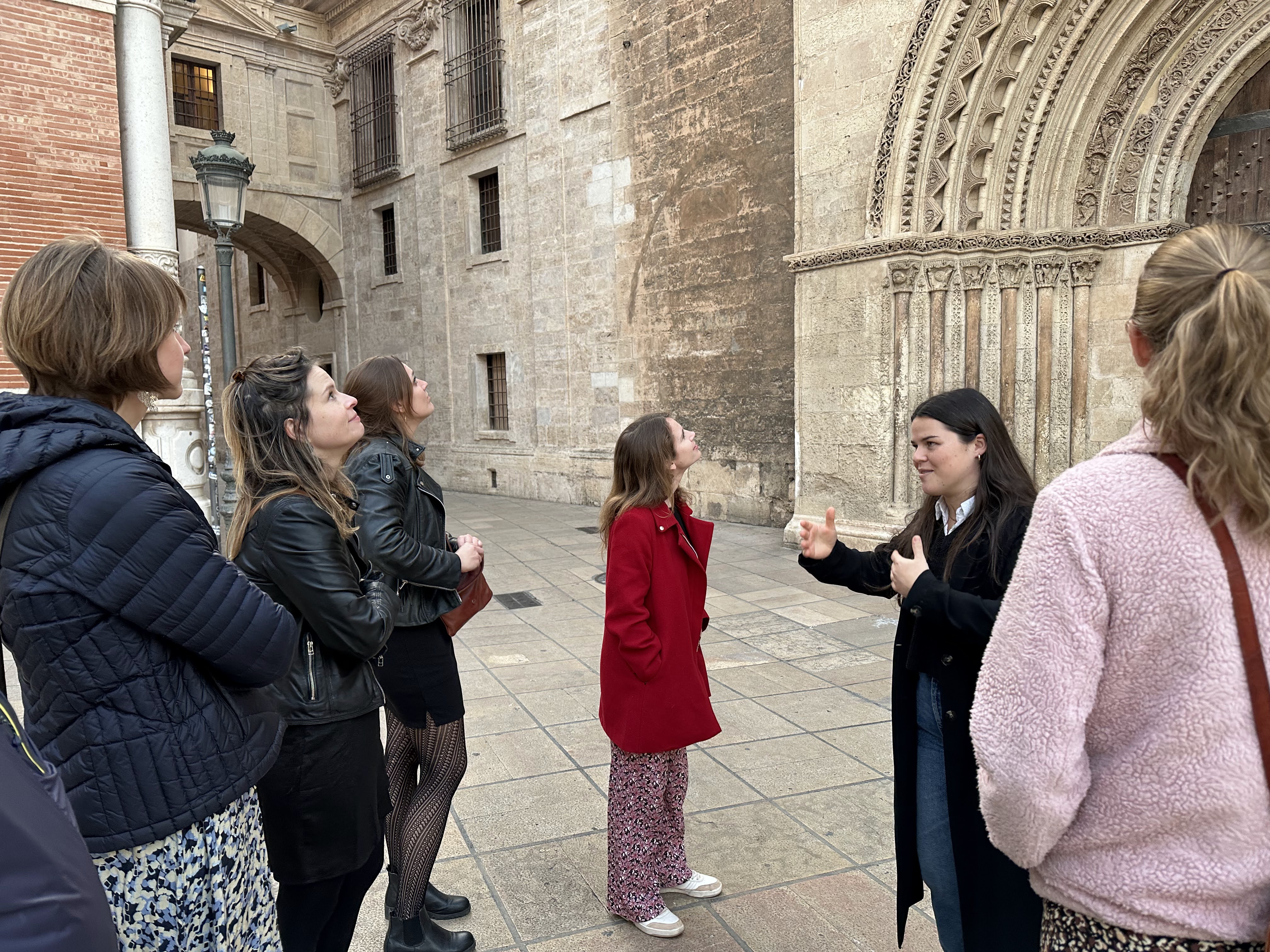
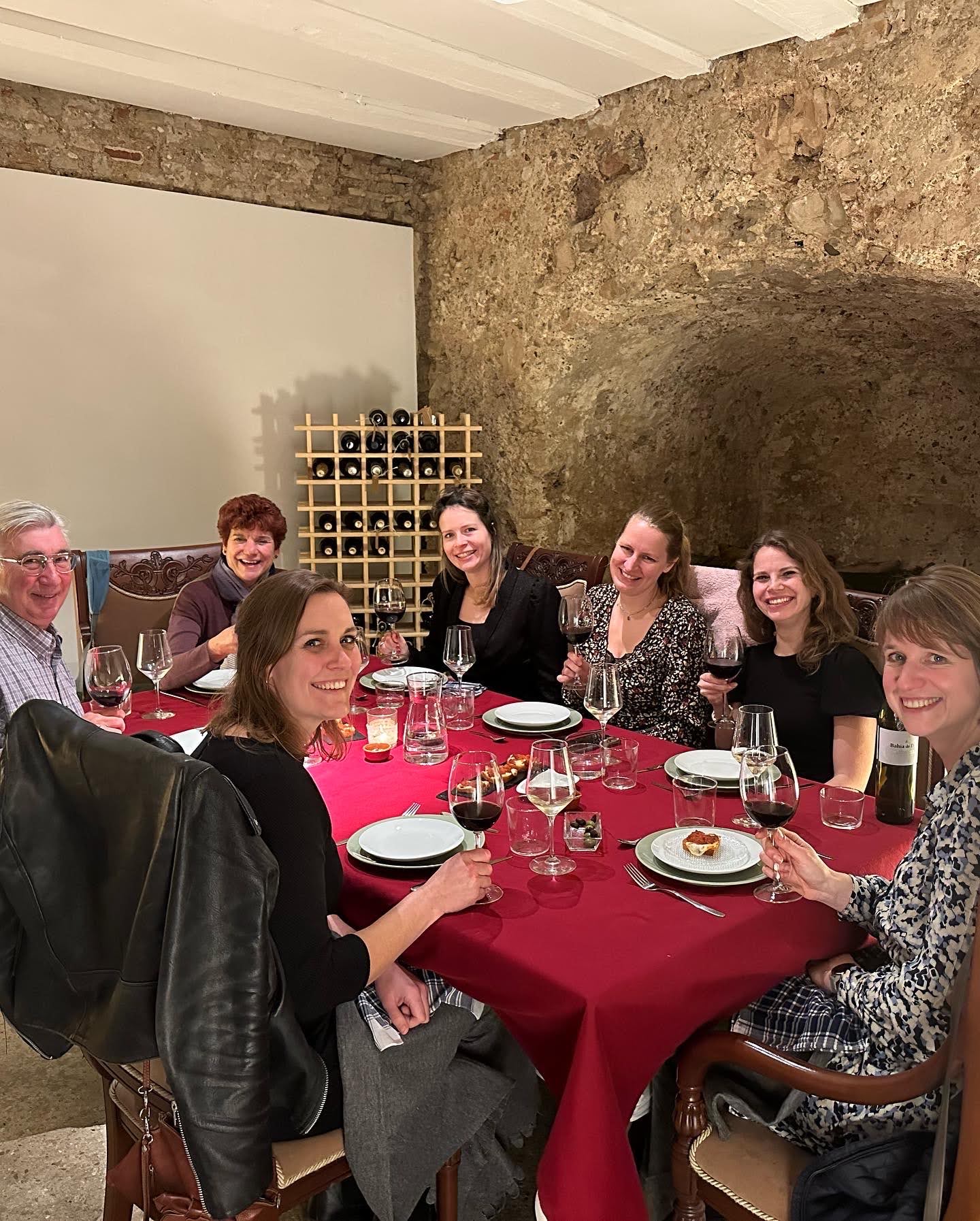
On Day 2 of our stay in Valencia, we took an evening walking tour. Our guide was Tula, a delightful Irish woman, now living in Valencia. We were joined by five Dutch ladies, who were enjoying a girlfriend’s weekend. They are college friends who now live in different cities in the Netherlands. Since graduation, they have travelled together once a year. One or two members of the group do the planning and the destination is a secret until departure. I love this idea!
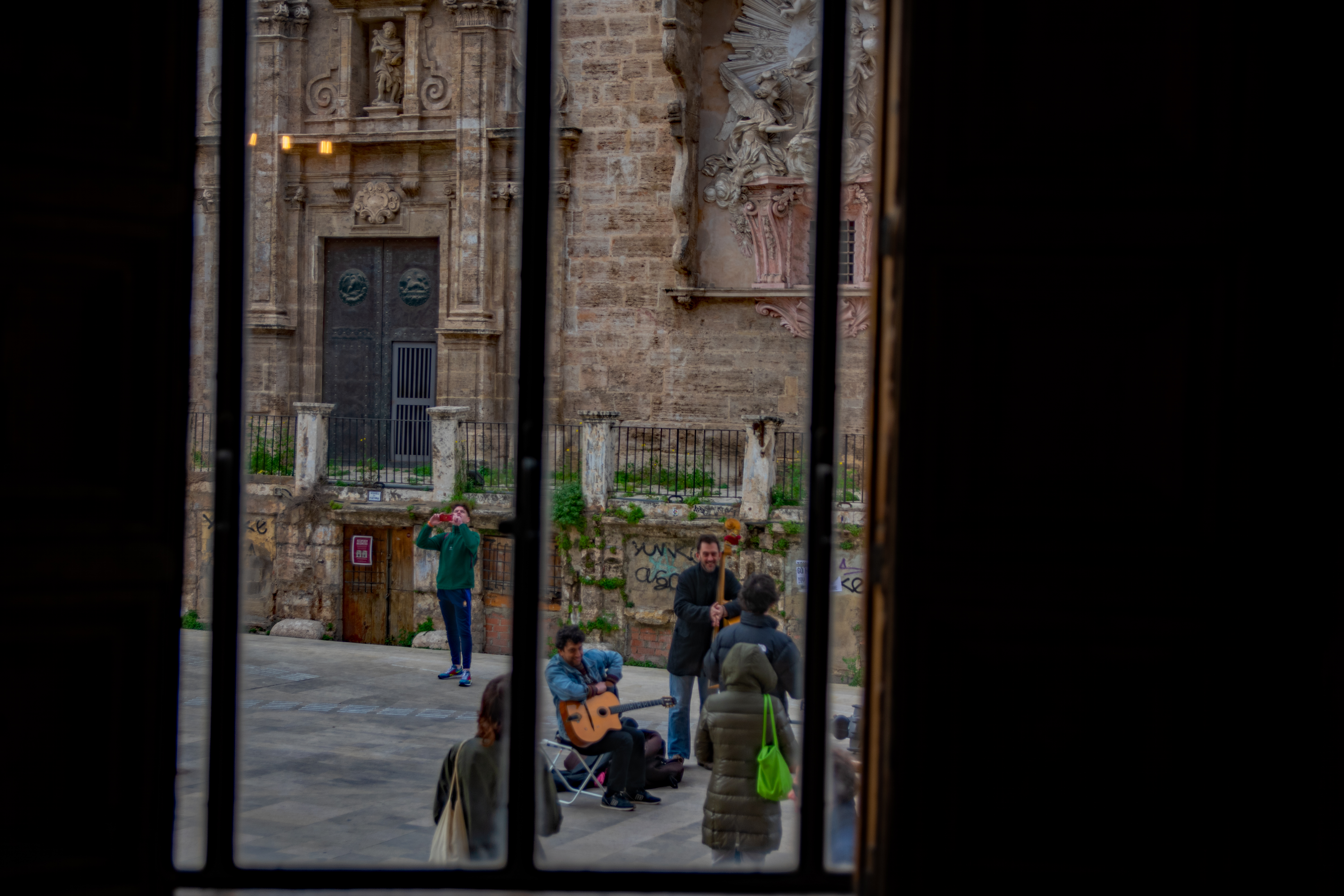
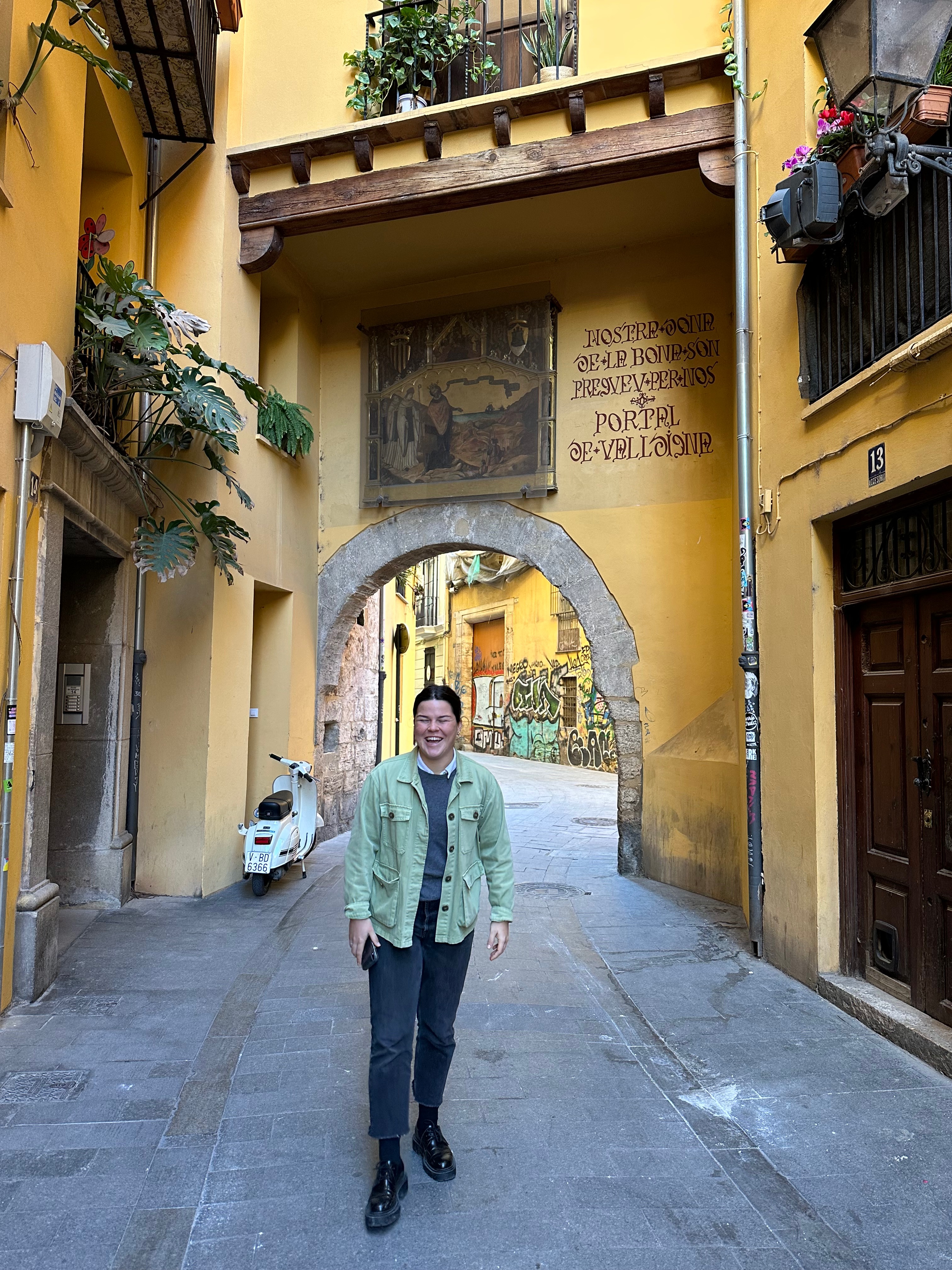
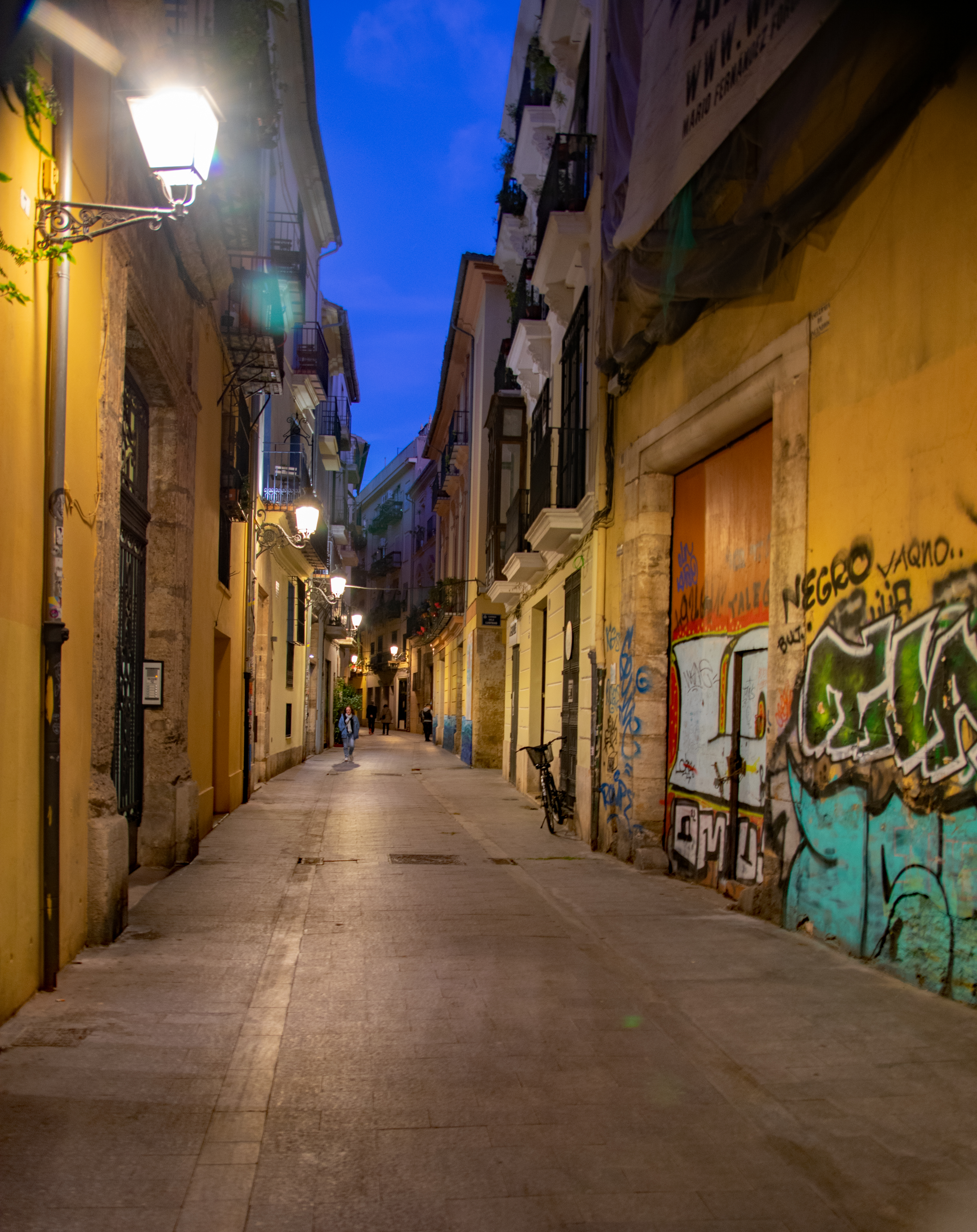
The tour was a lot of fun. We met in Plaza Jaime, a short walk from our apartment. Tula explained the history of the city as we strolled. We learned about the silk trade in Valencia during the 15th and 16th centuries. Tula pointed out certain buildings that once housed silkworms. The thriving silk industry attracted merchants and money to Valencia. In the 16th century, the impressive Lonja de Seda (Silk Market) was built to provide an indoor trading floor and to flaunt Valencia’s importance. Other industries flourished along with the fabric business. The Barrio de Carmen is supposedly named for the district’s most famous madame. I suspect this is an urban legend created to amuse the tourists.
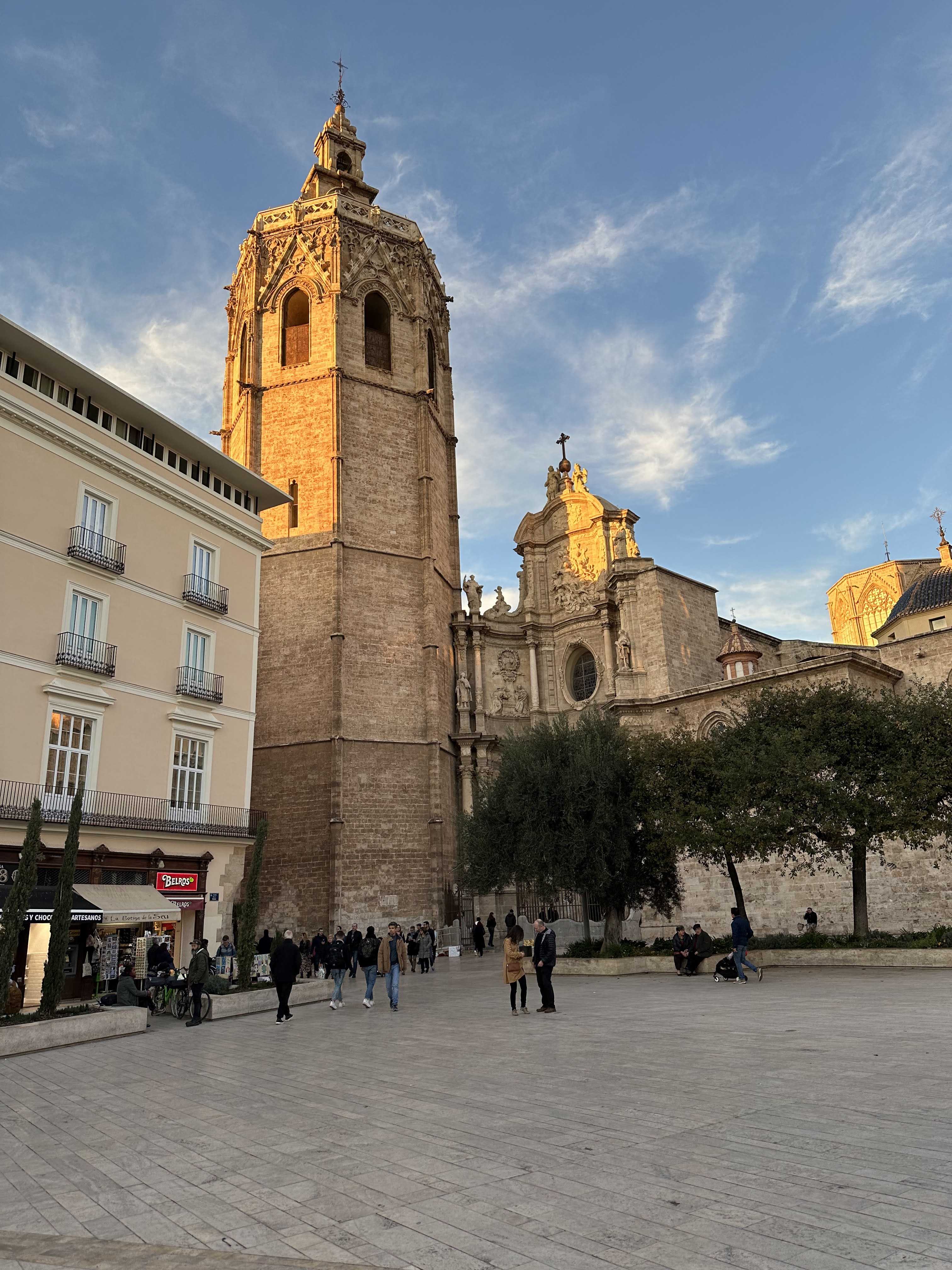
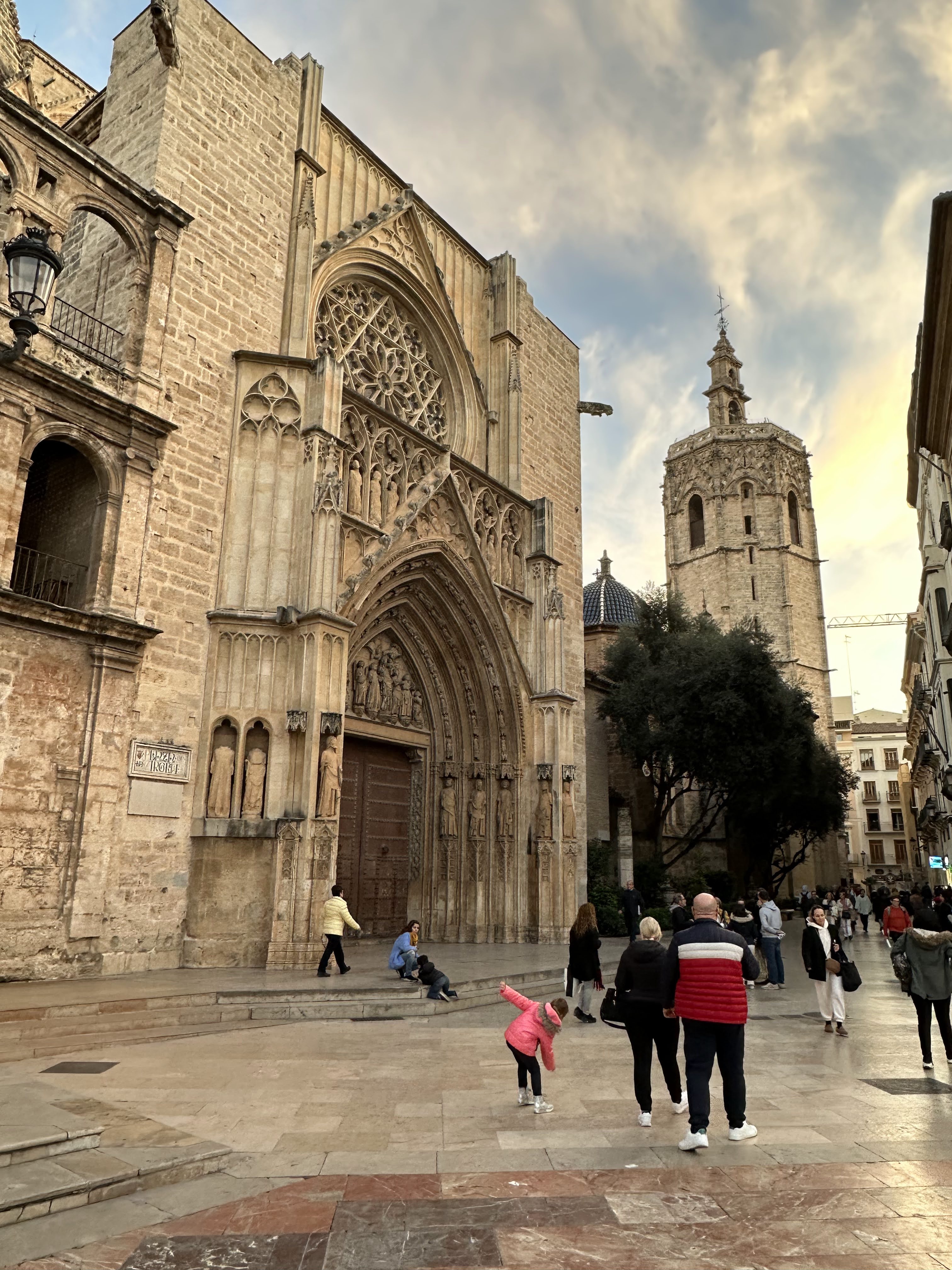
On our walk, we stopped in the cathedral plaza just as the late afternoon sun was hitting the roof of the cathedral and the bell tower. We did not go inside either building that night, so I’ll return to it in a subsequent post.
We passed the Basilica de la Virgen de los Desamparados (Our Lady of the Forsaken). We peeked inside, but there was a Mass going on; no photos.
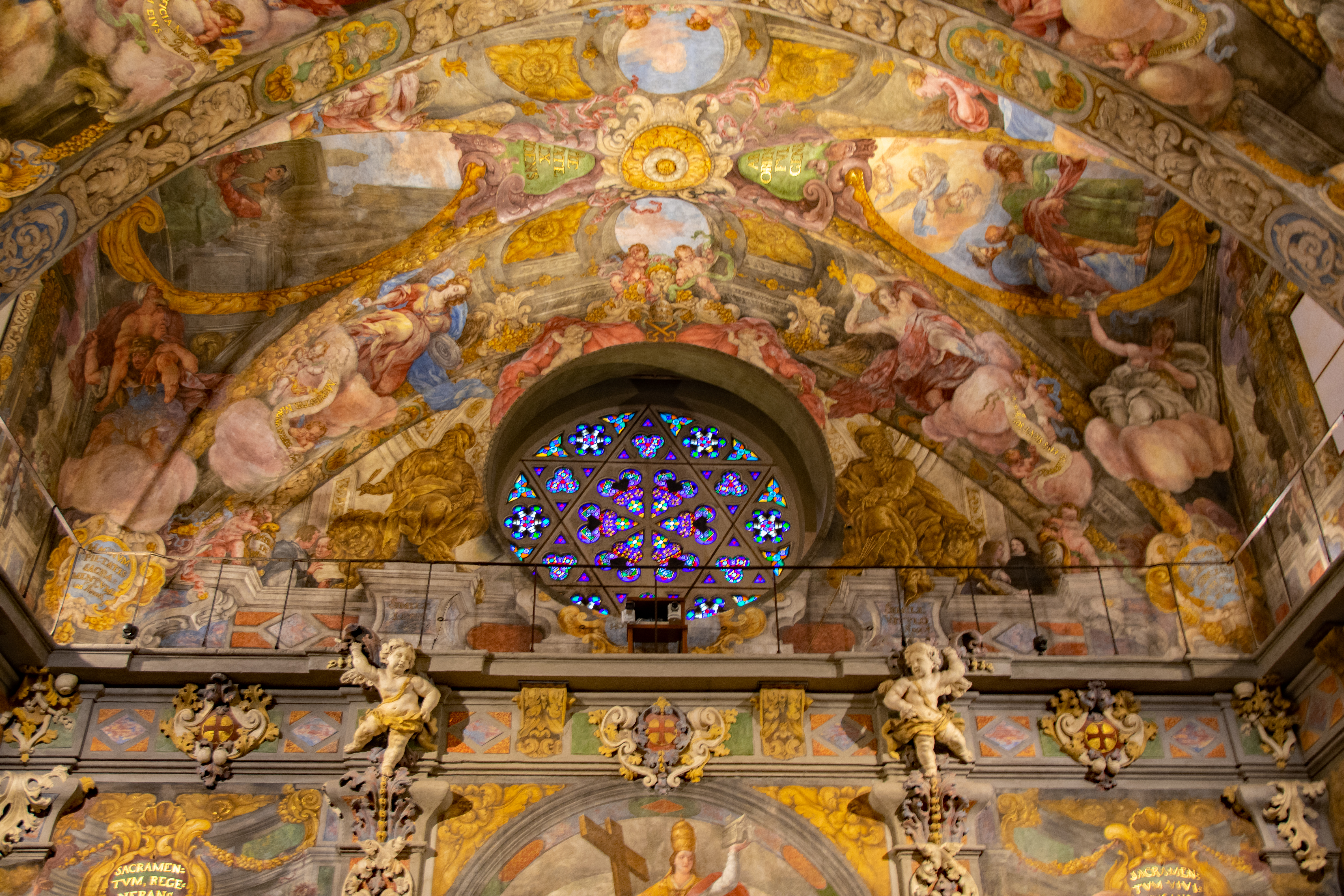
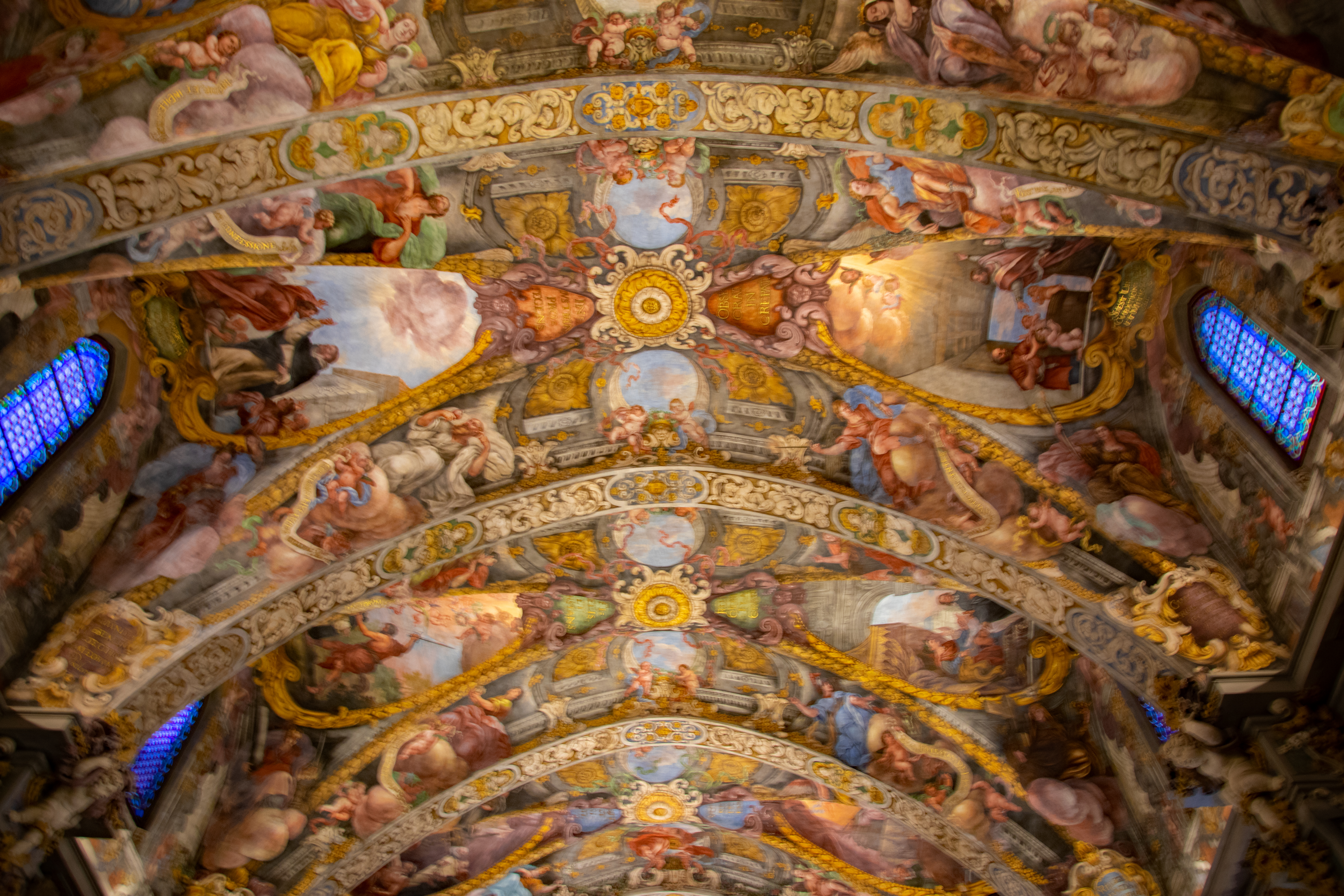
We did enter the church of San Nicolás. In the photos above, you can see the amazing frescoes on the ceiling; giving the church the nickname “Valencian Sistine Chapel.” The original church was built around 1242. It was restored between 1419 and 1455 by the Borja family. The frescoes were painted between 1690 and 1693.
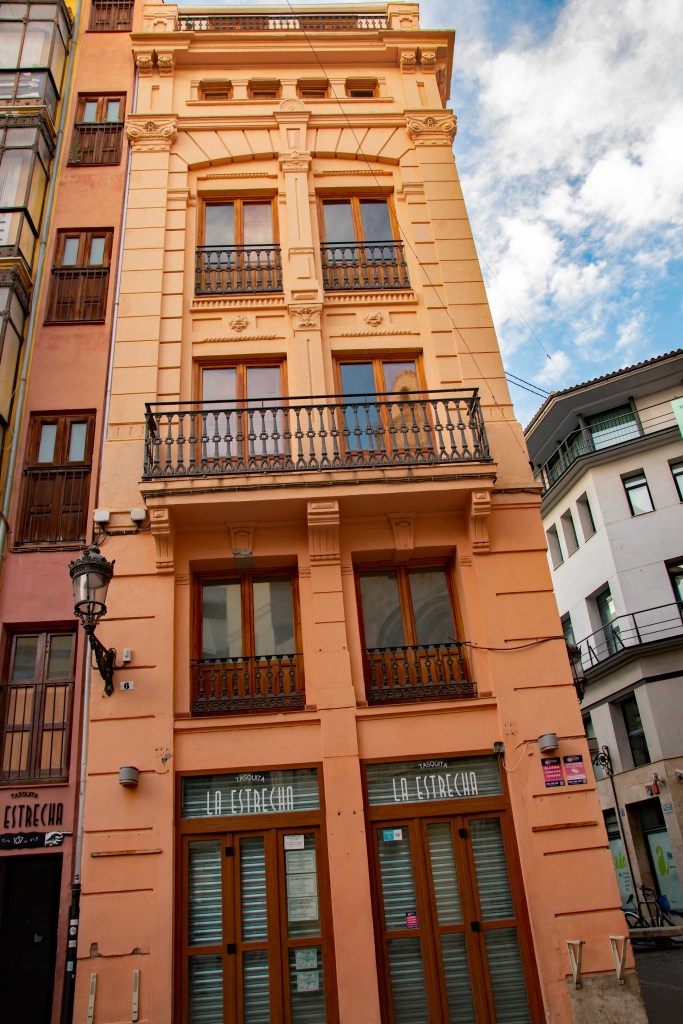
Another stop along our walk was at La Estrecha (The Narrow). It claims to be the skinniest building in Europe (or at least in Spain). According to legend it was built by a wealthy family hoping to avoid real estate taxes which were based on the width of the building. So they built up rather than out. ( the invention of the townhouse) As the story goes, the ladies of the home could not put on their hoop skirts indoors due to the lack of space , so they went out in the plaza in their underclothes to dress for the day. Note the four small rectangular windows on the upper floor. Those are ventilation for the silk worms. La Estrecha is now a tapas bar.
La Estrecha
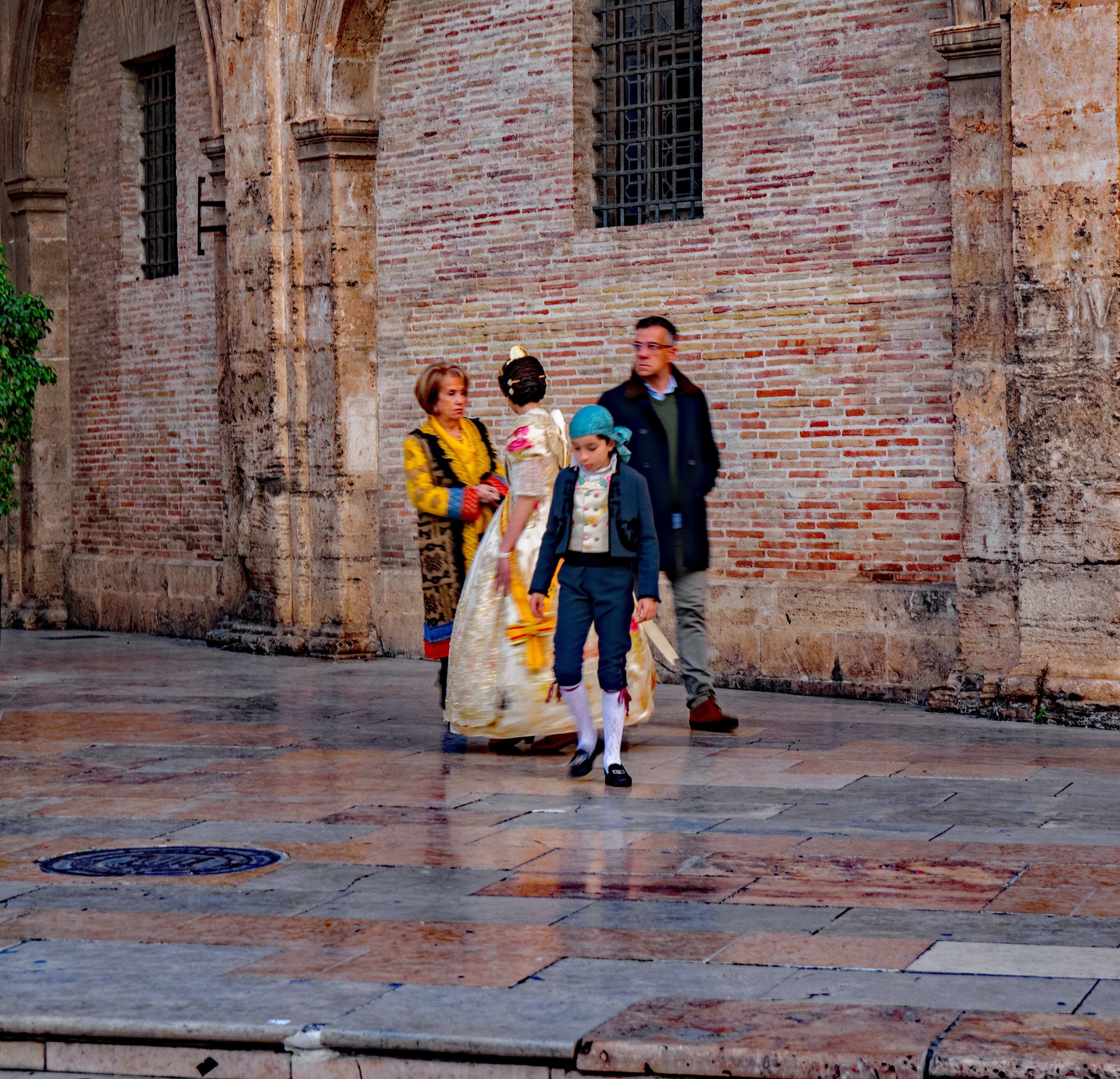
This photo (right) is a family we saw near the Basilica. The children are dressed in the traditional costumes of Las Fallas, Valencias’ festival that takes place every year to celebrate the arrival of spring. It officially begins on February 24th and runs through March 19th. It is a massive street party with fireworks, parades, music, and food. Huge paper -mache figurines (ninots) constructed by neighborhood committees and entered in competition. The winning ninot is spared from the flames on March 19th (St. Joseph’s Day) when the Fallas are publicly burned.
After two and a half hours of walking through Barrio Carmen, Tula said it was time for wine and food! She took us to a private space owned by the tour company called Smugglers’ Cave, where historically, people seeking asylum were smuggled into the Arab Quarter. The cave was an awesome setting for tasting local wines and enjoying several tasting courses of local specialties. A good time was had by all!





























































































 Adventures In The South of Spain